

Preventive Maintenance: The Secret Sauce for Smarter Asset Management
Why Asset Management Preventive Maintenance Changes Everything
Asset management preventive maintenance is the practice of fixing equipment before it breaks—and it's the difference between a shop floor that hums and one that hemorrhages money.
Here's what you need to know:
Preventive maintenance means scheduled, proactive upkeep of your most critical assets
It reduces unplanned downtime by catching problems early
It extends equipment life and cuts emergency repair costs by 3–5x
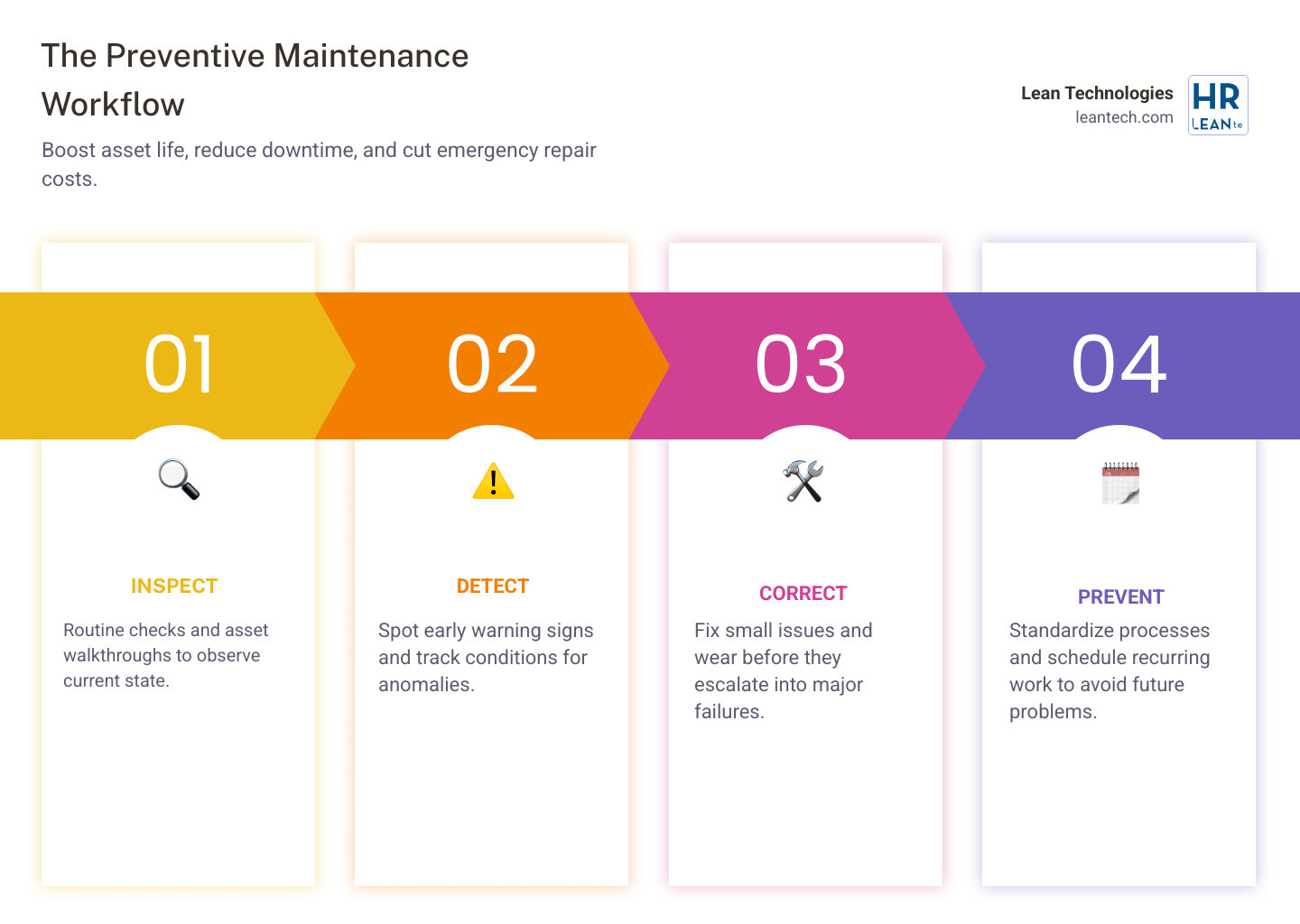
It's built on a simple workflow: Inspect → Detect → Correct → Prevent
Most effective programs mix time-based and usage-based schedules custom to each asset
The stats don't lie.
Unplanned downtime costs industrial manufacturers an estimated $50 billion annually, with equipment failure accounting for almost half of those losses, according to a Deloitte study.
And for every dollar you spend on preventive maintenance, you save roughly 10 dollars in future repairs and downtime costs, as studies suggest.
But here's the reality on most shop floors: maintenance teams are drowning in paper logs, spreadsheets, and reactive firefighting. They know what needs to be done—they just don't have a system to make it happen consistently.
That's where a structured approach to asset management preventive maintenance comes in.
Let's dig into how you can build a preventive maintenance program that actually works—without the fluff, without the complexity, and without replacing your entire tech stack.
What Is Preventive Maintenance and Why Does It Matter?
Preventive maintenance means fixing things before they break. It’s about being proactive instead of reactive.
This simple shift changes everything.
It protects your assets. It keeps your lines running.
Unplanned downtime can cost companies around $25,000 per hour on average. That’s real money bleeding out.
What does preventive maintenance mean for asset management?
For us on the shop floor, asset management preventive maintenance is about making smart decisions that impact our bottom line every single day.
It’s not just about maintenance; it’s about the entire asset lifecycle.
We protect our investments. We maximize uptime.
We keep our best machines running longer, performing as the manufacturer intended.
The real shop floor impact? Less stress, more production, better quality.
The Core Principles: Inspect, Detect, Correct, Prevent
The workflow for preventive maintenance is straightforward. It’s a loop that keeps our equipment healthy:
Inspect: This means routine checks and scheduled inspections. We’re looking for anything out of the ordinary.
Detect: We spot small issues. Early warning signs, wear and tear, anything that could lead to a bigger problem.
Correct: We fix these small issues before they become failures. A loose bolt, a worn belt, a dirty filter. Simple stuff that prevents catastrophic breakdowns.
Prevent: We standardize the process. We schedule recurring work. We create checklists. This ensures consistency and prevents future issues.
This systematic approach is the backbone of any effective maintenance strategy.
The Different Flavors of Preventive Maintenance
There's no one-size-fits-all approach to preventive maintenance. What works for one machine might be overkill for another.
We pick the right approach for our team and our equipment.

How does preventive maintenance stack up against other strategies?
Let's break down the main types of maintenance strategies we see on the shop floor:
Time-based Maintenance (TBM): This is straightforward. We service equipment at set intervals, regardless of actual usage. Think oil changes every three months, or a filter replacement semi-annually.
Usage-based Maintenance: Here, maintenance is triggered by how much an asset is used. It could be after X cycles, Y hours of operation, or Z miles driven. A car’s dashboard light for an oil change after a certain mileage is a perfect example.
Condition-based Maintenance (CBM): We perform maintenance when we see early warning signs. This relies on monitoring the real-time condition of equipment (e.g., vibration, temperature, pressure). When performance starts to decline or issues are identified, we act.
Run-to-failure Maintenance (Reactive): This is exactly what it sounds like. We wait until it breaks, then we fix it. For non-critical, easily replaceable, low-cost items, this might make sense. But for anything critical to production? Not recommended. This is where emergency repairs kick in, typically 3-5x more expensive than planned interventions.
Here’s a quick look at how these stack up:
Strategy Trigger Best For Pros Cons Time-Based Fixed calendar intervals Non-critical assets, regulatory requirements, predictable wear patterns Simple to schedule, easy to implement Can lead to over-maintenance or premature part replacement Usage-Based Operating hours, cycles, mileage Assets with variable usage, components with known lifespans More efficient than time-based, reduces over-maintenance Requires accurate usage tracking Reactive (Run-to-failure) Equipment failure Non-critical, inexpensive, easily replaceable assets No upfront planning High repair costs, unplanned downtime, safety risks
Is Predictive Maintenance the same thing?
Nope. And this is a key distinction for us on the shop floor.
Predictive maintenance (PdM) uses advanced analytics, sensors, or machine data to forecast failures. It’s about predicting when a failure might occur, often using complex algorithms and real-time data. McKinsey suggests predictive maintenance can reduce machine downtime by 30–50%.
Preventive maintenance, on the other hand, is about sticking to a schedule or a checklist, based on what your team knows and sees. It's simpler. It's actionable. It’s about preventing problems through routine care.
Most small and midsize teams start with preventive maintenance—because it’s simple, actionable, and doesn’t require expensive, complex tech or a data science team. You can get started today with the knowledge you already have.
At Thrive, we understand this. We don’t collect sensor data or run predictive machine alerts ourselves. Instead, Thrive helps you organize and act on the data you already have—whether it’s from manual checks or imported from other systems. We help you digitize your maintenance processes so you can respond faster and smarter.
How to Build a Winning Preventive Maintenance Program
Building an effective asset management preventive maintenance program isn't rocket science. It's about a few actionable steps.
No theory—just what works.

Step 1: Map Your Assets and Rank by Criticality
You can’t manage what you don’t know.
List every asset: From your CNC machines to your forklifts, document everything that matters.
Figure out what happens if it fails: What’s the impact on production? Safety? Quality?
Prioritize the most critical: Focus your initial PM efforts where they’ll have the biggest impact. The asset that shuts down your entire line gets priority over the office printer.
This step is fundamental. It helps us allocate resources where they matter most.
Need help getting started with asset management? Check out our Guide to Asset Management.
Step 2: Create Standard Work and PM Checklists
This is where consistency happens.
Job plans: Develop clear, step-by-step instructions for each maintenance task.
Clear instructions: No guesswork. Every technician should be able to follow the same process.
Repeatable tasks: Standardize everything from lubrication to visual inspections.
No guesswork: This reduces errors and ensures quality work, every time.
These checklists become your team’s playbook for keeping assets running. At Thrive, we help you digitize these checklists, making them accessible and actionable right on the shop floor. Learn more about digital lean manufacturing with Thrive.
Step 3: Schedule, Execute, and Track the Work
This is where the rubber meets the road.
Set the schedule: Based on time or usage, plan out your PM tasks.
Assign work: Clearly assign tasks to your maintenance team.
Track in real time (ditch the paper): We need to know what’s done, what’s in progress, and what’s overdue. Paper logs are too slow.
Hold people accountable: When tasks are visible, accountability improves.
Use Thrive to log, track, and close the loop—right at the source: Our platform lets your team execute these tasks on a tablet or mobile device, eliminating manual entry and ensuring real-time data.
Step 4: Measure What Matters
We can’t improve what we don’t measure.
MTBF (Mean Time Between Failures): How long does equipment run before it breaks? We want this number to go up.
MTTR (Mean Time To Repair): Once it breaks, how long does it take to fix? We want this number to go down.
PM completion rate: Are we actually doing the scheduled maintenance? This tells us if our plan is working.
Planned maintenance %: Aim for a high percentage of planned work. This shows we’re proactive.
Use data to drive decisions: These KPIs tell us where we're winning and where we need to adjust.
Thrive gives you real-time visibility—so you can act, not just react: Our dashboards show you exactly where you stand, helping you make data-driven decisions that improve your asset management preventive maintenance program.
The Payoff: Real-World Benefits and Common Problems
So, why go through all this effort? Because the payoff is huge.
We're talking about real ROI. Significant cost savings. A safer shop floor.
More production, less chaos.
Key benefits of a preventive maintenance program
Implementing a solid asset management preventive maintenance program brings tangible results:
Less unplanned downtime: The big one. We catch issues before they stop production. This means consistent output and happier customers.
Longer asset life: Regular care extends the lifespan of our expensive equipment, delaying costly replacements.
Fewer expensive repairs: Emergency repairs are a budget killer. PM helps us avoid those massive, unexpected costs.
Safer work environment: Well-maintained equipment is safer equipment. This reduces risks for our team and improves compliance.
Better resource planning: When maintenance is planned, we can schedule labor, order parts, and manage our time efficiently. No more scrambling.
Nearly 70% of businesses believe preventive maintenance is a strategic priority, and for good reason.
Common challenges and how to beat them
We know it's not always easy. Here are some common problems and how we can overcome them:
No buy-in from leadership or the team? Start small. Pick one critical asset, show clear results, and prove the value. Quantify the savings and uptime gains.
No time to implement? We’re already stretched thin, right? Prioritize your top assets first. Even a small start can make a big difference. The time you invest now saves you much more time later.
Tight budget for new tools? Prove the savings first. Show how PM reduces emergency repair costs, which are typically 3-5 times higher. The "10 rule" of PM suggests significant savings.
Bad data or paper-based systems? This is a huge roadblock. Go digital. Standardize your data collection. A platform like Thrive helps you ditch the paper and centralize your information.
Culture stuck in the "fix it when it breaks" mentality? Get leadership on board to champion the change. Train your team, explain the why, and celebrate small wins. Change takes time, but the benefits are undeniable.
Frequently Asked Questions about Asset Management Preventive Maintenance
What’s a good goal for planned vs. unplanned maintenance?
A common benchmark is to shoot for 80% planned maintenance and 20% unplanned maintenance.
This means 80% of your maintenance activities are scheduled, proactive tasks, and only 20% are reactive fixes.
Most teams don’t start there. Start where you are—and aim to improve every month. Even moving from 50% planned to 60% planned is a massive win.
How can software help with preventive maintenance?
Software is a game-changer for asset management preventive maintenance.
Ditch the paper: No more lost checklists or illegible notes.
Automate work orders: Schedule recurring PM tasks to automatically generate work orders.
Centralize data: All asset history, repair logs, and checklists in one place.
Give techs mobile access: Your team can access instructions, complete tasks, and log issues right on the shop floor from a tablet or phone.
Real-time tracking and reporting: See what’s happening, right now.
Thrive lets you do all this—without replacing your ERP or MES. We integrate seamlessly, digitizing your lean work processes for maintenance, quality, safety, and more.
Where do I start if I’m still using paper and spreadsheets?
This is a common starting point for many manufacturers. Here’s a simple plan:
Pick one critical asset: Don’t try to overhaul everything at once. Choose one machine that causes a lot of headaches.
Document failure modes: What usually goes wrong with it? What are the warning signs?
Build a simple checklist: Create a basic, actionable PM checklist for that asset.
Track results: Implement the PM, track when it’s done, and monitor the asset’s performance.
Prove it works—then scale up: Once you see the benefits for that one asset (less downtime, fewer emergency calls), you’ll have a compelling case to expand.
Thrive makes it easy to digitize and standardize your PM process, even if you’re starting from scratch. We help you move from manual chaos to structured, accountable work.
Stop Firefighting and Start Winning
Asset management preventive maintenance is the fastest way to smarter asset management.
You get control, not chaos.
Start small. Go digital.
Stop managing your shop floor through spreadsheets and wishful thinking.
Let your team run lean—with real-time visibility and fewer workarounds.