The Synergy of Kaizen and Continuous Improvement: A Deep Dive
Why "Good Enough" Is Costing You Money
Continuous improvement and Kaizen are not the same thing—but they work together to help manufacturers eliminate waste, solve recurring problems, and build a culture where small changes add up to major gains.
Quick Definition:
Continuous Improvement (CI) is the ongoing effort to make processes better, faster, and more efficient.
Kaizen is a Japanese philosophy meaning "change for better"—it's the method that drives CI through small, daily improvements made by everyone on the team.
The relationship: CI is the goal. Kaizen is how you get there.
Here's the hard truth: most manufacturing plants are bleeding money—not from catastrophic failures, but from a thousand small inefficiencies. A bottleneck no one owns. A rework loop that's "just how we do it." A safety issue logged on paper and forgotten by Friday.
You know the problems are there. Your team knows them too. But when visibility is poor, data is late, and accountability is fuzzy, those problems never get solved. They just become part of the background noise.
That's where continuous improvement and Kaizen come in. This isn't about overhauling your entire operation overnight. It's about building a system where your team can see problems, act on them quickly, and make incremental changes that stick. When done right, it turns your shop floor into a problem-solving engine—one that runs faster, wastes less, and drives real profit to the bottom line.
But here's the catch: CI only works if your processes are structured and your data is real-time. If issues are captured on paper, logged in spreadsheets, or entered hours (or days) after they happen? You're already too late. The problem has already spread, the waste has already happened, and your team is stuck reacting instead of improving.
In this guide, we'll break down what continuous improvement really means, how Kaizen makes it happen on the ground, and how to build a culture where small wins compound into massive results—without adding more meetings, more overhead, or more frustration.
What is Continuous Improvement? More Than Just a Buzzword
You've probably heard the term Continuous Improvement (CI) tossed around in boardrooms and on shop floors. But what does it actually mean? At its core, CI is a relentless, systematic effort to optimize an organization’s processes, products, and services. It's not a one-and-done project; it's an ongoing journey.
Think of it this way: CI is the unwavering belief that there's always a better way to do things, no matter how good your current processes seem. It’s an organizational commitment to constant growth and adaptation, ensuring long-term sustainability and competitiveness. This philosophy is about making constant, incremental changes rather than waiting for a crisis to force a massive overhaul.
The goal of CI is clear: eliminate waste, boost efficiency, improve quality, and ultimately, improve customer satisfaction. It’s about streamlining operational efficiency and driving process improvement across the board.
Where did this idea come from? Much of what we understand about modern continuous improvement traces back to the lean manufacturing techniques pioneered by Toyota in the 1950s. Their approach, known as The Toyota Production System, laid the groundwork for many of the principles we use today.
Key principles of CI include:
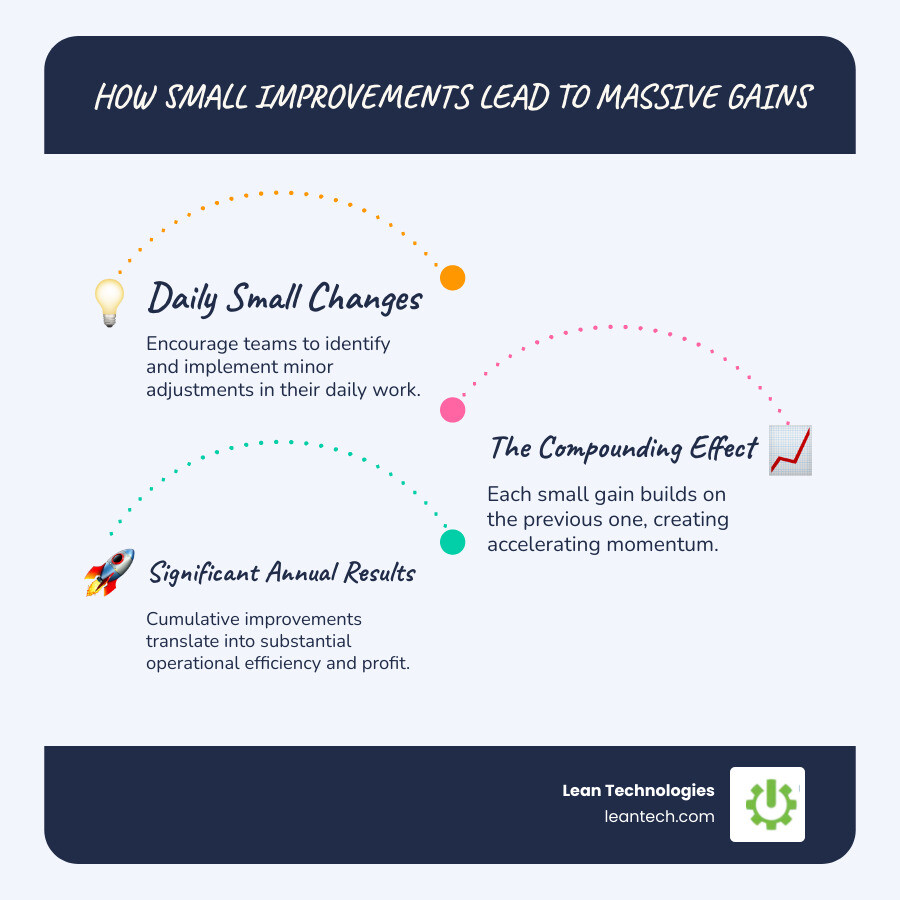
Incremental Change: Focus on small, manageable improvements rather than disruptive, radical changes. These small changes add up to significant gains over time.
Eliminating Waste (Muda): Identify and remove anything that doesn't add value to the customer or the product. This could be anything from unnecessary movement to overproduction.
Customer Value Focus: Every improvement should ultimately serve to deliver more value to the end customer.
Process-Oriented Mindset: Understand that problems usually lie in the process, not the people. By improving the process, you empower your team.
Flow and Pull: Organize work to move smoothly and efficiently without interruption (flow), and only perform work when there's an actual demand for it (pull system).
CI is a shared responsibility. It thrives when everyone, from the frontline operator to senior leadership, is engaged and committed to making things better. It’s about cultivating a culture where every contribution to improvement is valued.
What is Kaizen? The Engine of Daily Improvement
If Continuous Improvement is the destination, then Kaizen is one of the most powerful engines that gets you there. The word "Kaizen" (改善) is Japanese for "change for better," derived from "kai" (change, revision) and "zen" (virtue, goodness). It’s a philosophy that translates to "constant improvement" or "doing better every day, with everyone, and everywhere."

Kaizen isn't just a buzzword; it's a mindset rooted in respect for people and problem-solving. While often associated with manufacturing, particularly its origins at Toyota in the post-WWII era, Kaizen is a universal concept. It gained global recognition through Toyota's consistent success in operational excellence, becoming a foundational concept in Lean thinking.
The core belief of Kaizen is simple yet profound: small, tiny, continual positive adjustments, routinely applied and sustained over time, will yield substantial results. This contrasts sharply with the Western tendency towards radical, top-down reforms. Kaizen champions bottom-up improvement, empowering the very people who perform the work to identify and implement solutions.
Key aspects of Kaizen include:
Everyone, Everywhere, Every Day: Kaizen believes that improvement is everyone's job, not just management's. It encourages employees at all levels to actively look for ways to improve processes.
Respect for People: This is a cornerstone. Kaizen humanizes the workplace, eliminates overly hard work, and teaches people to spot and eliminate waste. It's about empowering your team to act, improve, and grow together.
Empowering the Front Line: Kaizen empowers workers to stop production lines when they spot defects or issues, promoting real-time problem-solving. This fosters a sense of ownership and accountability.
Challenging the Status Quo: The Kaizen philosophy questions the phrase, "that is just how we do things." It encourages self-reflection (Hansei) and a proactive approach to problem-solving, always challenging fixed ideas and assumptions.
Creativity Over Capital: Kaizen often focuses on low-cost, incremental changes using existing resources, rather than requiring massive capital investments.
Kaizen is a long-term strategy. It's about developing the capabilities and confidence of your team, combining their collective talents to create a powerful engine for improvement. When your people are actively involved and engaged, that's when the real magic of Kaizen happens.
The Real Difference: Continuous Improvement vs. Kaizen
While often used interchangeably, understanding the nuances between continuous improvement and Kaizen is key to effective implementation. Think of it like this:
Continuous Improvement (CI) is the broad strategic objective. It's the overarching goal of consistently making things better. It's the umbrella under which various methodologies and philosophies reside.
Kaizen is a specific philosophy and method for achieving CI. It's the engine that drives the daily, incremental changes necessary for continuous improvement.
You could say CI is what you want to achieve, and Kaizen is how you achieve it through a particular, people-centric approach. CI can be implemented using various methodologies like Six Sigma, Lean, or Total Quality Management. Kaizen is a core principle within Lean that focuses on the specific practice of making small, incremental improvements.
Here's a breakdown of their key differences:
Feature Continuous Improvement (CI) Kaizen Focus Achieving specific goals through systematic process improvement; often project-based. Creating a culture of ongoing improvement by empowering employees; daily practice. Pace Can involve significant, strategic shifts or radical changes; sometimes larger projects. Emphasizes small, incremental changes; a gentler approach to change. Scope Can be applied to any specific process, system, or workflow; often targeted. Broader, aiming to improve all aspects of a business, including culture and mindset; holistic. Involvement Can be driven top-down or cross-functional; relies on diverse expertise. All-hands approach; every employee is empowered to contribute. Methodology Uses various tools like Lean, Six Sigma, TQM, PDCA cycles. A philosophy that uses tools like PDCA, 5 Whys, 5S, but emphasizes the mindset.
Both are essential for manufacturing excellence. CI provides the framework and the strategic direction, while Kaizen provides the daily discipline and employee engagement needed to make that framework come alive on the shop floor.
Putting It to Work: Key Tools and Real-World Examples
You can talk about continuous improvement and Kaizen all day, but where the rubber meets the road is in the tools and techniques you use. These aren't just academic concepts; they're practical aids that help your team identify problems, analyze them, and implement solutions.
Essential Tools for Continuous Improvement and Kaizen
Here are some of the heavy-hitters you'll find in the CI and Kaizen toolbox:
PDCA Cycle (Plan-Do-Check-Act): This critical-thinking model, popularized by W. Edwards Deming ("the father of quality control"), is the bedrock of iterative improvement.
Plan: Identify the problem, analyze its root causes, and develop a plan for improvement.
Do: Implement the solution on a small scale, often as a pilot project.
Check: Evaluate the results against your initial plan and metrics. Did it work?
Act: If successful, standardize the change. If not, go back to the "Plan" stage with new insights. The PDCA cycle is often followed in Kaizen events to accelerate problem-solving. Click here to learn more about the PDCA Cycle.
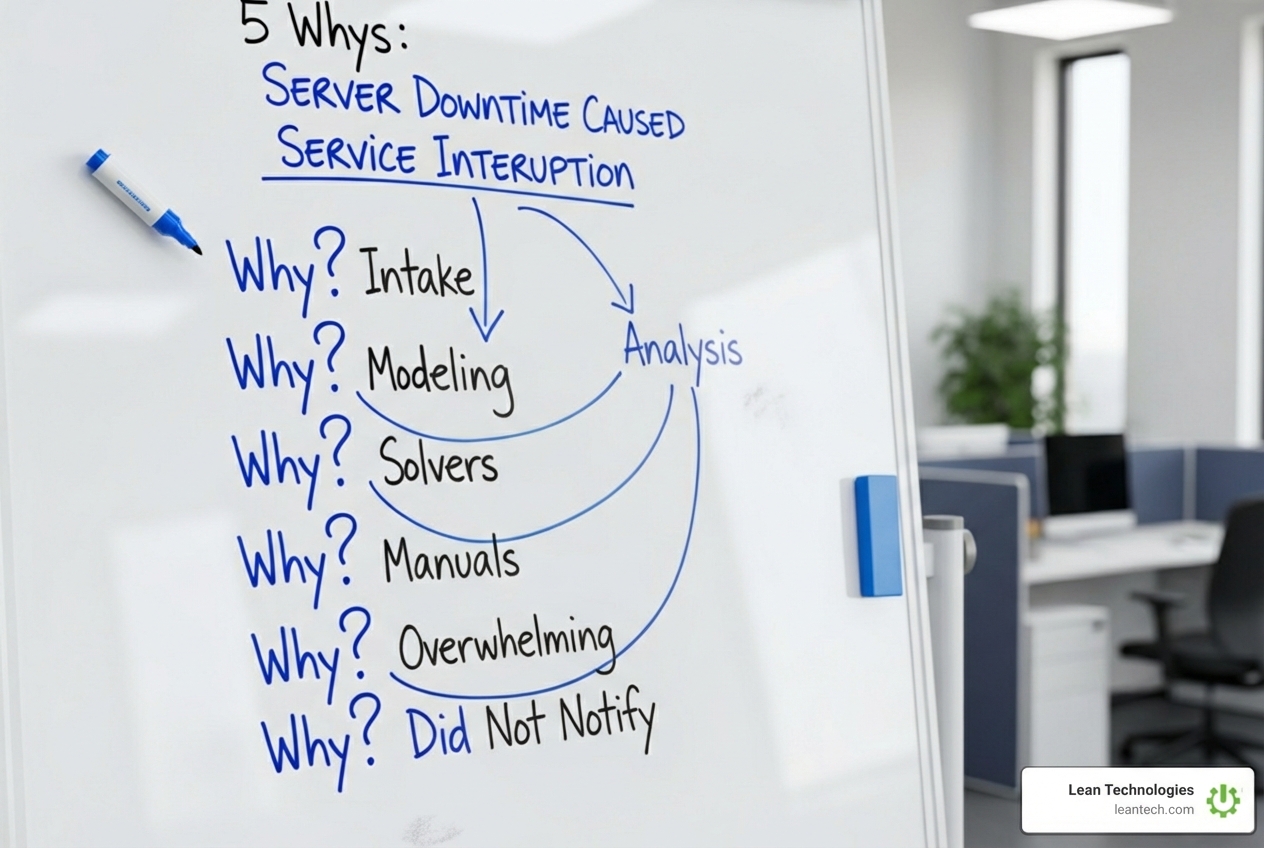
5 Whys for Root Cause Analysis: When a problem pops up, the natural inclination is to fix the symptom. But Kaizen demands you dig deeper. The 5 Whys technique involves repeatedly asking "why" a problem occurred, typically five times, to uncover its underlying root cause. It's deceptively simple but incredibly powerful for getting past assumptions.
5S Methodology for Workplace Organization: This Japanese-derived method focuses on creating an organized, clean, and efficient workspace. The five S's (Sort, Set in Order, Shine, Standardize, Sustain) are crucial for eliminating waste, improving safety, and making problems visible. Click here to learn more about the 5S Model.
Value Stream Mapping (VSM): This Lean-management method visually outlines every step in a process, from product design to final delivery. The objective is to identify all value-adding and non-value-adding activities to maximize productivity and minimize waste. Click here to learn more about Value-Stream Mapping.
Kanban for Visualizing Work: Originally a scheduling system for Lean manufacturing, Kanban is now widely used to visualize workflows, limit work in progress, and optimize efficiency. It helps teams see bottlenecks and manage continuous workflow.
The 8 Wastes of Lean (DOWNTIME): Identifying waste is fundamental to both CI and Kaizen. These 8 categories represent common sources of inefficiency and loss in manufacturing:
Defects: Errors that require rework or scrap.
Overproduction: Making more than is needed, sooner than needed.
Waiting: Idle time for people or machines.
Non-used Talent: Underutilizing skills or creativity of employees.
Transportation: Unnecessary movement of materials or products.
Inventory: Excess raw materials, WIP, or finished goods.
Motion: Unnecessary movement by people.
Extra Processing: More work than is required by the customer.
Examples from the Trenches
These aren't just theories; they're strategies that deliver real results across various industries.
Manufacturing Examples:
Reducing Changeover Time: A common application involves reducing the time it takes to switch a production line from one product to another. By applying 5S, VSM, and Kaizen events, teams can identify steps that can be done offline, streamline setup, and cut changeover times significantly, boosting overall production capacity.
Improving Assembly Line Flow: Companies like Toyota famously empower their employees to stop the production line if they spot a defect or inefficiency. This immediate problem-solving, a core Kaizen practice, prevents minor issues from becoming major quality problems down the line.
Quantifiable Gains: AK Gida, a dairy producer in Turkey, applied continuous improvement principles and managed to improve cycle time by 54% and reduce lead time by 23%. That's real money in the bank. Lockheed Martin, using Kaizen, reduced manufacturing costs by 38% and cut inventory by 50%.
Healthcare Examples:
Streamlining Patient Discharge: Hospitals use CI to reduce patient wait times and improve patient outcomes. By mapping out the discharge process (VSM) and applying Kaizen principles, they can identify bottlenecks, such as waiting for paperwork or prescriptions, and streamline the flow, leading to faster, smoother transitions for patients.
Enhancing Patient Safety: In one intensive care unit, employees rearranged and labeled oxygen cylinders to quickly distinguish between full and empty ones. This small, incremental change, a classic Kaizen example, improved patient safety and work efficiency, especially in emergencies. You can read more in A Practical Guide to the Kaizen Approach.
Software Development: The Agile and Scrum methodologies widely used in software development are deeply rooted in continuous improvement and Kaizen principles. They emphasize iterative development, frequent feedback loops, and continuous adaptation to improve product quality and team efficiency.
Building a Culture of Continuous Improvement and Kaizen
It's one thing to understand the tools; it's another to embed continuous improvement and Kaizen into the very DNA of your organization. This isn't just about processes; it's about people and culture.
How to Get Started (Without Boiling the Ocean)
You might be thinking, "This sounds great, but where do we even begin?" The good news is, you don't need a massive budget or a team of consultants to start.
Leadership Buy-In: This is non-negotiable. Continuous improvement needs support from the top. Management must communicate the need for change, demonstrate commitment, educate staff, and actively manage the improvement process. Without it, efforts will fizzle.
Start Small, One Process, One Team: Don't try to overhaul everything at once. Pick a manageable area—a single production line, a specific maintenance process, or an administrative task that's a known pain point. Introduce Kaizen principles to one team, train them on the tools, and let them experience success. This builds momentum and confidence.
Training Your People: Empowering your team means equipping them with the knowledge and skills they need. Train them on Lean tools like PDCA, 5 Whys, and 5S. Explain the "why" behind the methodologies, not just the "how."
Empowering Employees to Act: Encourage suggestions and feedback. Facilitate idea generation through Kaizen boards, quality circles, or simple suggestion boxes. Crucially, allow employees to implement their own suggestions. When people own the problem and the solution, engagement skyrockets.
Making Improvements Visible: Celebrate every win, no matter how small. Post before-and-after photos, share success stories, and acknowledge the teams making a difference. This reinforces participation and encourages others.
Celebrate Small Wins: Nothing builds a culture of improvement faster than seeing tangible results. When a team successfully reduces setup time by 10 minutes or eliminates a common defect, make sure everyone knows about it. These small victories are the fuel for ongoing motivation.
Common Pitfalls in Continuous Improvement and Kaizen
Even with the best intentions, implementing continuous improvement and Kaizen can hit roadblocks. Beware of these common pitfalls:
"Kaizen Events" with No Follow-Up: Kaizen events (or "blitzes") are focused, short-term improvement projects, typically lasting a few days. They're great for quick wins, but if the improvements aren't standardized, monitored, and sustained, they become temporary fixes. The excitement fades, and old habits creep back in. Kaizen is a journey, not a sprint.
Lack of Employee Engagement: This is a killer. A Gallup poll in 2015 showed that only 32% of US workers were engaged. If your team isn't bought in, they won't identify problems, suggest solutions, or own the improvements. Without their insights and ownership, CI becomes a top-down mandate that rarely sticks.
Not Standardizing Successful Changes: What's the point of finding a better way if you don't make it the new standard? Successful changes need to be documented, trained, and integrated into your standard operating procedures (SOPs). Otherwise, you'll solve the same problem repeatedly.
Focusing Only on Tools, Not Culture: You can have all the PDCA charts and 5S checklists in the world, but if you don't cultivate a mindset of excellence and respect for people, it won't last. Kaizen isn't just about fixing what's broken; it's about building a culture where everyone is committed to ongoing growth.
Data Blindness: Trying to improve processes without real-time data is like driving blindfolded. If you're relying on paper logs or spreadsheets updated once a week, you're reacting to problems too late. You need real-time visibility to identify issues as they happen and measure the impact of your changes. For more insights on this, check out More info about digital lean manufacturing.
Frequently Asked Questions about Continuous Improvement and Kaizen
Is Kaizen the same as Lean?
No, but they are very closely related. Lean is a broader methodology aimed at maximizing customer value while minimizing waste across the entire value stream. It encompasses principles like value stream mapping, just-in-time production, and waste elimination. Kaizen, on the other hand, is a fundamental philosophy within Lean. It's the specific practice of making small, incremental, continuous improvements, driven by everyone in the organization. So, Kaizen is a key component and a powerful enabler of Lean.
How do you measure the success of Kaizen?
Measuring Kaizen's success isn't about grand, sweeping metrics but rather focused, process-specific indicators. Success is measured by tracking key performance indicators (KPIs) directly relevant to the process being improved. Examples include:
Cycle Time: The time it takes to complete a process.
Lead Time: The total time from customer order to delivery.
Defect Rates: The percentage of products or services that fail to meet quality standards.
On-Time Delivery: The percentage of products delivered on schedule.
Employee Suggestions Implemented: A direct measure of engagement and active participation.
Scrap Rate: Amount of material wasted.
Square Footage Used: Efficiency of space usage.
For example, a dairy producer applying continuous improvement reduced cycle time by 54% and lead time by 23%. These are tangible, measurable outcomes that demonstrate the power of incremental changes.
Can continuous improvement work without employee involvement?
No, not effectively. True continuous improvement fundamentally relies on the insights, experience, and ownership of the people who perform the work every day. Think about it: who knows the most about the challenges and inefficiencies of a task? The person doing it. Without their active participation and commitment, CI becomes a top-down mandate, often perceived as an extra burden, and rarely sticks. The Toyota Way, for instance, has two pillars: Kaizen and respect/empowerment for people. Both are absolutely required for Lean to work. When employees are involved, they feel valued, leading to increased job satisfaction, lower turnover, and higher rates of innovation.
What to Do Next: From Theory to Action
We've covered a lot of ground, but the message is clear: continuous improvement is the strategic imperative for manufacturers aiming for operational excellence, and Kaizen is the daily practice that makes it happen.
The first step toward building this culture is simple: make problems visible. You can't fix what you can't see, or what's hidden in stacks of paper, outdated spreadsheets, or delayed reports. It's time to stop managing your shop floor through wishful thinking and start leveraging real-time data.
Moving from paper and spreadsheets to real-time data is crucial. If issues are captured on paper or in Excel and entered at the end of the shift or week, it's already too late. The problem has already spread, the waste has already happened, and your team is stuck reacting instead of improving.
Digitizing your processes with tools like Thrive gives your teams the visibility they need to solve problems faster. Thrive is a flexible digital toolbox, not an ERP or MES, designed specifically for operators and supervisors. It helps them log issues, track actions, and drive continuous improvement right at the source, in real time.
Stop managing with outdated information. Empower your team with the tools they need to identify, address, and prevent problems. Let your team run lean—with real-time visibility and fewer workarounds.
Want faster problem-solving? It starts with better visibility. Drive real-time continuous improvement with Thrive.