Continuous Improvement Lean Management 101
Why Shop Floors Struggle Without Continuous Improvement Lean Management
Continuous improvement lean management is a structured approach to eliminating waste, improving efficiency, and delivering more customer value by making small, incremental changes to your processes—all while empowering your team to identify and solve problems at the source.
Quick Answer: What You Need to Know
What it is: A combination of Lean principles (waste elimination, flow, pull) and the Kaizen philosophy (continuous, incremental improvement)
Where it came from: The Toyota Production System in the 1950s, pioneered by Taiichi Ohno
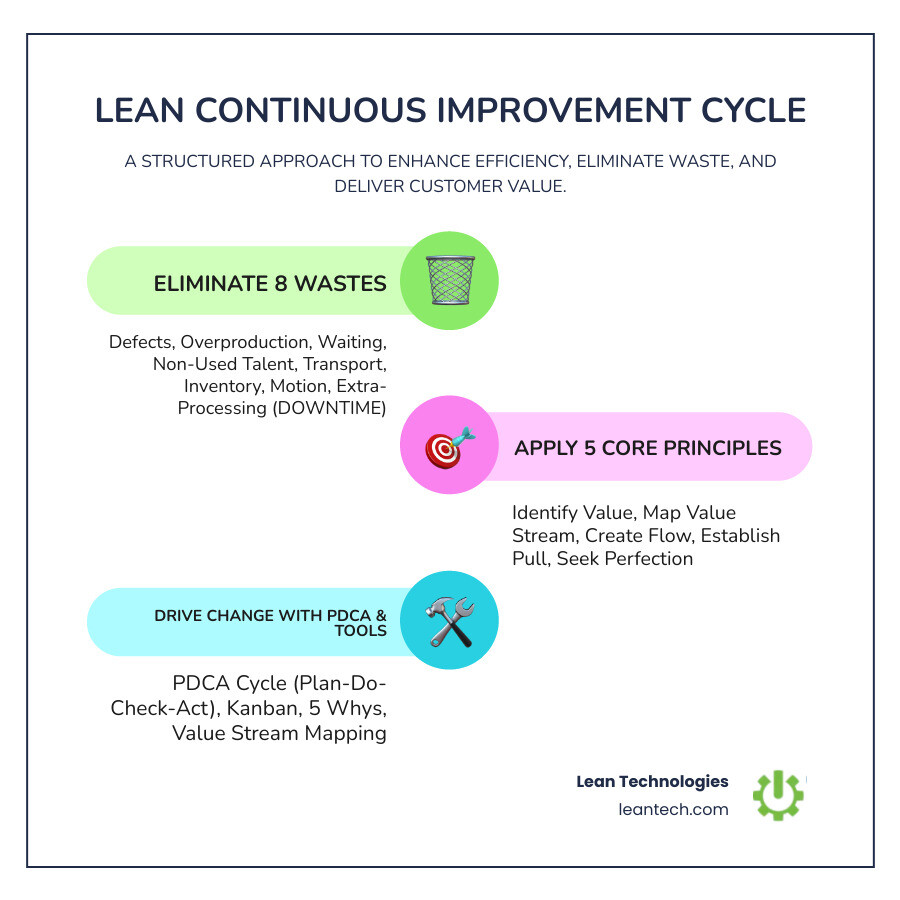
Core goal: Create more value with fewer resources by systematically removing the 8 types of waste (defects, overproduction, waiting, non-used talent, transportation, inventory, motion, extra-processing)
How it works: Using tools like PDCA (Plan-Do-Check-Act), Kanban boards, 5 Whys, and Value Stream Mapping to drive change
Why it matters: Companies using Lean report 10-30% reduction in operational costs, 20-50% increase in productivity, and 50% reduction in lead times
You've been there. Standing on the shop floor at 2 PM, staring at a problem that's been happening for weeks. Your team is working hard—really hard—but defects keep slipping through, lead times keep stretching, and you're still stuck manually pulling reports from three different spreadsheets just to figure out what happened yesterday.
The problem isn't effort. It's structure.
Continuous improvement lean management gives you that structure. It's not about working harder or "trying to do better." It's about building a system where problems surface quickly, get solved by the people closest to the work, and stay solved—because you've addressed the root cause, not just the symptom.
This guide breaks down exactly what Lean continuous improvement is, where it came from, how it works in practice, and how to start applying it on your shop floor—without overhauling your entire operation or replacing your ERP.
What Is Lean Continuous Improvement? (And Why It's Not Just "Trying Harder")
Continuous improvement lean management is a strategic methodology focused on enhancing efficiency and eliminating waste across all processes. It combines the Lean philosophy, which emphasizes value creation and waste elimination, with the Kaizen approach of making small, incremental improvements. Essentially, it's about constantly seeking ways to do things better, faster, and with fewer resources, always with the customer's needs in mind.
While general continuous improvement (CI) is the ongoing effort to improve products, services, or processes, Lean continuous improvement adds a specific framework and set of tools. General CI might involve any improvement, large or small. Lean CI, however, is laser-focused on identifying and eliminating anything that doesn't add value to the customer, often referred to as "waste." It’s the difference between generally trying to be better and systematically removing the obstacles preventing you from being your best.
The core idea is simple: businesses must constantly strive to improve to sustain success. This philosophy, encapsulated by Kaizen, promotes the view that an organization should never rest on its laurels but always look for ways to improve its processes, products, and services. It’s a proactive, systematic approach to making your operations smoother, more reliable, and more profitable.
The Origins of Lean: From the Shop Floor to a Global Movement
The roots of Lean methodology stretch back over 500 years, but it truly gained prominence in the early 20th century. Visionaries like Henry Ford of the Ford Motor Company introduced concepts of mass production and efficiency. However, the system we recognize today as Lean truly blossomed in the 1950s with the Toyota Production System (TPS).
Taiichi Ohno, an industrial engineer at Toyota, is widely credited with developing the principles of TPS, which became the foundation of modern Lean manufacturing. Ohno's goal was to reduce waste and create maximum value for the customer by streamlining production. At the heart of TPS, and subsequently Lean, is the principle of Kaizen. This Japanese philosophy loosely translates to "continuous improvement" or "change for the better," underscoring the idea that perfection is a journey, not a destination.
The Toyota Production System (TPS) helped Toyota become one of the world's most successful automotive manufacturers by relentlessly focusing on eliminating waste, improving efficiency, and delivering high-quality products. Since then, Lean has been adopted by businesses across various industries worldwide, proving its universal applicability.
Core Goals of Lean Continuous Improvement
Implementing continuous improvement lean management isn't just about buzzwords; it's about achieving tangible, impactful results on your shop floor and across your entire organization. The core goals are clear and directly address common pain points faced by operations, production, and maintenance managers:
Increased Efficiency: By streamlining processes and eliminating bottlenecks, Lean helps work flow smoother and faster. Companies using Lean methodologies report a 20-50% increase in productivity. This means getting more done with the same resources, reducing the pressure on your teams.
Improved Quality: Focusing on value and eliminating defects means fewer errors, less rework, and higher-quality products or services reaching your customers. This translates to fewer customer complaints and a stronger brand reputation.
Reduced Operational Costs: Waste costs money—in materials, labor, time, and energy. Eliminating this waste directly impacts your bottom line. Organizations that implement Lean principles can see a 10-30% reduction in operational costs.
Increased Productivity: When processes are efficient and waste is minimized, your teams can produce more output in the same amount of time. This boost in productivity can also lead to a 50% reduction in lead times, making your operations more agile and responsive.
Improved Customer Satisfaction: Lean aims to deliver maximum value to the customer. This means getting them the right product, at the right time, at the right price, with the right quality. Satisfied customers are loyal customers.
Employee Empowerment: Lean isn't a top-down mandate; it's a collaborative effort. Empowering employees to identify problems and suggest solutions not only taps into their invaluable frontline knowledge but also boosts morale and engagement.
The Core Principles and The 8 Wastes of Lean
At the heart of continuous improvement lean management lies a deep understanding of what creates value and what doesn't. This understanding is built upon a set of core principles and a systematic identification of waste.

The 5 Core Principles of Lean Thinking
These five principles, popularized by Womack and Jones in "Lean Thinking," form the backbone of any successful Lean initiative:
Identify Value: This is where it all begins. What does your customer truly value? What problem are you solving for them? Anything that doesn't contribute to this defined value is considered waste. For Operations and Production Managers, this means understanding the customer's perspective, not just your internal processes.
Map the Value Stream: Once you know what's valuable, you need to visualize every step involved in delivering that value, from raw materials to the finished product or service. This helps identify all actions—both value-adding and non-value-adding—and reveals bottlenecks or inefficiencies. Think of it as drawing the journey of your product through your facility.
Create Flow: With the value stream mapped, the goal is to make value-adding activities flow smoothly without interruptions. This means eliminating waste, reducing delays, and ensuring that work progresses continuously from one step to the next. For Maintenance Managers, this could mean ensuring equipment uptime to prevent production stoppages.
Establish Pull: Instead of "pushing" products through production based on forecasts, Lean advocates for a "pull" system. Work is only performed when there is actual customer demand. This minimizes overproduction and excessive inventory, directly reducing costs and storage needs.
Seek Perfection: This is the continuous improvement aspect. Lean is not a one-time fix. It's a relentless pursuit of improvement, constantly striving to eliminate waste and improve value. It encourages a culture of ongoing reflection and problem-solving.
Want to dive deeper into how these principles translate into a digital environment? Explore More on digital lean manufacturing.
Eliminating the 8 Wastes (Muda) with Continuous Improvement Lean Management
Lean methodology emphasizes the elimination of waste (Muda) in all its forms. These eight types of waste are often remembered by the acronym DOWNTIME and are critical targets for any continuous improvement lean management initiative. For Quality Assurance Managers, identifying these wastes is crucial for preventing defects and ensuring compliance.
Here are the 8 Wastes, with examples common on the shop floor:
Defects: Products or services that fail to meet specifications, requiring rework or scrap.
Shop Floor Example: A batch of parts produced with incorrect dimensions, leading to rejection by Quality Control and requiring re-machining or disposal.
Overproduction: Producing more than what is needed, or sooner than needed. This is considered the worst waste because it often leads to other wastes.
Shop Floor Example: Manufacturing 1,000 units when only 500 are currently ordered, leading to excess inventory and storage costs.
Waiting: Idle time for people, equipment, or materials.
Shop Floor Example: An operator standing idle because a machine is broken down (Maintenance Manager's pain point) or waiting for raw materials to arrive.
Non-Used Talent (or Non-Used Talent): Underutilizing the skills, knowledge, or creativity of your employees.
Shop Floor Example: An experienced technician with problem-solving skills is only assigned routine tasks and isn't invited to contribute to process improvement discussions.
Transportation: Unnecessary movement of materials or products.
Shop Floor Example: Raw materials being moved from one end of a large warehouse to another, then back to the production line, due to inefficient layout.
Inventory: Excess raw materials, work-in-progress, or finished goods.
Shop Floor Example: Keeping a month's supply of a specific component on hand when lead times are only a week, tying up capital and requiring storage space.
Motion: Unnecessary movement of people.
Shop Floor Example: An assembly line worker repeatedly walking across their workstation to retrieve tools or components because they aren't organized efficiently (a 5S opportunity).
Extra-Processing (or Over-processing): Performing more work on a product than is required by the customer.
Shop Floor Example: Polishing a component to a higher finish than required, or performing redundant inspections that don't add value.
Understanding and systematically attacking these wastes is the bedrock of effective Lean continuous improvement. For more detail, you can explore The eight types of waste.
Putting Continuous Improvement Lean Management into Practice
Understanding the principles is one thing; putting them into action on the shop floor is another. This is where continuous improvement lean management truly shines, providing practical frameworks and tools to drive change.

The PDCA Cycle: Your Framework for Change
The Plan-Do-Check-Act (PDCA) cycle, also known as the Deming Cycle, is fundamental to continuous improvement lean management. It’s a simple, iterative, four-step management method used for the control and continuous improvement of processes and products. It’s essentially the scientific method applied to your operations.
Plan: Identify an opportunity for improvement and plan a change. This involves defining the problem, analyzing its root causes (perhaps using tools like the 5 Whys), setting clear objectives, and outlining a specific action plan. For Project Managers, this is where clear goals and tasks are critical.
Do: Implement the change on a small scale or in a controlled environment. This allows you to test your hypothesis without disrupting your entire operation. Collect data during this phase to observe the impact of the change.
Check: Analyze the results of your small-scale implementation. Compare the data collected against your initial objectives. Did the change lead to the desired improvement? Did it introduce any new problems? This step is crucial for learning.
Act: Based on what you learned in the "Check" phase:
If the change was successful and achieved the desired results, standardize it and implement it on a wider scale.
If it didn't work as expected, or introduced new issues, go back to the "Plan" stage, refine your approach, and start the cycle again.
The PDCA cycle encourages structured experimentation and learning, ensuring that improvements are data-driven and sustainable. For Project Managers, integrating PDCA into your workflows can lead to Better project management.
Key Lean Tools for Your Toolbox
To effectively steer the PDCA cycle and tackle the 8 Wastes, you need a set of reliable tools. These are some of the most common and powerful tools in continuous improvement lean management:
Value Stream Mapping (VSM): A visual tool that maps out the entire flow of materials and information required to bring a product or service to a customer. It helps identify all value-adding and non-value-adding steps, pinpointing areas of waste and opportunities for improvement.
5 Whys: A simple yet powerful root cause analysis technique. When a problem occurs, you repeatedly ask "Why?" (typically five times) to dig deeper beyond the symptoms until you uncover the underlying cause. This helps prevent superficial fixes and ensures you address the true issue.
Kanban: A visual system for managing work as it moves through a process. Kanban boards use cards or visual signals to represent tasks, helping teams visualize workflow, limit work-in-progress (WIP), and identify bottlenecks. Aerosud's engineering teams, for example, doubled their throughput within days by implementing Kanban boards and WIP limits.
Work-in-Progress (WIP) Limits: A core component of Kanban, WIP limits restrict the number of tasks or items that can be in progress at any given time. This forces teams to focus on completing current tasks before starting new ones, reducing multitasking and improving flow.
5S System: A methodology for organizing and managing workspaces to improve efficiency and safety. The 5S stand for:
Sort: Eliminate unnecessary items from the workspace.
Set in Order: Organize remaining items for easy access.
Shine: Clean and inspect the workspace regularly.
Standardize: Create consistent procedures for maintaining the first three S's.
Sustain: Make 5S a habit and continuously improve it.
The Power of Employee Empowerment
One of the most critical,, aspects of continuous improvement lean management is the role of the people on the shop floor. Front-line workers—operators, technicians, and supervisors—are closest to the processes and often have the best insights into problems and potential solutions.
Lean emphasizes empowering these employees to:
Identify Problems: They are the first to spot inefficiencies, defects, or safety hazards. Creating a system where they can easily log issues and observations is vital.
Suggest Solutions: Their practical experience makes them invaluable contributors to brainstorming and implementing improvements. "Non-Used Talent" is one of the 8 Wastes. Tapping into this talent is a direct path to reducing waste.
Take Ownership: When employees are involved in finding solutions and seeing their ideas implemented, they develop a sense of ownership and commitment to the continuous improvement process. This fosters a culture where everyone is invested in the company's success.
For Production Managers and Operations Managers, this means shifting from a command-and-control approach to one of coaching and facilitating, allowing your team to drive improvements from the ground up.
Building a Culture of Improvement and Measuring Success
Continuous improvement lean management is more than just a set of tools or a project; it's a fundamental shift in how an organization operates. It requires cultivating a specific culture and establishing clear ways to measure progress and sustain gains.
It's About Culture: The 3 C's of Improvement
A truly Lean organization understands that sustainable improvement comes from embedding the philosophy into its DNA. This is often summarized by the '3 C's' of continuous improvement:
Customer: Every improvement initiative must ultimately benefit the customer. This customer focus means understanding their needs, defining value from their perspective, and aligning all efforts to deliver that value. For Quality Assurance Managers, this means ensuring product standards meet or exceed customer expectations.
Culture: Continuous improvement lean management thrives in a culture that accepts change, encourages experimentation, and views problems as opportunities. It means embedding CI into daily habits, rituals, and values. Leaders must foster an environment where employees feel safe to identify issues, propose solutions, and even make small mistakes as part of the learning process. This is where HR Managers play a crucial role in shaping organizational values.
Capability: To continuously improve, teams need the right skills, tools, and systems. This involves ongoing training on Lean principles and tools, providing access to data, and building systematic learning mechanisms. It's about equipping your team with the ability to solve problems effectively.
Leadership plays a pivotal role here. Instead of dictating solutions, Lean leaders act as coaches, guiding their teams through problem-solving and fostering a collective sense of responsibility.
How to Measure and Sustain Success
"What gets measured, gets managed." This adage holds true for continuous improvement lean management. Without clear metrics, you can't truly know if your efforts are yielding results.
Key metrics to track include:
Lead Time: The total time from customer order to delivery. Lean aims to significantly reduce this.
Cycle Time: The time it takes to complete one unit of a process.
Throughput: The amount of product or service a company can produce and deliver within a specified period. Companies using Lean methodologies report a 20-50% increase in productivity, directly impacting throughput.
Defect Rate: The percentage of products or services that fail to meet quality standards. QA Managers rely heavily on this.
Operational Costs: Tracking reductions in costs associated with waste.
Employee Engagement Surveys: A highly engaged workforce is more likely to contribute to continuous improvement.
Sustaining improvements requires more than just tracking numbers. It involves:
Standardization: Once an improvement is proven effective, standardize the new process to ensure consistency.
Daily Huddles: Short, frequent meetings to review performance, identify immediate issues, and plan daily tasks.
Celebrating Wins: Acknowledging and celebrating even small improvements reinforces the culture and motivates teams.
Regular Reviews: Periodically reviewing outcomes and re-evaluating processes to ensure they remain effective and identify new opportunities for improvement.
The Role of Technology in Modern Continuous Improvement Lean Management
In today's manufacturing environment, relying solely on paper and spreadsheets for continuous improvement lean management is like trying to win a race with a horse and buggy. The problem isn't just that it's slow; it's that by the time you've manually collected and analyzed the data, the problem has often escalated, or the opportunity has passed. This is what we call "real-late" data.
Modern technology, especially digital shop floor software, transforms this landscape by providing real-time visibility. Imagine:
Instant Problem Logging: An operator spots a defect or a machine issue and logs it immediately via a tablet or mobile device. No more waiting for end-of-shift reports.
Centralized Visibility: Operations Managers and Production Managers can see issues, work-in-progress, and performance metrics across all lines or departments in real-time on a single dashboard.
Action Tracking: When an issue is logged, actions can be assigned, tracked, and closed out digitally, ensuring accountability and preventing problems from falling through the cracks. CI teams can finally "close the loop" on improvements.
Data-Driven Decisions: AI-based software can analyze this real-time data to identify patterns, predict potential inefficiencies, and even automate routine tasks. This frees up your team to focus on more complex, value-adding activities. For IT Managers, integrating such software can streamline data flow and improve decision-making capabilities.
This digital approach ensures that real-time beats real-late, allowing your team to identify issues faster, implement solutions quicker, and sustain improvements more effectively.
Frequently Asked Questions about Continuous Improvement Lean Management
What's the difference between Lean and Six Sigma?
While both aim to improve processes, Lean and Six Sigma have distinct focuses. Lean primarily focuses on eliminating waste (Muda) and improving the flow of value to the customer. It's about making processes faster and more efficient. Six Sigma, on the other hand, focuses on reducing process variation and defects, aiming for near-perfect quality by using statistical analysis. Lean Six Sigma combines both methodologies, leveraging Lean's waste reduction with Six Sigma's quality improvement to achieve both speed and precision.
How long does it take to see results from Lean?
The beauty of continuous improvement lean management is that you can see results quickly. Implementing simple tools like Kanban boards or the 5S system can lead to small, immediate wins in days or weeks, such as improved organization or better workflow visualization. For example, some organizations have doubled throughput within days of implementing Kanban. However, achieving significant cultural change, major cost reductions (10-30%), and substantial productivity increases (20-50%) is a long-term journey that requires sustained effort and commitment.
Can Lean continuous improvement work in non-manufacturing industries?
Absolutely! While Lean originated in manufacturing, its principles of waste elimination, value creation, and continuous improvement are universally applicable. Organizations in diverse sectors like healthcare (reducing patient waiting times), software development (streamlining agile workflows), construction (optimizing project timelines), hospitality (enhancing customer service), and administration (cutting down on paperwork) have successfully adopted Lean methodologies to improve their processes and deliver greater value. The core idea—doing more with less and always getting better—translates across any industry.
What to Do Next
The journey of continuous improvement lean management is exactly that—a journey, not a destination. It's about taking small, consistent steps, empowering your team, and building systems that allow problems to be solved at their source, not just managed.
Are you tired of firefighting on the shop floor? Ready to move beyond paper-based workarounds and "real-late" data? It's time to equip your team with the tools to log issues, track actions, and drive continuous improvement with real-time visibility.
Let your team run lean—with real-time visibility and fewer workarounds. Find how Lean Technologies can help you Drive continuous improvement on your shop floor.