
The Ultimate Guide to Lean Manufacturing in the Industry 4.0 Era
Why Industry 4.0 Lean Manufacturing Matters Now
A busy plant can have plenty of data and still lack answers. Teams chase paper reports, miss handoffs between shifts, and find problems after scrap, downtime, or delays have already grown.
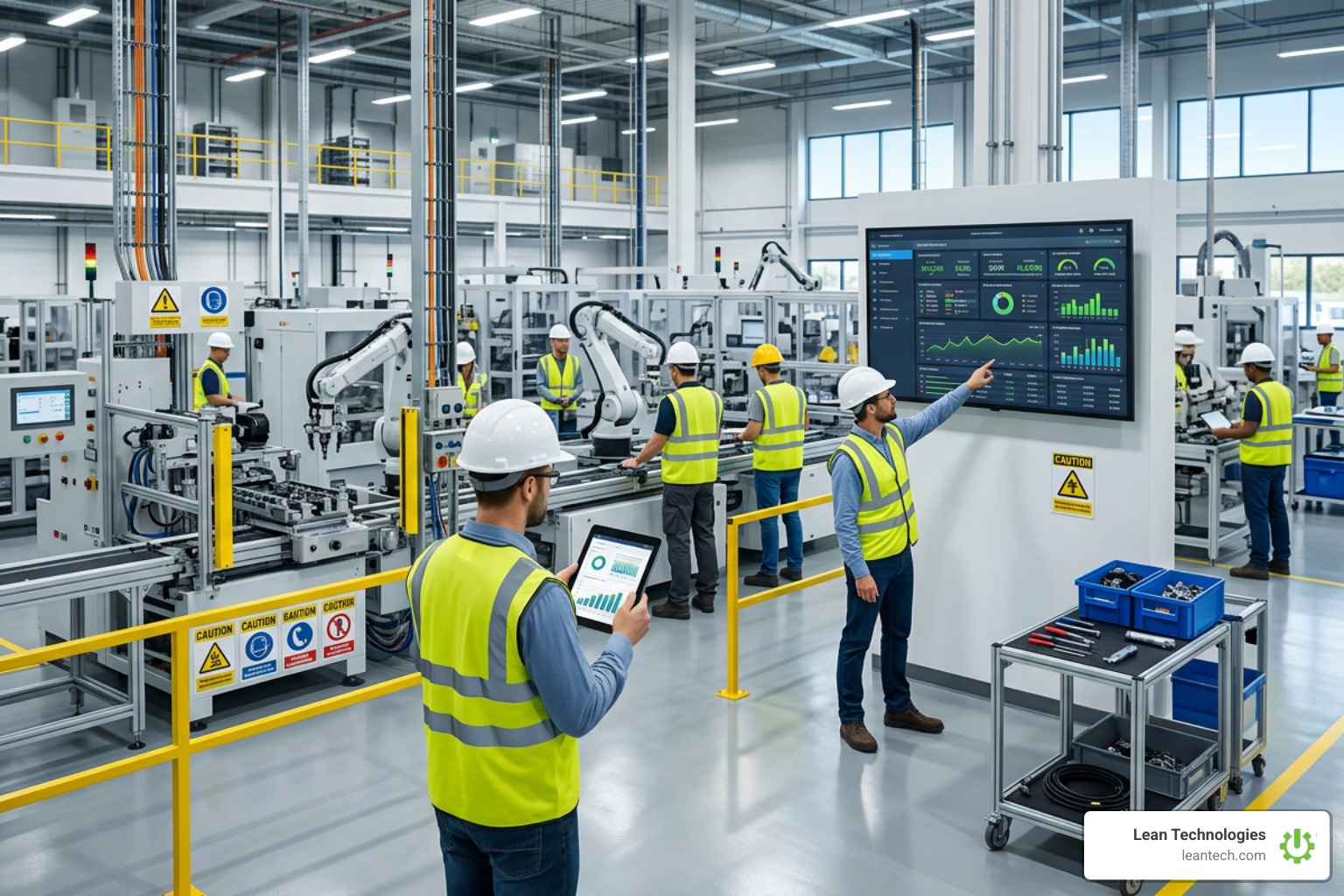
Industry 4.0 lean manufacturing combines lean's focus on removing waste with connected digital tools that make work, delays, and defects easier to see and improve. Start with stable standard work and clear process ownership. Then use real-time production data, digital visual management, automation, and structured problem solving to help people act faster - not just collect more data.
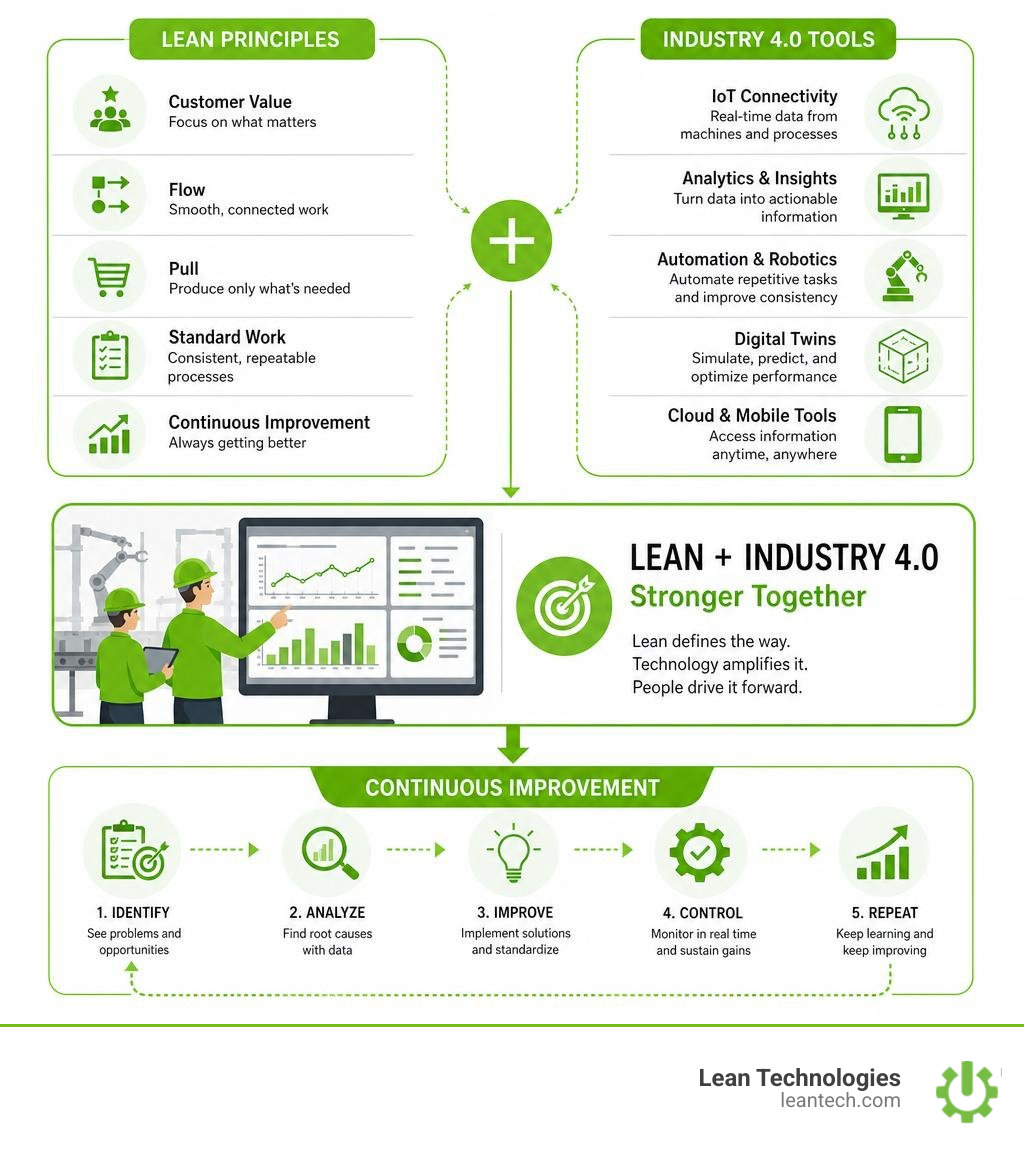
Lean supplies the operating system: customer value, flow, pull, standard work, and continuous improvement. Industry 4.0 adds capabilities such as IoT-connected equipment, analytics, digital twins, robotics, cloud platforms, and mobile tools. Together, they can turn a static value-stream map or whiteboard into a current view of what is happening on the floor.
The important point is simple: technology does not fix a broken process. Digitizing unclear handoffs, inconsistent work instructions, or weak follow-up only makes the confusion happen faster. The strongest programs use lean to identify the problem first, then choose technology that removes the waste.
For small and midsize manufacturers, Thrive is a digital platform built to digitize lean work processes in real time without replacing ERP or MES systems. It is a flexible toolbox for logging issues, tracking actions, and driving continuous improvement. Thrive provides real-time visibility when processes are structured and people enter data at the source through mobile, tablet, or desktop. It does not collect sensor data or run predictive alerts; instead, it helps teams organize action around machine data they enter or import from other systems.
Understanding the Convergence: Lean Management Meets Smart Industry
To understand why modern operations are evolving so rapidly, we have to look at what digital lean is and why it's the future of manufacturing. Traditional Lean, rooted in the world-renowned Toyota Production System, centers on maximizing customer value by systematically eliminating non-value-added activities, known as waste or muda. It relies on visual management, standard work, and disciplined Plan-Do-Check-Act (PDCA) problem-solving cycles.
However, traditional lean methods often run into physical boundaries. Paper boards lag behind real production events, manual shift logs introduce human recording bias, and continuous improvement projects frequently stall because historical data must be compiled by hand.
Industry 4.0 introduces cyber-physical integration—connecting physical plant assets with cloud computing, networks, and computational analysis. When these smart systems merge with operational discipline, the result is a dynamic production ecosystem.
Academic research on the integration of Industry 4.0 and Lean Management confirms that Lean Management serves as the structural foundation for digital transformation, while Industry 4.0 provides the technological tools to scale Lean across complex, high-mix production environments. Rather than replacing the human-centric PDCA cycle, digital tools accelerate it by eliminating information waste—the delays, transcription errors, and missing data that slow down frontline troubleshooting.
Comparing Traditional Methodologies and Connected Operations
Comparing old school lean vs digital lean highlights how connectivity transforms daily shopfloor routines without stripping away core principles.
Operational Dimension | Traditional Lean Method | Industry 4.0 Lean Manufacturing |
|---|---|---|
Visual Management | Static whiteboards, magnetic tags, manual paper tracking | Dynamic shopfloor dashboards, mobile alerts, live shift tracking |
Standardized Work | Laminated binders, paper-based SOPs, manual sign-offs | Interactive digital checklists, mobile work instructions, in-app validation |
Material Replenishment | Physical card kanbans, manual bin audits | e-Kanbans, automated pull triggers, AGV-assisted routing |
Equipment Maintenance | Calendar-based preventive checklists, reactive repair logs | Total Productive Maintenance supported by condition-based work orders |
Problem Solving | Post-shift whiteboard root-cause analysis (5 Whys) | In-shift root-cause logging, structured digital 5M investigations |
Value Stream Mapping | Periodic static snapshots drafted on paper or whiteboards | Dynamic VSM updated with current operational throughput data |
While traditional tools established the standard for workplace organization, connected operations remove the latency inherent in manual tracking.
Core Technologies Powering Industry 4.0 Lean Manufacturing
Building an agile, waste-free operation requires an integrated technology architecture rather than isolated software silos. A unified smart manufacturing platform coordinates several core technological pillars:
Industrial Internet of Things (IIoT): Networked sensors capture parameters like temperature, vibration, cycle times, and electrical loads, feeding raw context into production systems.
Cloud & Edge Computing: Edge nodes process time-sensitive data directly on the shop floor, while cloud platforms aggregate cross-facility trends for enterprise analysis.
Digital Twins: Virtual representations of lines, cells, or components allow engineers to simulate line balance changes and test takt-time adjustments before making physical alterations.
Autonomous Mobile Robots (AMRs) & AGVs: Guided vehicles streamline material handling, upholding just-in-time (JIT) material delivery without unnecessary operator handling.
Additive Manufacturing: On-demand 3D printing accelerates quick-changeover tooling, prototype validation, and replacement part fabrication directly on-site.
As highlighted in research exploring Lean Manufacturing in Industry 4.0: A Smart and Sustainable Manufacturing System, pairing these physical tools with Lean principles turns raw operational data into actionable waste reduction.
The Strategic Synergy of Industry 4.0 Lean Manufacturing
Adopting digital tools without Lean discipline leads to expensive, digitized clutter. Conversely, running Lean without digital connectivity leaves plants vulnerable to blind spots and slow execution. The true power lies in their convergence, often termed Lean 4.0: The Convergence of Lean Thinking.
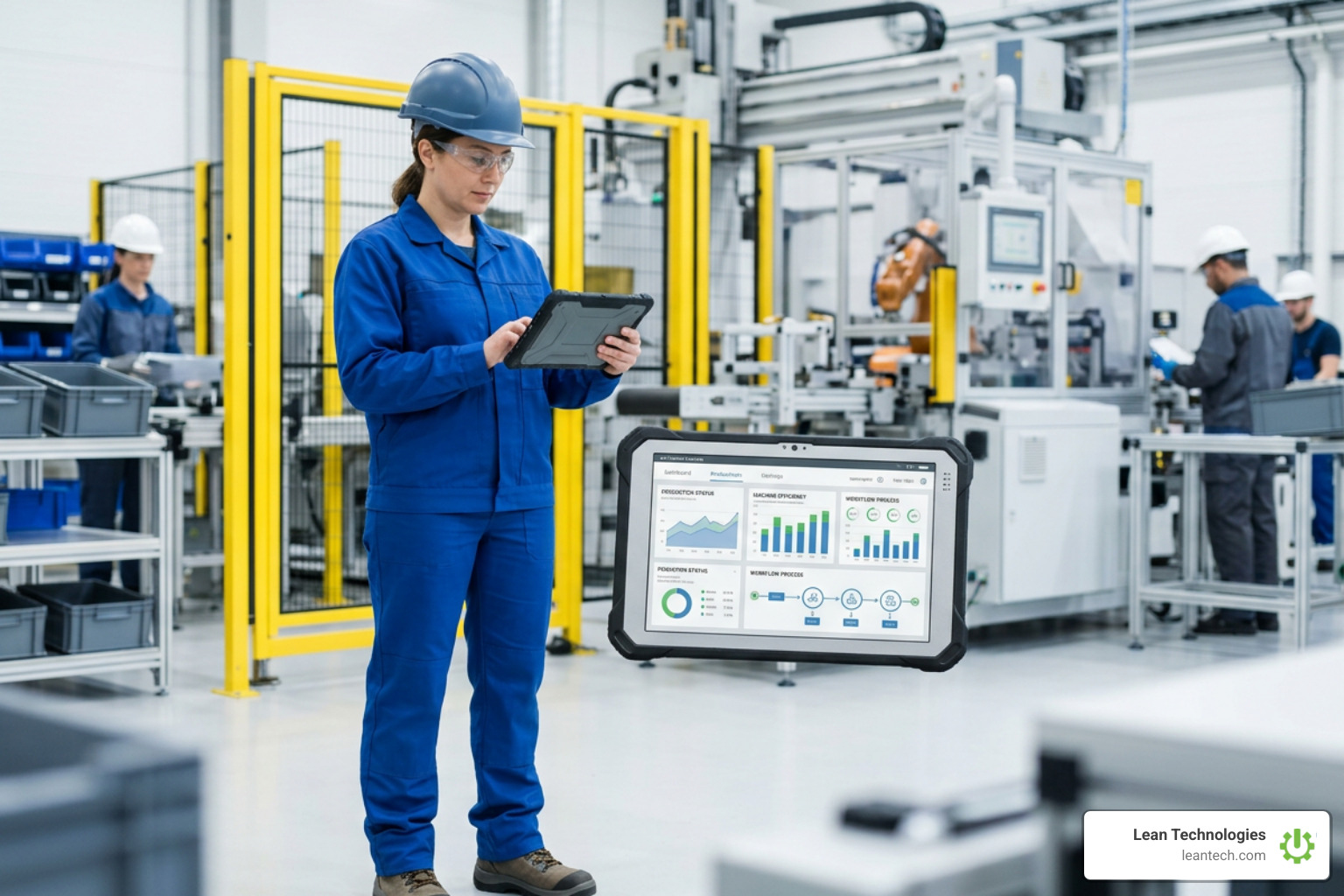
A landmark study by the Boston Consulting Group (BCG) revealed that manufacturers deploying combined Lean Industry 4.0 initiatives can reduce conversion costs by as much as 40% over five to ten years. This cost reduction significantly outpaces the isolated implementation of either Lean or Industry 4.0 alone. In practice, combining them can double the total savings realized across operations.
Furthermore, empirical research on the effects of Industry 4.0 technologies on Lean Manufacturing and organizational performance demonstrates via Structural Equation Modelling that Lean Manufacturing acts as an essential mediator. The indirect performance benefits of digital investments—realized through streamlined processes and empowered teams—are substantially stronger than any direct technology deployment alone.
Upgrading Core Lean Tools with Smart Solutions
When traditional Lean tools are upgraded with digital capabilities, standard continuous improvement methods achieve new levels of precision. Our complete guide to lean manufacturing solutions explores how classic concepts evolve:
Dynamic Value Stream Mapping (VSM): Instead of calculating lead times based on periodic manual sampling, dynamic VSM maps live operational throughput, instantly exposing bottlenecks caused by micro-stoppages.
Extended SMED (Single-Minute Exchange of Die): Setup times drop when changeover checklists, tooling locations, and pre-heating cycles are coordinated digitally on tablets before the line halts.
Digital Poka-Yoke (Error-Proofing): Integrating barcode verification, pick-to-light systems, and tablet-based validation prevents incorrect assemblies from moving downstream.
In a documented academic case study on vacuum degassing machinery manufacturing, implementing an integrated Lean 4.0 framework elevated the process capability index ($C_{pk}$) from 1.278 to a perfect 2.0. Simultaneously, production yield climbed from 99.44% to 100%, generating NT$68,000 in direct scrap and rework savings.
Transforming Maintenance and Quality Management
Maintenance is often where traditional Lean and digital tools deliver the fastest measurable returns. Moving toward Industry 4.0 maintenance allows plants to transition from calendar-based routines to proactive Total Productive Maintenance (TPM).
Instead of discovering broken components during scheduled runs, teams leverage condition monitoring to flag anomalies early. When downtime occurs, structured root-cause analysis platforms let operators immediately cross-reference the classic 5Ms:
Manpower: Verify operator training records and standard operating procedure (SOP) sign-offs.
Machine: Review historical run-rates, imported telemetry, and past work orders.
Materials: Track batch numbers, vendor specifications, and material tolerances.
Methods: Confirm whether the standard sequence of operations was executed correctly.
Measurement: Analyze calibration logs and digital gauge readings.
As published in research on integrating Lean Manufacturing and Industry 4.0 for sustainable operational excellence, unifying structured root-cause problem solving with real-time shopfloor visibility yields 30% to 40% productivity improvements and 25% to 35% overall operating cost reductions across multi-site facilities.
Overcoming Roadblocks and Building a Lean Automation Plan
Despite clear advantages, many digital initiatives hit roadblocks. Plants frequently suffer from "pilot purgatory," where point solutions are tested in isolation but fail to scale across the facility. Common hurdles include legacy machine interfaces, fragmented data silos, workforce apprehension, and a lack of clear accountability.
The German engineering association VDMA, in their guideline Industrie 4.0 meets Lean, emphasizes that technology must never bypass human involvement. When automated systems attempt to self-optimize without operator insight, teams lose touch with basic standard work, weakening the plant's continuous improvement culture.
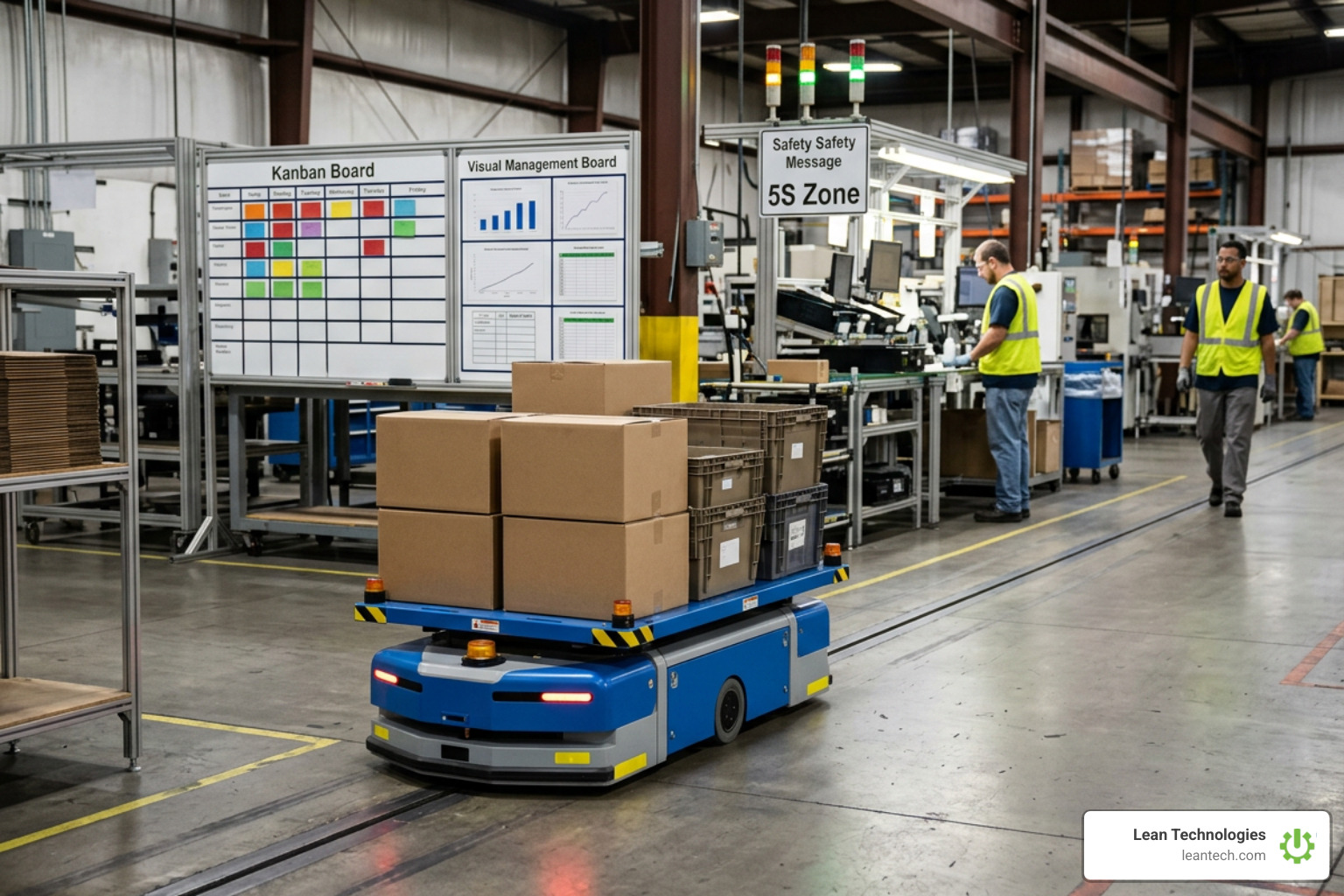
Successful programs apply a structured digital lean manufacturing framework that balances social, technical, and process requirements.
Implementing Industry 4.0 Lean Manufacturing on the Shop Floor
A pragmatic rollout avoids high-risk, "big-bang" deployments. Teams can follow our roadmap outlined in digital lean in 30 days: a practical starter plan, broken into three core phases:
Phase 1: Design and Standardize Workflows Audit existing processes to eliminate baseline waste. Standardize standard operating procedures and implement tablet-based checklists to replace paper binders. Verify that line balance and takt times are stable before introducing automation.
Phase 2: Structured Integration and Material Automation Introduce automated material movement, such as Autonomous Guided Vehicles (AGVs), along standardized delivery routes. Connect operators with digital platforms to capture shift events, downtime reasons, and maintenance requests directly at the source.
Phase 3: Continuous Improvement and Closed-Loop Problem Solving Review operational trends during daily tier meetings. When recurring issues emerge, use structured digital action-tracking to assign countermeasures, track completion dates, and sustain long-term standard work.
Driving Environmental Sustainability and Smart Performance
The intersection of Lean and smart tools also drives meaningful environmental gains. Waste elimination naturally lowers resource consumption, a dynamic highlighted in research on enhancing operational excellence in shop floor management using hybrid lean and smart manufacturing.
Combining energy monitoring with quick-changeover techniques allows manufacturers to pinpoint unnecessary power consumption during equipment idling. Real-world implementations of these hybrid models have demonstrated up to a 56.2% reduction in non-value-added cycle time and up to a 55% reduction in production greenhouse emissions. Eliminating scrap at the source prevents wasted raw materials and the embedded carbon cost of reprocessing defects.
Frequently Asked Questions About Lean and Smart Factories
How do Industry 4.0 technologies support continuous improvement?
Digital tools support continuous improvement by capturing accurate operational data at the source, eliminating the guesswork of paper logs. During daily Gemba walks or tier meetings, cross-functional teams review live operational metrics, pinpoint true root causes using structured 5M frameworks, and track action items to completion across shifts.
What are the main barriers to adopting Lean 4.0?
The most common barriers are cultural resistance, legacy equipment incompatibility, lack of in-house digital skills, and unstructured workflows. Attempting to deploy software or robotics over broken, non-standardized processes creates friction. Successful plants prioritize standard work and user-friendly mobile tools before adding complex automation.
What is the future outlook for Lean in the Industry 5.0 era?
Industry 5.0 builds on Industry 4.0 by placing human centricity, sustainability, and resilience at the center of manufacturing. Rather than pursuing lights-out automation, Industry 5.0 uses collaborative robotics (cobots) and intuitive digital interfaces to support human decision-making, reinforcing Lean's core principle of respect for people.
What to Do Next
Transforming your shop floor does not require a multi-million-dollar systems overhaul or years of complex systems integration. To discover practical steps for modernizing your operations, review our in-depth guide to digital lean manufacturing.
For small to midsize manufacturers seeking structured, accountable execution, Thrive provides an all-in-one, customizable shopfloor platform. Developed by manufacturing experts, Thrive helps teams digitize lean work processes in real time without replacing their existing ERPs or MES systems.
Positioned as a flexible digital toolbox, Thrive simplifies logging issues, tracking maintenance and safety actions, and driving continuous improvement across the plant. Because Thrive provides real-time visibility only when processes are structured and teams enter data at the source via mobile, tablet, or desktop, it reinforces human accountability while organizing clear action around imported or operator-entered machine data.
By starting with standardized processes and empowering frontline teams with practical digital tools, manufacturers can capture the full value of industry 4.0 lean manufacturing, cut conversion costs by up to 40%, and build a resilient culture of continuous operational excellence.