
L2L Competitors: How L2L, Poka, and Thrive Compare
Three platforms, three different bets on how a manufacturing plant should run. Here's what each one actually looks like once the sales deck closes.
Walk onto most mid-size manufacturing floors, and you'll still find the same three artifacts: a maintenance log someone forgot to update, a quality checklist clipped to a binder, and a whiteboard tracking "continuous improvement" ideas that never quite make it into a system. L2L, Poka, and Thrive all exist to replace that setup — but they were built by people solving slightly different problems, and it shows in how each platform actually feels to use.
If you've gotten this far in your research, you've probably already sat through a demo or two and heard some version of "we do it all." This is the version of that comparison written for someone who wants to know what "all" actually means for each vendor — not just what it costs, but how the software behaves once your team is actually standing in front of a machine with it open.
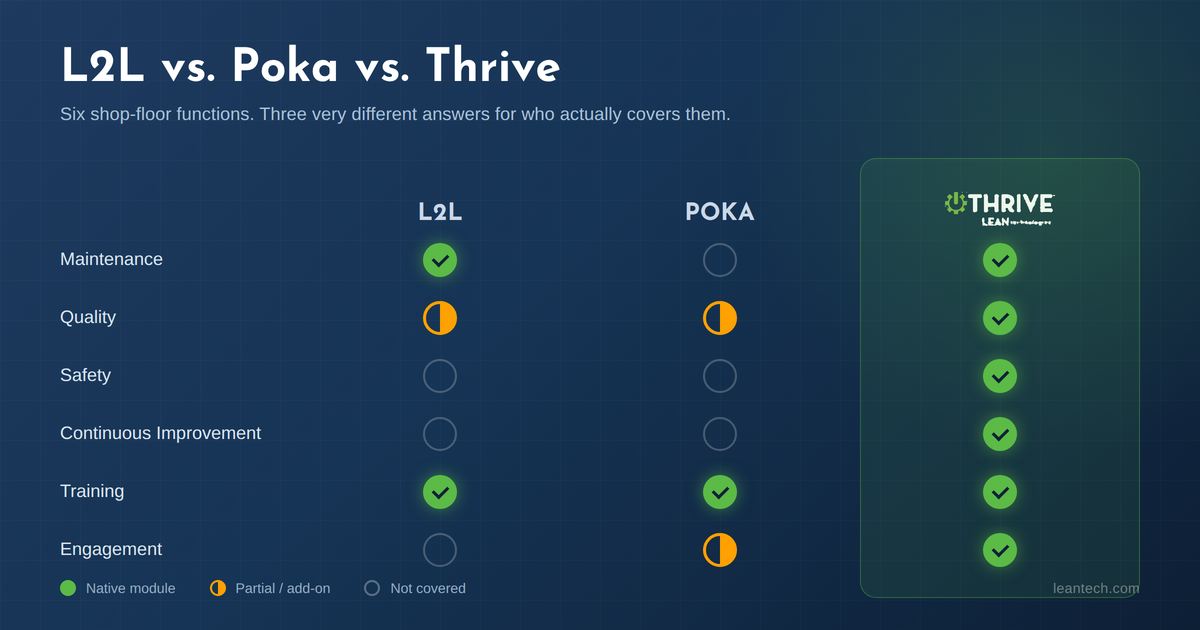
L2L — The maintenance-first specialist. A five-module suite built around dispatch, maintenance, and production data. Deepest where root-cause problem-solving and asset management are concerned.
Poka — The training-and-knowledge coach. Owned by IFS. Strongest at digital work instructions, skills tracking, and getting new hires productive fast — lighter on maintenance and formal quality workflows.
Thrive — The platform you scale into. Maintenance, quality, safety, CI, training, and engagement all live on one platform — start with what you need, add the rest as you grow, never at extra cost.
What Each Platform Was Actually Built to Solve
L2L: Born on the Maintenance Floor
L2L's core pitch is that most plants already run an MES, ERP, and SCADA system — but those systems are usually disconnected from each other, which leaves data siloed and tasks piling up with no clear owner. L2L positions itself as the connective layer between those systems and the people actually standing on the floor. It's organized around five modules, and the ordering isn't an accident: Dispatch and Maintenance are where the platform is most mature, and it shows in how manufacturers talk about it — on G2, L2L holds a 4.3 out of 5 rating across roughly 120 reviews, with reviewers consistently calling out the interface as intuitive and fast for new technicians to pick up.
L2L Dispatch — root-cause problem-solving. Dispatch is the hub the other modules plug into. It gives everyone on the floor — operators, technicians, supervisors — a shared, real-time view of what's happening, and when a machine abnormality or process deviation occurs, it routes the issue to the right person automatically and tracks it through to a documented root cause. Problem it solves: frontline issues that historically got reported verbally or on paper and then quietly resurfaced weeks later because nobody tracked whether they were actually fixed.
L2L Maintenance — asset and maintenance management. This is L2L's CMMS layer: work orders, preventive maintenance scheduling, asset tracking, and spare parts. Because it stays connected to Dispatch and Production data, maintenance schedules can be aligned with what production actually needs that day rather than planned in isolation. Problem it solves: reactive, firefighting maintenance and unplanned downtime caused by missed PMs or maintenance and production teams working from different information.
L2L Production — production optimization. Real-time dashboards connect floor data to tasks and actions so supervisors can calculate OEE and track scrap or rework by line, machine, or scrap code. Problem it solves: the classic "underperforming line nobody can explain" — Production is built to surface the root cause with full visibility rather than guesswork.
L2L Connect — machine and systems integration. Connect pulls data from machines, MES, ERP, and SCADA systems into L2L so the other modules act on real, live data instead of numbers keyed in by hand. Problem it solves: the gap between what's happening on the machine and what's visible in the software teams are using to manage it.
L2L Studio — no-code app builder. Studio lets plant IT or power users build custom workflows on top of the platform without writing code. Problem it solves: the plant-specific processes that don't fit neatly into a standard module, without needing a developer to build them.
Quality and 5S, delivered through Dispatch. L2L also digitizes 5S checklists and layered process audits, letting operators flag quality deviations and escalate them immediately. It's a real capability, but it lives as a workflow inside Dispatch rather than as a standalone, dedicated QMS — worth confirming directly in a demo if formal quality management is a primary requirement rather than a nice-to-have.
In September 2024, L2L acquired SwipeGuide, an Amsterdam-based digital work-instructions company, and folded it in as a training and standard-work layer — L2L's newest module and the source of its one published price point ($150/user/month). Safety/EHS incident tracking and employee engagement are not core, purpose-built modules on the platform. The most repeated criticism across independent review sites isn't about capability — it's that the mobile app could use more polish, and that more advanced configurations come with a real learning curve.
Poka: Built for the Frontline, Not the Back Office
Poka takes a different starting point than L2L. Rather than beginning with maintenance, it begins with the person on the line — how quickly they can learn a new task, find the right work instruction, or flag a problem before it becomes a bigger one. Acquired by IFS in June 2023 for a reported $200 million, Poka has built genuine strength in digital work instructions, skills management, and structured daily communication, and it shows in its reviews: a strong 4.7 out of 5 on G2 across 210+ reviews.
Digital Work Instructions. Poka replaces paper binders and outdated SOPs with step-by-step interactive guidance — video, images, and (more recently) agentic AI assistance — delivered right at the point of work for operators, technicians, and maintenance staff. Problem it solves: tribal knowledge that lives in a veteran operator's head and disappears when they retire or transfer, plus the slow, inconsistent onboarding that comes from paper SOPs nobody keeps updated.
Skills Management. A live skills and training matrix shows who's qualified for every job, by shift and by site, and routes work only to certified operators. Expiring certifications get flagged automatically. Problem it solves: static skills spreadsheets that go stale, and the compliance risk of assigning work to someone who isn't actually certified for it.
Huddle Boards. Digital tiered-meeting boards give shift teams a live, shared view of safety alerts, priorities, and the previous shift's misses, with Tier 1 issues that need escalation surfacing automatically to Tier 2 and Tier 3. Problem it solves: the context that traditionally gets lost during shift handovers, and the time wasted running daily meetings off a whiteboard nobody photographs before it's erased.
Forms & Checklists / Issues Management. Digital forms and structured issue-tracking let operators log problems and route them for resolution, with analytics to surface recurring issues by line, shift, or piece of equipment. Problem it solves: problems that get mentioned verbally in passing and never formally tracked, so the same issue keeps recurring without anyone connecting the dots.
Communications (Factory Feed). A social-media-style feed gives every operator, team lead, and plant manager a shared operational view, so an incoming shift can see exactly what happened and what still needs attention. Problem it solves: the same shift-handover and cross-team visibility gap huddle boards address, extended into an always-on feed rather than a once-per-shift meeting.
Industrial AI. Poka has recently layered AI agents on top of its knowledge base — designed to answer operator questions using a plant's own documentation and guide step-by-step responses to abnormal events. It's a newer capability, worth asking how mature it is for your specific use case in a demo.
What Poka isn't built to be is a CMMS or a formal QMS. Maintenance scheduling and quality workflows exist inside forms and checklists rather than as dedicated, purpose-built modules — which is fine if training and knowledge-sharing are your primary pain point, but it means most Poka customers are still running a separate system for maintenance. Poka also keeps its pricing entirely private; there's no published rate anywhere, which means the true cost of a rollout only becomes clear once you're in a sales conversation.
Thrive: One Login for Every Function on the Floor
Thrive, built by Lean Technologies, isn't trying to be an all-in-one platform everyone uses in full from day one — most plants don't need six modules running at once, and most software vendors who've claimed "all-in-one" for years (look at any ERP) haven't delivered on it. What Thrive offers instead is one platform you scale into: start with the function solving your biggest problem right now — maintenance, quality, safety, continuous improvement, training, or engagement — and add the rest whenever the need actually shows up, without a new contract, a new login, or a new bill.
Maintenance (CMMS). Work orders, preventive maintenance scheduling, and asset management built in natively. Problem it solves: the same reactive-maintenance and missed-PM issues L2L targets — but without needing to license a separate module or negotiate a second contract to get there.
Quality (QMS). Digital inspections, checklists, and non-conformance tracking give quality issues a formal home instead of living inside a general-purpose issue tracker. Problem it solves: quality data trapped in spreadsheets or paper checklists that never roll up into a plant-wide view of defects and trends.
Safety (EHS). Incident reporting, safety inspections, and near-miss tracking — a dedicated module rather than a workaround inside a general forms tool. Problem it solves: safety data that's scattered across paper logs and after-the-fact reports, instead of visible in real time to the people who can act on it.
Continuous Improvement. Digital andons, real-time goal boards, and structured CI workflows replace the whiteboard-and-sticky-note version of daily management. Problem it solves: improvement ideas that get raised once in a meeting and then quietly disappear because nothing tracked them to closure.
Training / Connected Worker. Digital work instructions and training content, similar in spirit to what Poka offers, but included as one of six modules rather than the entire platform. Problem it solves: the same onboarding-speed and tribal-knowledge problem Poka addresses, without requiring a second platform for maintenance or quality.
Engagement. Tools for frontline recognition and communication, built to keep operators connected to what's happening plant-wide. Problem it solves: frontline disengagement that tends to follow when the software a company buys is aimed only at supervisors and managers, not the people actually running the line.
Thrive is explicitly not trying to be an MES or ERP. It operates at the people-and-process layer, which is also why implementation tends to be lighter than a full MES rollout — there's no production scheduling engine or financial system to reconcile against, just the workflows your team already touches every shift.
Results manufacturers have seen on Thrive: 66% reduction in past-due work orders (ASSA ABLOY) | Daily admin time down from 6 hours to 5 minutes (ASSA ABLOY) | 30% downtime reduction (Pella) | Full ROI in 10 months (Pella)
A Monday Morning on Each Platform
The clearest way to see the difference isn't in a feature list — it's in how a plant manager's morning actually plays out.
On L2L, a maintenance lead opens Dispatch to a stack of overnight issues, triages them by root cause, and pushes urgent work orders into Maintenance for the technician on shift. It's a tight, well-worn loop for anything mechanical — but if that same manager also needs to log a safety near-miss or run a quality audit, they're reaching for a different system to do it.
On Poka, a shift supervisor is more likely to be onboarding a new operator — pulling up a digital work instruction, checking a skills matrix to confirm the operator is certified for the task, and posting an update to the team's knowledge feed. It's an excellent morning for training. It's a quieter morning for anything involving a broken conveyor.
On Thrive, that same manager can move through all of it without switching systems: clear the overnight maintenance queue, review a quality inspection flagged by an operator, check a safety report, and glance at the CI board — all inside one platform, with every operator on shift able to log in without anyone checking whether there's a seat left on the license.
Side-by-Side: L2L vs. Poka vs. Thrive
Where the Money Actually Goes
Pricing isn't the whole story here, but it's not a footnote either — it's the mechanism that decides how much of your workforce can actually use what you bought. L2L's one published rate, $150 per user per month for its work-instructions tier, works out to roughly $90,000 a year for a 50-person team, before the Maintenance, Dispatch, or Production modules are even added.
Poka doesn't publish pricing at all, but every independent source points in the same direction: cost and complexity grow with the number of users and sites.
Thrive's flat, per-site model sidesteps that math entirely. A 50-person plant and a 500-person plant pay the same license fee, which means the constraint on adoption isn't budget — it's whether the workflow makes sense for the role. New hires, cross-trained operators, and an extra shift don't show up as a new line item.
What Manufacturers Are Actually Saying
Review data tells a consistent story across all three platforms, and it's worth taking at face value rather than cherry-picking.
L2L users like how fast the interface clicks for maintenance and dispatch teams, and dock points mainly for mobile polish and the learning curve on advanced setups.
Poka users are enthusiastic about onboarding speed and the Work Instructions/Skills & Forms experience, with the tradeoff being that it's not trying to be a full operations suite.
Thrive's track record shows up less in review-site star ratings and more in outcomes: ASSA ABLOY cut past-due work orders by 66% and dropped daily admin time from six hours to five minutes, visible within two weeks of go-live. Pella cut downtime 30% and reached full ROI in 10 months. BAND-IT/IDEX used it to retire spreadsheets in favor of virtual andons, real-time goal boards, and structured digital inspections.
Which One Should You Actually Choose?
Choose L2L if your biggest pain point is maintenance and root-cause problem-solving specifically, you're a larger manufacturer with budget to support per-seat licensing, and you're comfortable with a ~3-month implementation.
Choose Poka if training, digital work instructions, and getting new hires productive fast is your top priority, and you're fine pairing it with a separate system for maintenance and formal quality management.
Choose Thrive if you're a small-to-midsize manufacturer (roughly 40–600 employees) that needs maintenance, quality, safety, CI, training, and engagement covered under one login, wants every operator to have access without a per-seat bill, and wants the software cost to stay flat as headcount grows.
Bottom line: L2L and Poka are both genuinely strong in their specialties — maintenance/dispatch for L2L, training/knowledge-sharing for Poka. Neither was built to cover a plant's full set of functions natively, and both charge more as more of your team actually logs in. Thrive isn't positioned as an all-in-one — that's a promise ERPs have made for years, and most manufacturers have learned to be skeptical of it. What Thrive offers instead is a platform you can scale into: start where the pain is worst, and add maintenance, quality, safety, CI, training, or engagement whenever the need shows up, without a new contract or a new bill. That's why it tends to be the strongest fit for manufacturers who want room to grow without re-buying software every time they do.
Thrive was built to do all six, for one flat price per site, which is why it tends to be the strongest fit for manufacturers trying to get their entire workforce — not just a licensed subset of it — onto one system.
Frequently Asked Questions
What's the main difference between L2L, Poka, and Thrive?
Thrive charges one flat fee per site with unlimited users, and a plant can start with just the module or two it needs most and scale into the rest — maintenance, quality, safety, CI, training, and engagement — without paying more or switching platforms as those needs grow.
How much does L2L actually cost?
L2L doesn't publish full pricing. The one public number available is $150 per user, per month, for the work-instructions tier added through its 2024 SwipeGuide acquisition — roughly $90,000/year for a 50-person team. The Maintenance, Dispatch, Production, and Connect modules are quote-only.
Does Poka include maintenance management (CMMS)?
Not as a core, dedicated module. Poka's strength is digital work instructions, skills management, and frontline knowledge-sharing. Manufacturers who need robust preventive maintenance scheduling typically run a separate CMMS alongside it.
Is Thrive a replacement for our MES or ERP?
No. Thrive operates at the people-and-process layer — workflows, inspections, training, CI, and engagement — and is built to complement an existing MES or ERP rather than replace it, which is part of why implementation tends to be lighter than a full MES rollout.
How long does implementation typically take?
G2's review data lists an average implementation time of around 3 months for L2L. Poka reviewers frequently describe implementation as quick and intuitive, though timelines aren't standardized across sources. Thrive customers have seen measurable results — like ASSA ABLOY's 66% drop in past-due work orders — within two weeks of go-live, though full-plant rollout timelines vary by site complexity.
Can Thrive really support unlimited users at one flat price?
Yes. Because Thrive is priced per site rather than per seat, adding operators, cross-training staff, or bringing on a new shift doesn't trigger an additional license fee. The same flat price covers a 50-person plant or a 500-person plant.
Which platform is easiest to move to from spreadsheets and paper?
It depends on scope. If you're replacing one function — maintenance logs or training records, for example — L2L or Poka can be the more focused choice. If you're trying to retire multiple disconnected spreadsheets and paper systems across maintenance, quality, safety, and CI at once, Thrive's all-module coverage means one rollout instead of stitching together several separate tools.
See Thrive on Your Own Shop Floor
One flat price per site. Unlimited users. Every module included — maintenance, quality, safety, CI, training, and engagement.
Book a 15-Minute Screen Share: https://calendly.com/zack-leantech/thrive-discovery-call
Sources
L2L Connected Workforce Platform — G2, Capterra, GetApp, Software Advice, Research.com, SoftwareWorld (pricing, modules, ratings, implementation time, review data, retrieved August 2026)
Manual.to, "Work Instruction Software Pricing" — L2L/SwipeGuide acquisition and published $150/user/month pricing (retrieved August 2026)
CB Insights — SwipeGuide acquisition by L2L, September 2024
Poka — G2 (ratings, reviews, comparisons vs. Tulip, Dozuki, Rever, Augmentir, WorkClout), Capterra, GetApp, SoftwareSuggest, Toolradar (retrieved August 2026)
Poka.io — Digital Work Instructions, Skills Management, Huddle Boards, and Industrial AI product pages (feature detail, retrieved August 2026)
L2L.com — Maintenance Management, Production Management, and Quality Management solution pages (module and feature detail, retrieved August 2026)
Knowby, "Poka Pricing: Is It Worth the Digital Investment?" — pricing transparency and implementation notes (retrieved June 2026)
CheckThat.ai — IFS acquisition of Poka, June 2023
Thrive by Lean Technologies — internal case study data (ASSA ABLOY, Pella, BAND-IT/IDEX)