
MaintainX Alternatives: 9 Platforms Manufacturers Are Comparing in 2026 & 2027
MaintainX has become one of the most popular mobile-first CMMS platforms on the market, and for good reason. It's easy to deploy, technicians actually use it, and the free tier is a real way for a small team to get off paper. But a lot of manufacturers who start with MaintainX eventually go looking for alternatives — and it's rarely because the software is bad at what it does. It's usually one of two things: the per-user pricing gets expensive fast as headcount grows, or the plant realizes maintenance was never the only problem. The safety audits are still on paper. The CI ideas are still in a spreadsheet. The quality team is running a separate system nobody else can see.
This guide breaks down the strongest MaintainX alternatives on the market in 2026, including where each one fits — and makes the case for why manufacturers evaluating a CMMS switch should widen the search to platforms that solve more than maintenance alone.
What to look for in a MaintainX Alternative
Before comparing platforms, it's worth being clear about what's actually driving the search. Most manufacturers land here for one of these reasons:
Cost at scale. MaintainX prices per user, per month, across every paid tier. A 50-technician plant on the Premium plan is paying a materially different bill than the sticker price suggests once the whole team is licensed.
Feature gating. Inventory management, purchase orders, API access, and advanced analytics all sit behind paid tiers, and multi-site tools and IoT integrations require the top Enterprise tier.
Single-purpose scope. MaintainX is a maintenance and work-order platform. It does not manage safety audits, quality non-conformances, continuous improvement projects, training records, or plant-wide communication. Those stay in separate systems, on separate budgets, with separate logins.
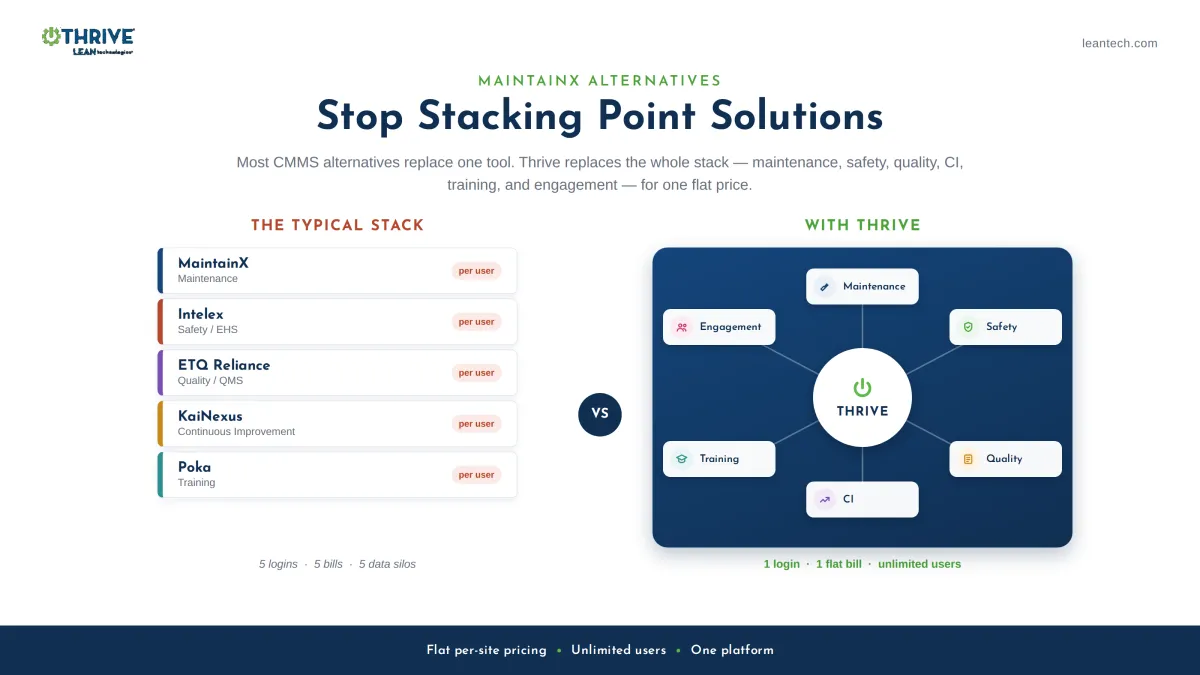
That third point is the one worth sitting with. A CMMS search is often the first thread a plant pulls on, but it's rarely the only rope. Most mid-size manufacturers (40–600 employees) are running four or five disconnected tools across maintenance, safety, quality, and CI at the same time — and paying for the integration headache on top of the software itself.
Thrive: the alternative built for the whole plant, not just maintenance
Thrive is the outlier on this list, and deliberately so. It's not trying to out-CMMS MaintainX feature-for-feature — it's built on the premise that maintenance shouldn't be the only operational process a plant runs digitally. Thrive covers maintenance, quality, safety, continuous improvement, training, and engagement in a single platform, positioned to complement (not replace) whatever ERP or MES a manufacturer already runs.
Why manufacturers switching from MaintainX land on Thrive:
Flat pricing, not per-user pricing. Thrive charges a flat monthly rate per site with unlimited users across every module. There's no calculation to run every time headcount changes, no gated tier standing between a technician and the features they need, and no incentive to limit who gets a login. On a CMMS priced per user, plant-wide adoption is a cost decision. On Thrive, it's just the default.
One platform instead of a growing stack. Maintenance work orders live next to safety audits, quality non-conformances, CI ideas, training records, and shift communication — all in the same system, with the same login, feeding the same dashboards. A plant that would otherwise run MaintainX plus a separate EHS tool, a separate QMS, and a separate kaizen tracker runs one system instead.
Manufacturing-first configuration, not IT projects. Plants configure their own forms, audits, workflows, and dashboards without submitting a ticket to IT. Thrive's Launchpads give each team — maintenance, quality, safety, CI — a home screen built around how they actually work.
Real-time visibility that closes the loop. Issues get tracked from identification to resolution, not just logged and forgotten. That applies whether the issue started as a maintenance work order, a safety near-miss, or a quality deviation.
Proven results at manufacturers similar in size to most MaintainX customers. ASSA ABLOY cut past-due work orders by 66% and reduced daily administrative time from 6 hours to 5 minutes, with results visible within two weeks of go-live. Pella reduced downtime by 30% with ROI inside 10 months. BAND-IT, an IDEX subsidiary, uses Thrive for virtual andons, real-time goal boards, and structured digital inspection workflows across maintenance, quality, and safety in the same system.
Who Thrive is built for: small-to-mid-size manufacturers (roughly 40–600 employees) already pursuing continuous improvement, currently running some mix of spreadsheets, paper forms, and disconnected point solutions, who want real-time visibility without stitching five systems together. If maintenance is the immediate pain but safety, quality, and CI are quietly running on paper in the same building, Thrive is built for exactly that plant.
The honest tradeoff: Thrive is not a machine-monitoring or predictive-maintenance platform, and it isn't trying to out-hardware vendors like Fabrico that ship IoT sensors. It's a workflow and accountability layer — it organizes and acts on data, including data from machine monitoring systems it integrates with, rather than collecting sensor data itself. For a plant that wants condition-based monitoring hardware bundled with software, that's a real distinction worth knowing going in.
Other MaintainX alternatives worth evaluating
UpKeep
UpKeep is a mobile-first CMMS with a genuinely easy deployment path, which is a big part of why it gets compared to MaintainX so often — the two solve a similar problem in a similar way. Pricing runs across Starter, Professional, and Business Plus tiers, all per user. UpKeep is a strong fit for a small-to-mid manufacturer that wants a straightforward maintenance tool and doesn't need the platform to stretch beyond work orders, PM scheduling, and inventory.
Fiix (by Rockwell Automation)
Fiix is an established mid-market CMMS with solid API integrations for pulling in sensor and IoT data — though it relies on third-party hardware rather than shipping its own. Being part of the Rockwell Automation family gives it a natural pull toward plants already invested in Rockwell's broader industrial automation stack.
Limble CMMS
Limble has built a reputation as a user-friendly CMMS that balances simplicity with enough structure for growing operations. It works particularly well for discrete manufacturers — electronics assembly, machine shops — where individual assets need tracking and failure modes tend to repeat. Preventive maintenance, work orders, and inventory are covered well; it doesn't extend past maintenance.
eMaint (by Fluke)
eMaint carries an established CMMS/EAM brand backed by Fluke, and it's frequently shortlisted alongside Fiix and UpKeep by mid-to-large manufacturers that want a more enterprise-proven name. Like the others in this category, it's maintenance-only.
Fabrico
Fabrico takes a different approach: it pairs OEE monitoring hardware (its own sensors) with CMMS functionality and video-based root cause analysis, aiming to generate work orders automatically from machine performance data rather than waiting on an operator to log a fault. It's the closest thing on this list to a maintenance-plus-CI hybrid, but it's hardware-dependent — the software value is tied to deploying Fabrico's sensors — and it doesn't cover safety, quality, or training.
eWorkOrders and FMX
Both are facilities-and-maintenance-oriented platforms that show up more often in organizations managing a mix of production and general facilities upkeep. They're solid, established CMMS options but stay within the maintenance lane.
TMA Systems (WebTMA)
TMA Systems has more than 30 years in the market and leans enterprise — strong for manufacturers that need structured governance, regulatory documentation, and asset lifecycle management across multiple facilities, particularly organizations that also operate in regulated adjacent sectors like healthcare or education.
How to actually choose
If the search started as "MaintainX alternative," the fastest way to narrow the list is to answer one question honestly: is this a maintenance-only decision, or is maintenance the first of several systems the plant needs to modernize this year?
If it's maintenance-only — a dedicated technician team, a defined PM program, and no near-term plan to digitize safety, quality, or CI — UpKeep, Limble, Fiix, or eMaint are all reasonable, proven choices. Compare them primarily on per-user cost at your actual headcount, not the advertised starting price.
If maintenance is one piece of a bigger shift — spreadsheets for safety audits, a paper-based CI program, a quality team running its own disconnected system — a platform-level decision makes more sense than a point-solution decision. That's the case Thrive is built for, and it's usually cheaper in aggregate than paying for a CMMS, an EHS tool, and a kaizen tracker separately, especially once every one of those tools is billing per user.
Frequently asked questions
Is there a free MaintainX alternative? MaintainX itself offers a free Basic plan, but it's capped in features (no preventive maintenance scheduling on some free tiers, limited analytics) and, on several plans, capped in user count. Most full-featured alternatives, including Thrive, price on a paid model — the meaningful comparison isn't "free vs. paid," it's per-user pricing vs. flat per-site pricing once a team scales past a handful of users.
What's the difference between Thrive and MaintainX? MaintainX is a CMMS: work orders, preventive maintenance, asset and inventory tracking. Thrive includes maintenance as one of six modules — alongside safety, quality, continuous improvement, training, and engagement — on flat per-site pricing with unlimited users, rather than MaintainX's per-user model.
Is Thrive a replacement for our ERP or MES? No. Thrive is not an ERP and not an MES — it doesn't manage financials or collect machine sensor data directly. It manages the operational workflows and accountability that happen around those systems: the work orders, audits, inspections, CI projects, and training that ERP and MES don't touch. Most Thrive customers run it alongside their existing ERP/MES rather than in place of one.
Which alternative is best for a small manufacturer just getting off paper? If the only goal is digitizing maintenance, UpKeep or MaintainX's own free tier are reasonable starting points. If the plant is also managing safety and quality on paper — which is common at this size — it's worth pricing out Thrive before buying two or three separate tools, since the flat per-site model tends to be less expensive than stacking point solutions as the team grows.
Does Thrive integrate with machine monitoring or IoT sensors? Yes. Thrive integrates with ERP systems, machine monitoring systems, and other data sources via API, organizing and acting on that data rather than collecting it directly. For plants that want monitoring hardware bundled with the software itself, a vendor like Fabrico is a closer fit.
Thrive is a digital lean platform built for small-to-mid-size manufacturers who want maintenance, quality, safety, continuous improvement, training, and engagement in one system — with flat, per-site, unlimited-user pricing. Book a demo to see how it compares against what you're running today.