
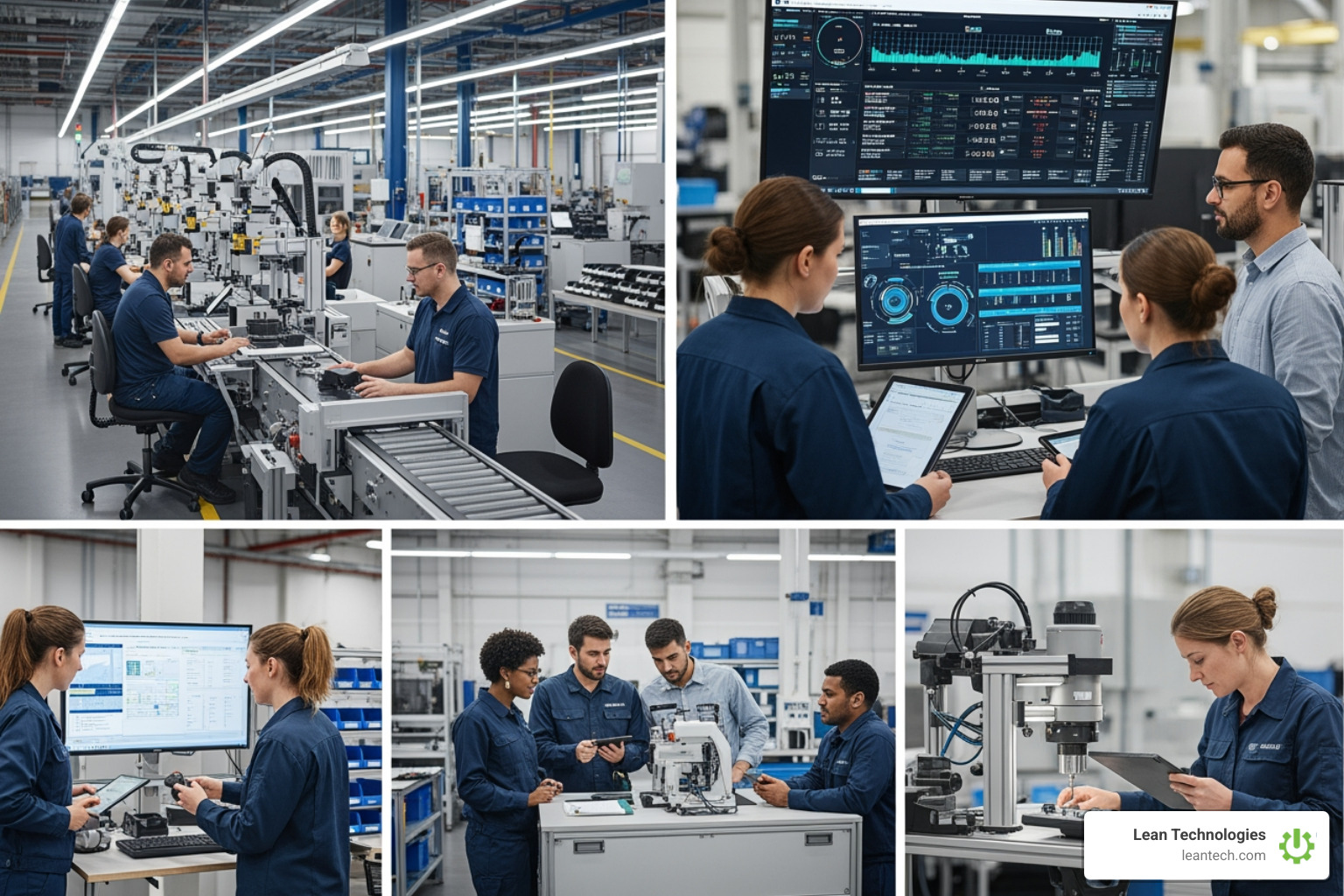
Operational Excellence is the New Black for Modern Factories
Why Operational Excellence Manufacturing Matters More Than Ever
Operational excellence manufacturing is the systematic approach that aligns people, processes, and technology to deliver consistent value with minimal waste, maximum efficiency, and zero compromises on quality or safety.
Here's what it actually means for your shop floor:
Continuous improvement mindset — not a one-time project, but a daily habit across all levels
Waste elimination — targeting downtime, defects, waiting, overproduction, and inefficient motion
Employee ownership — operators and supervisors driving problem-solving, not just following orders
Real-time visibility — knowing what's happening now, not last week's data entered from paper logs
Customer-focused outcomes — delivering on time, on spec, every time
Any business that survived the last few years of disruption—supply chain chaos, labor shortages, inflation—has earned its stripes. But survival isn't the same as thriving.
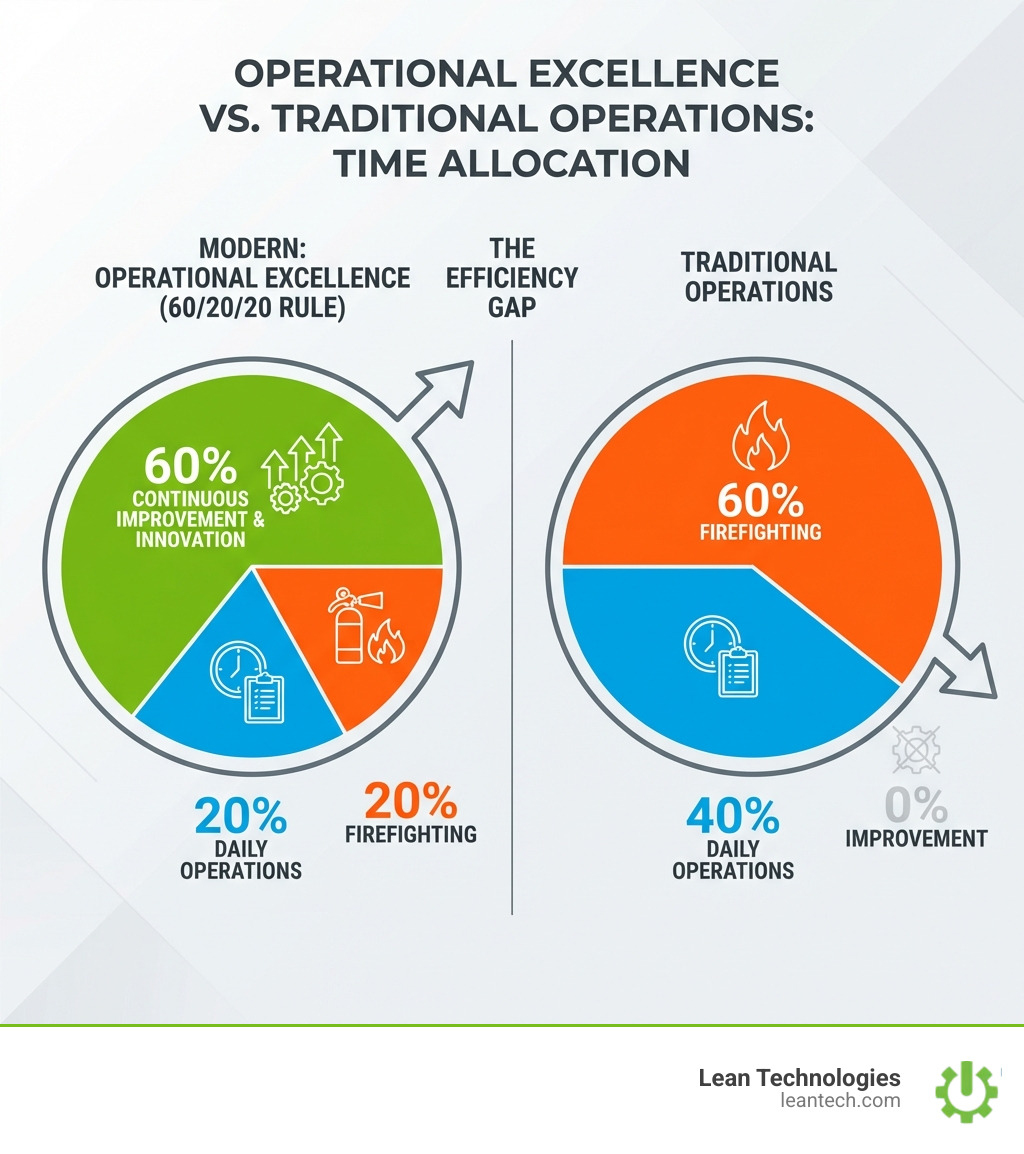
The best manufacturing organizations spend 60% of their time on continuous improvement and innovation, 20% on daily operations, and just 20% on firefighting. Most plants? They flip that ratio. They spend 60% firefighting, 40% keeping the lights on, and zero percent getting ahead.
That gap isn't just frustrating. It's expensive. One hour of unplanned downtime costs the average manufacturer $25,000. For larger operations, that number hits $500,000 per hour. When your team is stuck chasing problems instead of preventing them, you're bleeding profit every shift.
Here's the thing: operational excellence isn't about installing robots or buying fancy software. It's about building a system where problems get solved at the source, data flows in real time, and your team has the tools and trust to make things better every day.
You don't need to replace your ERP or MES. You need a flexible digital toolbox that helps your team log issues, track actions, and close the loop—right where the work happens.
That's what separates plants that firefight from plants that improve.
What Operational Excellence Manufacturing Means Today
In the past, "excellence" was often a corporate buzzword that lived in a binder on the Plant Manager’s shelf. Today, it’s about value flow. It’s the ability for every employee to see the flow of value to the customer and fix that flow when it breaks.
True operational excellence manufacturing is built on a team mindset. It’s not just about the "what" (the machines) but the "how" (the people and processes). To get this right, many leaders look to the Shingo Model, which emphasizes that sustainable results come from deeply embedded behaviors, not just tools.
Core Approaches for Operational Excellence Manufacturing
Achieving world-class status requires a mix of proven methodologies. You’ve likely heard of these, but the secret is in how they work together:
Lean Thinking: The relentless pursuit of eliminating the eight types of waste (defects, overproduction, waiting, talent under-utilization, transport, inventory, motion, and over-processing).
Kaizen: The philosophy of "continuous improvement." It’s the small, daily changes that lead to massive cumulative gains.
Scientific Problem-Solving: Using data and the Plan-Do-Check-Act (PDCA) cycle to move past "gut feelings" and find root causes.
Total Quality Management (TQM): A management approach centered on quality, based on the participation of all members and aiming at long-term success through customer satisfaction.
The modern challenge is moving these concepts off paper and into a digital lean environment where they actually drive shift-by-shift behavior.
2025 Trends Shaping the Shop Floor
As we move toward 2025, the bar for excellence is rising. Here is what is driving the most successful plants:
Smart Automation: It’s not just about replacing hands with robots; it’s about "cobots" working alongside teams to handle repetitive, high-strain tasks.
AI-Powered Insights: Moving from "what happened?" to "what will happen?" AI helps identify patterns in downtime or quality defects before they derail a shift.
Industrial IoT (IIoT): When sensors are integrated with digital tools, teams get real-time alerts. However, data is useless if it doesn't trigger an action in a system like Thrive.
Sustainability: Reducing energy and water usage isn't just for PR; it’s a core efficiency metric. Research shows mining companies using these practices reduced water usage by 7% while raising production by 10%.
Upskilling the Workforce: With the skills gap widening, the most excellent companies are the ones that make it easy for new hires to learn via digital SOPs and mobile-first training.
The Pillars of a High-Performance Shop Floor
You can't build a house on sand. In manufacturing, the "foundation" is your equipment and how you treat it.
Total Productive Maintenance (TPM) is the gold standard here. It moves maintenance from a "fix it when it breaks" department to a "zero breakdowns, zero defects, zero accidents" culture. This starts with 5S (Sort, Set in Order, Shine, Standardize, Sustain). If your shop floor is a mess, your data will be too.
Autonomous Maintenance
The biggest leap in TPM is Autonomous Maintenance. This is where operators—the people who spend 8 hours a day with the machine—take ownership of basic cleaning, lubrication, and inspection.
When operators log these checks in real-time, they catch "micro-stoppages" before they become catastrophic failures. According to industry reports, a single hour of unplanned downtime can cost $25,000. By using maintenance management with Thrive, teams can digitize these checks, ensuring they actually happen and alerting maintenance technicians the moment a "shine" check reveals a worn bearing.
Driving Quality with First Time Right (FTR)
Quality isn't something you check at the end of the line; it’s something you build into the process. The metric to watch is First Time Right (FTR).
If your FTR is 70%, that means 30% of your effort is wasted on rework or scrap. To improve this, you need robust Standard Operating Procedures (SOPs). Following the ISO 9000 quality principles helps, but those SOPs need to be accessible. Paper manuals in a drawer don't stop defects. Digital SOPs with photos and videos—accessible via tablet at the workstation—ensure the process is followed correctly every single time.
Manufacturers using quality control with Thrive see fewer errors because the "right way" is the only way presented to the operator.
Safety: The Foundation of Trust
You cannot have operational excellence without safety. It is the "trust component" of any manufacturing system. When a company is named among the nation’s safest, it’s usually because they’ve made safety a foundation for productivity, not a hurdle to it.
Excellent plants use safety modules in Thrive to:
Track incidents and "near misses" in real time.
Conduct digital hazard assessments.
Ensure compliance audits aren't a scramble for paperwork at the end of the year.
Breaking the "Data-Rich, Insight-Poor" Cycle
Most modern factories are drowning in data but starving for insights. You have ERP reports, machine logs, and stacks of paper checklists. But if you can't tell why Line 4 was down for 20 minutes this morning, the data is dead.
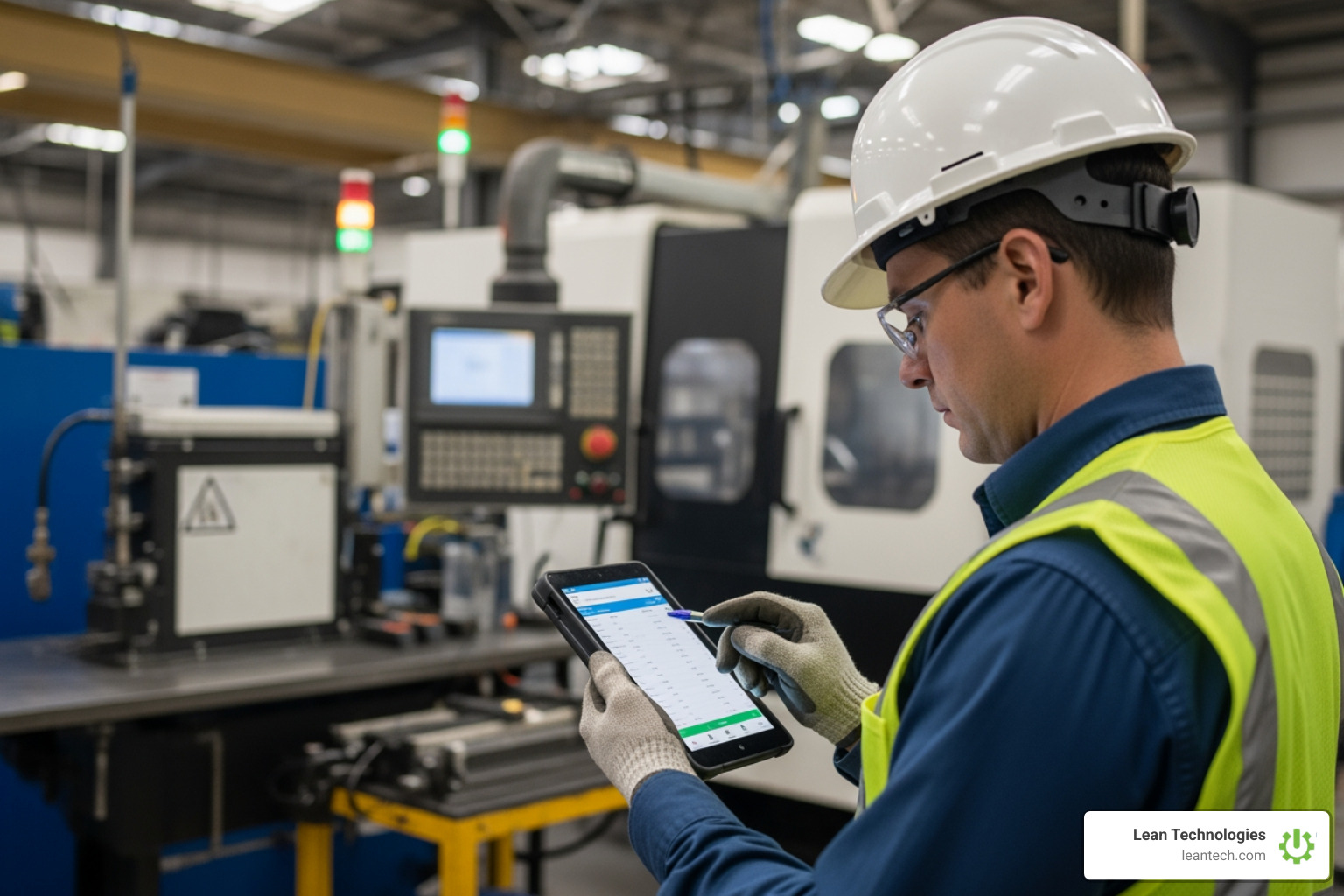
The "Connected Worker" is the solution. By giving operators mobile tools to log data at the source, you create a digital audit trail. This allows managers to identify bottlenecks instantly rather than waiting for an end-of-week spreadsheet.
Feature Paper-Based Logs Real-Time Digital (Thrive) Data Accuracy High risk of "pencil whipping" Time-stamped and verified Visibility 24-48 hours late Instant Accountability Hard to track who did what Clear ownership and logs Action Reactive (firefighting) Proactive (problem-solving)
Scaling Operational Excellence Manufacturing with Digital Tools
To scale excellence, you need workflow automation. This doesn't mean "robots"; it means ensuring that when a problem is logged, the right person is notified, an action is assigned, and the loop is closed.
Many initiatives stall because there is no accountability. A "suggestion box" is where good ideas go to die. Digital continuous improvement tools in Thrive allow operators to submit ideas, track their progress, and see the impact. This "closes the loop" and keeps the momentum going.
Leadership’s Role in Sustaining Change
Technology is only as effective as the people using it. Leadership must "lead with humility" and "respect each individual"—core Shingo principles.
True innovation often comes from the bottom up. The operator who has been running the same injection molder for 15 years knows more about its quirks than the engineer in the front office. Operational excellence gives that operator a voice. By using HR and workforce tracking in Thrive, leaders can monitor engagement, track training progress, and ensure that the workforce is empowered, not just managed.
Frequently Asked Questions about Operational Excellence
What’s the first step to achieving operational excellence in manufacturing?
The first step is a "dispassionate assessment" of where you stand. You need to go to the shop floor (Genchi Genbutsu) and see the reality of your processes. Don't rely on office reports. Identify your biggest bottleneck or your most frequent "fire" and start there with a pilot program.
How does workflow software like Thrive differ from a traditional MES?
A traditional Manufacturing Execution System (MES) is often rigid, expensive, and focused on machine data and scheduling. Thrive is a flexible digital toolbox designed for the people on the shop floor. It doesn't replace your MES; it fills the gaps where the MES is too complex or where processes are still handled on paper, like safety checks, CI logs, and maintenance work orders.
Why do most operational excellence initiatives stall after three years?
Most fail because they focus on "tools" (like just doing 5S) rather than "culture." If the leadership doesn't sustain the behaviors and the team doesn't see the value of the data they are entering, they revert to old habits. Digital tools help sustain this by making the process part of the daily workflow, not an "extra" task.
In Summary: The Path to Real-Time Results
Operational excellence isn't a destination; it's a journey. But you can't finish the journey if you're constantly stopping to put out fires.
The transition from a "firefighting" culture to an "improvement" culture requires three things:
A clear strategy that everyone understands.
Empowered people who take ownership of their machines.
A digital toolbox that provides real-time visibility.
Stop managing your shop floor through spreadsheets and wishful thinking. By centralizing your data and automating your workflows, you can turn your factory into a high-performance engine of growth.
Ready to see how real-time visibility can transform your shop floor? Explore the Thrive platform today and let your team run lean—with fewer workarounds and more results.