
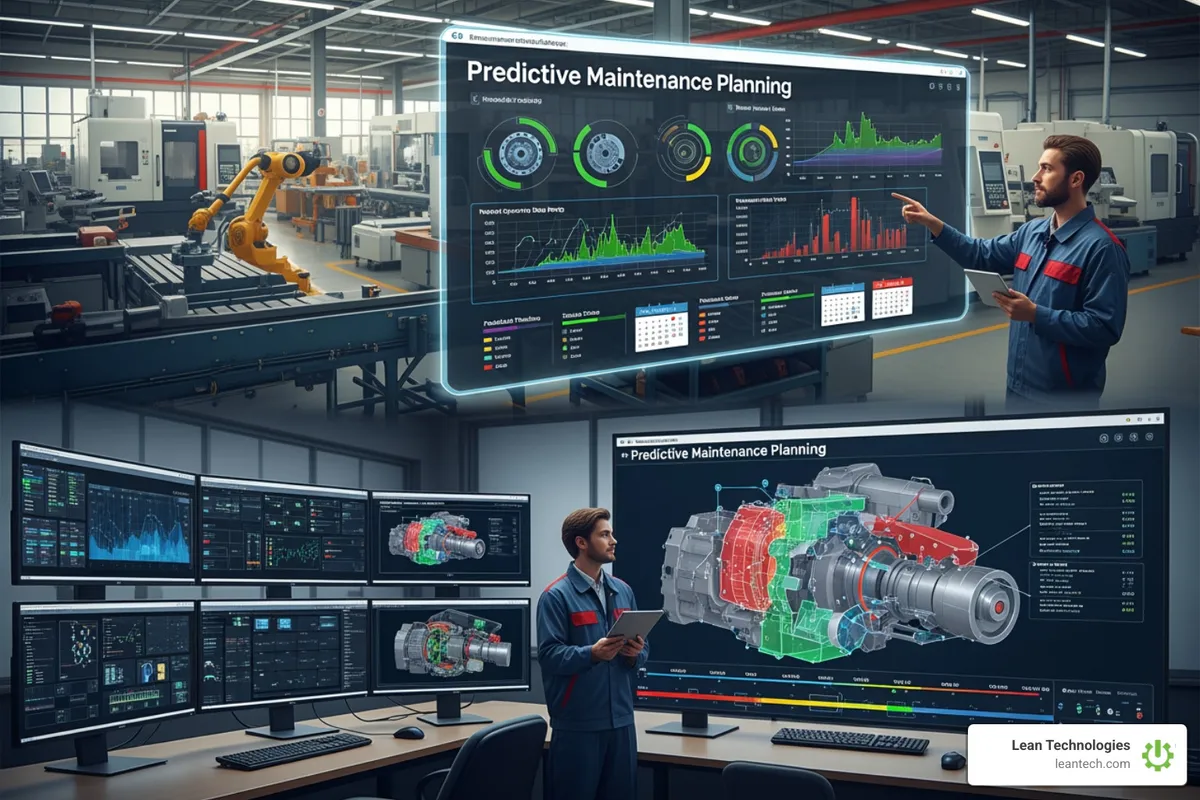
The Ultimate Guide to Predictive Maintenance Planning
Start with the Pain: Why Maintenance Still Breaks the Flow
Unplanned downtime hits manufacturers hard. It drains profits and kills productivity. But effective predictive maintenance planning can change the game. It moves you from reacting to problems to predicting and preventing them.
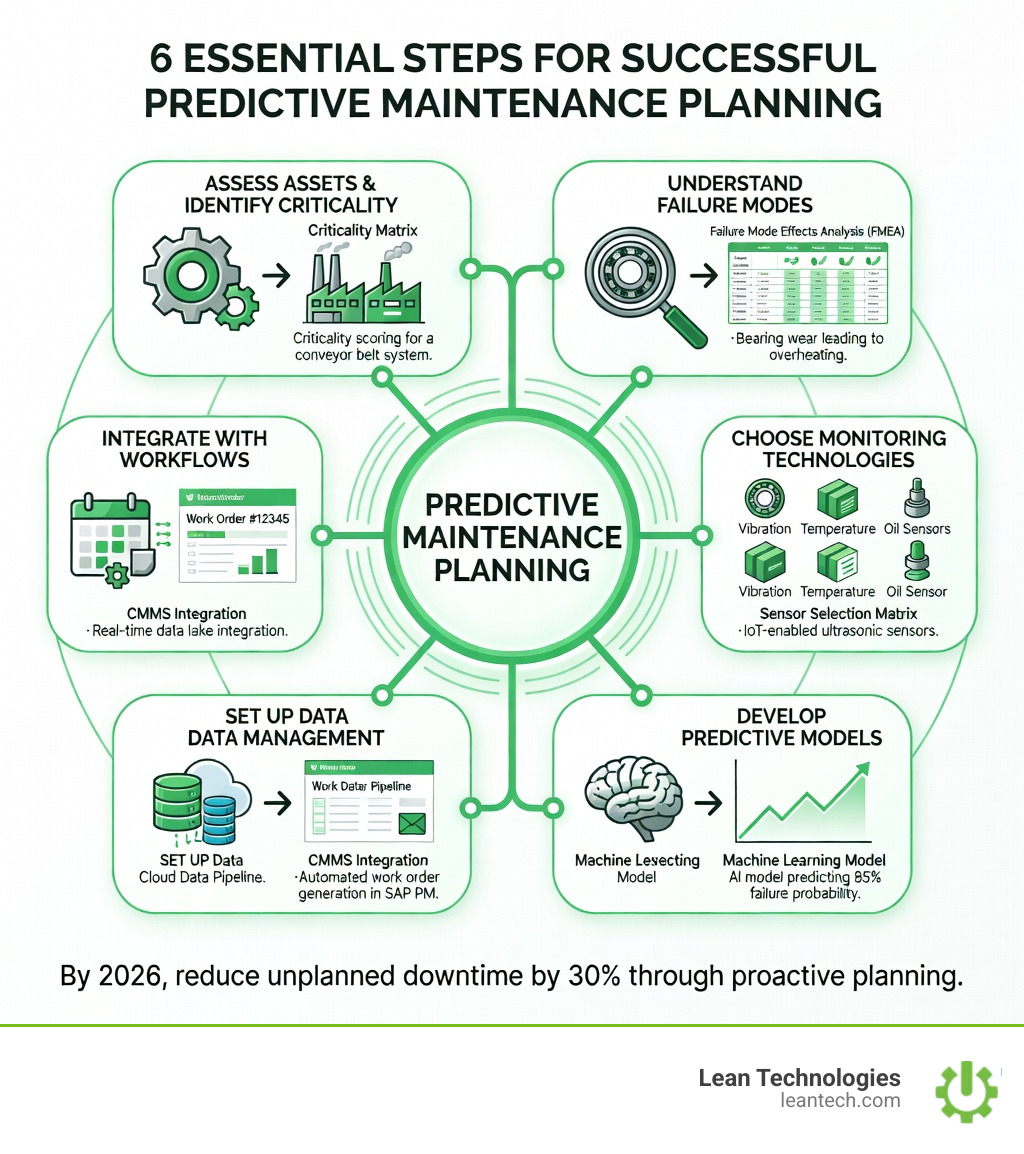
Here are the essential steps for successful predictive maintenance planning:
Assess Assets & Identify Criticality: Pinpoint which equipment matters most and where failures hurt the most.
Understand Failure Modes: Determine how and why your critical assets might fail.
Choose Monitoring Technologies: Select the right sensors and tools to watch asset health.
Set Up Data Management: Plan how you'll collect, store, and analyze real-time data.
Develop Predictive Models: Build systems that use data to forecast potential issues.
Integrate with Workflows: Link predictions to your maintenance scheduling and work order systems.
Operations managers know the drill. A machine goes down unexpectedly, and suddenly everyone is scrambling. Parts are rushed, production halts, and you're stuck in a reactive loop. This "run-to-fail" strategy is expensive and inefficient. It leads to average direct costs of $55,100 per asset group and $308,300 per factory annually. Predictive Maintenance enables teams to anticipate potential failures and optimize maintenance operations and timing.
Traditional preventive maintenance helps, but it often means fixing things on a schedule, whether they need it or not. This can consume over 50% of maintenance hours with little real reliability gain. Predictive maintenance planning offers a smarter way. It uses real-time data to tell you exactly when maintenance is needed, avoiding unnecessary work and preventing costly surprises.
Why Predictive Maintenance Planning Crushes the “Run-to-Fail” Trap

Most shops operate in a state of "reactive firefighting." When a motor burns out or a bearing seizes, the flow of the entire plant stops. This is the "run-to-fail" trap. You might think you're saving money by not performing maintenance until it's needed, but the secondary costs—lost labor, missed shipping dates, and emergency part premiums—are massive.
Predictive maintenance planning (PdM) moves the needle from "when did it break?" to "when will it break?" Unlike preventive maintenance, which relies on calendar dates or cycle counts (like changing your car oil every 5,000 miles regardless of how you drive), PdM looks at the actual health of the machine.
The Evolution of Strategy
The progression of maintenance looks like this:
Reactive (Fix-on-Fail): No planning. High stress. High cost.
Preventive (Scheduled): Better, but often wasteful. You might replace a perfectly good part just because the calendar says so.
Condition-Based (CBM): You intervene when a sensor hits a specific threshold (e.g., "The temp hit 100 degrees, stop the machine").
Predictive (PdM): Using data trends and AI to see the failure coming weeks or months away.
The results speak for themselves. Well-executed PdM programs deliver 8 to 12% overall cost savings and cut facility downtime by 5 to 15%. Even more impressive, research shows these methods can anticipate and prevent up to 75% of potential failures.
By monitoring equipment in real-time, you aren't just guessing. You are building a "live ecosystem" of your shop floor. This extends asset lifespan by 20% to 40% because you’re addressing small issues (like a lack of lubrication) before they turn into catastrophic failures (like a shattered gearbox).
8 Steps to Build a Predictive Maintenance Plan That Actually Works
Building a predictive maintenance planning strategy isn't about buying a bunch of sensors and hoping for the best. It requires a structured approach to ensure you're getting a return on your investment.
1. Build the Business Case
Don't start with the tech; start with the money. Identify where downtime costs you the most. If a specific CNC machine goes down and costs you $5,000 an hour in lost revenue, that’s your starting point. Use statistics like the average direct costs of $55,100 per asset group to justify the budget for sensors and software.
2. Prioritize Your Assets
You can't monitor everything at once. Use a criticality assessment to rank your machines based on their impact on production.
3. Conduct FMEA (Failure Mode and Effects Analysis)
For your top assets, ask: How does this fail?
Is it a bearing failure?
Is it an electrical surge?
Is it a seal leak? Knowing the failure mode tells you what kind of sensor you need. If a bearing failure is the main risk, you need vibration analysis, not just a temperature probe.
4. Select the Right Tools
Select hardware based on your FMEA. This might include IoT sensors for vibration, infrared cameras for heat, or ultrasonic tools for leaks.
5. Establish Digital Workflows
Data is useless if it sits in a silo. You need a way to turn a sensor alert into an action. This is where a platform like Thrive comes in. While we don't collect the sensor data directly, we provide the digital workspace where your team logs the issues, tracks the repairs, and ensures the "predictive" part of the plan actually results in a "maintenance" action.
6. Launch a Pilot Program
Pick one line or one specific type of failure. Test your sensors and your team's response time. Does the alert go to the right person? Does the technician have the parts ready?
7. Data Validation and Integration
Address the Challenges in predictive maintenance – A review by ensuring your data is clean. If sensors are miscalibrated, you'll get false positives, and your team will stop trusting the system.
8. Continuous Improvement
Review your KPIs. Are you seeing an increase in Mean Time Between Failure (MTBF)? If not, adjust your thresholds or your monitoring techniques.
How to Prioritize Assets for Predictive Maintenance
Not all machines are created equal. To prioritize for predictive maintenance planning, use these four criteria:
Criticality: Does this machine's failure stop the entire line?
Failure Frequency: Is this a "bad actor" that breaks down often?
Repair Cost: Are the parts expensive or hard to source?
Safety/Environment: Could a failure cause an injury or a leak? PdM helps protect workers and the environment by averting fires and mechanical breakdowns.
Scaling Predictive Maintenance on Your Shop Floor
Once the pilot is successful, it’s time to scale. This is where most companies fail because they don't have "team buy-in." If operators feel like the sensors are there to "spy" on them, they won't use the system. Show them how PdM makes their jobs easier—fewer emergency Saturday shifts and less time spent wrestling with broken, greasy hardware.
Core Tools and Techniques for Predictive Maintenance Planning
To make predictive maintenance planning stick, you need the right "eyes and ears" on the floor. Here are the heavy hitters in condition monitoring:
Vibration Analysis
This is the gold standard for rotating equipment (motors, pumps, fans). Every machine has a "signature" vibration. When a bearing starts to pit or a shaft becomes misaligned, that signature changes. Vibration analysis helps identify these shifts long before the human ear can hear a problem.
Infrared Thermography
Heat is a byproduct of friction or electrical resistance. Using infrared cameras, you can spot "hot spots" in electrical panels or overheating gearboxes. It’s non-intrusive and can be done while the machine is running at full capacity.
Oil Analysis
Think of this as a "blood test" for your machinery. By analyzing the particles in your lubrication oil, you can tell if gears are grinding (metal shavings) or if seals are failing (water or chemical contamination). Oil analysis programs are highly effective for gearboxes and hydraulics.
Ultrasonic Testing
This is great for finding leaks in compressed air systems or detecting "arcing" in electrical components. These sounds are at a frequency humans can't hear, but sensors pick them up easily.
The Role of the Operator (Digital Rounds)
Technology is great, but don't ignore the person standing next to the machine for 8 hours a day. Digital lean workflows allow operators to log "soft" signals—like a new smell or a weird rattle—directly into a tablet. When this human insight is combined with sensor data, your predictive maintenance planning becomes bulletproof.
Overcoming the Real-World Hurdles of PdM
If PdM was easy, everyone would do it. The reality is that Challenges in predictive maintenance – A review often stop programs in their tracks. Here is how to jump those hurdles:
Data Silos: Your maintenance software doesn't talk to your production logs. You need a cohesive, integrated platform to bridge the gap.
Skill Gaps: Your team might be great at fixing things but not at analyzing vibration spectra. You don't need to turn every mechanic into a data scientist; you just need systems that provide clear, actionable alerts.
The "Trust" Factor: If a model predicts a failure and the tech opens the machine only to find nothing wrong, they’ll lose faith. This is why "Explainable AI" is becoming important—showing the why behind the alert.
Incomplete Logs: If data isn't entered at the source, it's "real-late" visibility. Moving away from paper-based workarounds to real-time digital entry is the only way to ensure data quality.
The Future of Maintenance: Digital Lean, AI, and Real-Time Visibility
We are entering the era of "Industry 4.0," where maintenance is a competitive advantage. The future of predictive maintenance planning involves:
Machine Learning (ML): Algorithms that get smarter over time. The more data you feed them, the better they get at distinguishing between "normal" wear and a "critical" fault. Machine learning for predictive maintenance is a game-changer for complex systems.
Remaining Useful Life (RUL): Instead of just saying a part is "bad," the system tells you, "You have 42 hours of run-time left before this fails." This allows you to finish the current production run and schedule the fix for the weekend.
Digital Lean Workflows: This is where Lean Technologies shines. By digitizing the work processes, you ensure that when an AI predicts a failure, the corrective action is tracked, the parts are ordered, and the loop is closed.
Frequently Asked Questions about Predictive Maintenance Planning
How is predictive maintenance planning different from preventive maintenance?
Preventive maintenance is time-based (e.g., every 3 months). Predictive maintenance planning is condition-based and data-driven. It uses real-time sensors to determine the actual health of the machine, so you only perform maintenance when it's truly necessary.
What ROI can you expect from a predictive maintenance plan?
Organizations typically see a 25% reduction in maintenance costs, a 70% reduction in breakdowns, and a 20-40% extension in asset life. Well-executed programs deliver an 8-12% overall cost saving.
Which assets should you start monitoring first?
Start with your "critical" assets—the ones that have high repair costs, are essential for production flow, or pose safety risks if they fail. Look for machines where downtime costs exceed $10,000 per hour.
What to Do Next
Predictive maintenance planning is the fastest path to a more profitable shop floor. But sensors alone won't save you. You need a way to organize your team and drive action from the data.
Stop managing your shop floor through spreadsheets and wishful thinking. If your downtime logs are incomplete or your maintenance team is stuck in a reactive loop, it’s time for a change. Thrive helps you digitize your lean processes, giving you the real-time visibility you need to close the loop on maintenance alerts.
Stop managing your shop floor through spreadsheets and start your journey with Thrive. Let your team run lean—with real-time visibility and fewer workarounds.