

Scheduling Smarter, Not Harder: Optimizing Your Production Flow
Why Production Scheduling Feels Like a Never-Ending Fire Drill
Production scheduling optimization is the difference between a plant that runs smooth and one that's constantly putting out fires. It's how you turn chaos into control—matching resources, sequencing work, and hitting delivery dates without burning out your team or blowing your budget.
Here's what optimized production scheduling delivers:
Better OTIF (On-Time-In-Full) — Hit delivery dates consistently, build customer trust
Higher throughput — More output from the same assets, less overtime waste
Lower costs — Cut inventory, reduce waste, maximize machine and labor utilization
Real-time visibility — See problems before they derail your day
Faster response to change — Adapt to demand shifts, material shortages, and breakdowns in minutes, not hours
Smarter resource allocation — Balance machines, materials, and people to eliminate bottlenecks
Spreadsheets everywhere. Constant disruptions. Missed deadlines. Teams stuck in reactive mode.
The real problem? Manual production scheduling can't keep up with today's pace. When your schedule lives in Excel, on whiteboards, or inside one planner's head, you're flying blind. You don't know what's really happening on the floor until it's too late—end of shift, end of day, or worse, when a customer calls asking where their order is.
Production scheduling is the bridge between what you promised and what you actually build. It's the minute-by-minute, machine-by-machine plan that turns sales orders into finished goods. When it's optimized, your plant hums. When it's not, you're firefighting—chasing parts, juggling priorities, and hoping nothing else breaks.
Production scheduling optimization is the lever for smoother flow, less chaos, and more profit. It's about working smarter, not just grinding harder. Digital tools, real-time data, and structured processes replace guesswork with clarity. Your team stops reacting and starts executing.
What Is Production Scheduling? (And Why Spreadsheets Are Failing You)
Production scheduling is the tactical process of allocating resources, sequencing tasks, and setting precise timelines to ensure products are manufactured efficiently and delivered on time. It’s about determining the sequence and timing of production tasks to best use available resources while ensuring timely delivery. This critical process coordinates lead times, material availability, capacity, resource allocation, and labor. An ice cream manufacturer, for example, might have a production plan for 10,000 units of vanilla ice cream for the week. The production schedule then details the exact time and work center for each step—mixing, homogenization, freezing—to maximize equipment utilization.
Manual scheduling methods, often relying on tools like MS Excel after exporting data from ERP systems, break down quickly in dynamic manufacturing environments. Why? Because the plan always changes. A sudden rush order, a machine breakdown, or a material shortage can render a carefully crafted spreadsheet obsolete in moments. These static tools lack the ability to adapt in real-time, leading to constant rework, missed deadlines, and a reactive operational mode. When your schedule isn't a living document, it's already too late.
Production Scheduling vs. Production Planning: Big Picture vs. Minute-by-Minute
While often used interchangeably, production planning and production scheduling serve distinct, yet interconnected, purposes in manufacturing. Think of it this way:
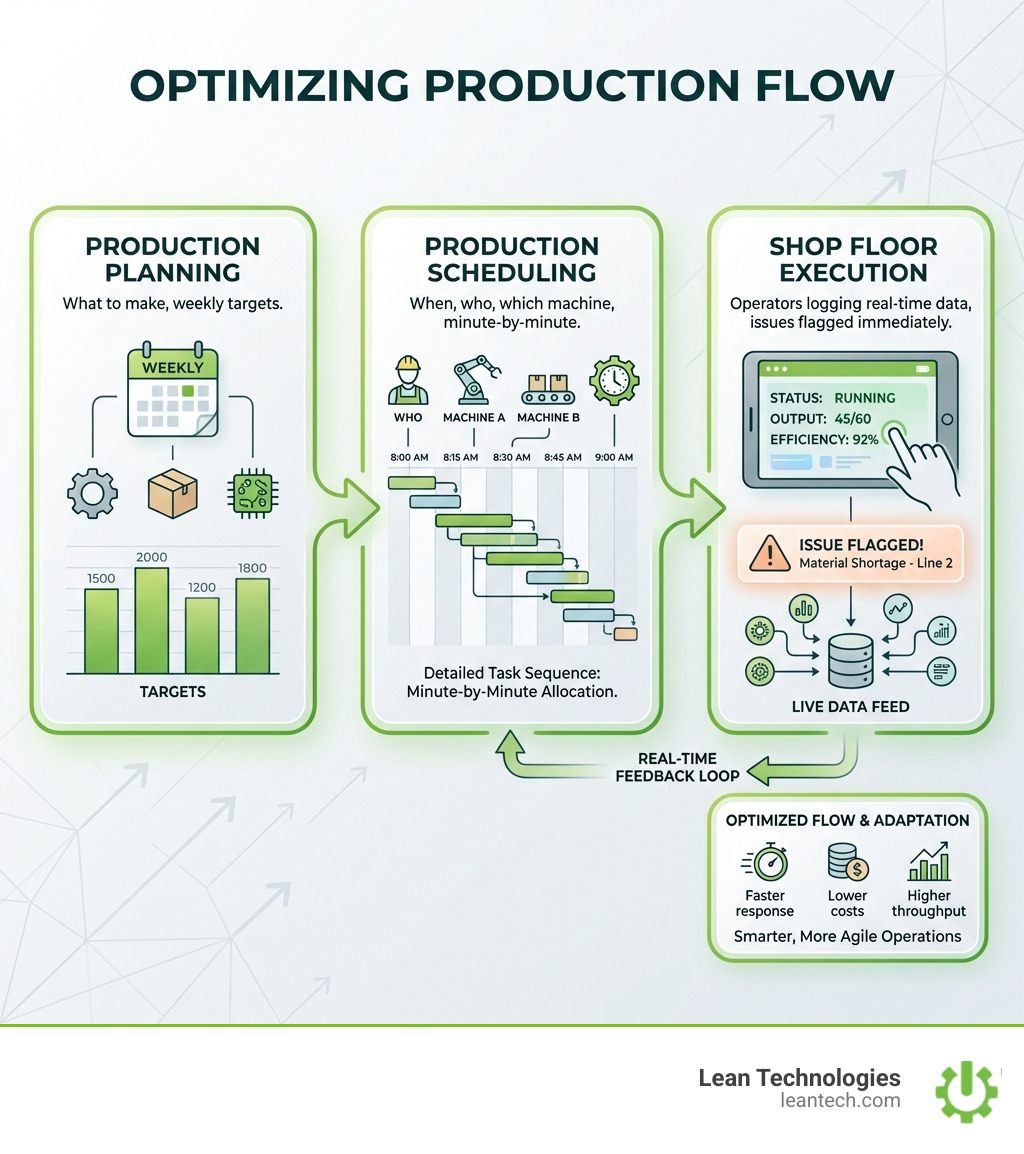
Production Planning: This is the strategic, higher-level view. It answers the "what, where, and how much" to produce, based on demand forecasts and long-term orders. It sets overall targets in daily or weekly buckets, focusing on the overarching direction and adjusting target stock levels.
Production Scheduling: This is the tactical, granular execution. It answers the "when, who, and which machine" for each production activity. It breaks down the plan into minute-by-minute details, allocating and sequencing activities to determine precisely when and where each step must be executed. It's about managing detailed production demands and making immediate, short-term, and medium-term decisions.
Planning = the map. Scheduling = the turn-by-turn directions. You need both to get where you're going efficiently.
Characteristic Production Planning Production Scheduling Horizon Long-term (weeks, months) Short-term (hours, days) Detail Level Aggregate, high-level Granular, minute-by-minute Goal Set targets, manage overall capacity Execute targets, optimize resource use Decision Type Strategic, tactical Operational, real-time
Real-World Scheduling Headaches
If you’re on the shop floor, you know the pain points all too well. Production scheduling is inherently complex, and manufacturers face a gauntlet of challenges that can derail even the best-laid plans.
Managing Constraints: Every plant has limits. Machine capacities, labor availability, material shortages, specific sequencing rules (like managing allergens in food production), and even tool availability all act as constraints. Balancing these effectively in a complex environment is a constant struggle. For instance, in an automotive manufacturing plant, machine shutdowns for maintenance or unexpected tool failures necessitate dynamic adjustments to the schedule.
Fluctuating Environments: Demand swings, supply chain hiccups, and unexpected events are the norm, not the exception. Industry 4.0 environments, while offering benefits, also introduce uncertainties like fluctuating due dates, order cancellations, and machine breakdowns. A static schedule can't respond to these rapid changes, leaving teams scrambling.
Poor Data Integration: Data often lives in silos—spread across disconnected systems, spreadsheets, or even paper logs. This fragmentation means planners lack a single, unified view of operations. Without real-time, integrated data on manufacturing processes, demand forecasts, sales orders, and inventory, effective decision-making is severely hampered.
Siloed Planning: Different departments—sales, operations, maintenance, quality—often work with their own plans and priorities. This lack of collaboration leads to miscommunication, conflicting objectives, and inefficient resource utilization. Legacy knowledge, often held by experienced planners, is difficult to systematize without automated solutions, further exacerbating the problem when that knowledge isn't shared or captured.
Machine Breakdowns: Equipment failures are a fact of life. When a critical machine goes down, it can ripple through the entire production line, causing delays, reworks, and frustrated customers. Without a system to quickly adjust and re-optimize, these incidents turn into costly disruptions. A 2024 Siemens survey showed that every hour of downtime in the Fast Moving Consumer Goods industry costs $36,000; every hour of downtime in the Automotive industry costs $2.3 million.
The Eight Wastes of Lean Manufacturing: These challenges often manifest as the "eight types of waste" (DOWNTIME): Defects, Overproduction, Waiting, Non-used talent, Transportation, Inventory, Motion, and Excess processing. Optimized scheduling directly targets and reduces these wastes.
The Payoff: Why Optimize Production Scheduling?
Optimizing your production schedule isn't just about making things run a bit smoother. It's about changing your entire operation, moving from a reactive, crisis-driven environment to a proactive, predictable, and profitable one. The benefits are tangible and directly impact your bottom line.
More throughput, less overtime: By efficiently sequencing tasks and allocating resources, you maximize the output from existing machinery and labor. This means you can produce more within standard working hours, reducing the need for costly overtime.
Lower costs, less waste: Optimized scheduling minimizes the total cost for production and maximizes production efficiency, directly reducing inventory costs. It helps prevent overproduction, minimizes idle time, and reduces scrap and rework. Finsbury Food Group, for instance, reduced net working capital by £1.6 million and improved service levels in Food Services by 5% year-on-year through optimized scheduling.
Better OTIF (On-Time-In-Full): When you can accurately predict and meet delivery dates, your customer satisfaction soars. Optimized scheduling ensures you have the right products, in the right quantity, at the right time.
Real-time visibility for everyone: Automated planning solutions provide a single, shared view of the production schedule. This transparency allows everyone, from the shop floor to management, to see what's happening, understand priorities, and make informed decisions.
Faster pivots when things change: Automated planning solutions drastically shorten the time required to generate schedules, allowing teams to initiate smart, rapid responses to changes in supply, demand, and capacity. When a disruption hits, you can quickly assess impacts and generate new, feasible schedules.
Higher capacity utilization: The model allows for cost savings and raises the overall efficiency of the production process by optimizing machine usage and product allocation. You ensure machines are running optimally, not sitting idle or being underused. The average capacity utilization in the US in 2023 was 79.31%. The Corporate Finance Institute suggests that a rate of 85% capacity utilization is optimal, as this provides optimal efficiency while maintaining flexibility for maintenance and unexpected demand fluctuations.
Less inventory sitting around: By aligning production closely with demand, you reduce the need for large buffer inventories, freeing up capital and warehouse space.
DOWNTIME slashed (Defects, Overproduction, Waiting, etc.): Optimized scheduling inherently targets the eight wastes of Lean manufacturing, systematically reducing them across your operations.

From Firefighting to Proactive Planning
Imagine knowing about a potential bottleneck before it grinds your line to a halt, or being able to test how a sudden rush order impacts your entire schedule without disrupting current operations. That's the power of moving from firefighting to proactive planning.
An optimized system empowers you to:
See issues before they become problems: With real-time visibility, you can identify potential delays or resource conflicts days or even weeks in advance, giving you time to adjust.
Cross-team collaboration (no more “I didn’t know”): When everyone works from the same live schedule, communication improves dramatically. Sales, production, and maintenance teams are all on the same page, reducing friction and improving response times.
Data-driven decisions, not gut feel: Automated systems provide the data and analytics needed to make informed choices. You stop relying on tribal knowledge or one person's experience and start making decisions based on facts.
Move from reactive to proactive: Instead of reacting to problems, you anticipate them. You can use scenario planning to simulate outcomes of changes, like increasing shifts to meet targets, before implementation. This allows you to manage disruptions with confidence, turning potential chaos into controlled adjustments.
To truly transform your operations, embracing a digital approach to manufacturing is key. Learn more about how to adopt a Digital Lean approach in your factory.
Boosting the Bottom Line and Customer Satisfaction
Production scheduling optimization directly impacts your company’s financial health and its standing with customers.
Maximize throughput, minimize overtime: By streamlining operations, you increase the amount of product you can push through your lines, often without additional capital investment. This reduces reliance on expensive overtime labor.
Hit delivery dates, improve service levels: Consistent on-time delivery builds trust and strengthens customer relationships. Improved OTIF rates lead to happier customers and repeat business.
Build a reputation for reliability: In a competitive market, being a reliable supplier is a massive advantage. Optimized scheduling helps you consistently meet promises, enhancing your brand's reputation.
Strengthen supplier relationships: Better planning and more accurate forecasts, derived from optimized schedules, allow you to communicate more effectively with your suppliers. This leads to stronger partnerships and potentially better terms.
The Modern Toolkit for Production Scheduling Optimization
The days of managing complex production schedules with spreadsheets and whiteboards are over. They simply can't handle the thousands of input variables and parameters that today's manufacturing demands. The modern toolkit for production scheduling optimization is digital, dynamic, and integrated.
Digital beats manual. Centralized platforms are replacing fragmented Excel files and paper logs. You need a system that offers real-time data—not "end of shift" updates that are already too late. This means breaking down data silos so everyone’s working from the same playbook, ensuring that information from manufacturing processes, demand forecasts, sales orders, and inventory data is unified.
Must-Have Features in Production Scheduling Tools
An effective production scheduling software solution isn't just a calendar; it's a powerful operational hub. Here are the essential features:
Automatic production schedule generation: The ability to rapidly generate detailed schedules, balancing constraints like machine capacity, labor, and material availability. Automated solutions drastically shorten the time required, allowing for quick adaptation.
Automatic order sequencing: Smart sequencing can optimize changeovers, minimize cleaning times (e.g., managing allergen introductions in food production), and ensure critical orders are prioritized.
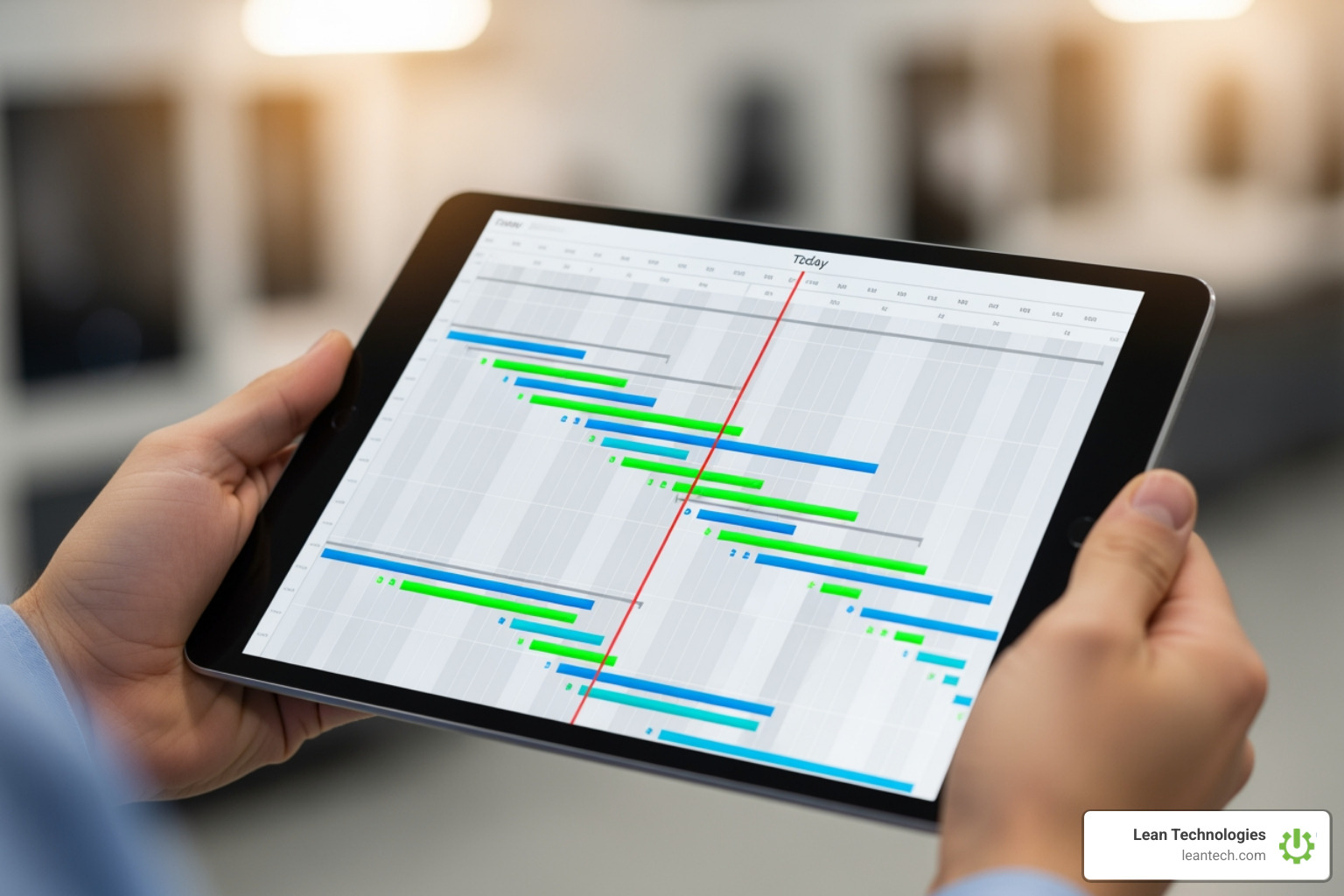
Automatic order visualization and synchronization: A visual representation, often a Gantt chart, that allows planners and operators to see the schedule, track progress, and understand dependencies in real-time. This promotes collaboration and ensures everyone is working from the same live data.
Automated scarcity prioritization: When resources are tight or demand outstrips capacity, the system should intelligently prioritize orders based on configurable rules to maximize profitability or meet critical deadlines.
Scenario planning (“what if”): The capability to model different scenarios (e.g., a machine breakdown, a surge in demand) and evaluate their impact on the schedule before committing to a plan. This allows for proactive decision-making and risk mitigation.
Seamless integration with production planning: The scheduling tool must seamlessly pull data from and push updates to higher-level production planning systems and ERPs, ensuring alignment and a continuous flow of information.
Modern platforms, like Thrive, are designed as flexible digital toolboxes that offer these capabilities, helping you streamline operations without replacing your core ERP or MES systems. If you're looking to improve your project management and scheduling capabilities, consider exploring dedicated project management tools that integrate with your operations.
Smarter Schedules with Digital Optimization
Leveraging mathematical optimization and AI is no longer a futuristic concept; it's a present-day reality for improving production scheduling. These advanced techniques allow for the processing of thousands of constraints and variables, delivering schedules that are not just feasible, but optimal.
Constraint-based scheduling: This approach focuses on defining all operational constraints—machine availability, material supply, labor skills, setup times, quality checks—and then finding the best possible schedule within those boundaries. Constraint programming, an approach similar to mathematical programming, can rapidly arrive at solutions given constraints and objective functions.
Scenario modeling for “what if” changes: Advanced algorithms can create a digital twin of your production operations by unifying disparate data sources. This digital twin allows you to run countless "what if" scenarios, testing the impact of different decisions on profitability, throughput, or delivery times without affecting your real-world operations.
Dynamic rescheduling when things go sideways: When unexpected events occur (a machine fault, a sudden order change), AI-powered systems can rapidly re-optimize the schedule, minimizing disruption and guiding operators on the fly. This adaptive capability is crucial in today's volatile manufacturing landscape.
Actionable analytics for better planning: Beyond just creating schedules, these tools provide insights into bottlenecks, resource utilization, and potential areas for improvement, empowering Continuous Improvement Managers to drive real change.
To dig deeper into how digital tools can optimize your Manufacturing Production Scheduling (MPS), check out our resources on optimizing MPS with digital tools.
Don’t Forget Preventive Maintenance
Preventive maintenance isn't a separate chore; it's an integral part of production scheduling optimization. Ignoring it leads to unplanned downtime, which is arguably the most disruptive and costly event in manufacturing.
Schedule maintenance like any other job: In advanced optimization models, preventive maintenance activities can be treated as "fictitious" or "dummy" products. They are assigned specific time windows and durations within the mathematical model, ensuring they are scheduled alongside production orders. This explicit integration addresses a significant gap in traditional scheduling approaches that often treat maintenance as an afterthought.
Treat maintenance as a planned event, not an afterthought: By proactively scheduling maintenance, you transform unexpected breakdowns into predictable, manageable events. This minimizes the impact on your production flow and avoids the chaos of emergency repairs.
Balance production needs with equipment health: Optimized scheduling considers both the need to meet production targets and the necessity of maintaining equipment health. This balance ensures long-term operational stability and extends asset lifespan. PMO (Planned Maintenance Optimization) programs can help organizations reduce maintenance costs by 25% compared to the 10–15% savings typically seen with standard preventive maintenance programs.
For a deeper dive into the integration of maintenance and scheduling, you can refer to academic research like the "Optimization model for production scheduling taking into account preventive maintenance in an uncertainty-based production system" here. To learn more about best practices for keeping your equipment running smoothly, visit our page on maintenance best practices.
Bringing It All Together: Integrated Planning for Real Results
True production scheduling optimization doesn't happen in a vacuum. It's about connecting the shop floor to the top floor, creating a cohesive, integrated system where information flows freely and decisions are aligned. This means breaking down the "black holes" of information and ensuring that every part of your supply chain is working from the same, real-time data.
Unifying manufacturing processes, demand forecasts, sales orders, and inventory data allows you to run complex scenarios for production operations, providing a holistic view that was once impossible.
Scheduling as Part of the Bigger Supply Chain Picture
Your production schedule is a critical link in the broader supply chain. Its effectiveness depends on how well it integrates with other planning processes:
Connect with ERP/MES (pull orders, push status): Modern production scheduling tools aren't meant to replace your ERP or MES. Instead, they improve them. They pull orders and material availability from your ERP and push back real-time production status, completion times, and resource utilization data to keep your enterprise systems updated. The model can present a production plan with optimal machine usage and product allocation, potentially saving time and streamlining the production scheduling process if incorporated into an ERP system.
Align with demand forecasts and S&OP: Your schedule needs to reflect current and future demand. Integration with demand forecasting and Sales & Operations Planning (S&OP) processes ensures that your production targets are realistic and aligned with market needs. This feedback loop is essential for agility.
Real-time feedback from the floor to the office: Operators logging data at the source—on tablets or mobile devices—provides immediate updates on task completion, issues, and deviations. This real-time visibility means management knows what's happening now, not at the end of the shift when it's too late.
Breaking Down Data and Department Silos
One of the biggest problems to effective scheduling is fragmented data and siloed departments. When sales, production, maintenance, and quality teams use different systems or rely on manual updates, miscommunication and inefficiencies are inevitable.
One platform, one version of the truth: A unified digital platform centralizes all relevant information. This means everyone is looking at the same data, working from the same schedule, and sharing a common understanding of operational status and priorities.
Standardized work processes: Implementing a digital toolbox like Thrive allows you to digitize and standardize work processes across departments. This ensures consistency, reduces variability, and provides a clear framework for how tasks should be performed and data should be captured.
Better communication, faster problem-solving: When data is integrated and visible, teams can collaborate more effectively. Issues are flagged immediately, allowing for faster diagnosis and resolution. This transparency fosters a culture of shared responsibility and continuous improvement.
For Quality Assurance Managers, having a single source of truth is crucial for maintaining product standards and managing compliance. Explore how Thrive can improve your quality management processes here.
Future-Proofing Your Scheduling
The manufacturing landscape is evolving rapidly. To stay competitive, your production scheduling must also evolve. Future trends point towards increasingly intelligent and autonomous systems:
Industry 4.0, IoT, digital twins: The integration of Industry 4.0 concepts like cyber-physical systems and the Industrial Internet of Things (IoT) provides the real-time data necessary for highly responsive scheduling. Digital twins—virtual replicas of your physical operations—allow for sophisticated simulation and optimization.
Prescriptive analytics, autonomous scheduling: Beyond predicting what will happen, prescriptive analytics suggests the best course of action. The ultimate goal is autonomous scheduling, where AI systems can dynamically adjust and optimize schedules with minimal human intervention, responding to changes instantly.
Continuous learning and adaptation: Future systems will continuously learn from operational data, refining their models and improving their scheduling recommendations over time.
As manufacturing becomes more connected and complex, ensuring workplace safety remains paramount. Find how digital tools can help manage safety and compliance effectively on our safety management page.
FAQs: Production Scheduling Optimization
What’s the first step to optimizing our production schedule?
The first step is to ditch paper and spreadsheets. You need to digitize your process to gain real-time visibility into your operations. Once data is captured at the source and structured, you can then begin to analyze, optimize, and improve your scheduling. Real-time beats real-late—if it’s captured on paper or in Excel and entered at the end of the shift or week, it’s already too late to react effectively.
How does optimized scheduling improve OTIF?
Optimized scheduling improves OTIF (On-Time-In-Full) by creating realistic and achievable production plans. It builds schedules that accurately reflect your real-world constraints—like available machines, materials, and people. By taking these factors into account, you set achievable targets, minimize unexpected delays, and ensure that products are completed and shipped exactly when promised, leading to more consistent delivery dates and higher customer satisfaction.
Can production scheduling tools work with my ERP?
Yes, absolutely. Modern production scheduling tools, especially flexible digital toolboxes like Thrive, are designed to integrate seamlessly with your existing ERP (Enterprise Resource Planning) and MES (Manufacturing Execution System) systems. They pull in necessary data like sales orders, inventory levels, and production capacities from your ERP, and then push back real-time updates on production status, material usage, and completion forecasts. This integration ensures that your scheduling is always based on the most current information and that everyone across the organization remains aligned.
What to Do Next
Manual scheduling is a losing game. It’s a constant battle against unexpected disruptions, data silos, and the limitations of outdated tools. Production scheduling optimization gives you the visibility, efficiency, and control to run a predictable, profitable operation. It transforms your shop floor from a place of constant firefighting to a well-oiled machine.
Thrive by Lean Technologies helps teams digitize and streamline work processes—creating a single source of truth from the shop floor to the top floor. We provide the flexible digital toolbox that empowers operators and supervisors to log issues, track actions, and drive continuous improvement, all in real-time. Stop managing your shop floor through spreadsheets and wishful thinking. It’s time to accept a structured, accountable work process that delivers real-time visibility and fewer workarounds. Learn more about digital lean manufacturing and how Thrive can help you schedule smarter, not harder.