
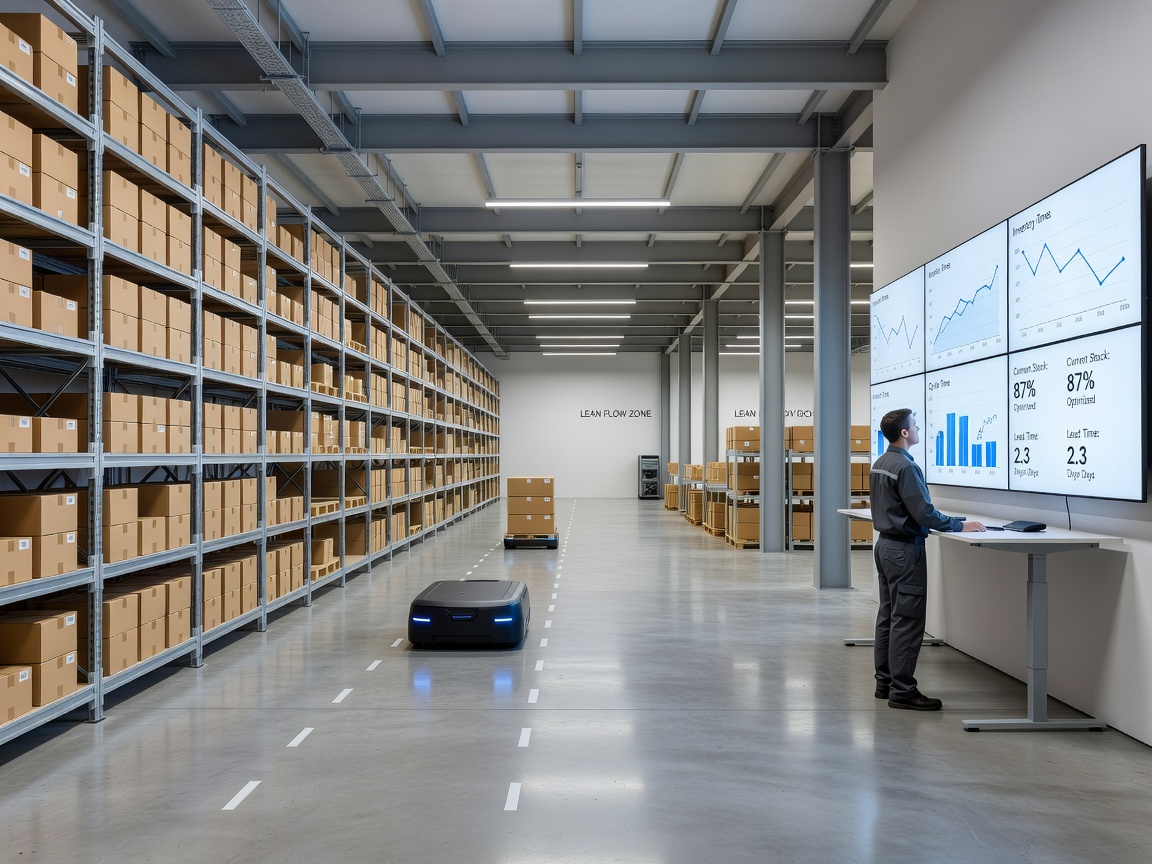
All About Lean Inventory Management Basics
Traditional inventory management relies heavily on a "push" approach. In a push model, production schedules are generated using long-range sales forecasts. Materials are purchased in large, bulk batches, processed through assembly steps, and pushed into the warehouse as finished goods stock—regardless of whether an immediate customer order exists. This strategy assumes that high unit volumes will capture economies of scale.
In contrast, a lean inventory management system runs on a "pull" framework. Production and material movements are triggered strictly by downstream demand signals. Materials move through the production value stream only when an actual customer or downstream workstation pulls them.
Understanding the distinction between push and pull dynamics requires clear definitions of inventory classifications by operational purpose:
Buffer Stock: Stock maintained to protect the customer from sudden, unexpected spikes in downstream market demand that exceed normal plant capacity.
Safety Stock: Stock held to protect internal plant operations from upstream process failures, such as unreliable vendor lead times, equipment breakdowns, or raw material quality failures.
Shipping (Cycle) Stock: Inventory held to fill immediate orders while batch orders are being packed or transported.
Lowering inventory levels without first addressing operational stability creates severe risk. Reductions in buffer or safety stock should only occur after downstream demand variability is stabilized and upstream process capability is increased. Prematurely cutting stock levels without fixing shop floor variability leads directly to line stoppages and missed shipments.
Core Principles of a Lean Inventory Management System
Modern lean operations follow five foundational principles:
Define Value: Identify customer value based on exact product specifications, quality requirements, pricing, and lead time expectations. Any stock movement or storage step that does not directly add value from the customer's perspective is flagged as potential waste.
Map the Value Stream: Map every single step, material movement, and delay involved in transforming raw materials into finished goods. This visual map helps teams identify non-value-added activities and bottlenecks across the plant.
Establish Continuous Flow: Reorganize work cells, production steps, and parts management to ensure materials move smoothly through the facility without stopping in long queues or accumulating as excess Work-in-Process (WIP).
Implement Pull Systems: Introduce visual signals—such as Kanban cards or electronic triggers—so upstream workstations produce parts only when pulled by downstream consumption.
Strive for Perfection: Continuously refine workflows, update standard work procedures, and systematically reduce setup times to eliminate operational friction over time.
The 7 Types of Waste (Muda) in Inventory Operations
Lean manufacturing categorizes non-value-added activities into seven operational wastes, originally outlined by Shigeo Shingo within the Toyota Production System:
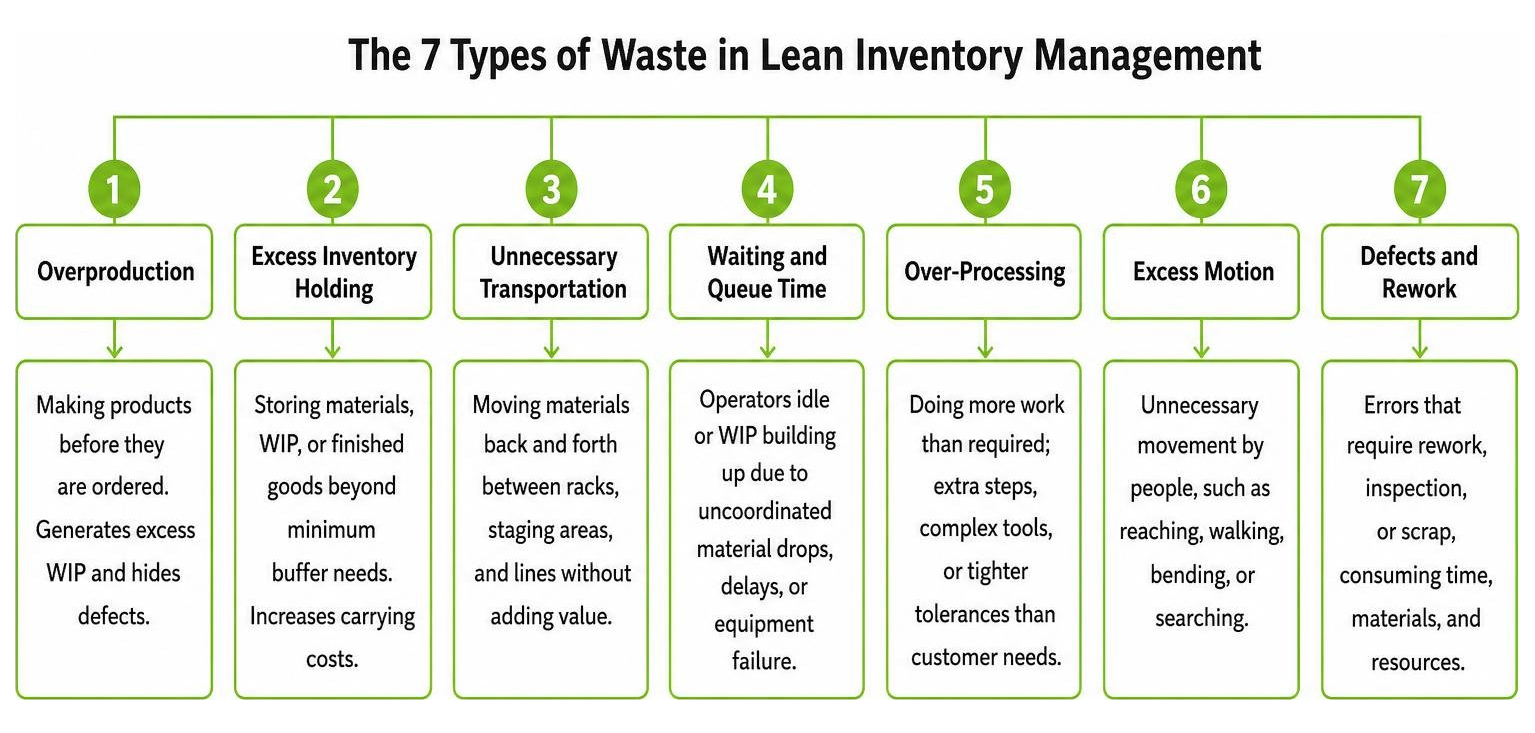
Overproduction: Manufacturing items before they are ordered. Overproduction is considered the most critical waste because it generates excess WIP and hides downstream process defects.
Excess Inventory Holding: Storing raw materials, WIP, or finished goods beyond minimum buffer requirements. Holding inventory incurs carrying costs—which can add up to 30% per year in storage fees, insurance, handling, and capital tie-up. A $10 part sitting on a shelf for six months can incur $1.50 in hidden holding costs, raising its effective cost to $11.50.
Unnecessary Transportation: Moving materials, parts, or finished assemblies back and forth between warehouse racks, staging areas, and production lines without adding functional value to the product.
Waiting and Queue Time: Operators standing idle or WIP accumulating at work stations due to uncoordinated material drops, delayed changeovers, or upstream equipment failure.
Over-Processing: Performing excessive processing steps, using overly complex tools, or enforcing unnecessary tolerances that exceed customer specifications.
Operator Motion Waste: Unnecessary physical movement by operators—such as bending, stretching, or walking across the warehouse to look for misplaced parts or tools.
Defects and Rework: Producing parts that fail quality inspections. Scrap and rework directly consume extra materials, labor hours, machine time, and warehouse space.
Frameworks and Methodologies Supporting Lean Operations
To systematically uncover and eliminate waste, plants rely on proven structural frameworks. The most fundamental entry point for physical inventory control is the 5S framework.
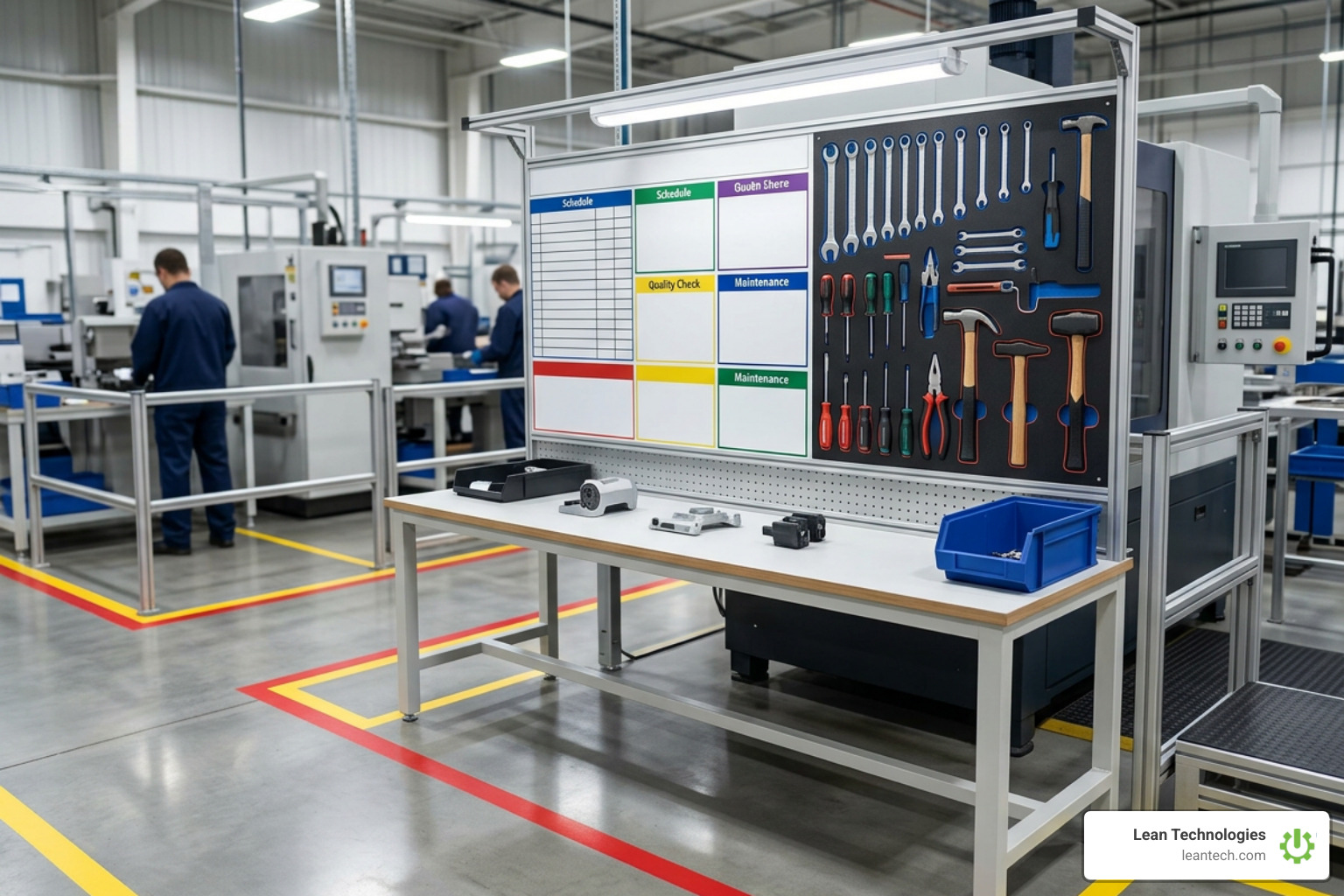
The 5S Framework Breakdown
Sort (Seiri): Inspect storage areas, racks, and assembly stations. Retain only the tools, raw materials, and fixtures needed for current production; remove obsolete or unneeded items.
Straighten / Set in Order (Seiton): Organize remaining items logically. Assign every part, tool, and material batch a dedicated, clearly labeled storage location to reduce search time.
Shine (Seiso): Clean equipment, storage shelves, and floor areas thoroughly. Cleaning serves as an inspection process to spot oil leaks, worn components, missing stock, or damaged packaging.
Standardize (Seiketsu): Create written standard operating procedures, visual workplace indicators, and clear color-coding for part bins so visual management is uniform across shifts.
Sustain (Shitsuke): Perform regular audits, maintain accountability, and integrate 5S routines into standard daily workflows to keep the workplace organized.
Applying 5S directly improves standardized Work-in-Process (WIP)—the absolute minimum volume of parts required inside machines and between work stations to keep an assembly line flowing smoothly without interruption. Maintaining standardized WIP prevents operators from building up unapproved buffer piles between processes. Incorporating structured workflows through platforms like thrive quality ensures that quality standards are sustained across all operations.
Integrating Kanban, JIT, Kaizen, and Six Sigma into a Lean Inventory Management System
A successful lean inventory management system integrates multiple operational methodologies:
Just-in-Time (JIT): Ensures raw materials and components arrive from suppliers right as they are needed for production. In 1998, an NCR manufacturing plant in Dundee, Scotland transitioned to JIT operations over a single weekend. The facility reduced raw inventory from 47 days down to 5 days, cut material flow time from 15 days to 2 days, and arranged for 77% of purchased parts to go directly from the receiving dock to the production line.
Kanban: Uses visual cards, physical bin systems, or electronic notifications to signal upstream workers to produce or replenish a specific quantity of parts. Kanban prevents overproduction by capping maximum WIP.
Kaizen: Engages shop floor operators in ongoing, incremental continuous improvement events to identify bottlenecks, shorten lead times, and eliminate daily operational friction.
Six Sigma (DMAIC): Employs statistical methods across five phases—Define, Measure, Analyze, Improve, and Control—to reduce process variance and eliminate manufacturing defects.
Implementing smooth material pull requires reliable procurement execution. Utilizing structured tools for purchasing suggestions and formal material requisitions keeps purchasing aligned directly with live shop floor consumption rates.
Key Benefits, Challenges, and Technology in Lean Inventory
Dimension Traditional Push Management Lean Pull Management Production Trigger Long-range sales forecasts Actual downstream customer demand Batch Sizes Large batch runs to capture scale Small batch runs aligned with takt time Inventory Focus Large safety buffers to mask process issues Minimal right-sized buffers; issue resolution Carrying Costs High capital tie-up (up to 30% annually) Low holding costs; maximized working capital Quality Control End-of-line inspections; high rework risk In-process quality control (Jidoka); early defect identification Lead Times Weeks to months Days to hours
Quantified Benefits of Lean Adoption
Implementing lean inventory strategies yields dramatic, measurable operational gains across discrete and continuous manufacturing setups:
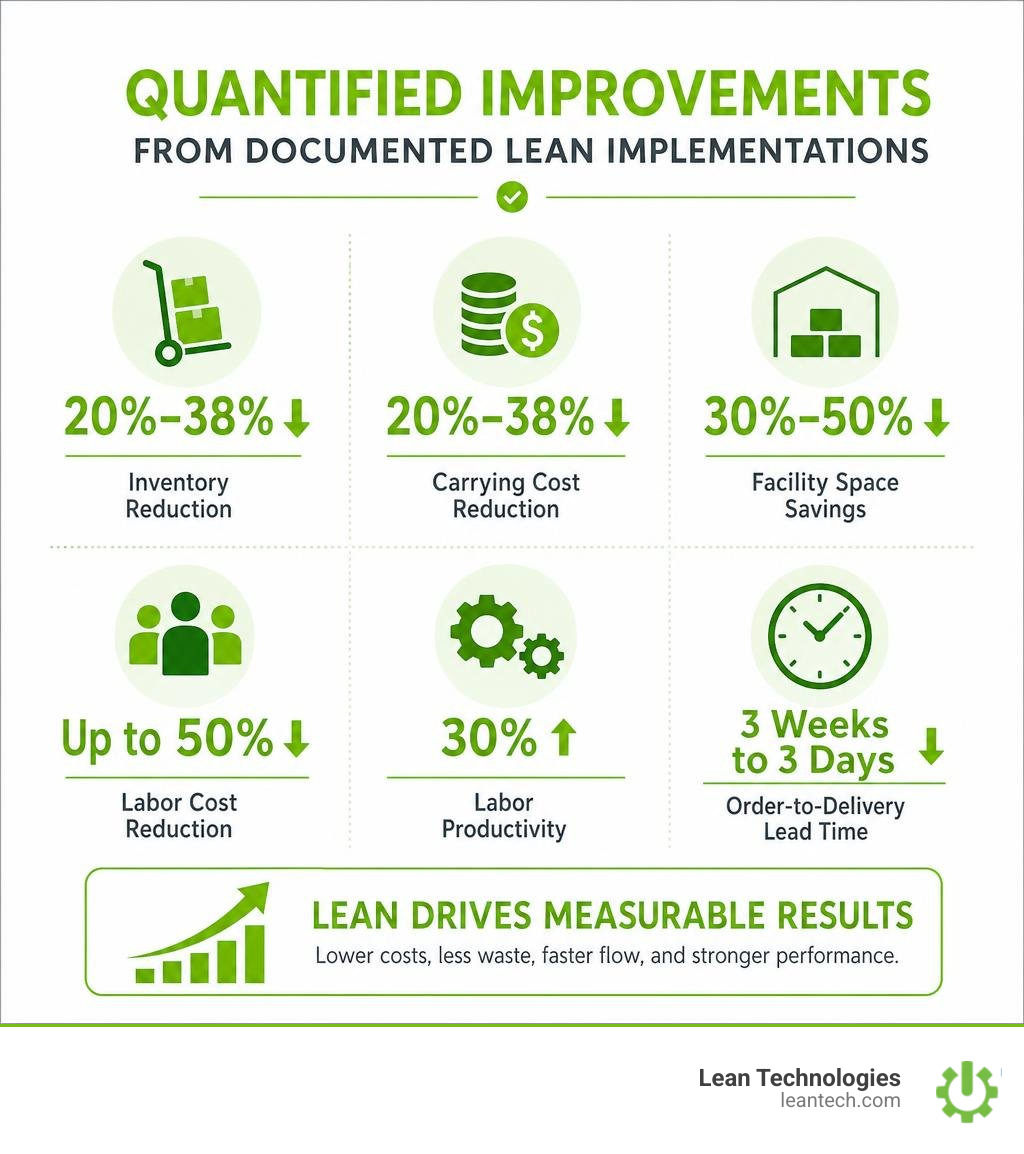
Carrying Cost & Capital Liberation: Eliminating unnecessary buffer stock frees up critical working capital. Modern deployment sites frequently demonstrate immediate inventory reductions of 20% to 38% within weeks of streamlining inventory controls, unlocking tens of thousands of dollars in cash flow.
Space and Productivity Gains: Strategic historical documentation at Hewlett-Packard across four operating divisions revealed division-wide inventory drops of 75%, labor cost reductions up to 50%, facility space savings between 30% and 50%, and WIP stock drops from 22 days down to 1 day.
Drastic Lead Time Reductions: At Omark’s drill bit manufacturing plant in Mesabi, Minnesota, adopting lean principles slashed large-size drill bit inventory by 92%, boosted labor productivity by 30%, reduced scrap and rework by 20%, and reduced order-to-delivery lead times from three weeks down to three days. Similarly, historical data from Daman Products documented total cycle time reductions of 97%, setup time cuts of 50%, and total floor travel distance reductions of 90%.
Implementation Challenges and Risk Mitigation
While the advantages of lean are substantial, transitioning to a lean framework presents operational risks that must be managed:
Supply Chain Fragility: Operating with minimal safety stock leaves facilities vulnerable to vendor delays, port congestions, or sudden material shortages. Stockouts translate directly into financial losses—typically cutting total retail sales by approximately 4%. To mitigate this, plants should maintain strategic safety stock for long-lead components while keeping local, high-velocity items on strict JIT replenishment.
Resistance to Change: Plant personnel used to large inventory buffers may feel uncomfortable running lean lines. Building a sustainable lean culture requires consistent role-based training and transparent communication from leadership.
Standard Accounting Conflicts: Traditional standard cost accounting practices treat inventory as an asset and penalize lower volume production runs by under-absorbing fixed overhead. Lean operations focus on direct value stream costing to accurately evaluate working capital savings.
Digital Tools and Modern Software in Lean Execution
Digital tools play a key role in supporting lean execution across modern shop floors. However, technology alone cannot replace sound operational practices; software provides real-time visibility only when internal processes are clearly structured and data is accurately entered at the source via mobile, tablet, or desktop devices.

Small to midsize manufacturers often struggle when trying to apply lean principles using rigid, complex legacy software. Large enterprise systems frequently require months of setup and disrupt everyday floor routines.
This is where lightweight, adaptable software tools add value:
Positioning as a Digital Toolbox: Modern tools like Thrive function as a flexible digital toolbox built specifically to help small to midsize manufacturers digitize lean work processes in real time without replacing existing ERP or MES systems.
Targeting Real Shop Floor Friction: Instead of forcing workers to complete paper workarounds or navigate complex software menus, simple digital entries eliminate late downtime logging, help teams close continuous improvement loops, and organize compliance tracking across shifts.
Organized Action Around Machine Data: Digital toolboxes organize practical daily actions around machine data entered directly by teams or imported from other external systems. They focus on structuring human workflows rather than collecting raw sensor data or generating complex predictive alerts.
Compliance and Traceability Integration: Connecting material usage updates directly with digital standard operating procedures simplifies tracking, helping facilities meet stringent industry rules through streamlined materials compliance management.
How to Implement Lean Inventory Management: Step-by-Step Best Practices
Transitioning to a lean inventory management system requires a structured, step-by-step roadmap:
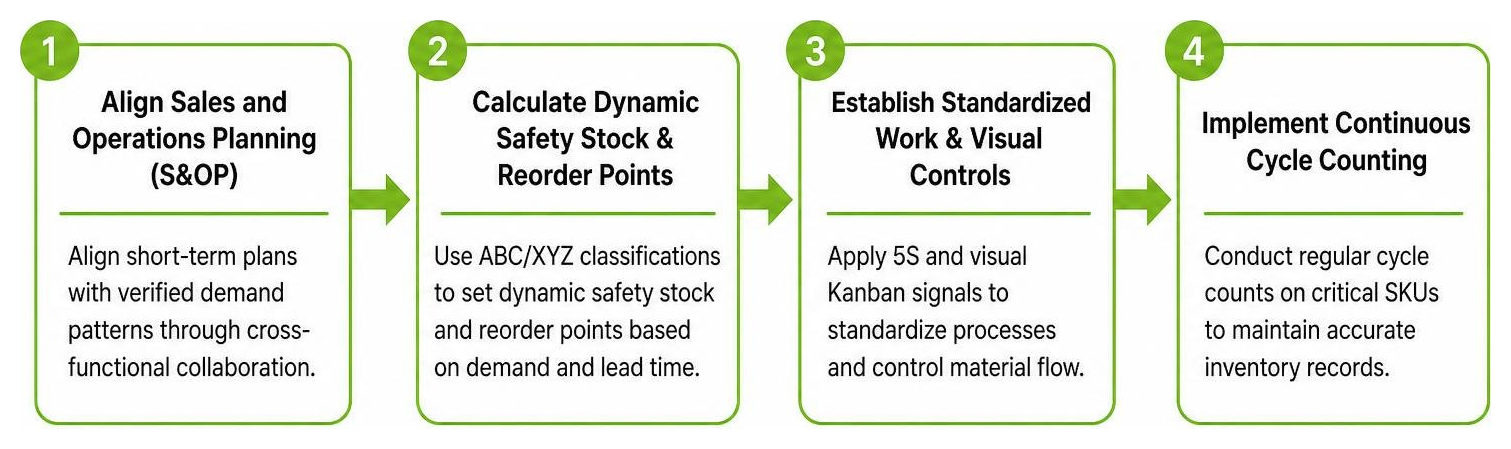
Align Sales and Operations Planning (S&OP): Establish routine communication between sales, procurement, and production planning teams. Align short-term scheduling with verified demand patterns rather than uncalibrated sales targets.
Calculate Dynamic Safety Stock & Reorder Points: Differentiate inventory policies across product categories using dynamic ABC/XYZ inventory classifications. Calculate dynamic safety stock buffers using the established formula: $$\text{Safety Stock} = (\text{Maximum Daily Usage} \times \text{Maximum Lead Time}) - (\text{Average Daily Usage} \times \text{Average Lead Time})$$
Establish Standardized Work & Visual Controls: Implement 5S across all warehouse racks, staging lanes, and work cells. Apply visual Kanban signals to govern material movements.
Implement Continuous Cycle Counting: Replace disruptive annual physical inventory counts with regular cycle counting. Audit small, preselected sections of inventory daily based on SKU criticality to maintain ongoing record accuracy.
Develop Strategic Supplier Partnerships: Build long-term relationships with reliable suppliers. Share production schedules openly to help vendors stabilize their own manufacturing lead times, negotiate smaller batch delivery schedules, and establish dock-to-line material drops.
Go Paperless on the Shop Floor: Replace paper pick tickets, traveler sheets, and manual logs with user-friendly mobile interfaces. Fast data entry at the source prevents data lags and administrative errors.
Conduct Ongoing Audits and Onboarding: Regularly evaluate shop floor adoption using structured assessments like a lean culture assessment. Ensure new operators receive practical onboarding using resources such as a comprehensive guide to digital lean manufacturing.
Frequently Asked Questions About Lean Inventory
How does lean inventory management differ from traditional inventory management?
Traditional inventory management relies on push scheduling, large batch sizes, and high safety stock buffers to guard against production disruptions. A lean inventory management system relies on pull signals driven by actual customer demand, small batch sizes, and continuous waste reduction to minimize carrying costs and shorten order lead times.
What is the difference between buffer stock and safety stock in lean manufacturing?
Buffer stock is inventory held specifically to protect the customer from sudden, unpredictable spikes in downstream market demand. Safety stock is inventory held to protect internal plant operations from upstream process disruptions, such as unexpected machine downtime or supplier delivery delays.
How can small to midsize manufacturers adopt lean inventory without replacing legacy ERP systems?
Small to midsize manufacturers can implement lean inventory management by establishing standardized 5S workflows, introducing visual Kanban pull signals on the shop floor, and using lightweight digital toolboxes like Thrive. Platforms like Thrive digitize lean work processes, log issues, and track corrective actions in real time without requiring the replacement of existing legacy ERP or MES infrastructure.
In Summary
Implementing a lean inventory management system allows manufacturers to cut unnecessary carrying costs, eliminate shop floor waste, and maintain steady material flow without sacrificing customer delivery performance. By focusing on fundamental lean principles—defining value, mapping value streams, establishing continuous flow, building pull systems, and pursuing perfection—plants can lower inventory holding costs while improving product quality and operational agility.
Achieving sustainable lean execution relies on standardized work processes, disciplined workplace organization, and active daily problem-solving by shop floor teams. Adopting a flexible digital platform like Thrive provides small to midsize manufacturers with the practical tools needed to log issues, track corrective actions, and support real-time process visibility.
To learn more about optimizing shop floor execution and building sustainable continuous improvement practices, explore how thrive_ci supports your operational goals.