
Apparel Manufacturing Technology: From Digital Patterns to Floor Operations
How Apparel Manufacturing Technology Connects Design to the Shop Floor
A fabric roll passes inspection, but the cutting team still has the wrong pattern version. Apparel manufacturing technology helps prevent gaps like this by connecting material checks, digital patterns, cutting plans, sewing, quality checks, finishing, and dispatch. For an operations manager, the goal is simple: get the right information to each team before a small mistake becomes wasted fabric, rework, or a late order.
The tools span the full process, from software that plans how pattern pieces fit on fabric to systems that help teams act on shop floor issues. Lean Technologies' Thrive is a flexible digital toolbox for small to midsize manufacturers. It helps operators and supervisors log issues, track actions, and improve lean work processes. Thrive is not an ERP or MES and does not replace either. When teams enter information at the source on a mobile device, tablet, or desktop, it can provide real-time visibility and help drive action from machine data entered by the team or imported from other systems.
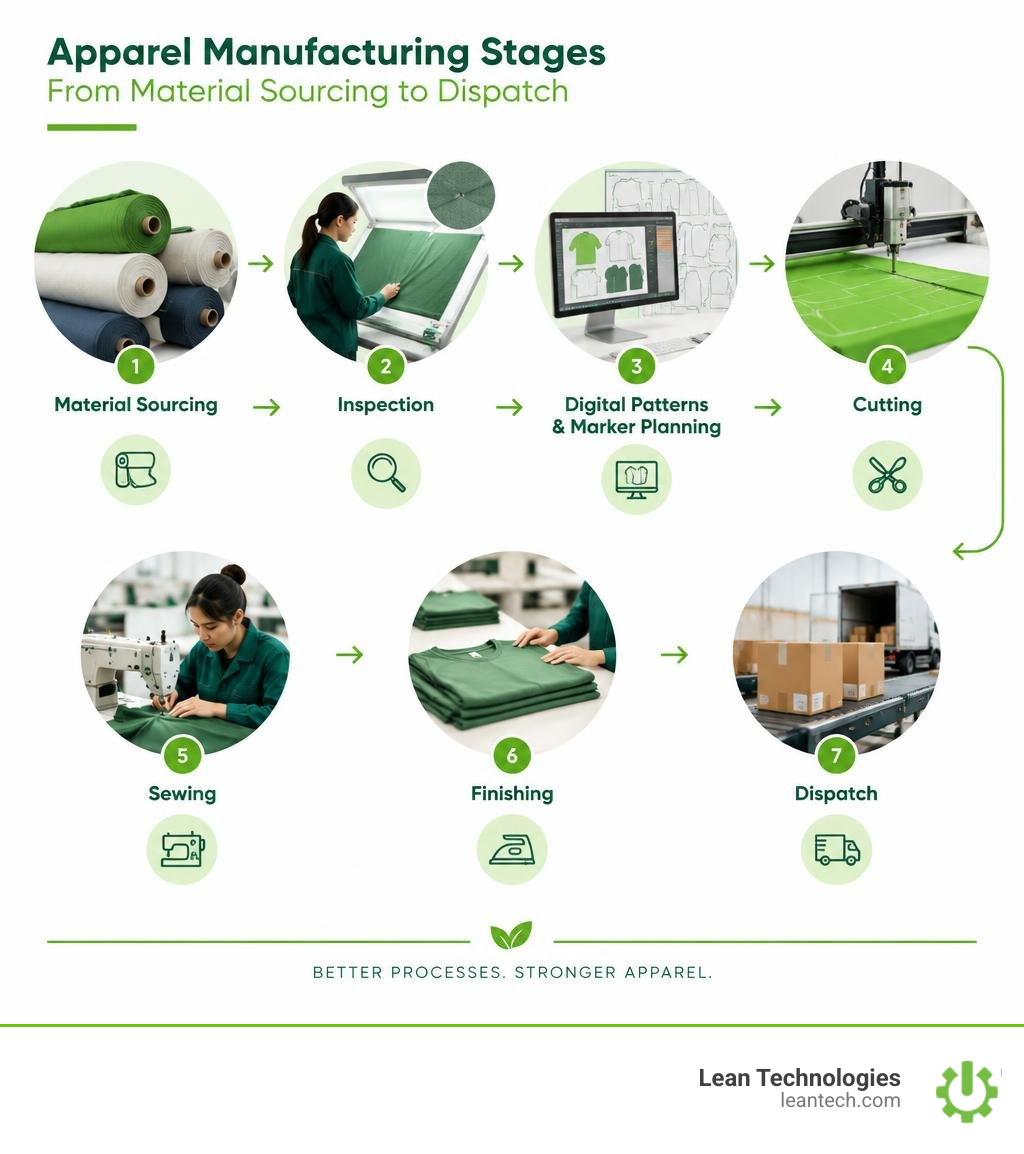
Pre-Production: Inspection Systems, Digital Patterns, and Marker Planning
Quality apparel manufacturing begins long before a single blade touches fabric. Raw textile rolls arrive with natural variations, tension irregularities, and structural flaws. If defective yardage slips into the cutting room, it multiplies rework costs across the entire sewing line.
To standardize material evaluation, quality assurance managers implement standardized fabric inspection frameworks:
Four-Point System (ASTM D5430): The most widely adopted grading method in global apparel production. Penalty points (1 to 4) are assigned based on defect length:
Defects up to 3 inches: 1 point
Defects between 3 and 6 inches: 2 points
Defects between 6 and 9 inches: 3 points
Defects over 9 inches: 4 points
Holes and openings larger than 1 inch receive the maximum penalty of 4 points.
Points are normalized per 100 square yards: Total points × 3600 ÷ (Fabric width in inches × Total yards inspected). Standard acceptance limits typically range between 28 and 40 penalty points per 100 square yards, depending on buyer specifications.
Ten-Point System: Assigns penalty points (from 1 up to 10 points) based on defect size, with severe penalties reserved for full-width defects and holes over 1 inch. It provides granular discrimination for high-end suiting and luxury textiles.
Graniteville '78' System: Designed primarily for woven cottons and workwear fabrics, grading defects based on linear length along the warp and weft axes.
Dallas System: Engineered for knitted fabrics, evaluating defects based on localized knit distortions, loop drops, and structural barré.
Beyond point scoring, pre-production workflows require precise fabric relaxation. Spreading rolls under mechanical tension causes elastomeric yarns and knit structures to recover after cutting, resulting in undersized panels. Modern facilities mandate 24- to 48-hour mechanical relaxation periods on rolling racks before spreading. Material handlers then execute roll allocation, matching specific dye lots (shade bands) and roll widths to distinct marker groups to eliminate panel-to-panel color shading within finished garments. Adopting a structured approach from a digital lean manufacturing guide ensures these pre-production inspections feed clean, actionable data directly into plant schedules.
Advancements in Apparel Manufacturing Technology for Pattern Making and Grading
Traditional manual pattern drafting relied on heavy cardboard blocks, grading rulers, and human proportion theories like the Eight-Head Theory—a classical method dividing the human figure into eight equal units based on head height. Today, apparel manufacturing technology digitizes this foundation through 2D CAD drafting platforms, 3D body scans, and virtual fitting avatars.
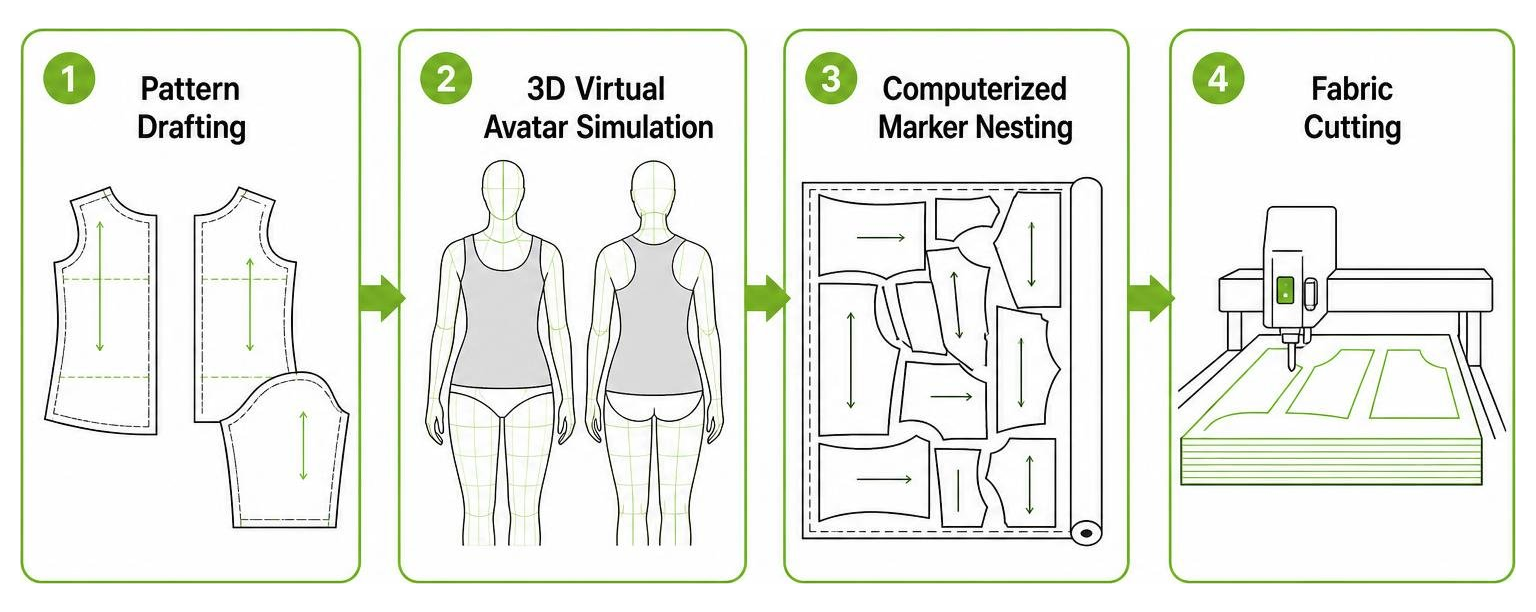
CAD systems allow pattern engineers to digitize master slopers and apply multidirectional grading rules across standard size breaks (XS through XXL). Rather than cutting physical sample garments across every size, 3D simulation tools drape digital patterns over parameterized 3D avatars. These platforms simulate physical textile mechanical properties—tensile stretch, shear, bending rigidity, and surface friction—to reveal drag lines, seam strain, and ease distribution before physical fabric is allocated.
Once graded pattern components are validated, computerized marker planning takes over. Advanced nesting algorithms analyze fabric grain lines, rotational constraints, piece symmetry, and fabric defects to pack pattern shapes into the tightest possible envelope. Marker efficiency is measured directly:
Marker Efficiency % = (Total Pattern Area ÷ Total Marker Area) × 100
While manual marker drafting rarely exceeds 80–82% utilization, automated nesting engines routinely achieve 88% to 94% marker efficiency. In high-volume plants running thousands of yards daily, a 1% gain in fabric utilization translates to tens of thousands of dollars saved annually.
Assembly Engineering: Machine Classifications, Stitch Types, and Defect Prevention
Feed Mechanisms, Stitch Types, and Seam Classifications
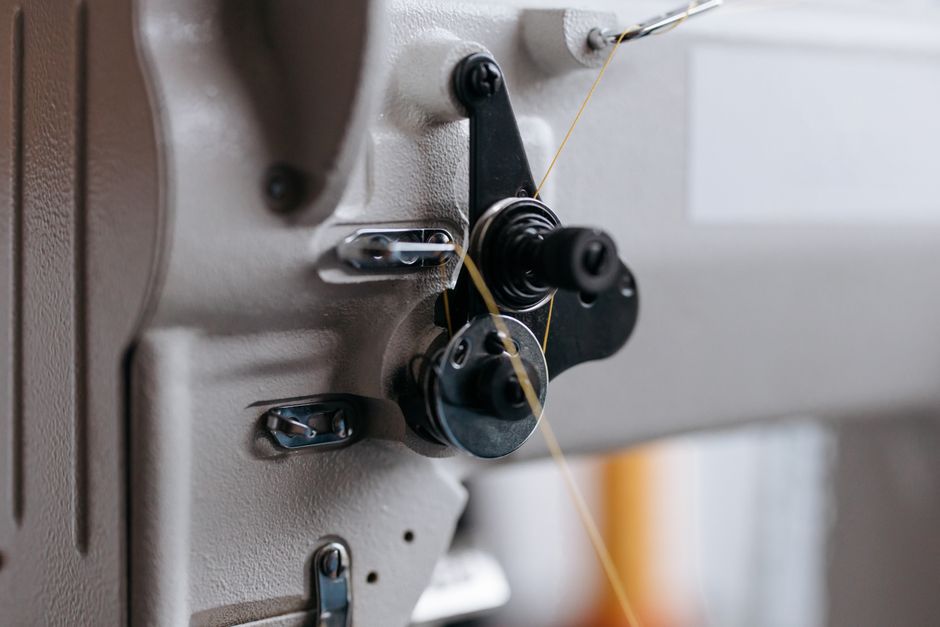
Garment structural integrity relies on the proper combination of sewing machine mechanics, needle systems, stitch formations, and seam layouts. Industrial sewing machines are categorized by bed type (flatbed, cylinder bed, post-bed, and feed-off-the-arm) and fabric feeding kinematics:
Drop Feed: The standard feed dog moves upward and forward beneath the throat plate. Ideal for flat, non-stretching woven goods.
Differential Feed: Features two independent feed dog sets (front and rear) operating at different stroke ratios. Accelerating the front feed dog gathers knit fabrics to prevent wavy edges; decelerating it stretches fabrics to eliminate structural puckering.
Needle Feed (Compound Feed): The needle penetrates the fabric and moves horizontally in tandem with the feed dog during the feed stroke. This prevents ply slippage in slippery synthetics, waterproof laminates, and multilayer heavy outerwear.
Puller Attachments: Auxiliary driven rollers mounted behind the presser foot provide continuous, non-slip pulling tension for long, straight seams on heavy canvas, denim, or elastic waistband attachments.
Stitches are classified under ASTM D6193 (and ISO 4915) into six fundamental families:
Class 100 (Single-Thread Chainstitch): Simple, economical, and unravelable; used for button sewing, temporary basting, and bag closures.
Class 200 (Hand Stitch Formations): Machine-simulated pick stitches for high-end tailored lapels.
Class 300 (Lockstitch): Formed with a needle thread and a bobbin thread interlocking in the center of the plies. Highly secure and reversible; the backbone of shirts, trousers, and tailored apparel (e.g., Stitch 301).
Class 400 (Multi-Thread Chainstitch): Formed with needle threads and looper threads. Flexible and durable for jeans, workwear, and long inseams (e.g., Stitch 401).
Class 500 (Overedge/Overlock): Trims fabric edges while forming thread loops around the raw cut to prevent fraying (e.g., 3-thread Stitch 504 or 5-thread Safety Stitch 516).
Class 600 (Coverstitch/Flatlock): Interlaces multiple needle threads with top and bottom cover threads to form flat, highly extensible, low-bulk seams on activewear, knitwear, and underwear (e.g., Stitch 602 and 607).
Seams are standardized under ISO 4916 across eight distinct classes:
Class 1 (Superimposed Seams - SS): Plies laid flat on top of each other and joined near the edge (standard side seams).
Class 2 (Lapped Seams - LS): Plies overlapped and joined, often seen in jeans' felled inseams.
Class 3 (Bound Seams - BS): A bias binding strip encloses the raw edge of one or more plies (necklines and pocket edges).
Class 4 (Flat Seams - FS): Two flat raw edges abutted and joined without overlapping to eliminate bulk (athletic flatlock seams).
Classes 5–8: Encompass decorative stitching, edge neatening, and applied components (elastic, belt loops, and zippers).
Identifying and Preventing Common Sewing Defects
Seam quality defects compromise garment aesthetics and structural strength. Identifying root causes allows floor mechanics and quality engineers to implement permanent corrective adjustments:
Tension Puckering: Occurs when sewing thread is stitched under excessive tension. When the garment is released from the machine, the elastic thread contracts, gathering the fabric. Prevention: Calibrate thread tension gauges, use low-stretch synthetic threads, and select lubricated core-spun threads.
Feed Puckering (Ply Slippage): Happens when the presser foot drags the top fabric ply while the feed dog advances the bottom ply, creating unequal lengths at the seam end. Prevention: Switch from drop feed to differential or needle feed machines, and adjust presser foot spring pressure.
Structural Jamming Puckering: Common in tightly woven, high-count microfibers. Thick needles displace warp and weft yarns, causing localized fabric distortion. Prevention: Downsize needle gauges (e.g., from size 90/14 to 70/10 or 65/9), switch to ball-point or slim-taper acute round points (SPI), and align stitch lines diagonally to fabric grain where possible.
Skipped Stitches: Needle fails to form a thread loop for the looper or bobbin hook to catch, often caused by needle deflection, needle heat buildup, or flag movement of fabric. Prevention: Check needle alignment, replace bent needles, install air-assisted needle cooling jets, and ensure correct needle-to-hook clearance (typically 0.05 to 0.1 mm).
Needle Cutting / Fabric Rupture: The needle severs knit yarns during penetration, creating small holes along the seam line that expand upon washing. Prevention: Replace standard sharp needles with light, medium, or heavy ballpoint needles (SES/SUK) that push yarns aside rather than piercing them.
Optimizing the Shop Floor: Apparel Manufacturing Technology for Production Systems
Production Planning and Industrial Engineering for Line Balancing
Production Planning and Control (PPC) and Industrial Engineering (IE) teams transform technical design packs into balanced, cost-effective shop floor operations. The core metric driving line engineering is the Standard Minute Value (SMV)—the standard time required for a qualified operator working at standard performance to complete an operational breakdown step.
Industrial engineers analyze each seam assembly to calculate:
Basic Minute: Observed cycle time × (Operator Performance Rating ÷ 100)
SMV: Basic Minute × (1 + Machine and Personal Allowances)
Line balancing matches the sum of operational SMVs to customer demand, defined by Takt Time:
Takt Time = Available Production Time per Shift ÷ Target Output per Shift
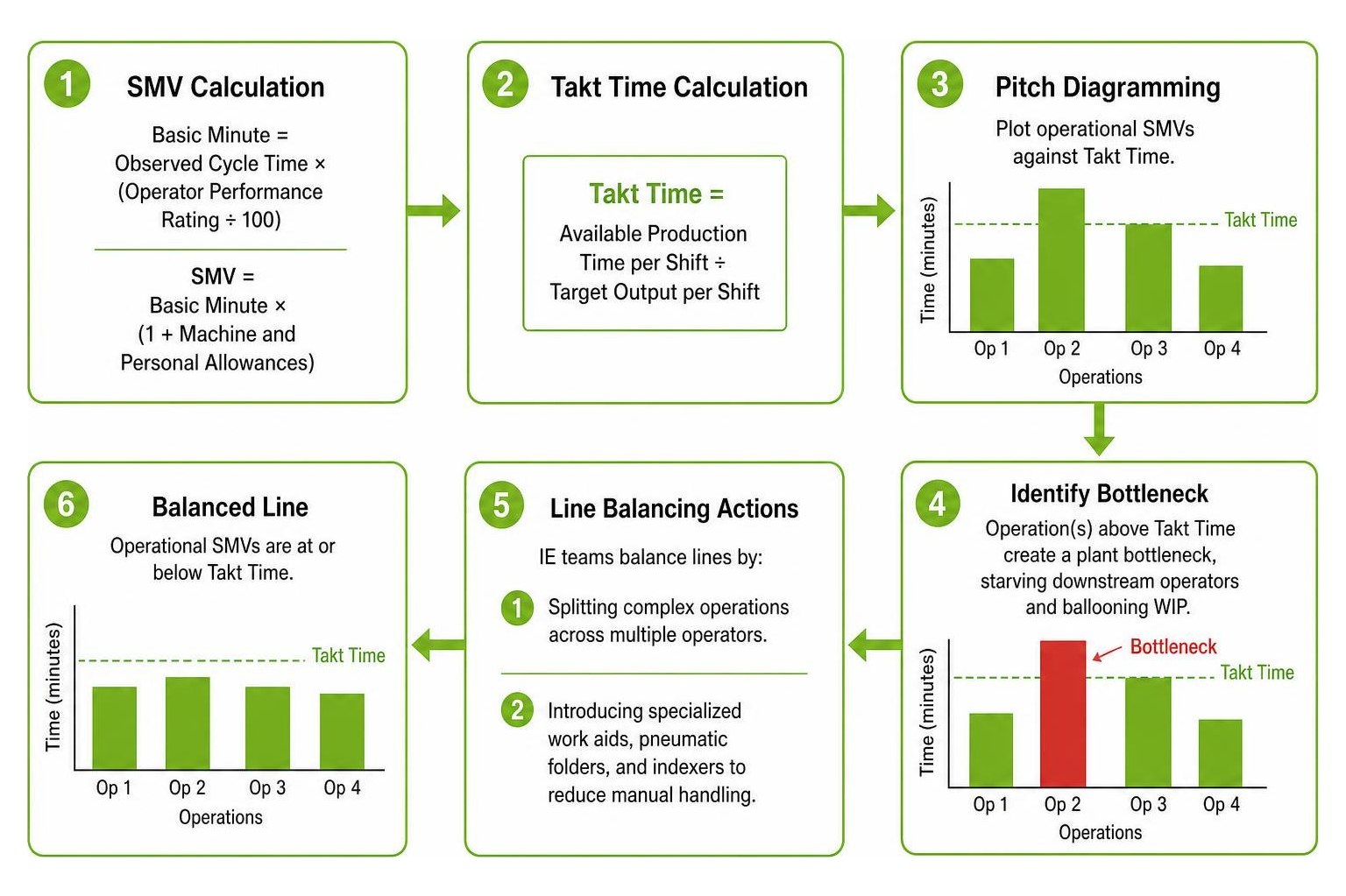
Engineers plot Pitch Diagrams to visualize operational cycle times against takt time. When an operation exceeds takt time, it creates a plant bottleneck, starving downstream operators and ballooning Work-In-Progress (WIP).
IE teams balance lines by:
Splitting complex operations across multiple operators.
Introducing specialized work aids, pneumatic folders, and indexers to reduce manual handling.
Merging short operations into unified workstations.
Reallocating floating utility operators to support high-SMV workstations.
To maintain line balance, supervisors track operational throughput at the source. Implementing shop floor software gives plant managers real-time visibility into operator output, downtime causes, and line balance efficiencies without relying on end-of-shift paper tallies.
Evaluating Garment Production Systems: Bundle, Modular, and Unit Production
Apparel factories organize workstations using three primary manufacturing systems, each balancing workflow velocity, flexibility, and capital investment differently:
Production System | Work-In-Progress (WIP) | Changeover Flexibility | Capital Investment | Throughput Velocity |
|---|---|---|---|---|
Progressive Bundle System (PBS) | High (Days to Weeks) | High (Easily handles diverse styles) | Low (Standard sewing machinery) | Slow (Batch-and-queue delays) |
Modular Manufacturing System (MMS) | Very Low (Hours) | Moderate (Requires cross-trained teams) | Moderate (U-shaped cells, multi-machine tables) | Fast (One-piece or small-batch continuous flow) |
Unit Production System (UPS) | Low to Moderate (1–2 Days) | Low to Moderate (Setup changes on overhead rails) | High (Overhead conveyors, computerized tracking) | Very Fast (Continuous single-garment flow) |
Progressive Bundle System (PBS): Cut parts are grouped into bundles (typically 20–50 pieces) along with route tickets and transported manually between specialized operations. While PBS delivers high machine utilization and accommodates diverse garment styles, it generates massive WIP inventory and long cycle times.
Modular Manufacturing System (MMS): Operators work in small self-contained teams (typically 4 to 12 members) arranged in U-shaped cells. Operators are cross-trained across multiple sewing machines and pass garments using single-piece or small-batch flow. MMS minimizes WIP, slashes lead times, and surfaces quality defects immediately, though it requires a collaborative culture and multi-skilled operators.
Unit Production System (UPS): Garment components are loaded onto computerized overhead mechanical carriers that transport individual units directly to operator workstations. Operators perform their designated stitch sequence without manually unfolding or re-bundling fabric panels. UPS reduces non-productive manual handling by up to 80% and accelerates throughput, but requires significant capital investment and rigid line configurations.
Finishing Operations, Merchandising, and Garment Costing Models
Fusing, Pressing, and Packaging for Retail Readiness
A garment’s retail appeal and structural durability depend on precise finishing and wet/dry processing.
Interlining Fusing: Fusible interlinings provide shape, crispness, and structural support to collars, cuffs, lapels, and plackets. Fusing performance depends on precise calibration of the Temperature-Time-Pressure triangle:
Temperature: Must reach the exact melting point of the thermoplastic resin (polyamide, polyester, or HDPE)—typically between 120°C and 160°C.
Time: Dwell time (usually 10–20 seconds) inside continuous flatbed or rotary fusing presses must allow full resin flow into the base textile fibers.
Pressure: Uniform pneumatic or spring roller pressure (1.5 to 4.0 bar) ensures complete mechanical interlocking without resin strike-through (glue oozing to the face fabric) or strike-back.
Under-Pressing and Top-Pressing: Under-pressing opens intermediate seam allowances during assembly. Top-pressing uses specialized buck pressing machines or robotic tunnel finishers to mold the final garment shape. Pressing cycles inject dry steam to relax fiber internal strains, apply mechanical pressure to set creases, and use powerful vacuum suction to cool and extract residual moisture, locking the garment silhouette in place.
Packaging Operations: Finished apparel passes through barcode scanning stations, hang-tag attachment, moisture-absorbing silica placement, automated polybagging, and carton packing. Packaging protocols must safeguard garments against transport creasing, moisture-induced mold, and packaging deformation.
Merchandising Coordination and End-to-End Costing Formulas
Merchandising serves as the operational bridge between retail buyers, technical design teams, and production floors. Merchandisers manage the development calendar from technical pack receipt, lab dip approvals, and trim sourcing to pre-production (PP) samples and final size sets.
A garment factory's profitability hinges on precise Cut-Make-Trim (CMT) and FOB (Free on Board) costing structures:
Total Garment Cost = Fabric Cost + Trims Cost + CMT Cost + Value-Added Process Cost + Factory Overhead & Profit Margin
Breaking down cost components:
Fabric Cost: (Marker Consumption in yards/meters × Fabric Unit Price) × (1 + Fabric Wastage Allowance %). Fabric represents 50% to 70% of total garment manufacturing costs.
Trims & Accessories Cost: Total sum of sewing threads, buttons, zippers, polybags, main labels, care labels, hangtags, and cartons.
CMT Cost: Calculated from operational work content:
CMT Cost = (Garment Total SMV × Labor Cost per Minute) ÷ Target Line Efficiency %
Value-Added Processes: Garment washing (enzyme, stone, ozone), localized dry processing, screen printing, heat-transfer decals, and computerized embroidery.
Reconciliation & Cut-to-Ship Ratio: Factory performance is measured by the Cut-to-Ship Ratio:
Cut-to-Ship Ratio % = (Total Garments Shipped ÷ Total Garments Cut) × 100
High-efficiency manufacturing operations target a cut-to-ship ratio of 98.5% or higher, actively identifying and eliminating fabric defects, sewing rejects, and finishing damages.
Modern Innovations and Sustainable Apparel Engineering
Next-Generation Frontiers in Apparel Manufacturing Technology
The apparel industry faces urgent demands for faster turnaround, shorter runs, and radical waste reduction. Traditional cut-and-sew operations can generate up to 15–20% cutting room textile waste. In response, engineering teams are advancing single-step production technologies.
Recent manufacturing research demonstrates the viability of 3D single-step garment weaving, where complex 3-D garments—such as intimate apparel and structured tops—are woven directly in three orthogonal dimensions on Jacquard looms, eliminating post-loom cutting and sewing steps entirely (Shi et al., 2024).
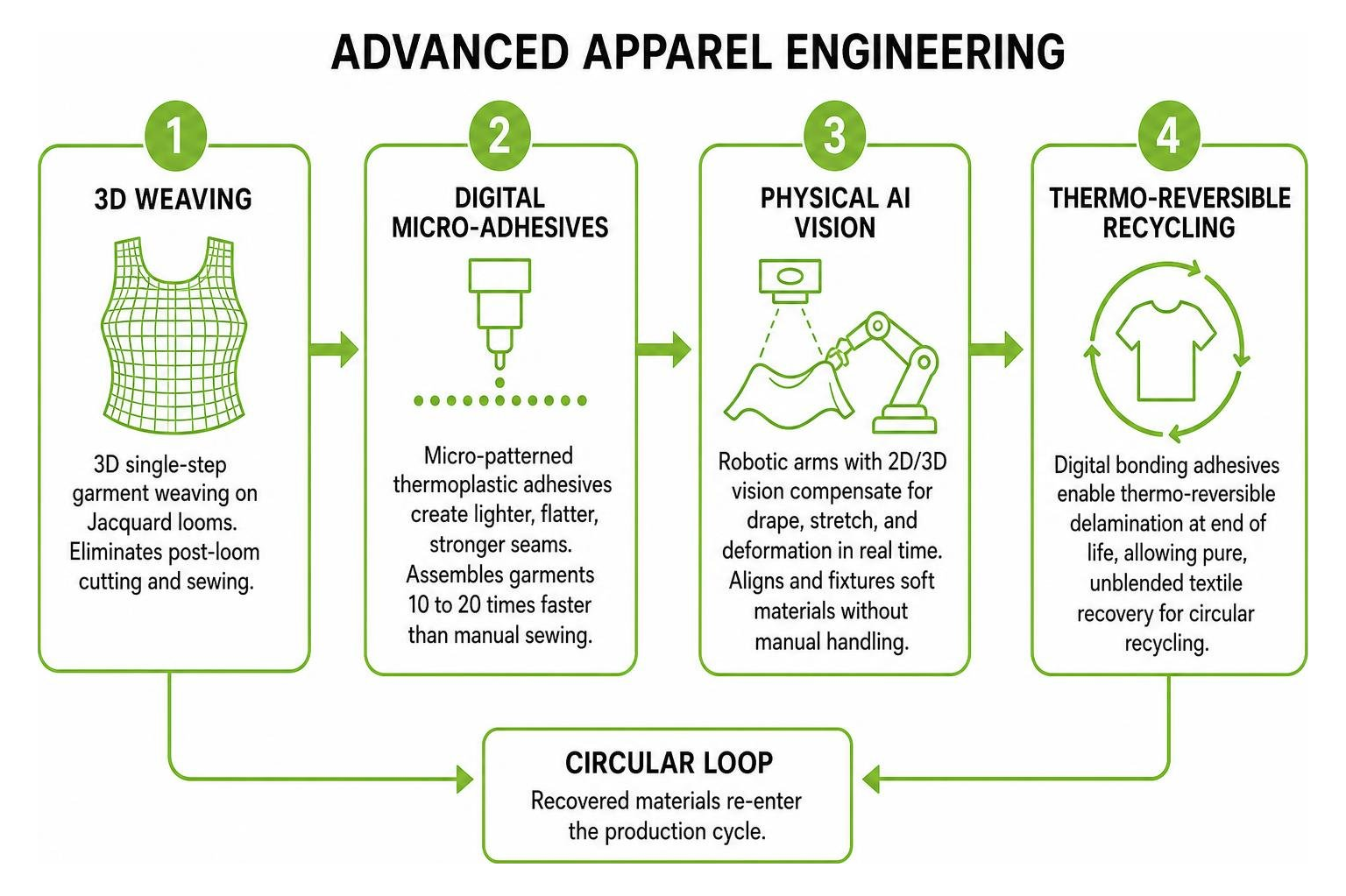
Concurrently, robotic automation is transforming soft-goods joining through non-stitched technologies:
Digital Micro-Adhesives & Bonding: Dispensing micro-patterned thermoplastic adhesives via automated heads creates seams that are lighter, flatter, and stronger than traditional stitching. These systems can assemble garments up to 10 to 20 times faster than manual sewing lines.
Physical AI and Vision Guidance: Advanced robotic arms paired with 2D/3D machine-vision cameras actively compensate for textile drape, stretch, and deformation in real time, enabling machines to align and fixture soft materials without manual handling.
Thermo-Reversible Circularity: Novel digital bonding adhesives are engineered for thermo-reversible delamination. At the end of a garment’s lifecycle, exposing it to specific thermal thresholds cleanly unbonds the seams, allowing pure, unblended textile recovery for circular recycling.
To operationalize these technological leaps without adding administrative overhead, manufacturers implement customizable lean production software. These systems connect physical machine operations with dynamic continuous improvement workflows across cutting, assembly, and finishing.
Frequently Asked Questions About Apparel Manufacturing Technology
What is the four-point fabric inspection system in garment manufacturing?
The Four-Point System (ASTM D5430) is an industry-standard method for evaluating fabric roll quality. Inspectors assign penalty points from 1 to 4 based on defect length: defects up to 3 inches receive 1 point, 3–6 inches receive 2 points, 6–9 inches receive 3 points, and defects over 9 inches (or holes over 1 inch) receive 4 points. The total points are normalized per 100 square yards of inspected material. If the calculated score falls below the buyer's designated threshold (typically 28 to 40 points per 100 square yards), the roll is accepted for production.
How do progressive bundle and unit production systems differ?
A Progressive Bundle System (PBS) moves cut parts through the factory in manual batches of 20 to 50 pieces. Operators complete their designated step on the entire bundle before it is tied and moved to the next workstation, creating high Work-In-Progress (WIP) and longer lead times. In contrast, a Unit Production System (UPS) uses a computerized overhead conveyor to transport single garments directly between workstations on hanging carriers. UPS reduces manual handling, slashes WIP levels, and provides immediate visibility into line bottlenecks.
What causes seam puckering and how can sewing operators prevent it?
Seam puckering results from four primary root causes:
Tension Puckering: High thread tension contracts after stitching. Solution: Reduce needle and bobbin thread tensions and use lubricated core-spun threads.
Feed Puckering: Uneven feeding of top and bottom plies. Solution: Use differential feed or needle feed sewing machines and calibrate presser foot pressure.
Structural Jamming: Needles displacing yarns in dense weaves. Solution: Use thinner needles (sizes 65/9–75/11) with slim acute points (SPI).
Differential Shrinkage: Unequal shrinkage between thread and fabric during washing or pressing. Solution: Match thread thermal and wash shrinkage properties to the base fabric.
In Summary
Standardizing modern apparel production requires complete alignment across every phase—from raw fabric inspection and computerized marker planning to sewing line balancing and retail finishing. When departments operate in data silos, minor pre-production errors quickly turn into expensive floor downtime, high reject rates, and delayed dispatches.
Lean Technologies' Thrive provides a flexible digital toolbox for small to midsize manufacturers to digitize lean work processes. Thrive helps operators, supervisors, and industrial engineers log quality issues, track corrective actions, and drive continuous improvement across cutting, sewing, and finishing lines.
Thrive is not an ERP or MES and does not replace existing enterprise software. Instead, it organizes and drives practical action from machine and process data entered by the team on mobile, tablet, or desktop devices or imported from other systems. By capturing data at the source on the shop floor rather than relying on delayed paper logs or spreadsheets, plant managers gain the real-time visibility needed for improving manufacturing efficiency with proven tools. Implementing these connected tools alongside advanced apparel manufacturing technology keeps production lines agile, balanced, and profitable.
References
Shi Y, Taylor LW, Kulessa A, Cheung V, Sayem ASM. "Re-engineer apparel manufacturing processes with 3D weaving technology for efficient single-step garment production.." iScience, 2024. PMCID PMC11298610.