
Upgrade Your Daily Tier Meetings with Digital Lean Execution Software
Why Traditional Manufacturing Software Fails Daily Tier Meetings
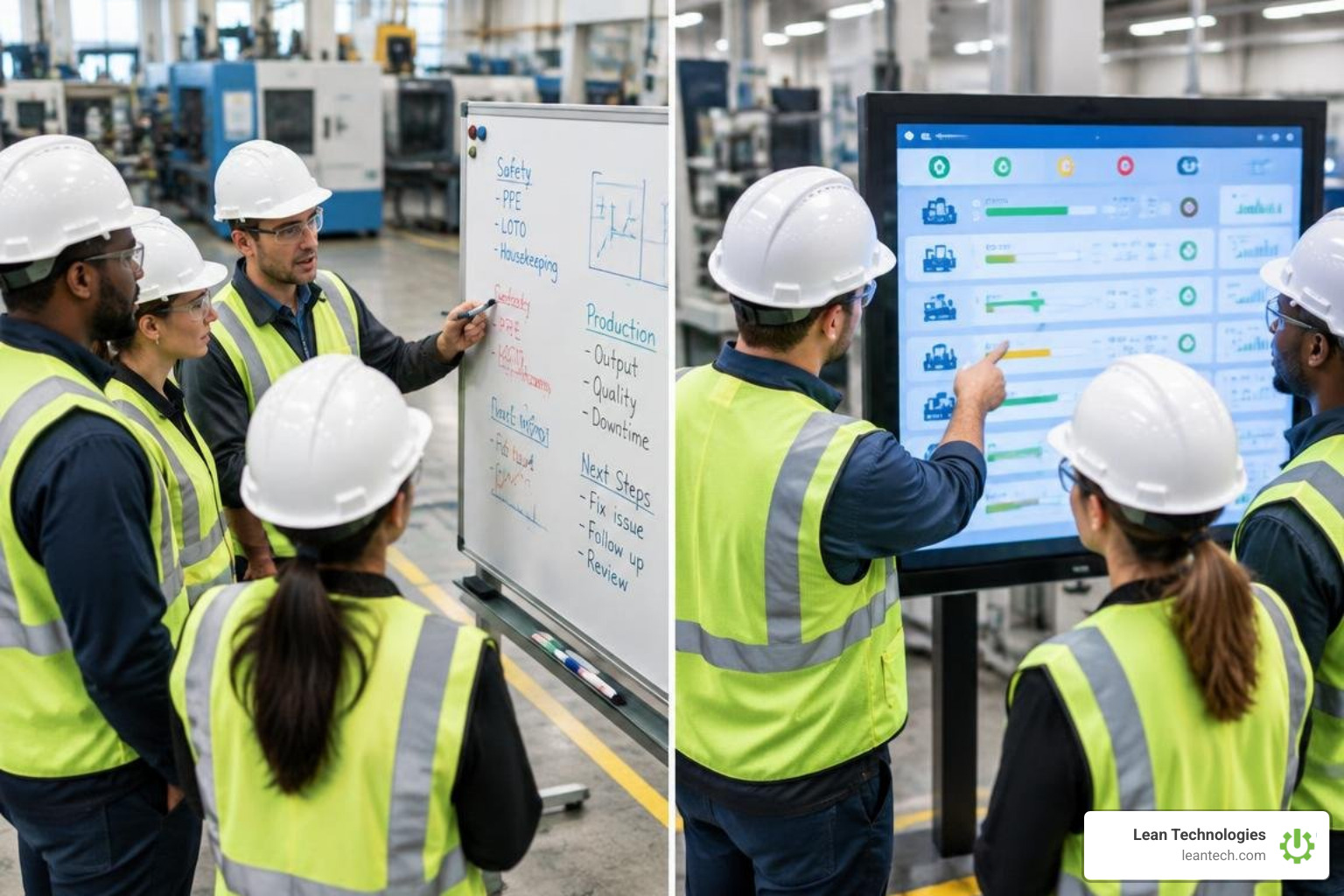
Digital lean manufacturing software upgrades daily tier meetings by replacing static whiteboards and disconnected spreadsheets with a live, operator-fed execution layer. Teams log issues at the source, assign owners, and escalate blockers from Tier 1 to plant leadership in one click, so shift handovers carry forward real actions instead of erased notes. This matters because every morning on plant floors across the country, teams huddle around physical whiteboards for their daily standup meetings. Operators point out scrap spikes, maintenance techs mention a recurring motor stall, and safety officers log minor near-misses. But as soon as the huddle breaks, those critical operational notes stay trapped on dry-erase boards or get re-typed hours later into disconnected spreadsheets. This creates classic spreadsheet chaos, leaving leadership blind to shift trends and forcing continuous improvement managers to chase status updates instead of solving root problems.
When plants attempt to solve this by forcing frontline teams into heavy enterprise platforms, they run straight into typical erp pain. Traditional enterprise resource planning systems and rigid legacy databases were built for transactional accounting, financial rollups, and high-level inventory tracking—not the agile, minute-by-minute communication needed during shift handovers and frontline tier huddles.
The Critical Difference: Legacy ERP and MES vs Digital Lean Manufacturing Software
Understanding where shop floor tools fit is essential for plant managers and IT leaders alike. Comparing legacy systems and modern execution platforms highlights a massive functional gap:
ERP Systems: Handle financial records, purchasing, order entry, and top-level resource planning. They operate on historical transactions rather than immediate shift events.
MES Platforms: Focus heavily on machine integration, rigid production recipes, and heavy execution workflows, often requiring extensive IT overhead to configure.
Digital Lean Manufacturing Software: Acts as an execution and continuous improvement layer. Solutions like Thrive serve as a flexible digital toolbox for small to midsize manufacturers that digitizes lean work processes to help operators and supervisors log issues, track actions, and drive continuous improvement.
It is important to remember that digital lean execution software is not an ERP or MES, and it does not replace existing ERP or MES systems. Instead, it bridges the communication gap between workers and leadership. When evaluating lean mes vs digital lean workflows, modern plants find that digitizing the human side of operational problem-solving delivers faster momentum. Thrive organizes and drives action from machine data when entered by the team or imported from other systems, providing real-time visibility when data is entered at the source (mobile, tablet, desktop) rather than logged later on paper or spreadsheets. This practical execution focus explains what is digital lean why its the future of manufacturing.
Core Principles of Lean Software Development in Plant Operations
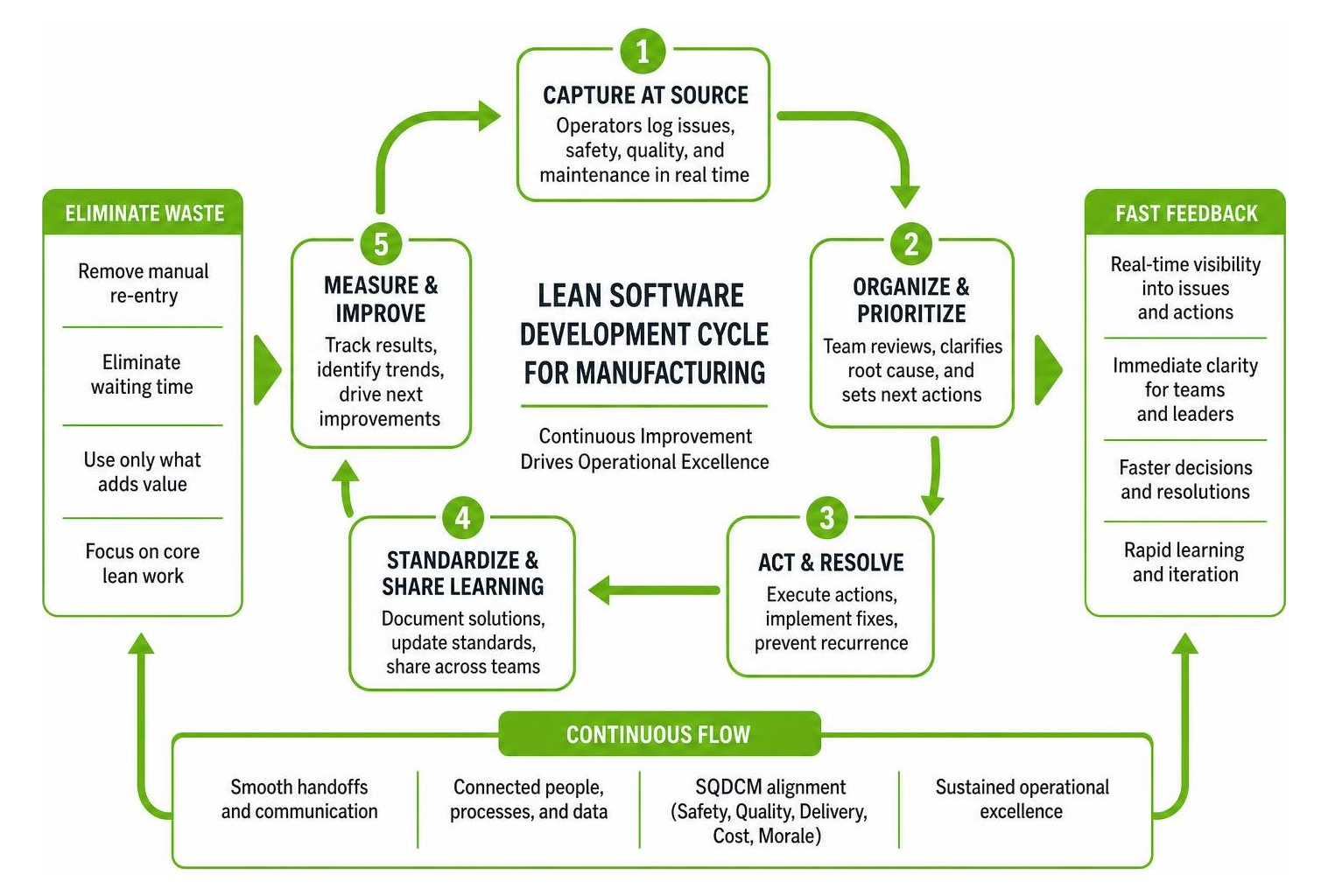
Applying lean software principles directly to factory operations mirrors the proven methods of the Toyota Production System. By eliminating unnecessary administrative overhead, software workflows stay lean, fast, and operator-friendly:
Eliminate Waste: Remove manual data re-entry, administrative waiting times, and unused software features to focus on core lean eliminating waste practices.
Build Quality In: Prevent recurring defects by standardizing root cause capture directly at the workstation during production.
Create Knowledge: Document standard operating procedures, Kaizen events, and maintenance fixes in a central searchable system.
Deliver Fast: Give supervisors immediate visibility into operational bottlenecks rather than waiting for end-of-week reporting.
Respect People: Empower frontline operators with intuitive, simple interfaces that value their time and input.
Optimize the Whole: Connect safety, quality, delivery, cost, and morale (SQDCM) into a unified continuous improvement cycle guide 2026 framework.
Key Capabilities to Look for in Digital Lean Manufacturing Software
Evaluating digital lean manufacturing software requires focusing on frontline adoption and rapid action resolution. If a tool takes weeks of technical classroom training just to log a safety observation, operators will revert to paper sheets and sticky notes.
Evaluation Criteria | Manual Whiteboards & Spreadsheets | Heavy Legacy Systems (ERP/MES) | Digital Lean Execution Software (Thrive) |
|---|---|---|---|
Data Capture Speed | Slow; manual handwriting or end-of-day typing | Complex forms with required transactional codes | Fast logging at the source via tablet, mobile, or PC |
Shift Handover Visibility | Erased daily; zero searchable history across shifts | Buried deep in transactional tables | Instant roll-forward of open tasks and shift notes |
Tier Escalation | Requires manual phone calls, emails, or walking the floor | Rigid approval workflows detached from daily huddles | One-click escalation from Tier 1 to plant leadership |
Action Accountability | Names written on boards with no due-date tracking | Separate project management tools disconnected from floor | Integrated task assignment with clear ownership |
System Flexibility | Highly flexible but unstandardized and unscalable | Extremely rigid; changes require costly IT consulting | Modular digital toolbox customized by plant teams |
Adopting modern digital visual management ensures every level of the facility looks at the same operational truth without assembling slide decks.
Tiered Escalation and Digital Visual Management
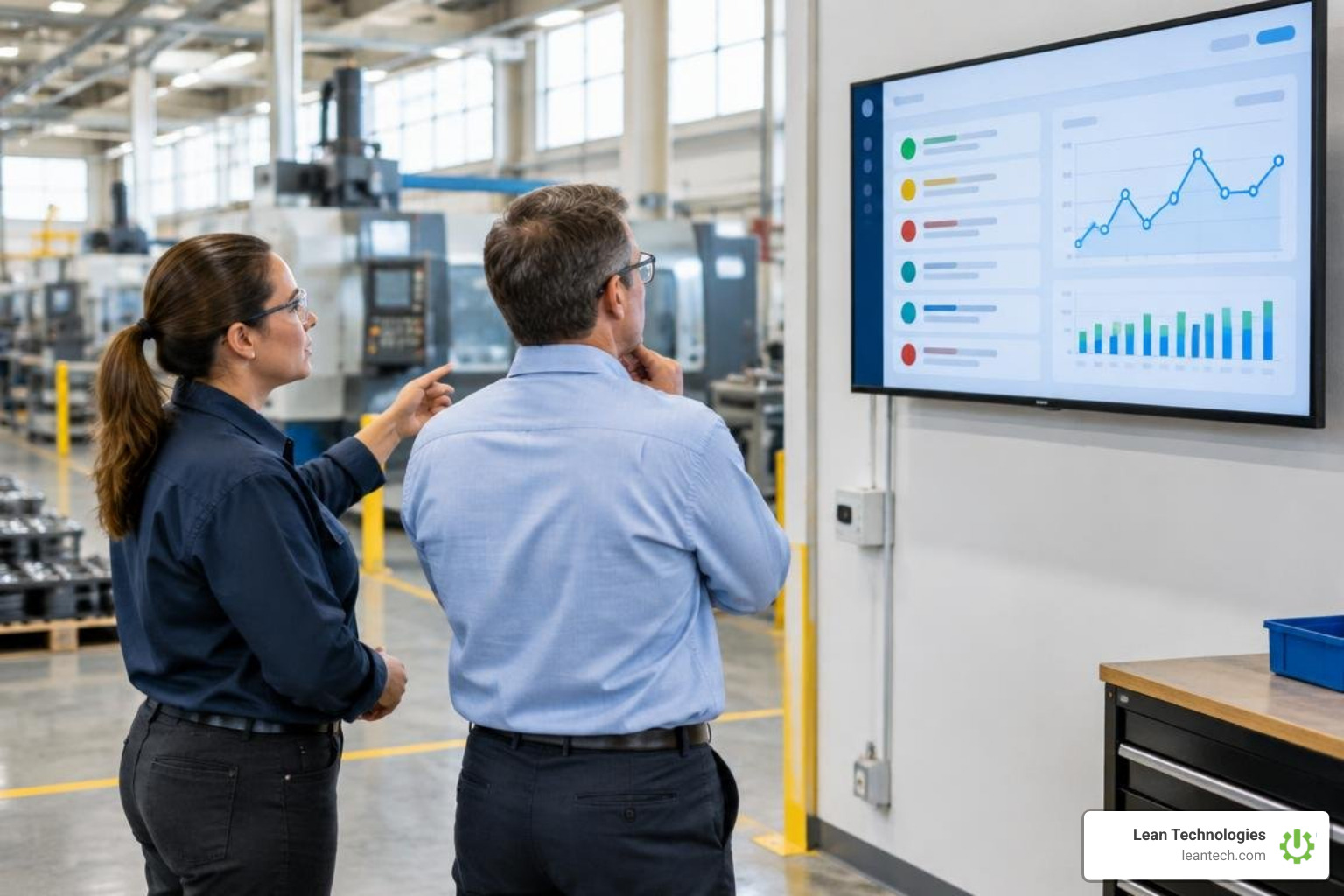
A healthy daily management system relies on clear escalation paths. Tier 1 meetings take place on the plant floor by cell or line, Tier 2 meetings pull department supervisors together, and Tier 3 meetings align plant managers and executive leadership. Modern platforms turn these separate huddles into an integrated chain of accountability.
When a maintenance or quality roadblock cannot be resolved at the line within 15 minutes, the supervisor escalates the record directly into the Tier 2 meeting agenda with a single click. Plant leaders running Tier 3 reviews can see system bottlenecks across all production lines instantly, verify assigned owners, and track resolution timelines. Implementing structured shop floor management practices backed by dedicated digital lean tools and why they matter in shop floor management keeps action items moving across shift boundaries.
Evaluating Digital Lean Manufacturing Software for Frontline Usability
Adoption lives and dies with the frontline operator. When reviewing digital lean software options, ensure the system meets these core practical usability standards:
Source-Level Data Entry: Operators must be able to log downtime reasons, scrap counts, and near-misses on shop-floor tablets or mobile interfaces in under 30 seconds.
No Code Configuration: Operations and CI managers should be able to modify audit forms, checklists, and tier meeting agendas without calling external software developers.
Unified Digital Toolbox: Replace separate apps for 5S audits, safety observations, Kaizen tracking, and shift logs with a cohesive system for a truly connected shop floor.
Clear Action Ownership: Every flagged bottleneck must allow an assigned owner, due date, priority tag, and photo attachment, reflecting the 5 must have features in shop floor management software.
Proven Operational Benefits for Small and Midsize Manufacturers
Small to midsize manufacturers across the United States face significant headwinds, particularly when balancing rising material and energy costs with a shrinking skilled workforce as of 2025. In this tight operating environment, plants cannot afford lost production hours caused by poor communication or recurring equipment failures.
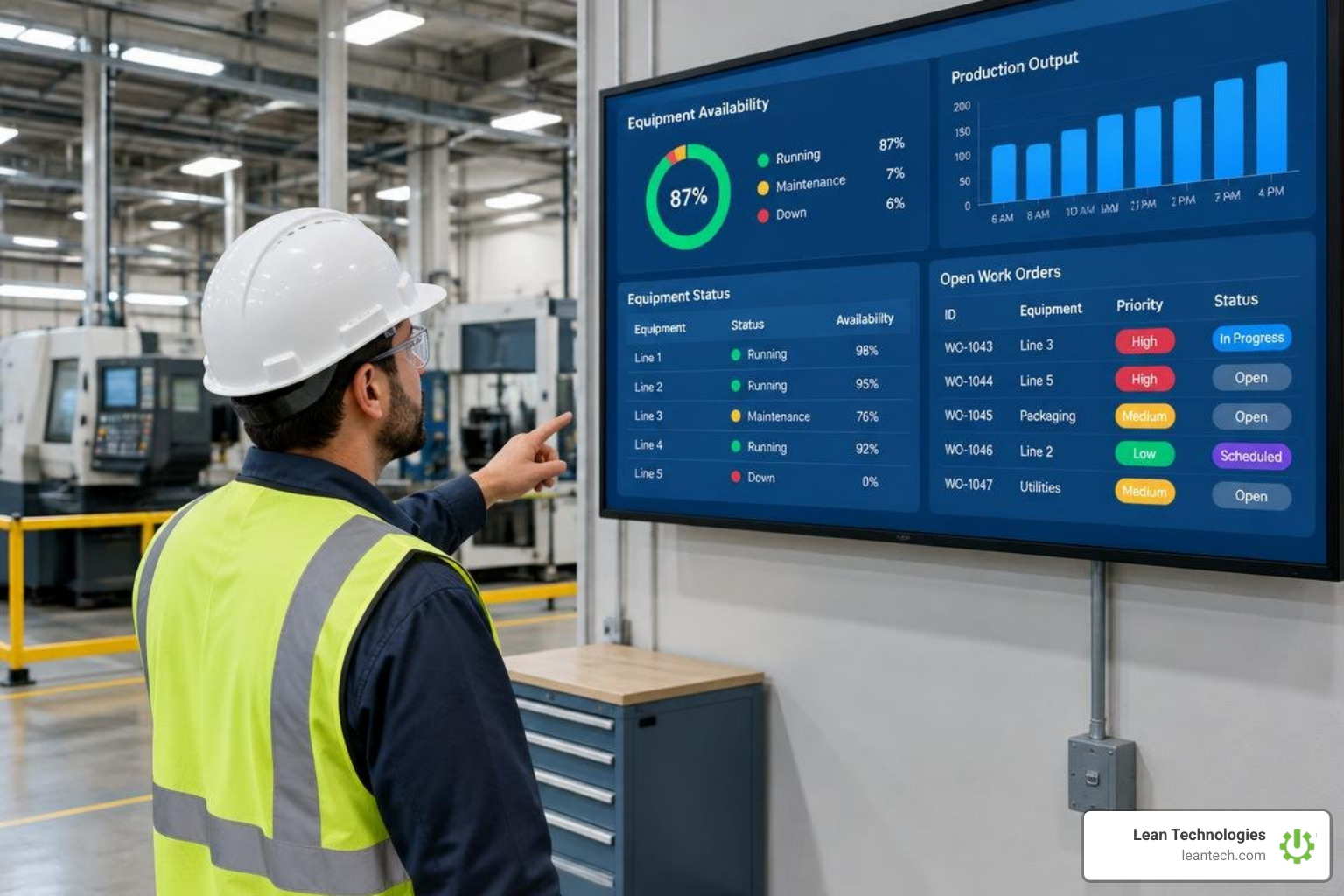
Standardizing daily communication and digitizing routine processes delivers direct cost reduction manufacturing gains. Production and plant managers gain the operational clarity needed to stabilize throughput, while maintenance and quality teams eliminate the administrative drag of manual paperwork to drive consistent operational excellence manufacturing.
Real-World Impact: Uptime, Waste Reduction, and Maintenance Gains
When frontline teams use lean tools to capture shop floor friction at the source, the operational improvements compound quickly across several key areas:
Downtime Mitigation: By tracking micro-stoppages and equipment anomalies immediately during shift handovers, plants catch minor mechanical wear before catastrophic breakdown. For instance, a U.S.-based carmaker reduced downtime by 25% after applying lean development methodologies to build a tailored engineering support system.
Inventory & Scrap Waste Reduction: A frozen food brand reduced waste from expired stock by 30% after implementing a lean-developed real-time inventory tracking MVP. Capturing defect parameters at the line allows QA engineers to implement targeted defect scrap tracking and take immediate corrective measures.
Maintenance Labor Optimization: Industry benchmarks show that top-performing maintenance teams achieve around 80% preventive maintenance percentage by work order volume. However, data tracking gaps often conceal deep inefficiencies—one studied maintenance team hitting a 70% preventive rate by volume still spent over half of its total labor hours reacting to sudden breakdowns. Digital lean task tracking helps maintenance managers rebalance wrench time toward planned work, reinforcing proven methods in how to improve manufacturing efficiency best practices tools.
Starting Small: MVP Implementation and Continuous Kaizen
You do not need to overhaul your entire operating system on day one. Lean principles advocate for launching a Minimal Viable Product (MVP)—starting with a single pilot line, a specific department, or a single tier meeting board.
By following a structured starter roadmap like digital lean in 30 days a practical starter plan, plant teams can deploy digital tier boards, gather direct feedback from operators, adjust workflows, and expand floor-wide. This iterative rollout keeps change management manageable and builds a genuine culture of continuous improvement and kaizen.
Frequently Asked Questions about Digital Lean Software
What is digital lean manufacturing software and how does it support tier meetings?
Digital lean manufacturing software is an execution and continuous improvement platform designed to digitize standard shop floor routines, daily standups, and layered audits. It supports tier meetings by replacing manual whiteboards with interactive visual dashboards. Teams log issues at the workstation, assign tasks to specific owners, track escalation from Tier 1 to Tier 3, and maintain clear records across shift handovers.
Does digital lean software replace existing ERP or MES systems?
No. Digital lean execution software acts as a complementary toolbox and does not replace your ERP or MES. While ERPs manage finance, purchasing, and order scheduling, and MES platforms manage detailed machine control and batch recipes, digital lean tools like Thrive focus on the human execution layer. Thrive organizes and drives action from machine data when entered by the team or imported from other systems, providing a simple workspace for issue logging, Kaizen events, and shift communication within an integrated manufacturing operations platform.
How fast can a plant see ROI after rolling out a digital lean tool?
Most small to midsize plants see measurable returns within weeks of launching a pilot line. Because operators log issues directly at the source, supervisors eliminate hours of daily administrative data collation. Faster issue escalation reduces line downtime, prevents recurring scrap runs, and recovers productive maintenance wrench time, delivering a strong return on investment as outlined in the roi of shop floor operations software.
What to Do Next
Transforming daily plant execution does not require multi-year software deployments or expensive custom IT overhauls. Real operational progress happens when frontline operators, maintenance technicians, quality engineers, and plant managers share a single, easy-to-use digital workspace for daily problem-solving.
Explore how Lean Technologies' Thrive—an all-in-one, customizable shopfloor software platform developed by manufacturing experts—can help your plant streamline operations, boost productivity, and improve profitability. Read our comprehensive guide to digital lean manufacturing to start upgrading your daily tier meetings today.