
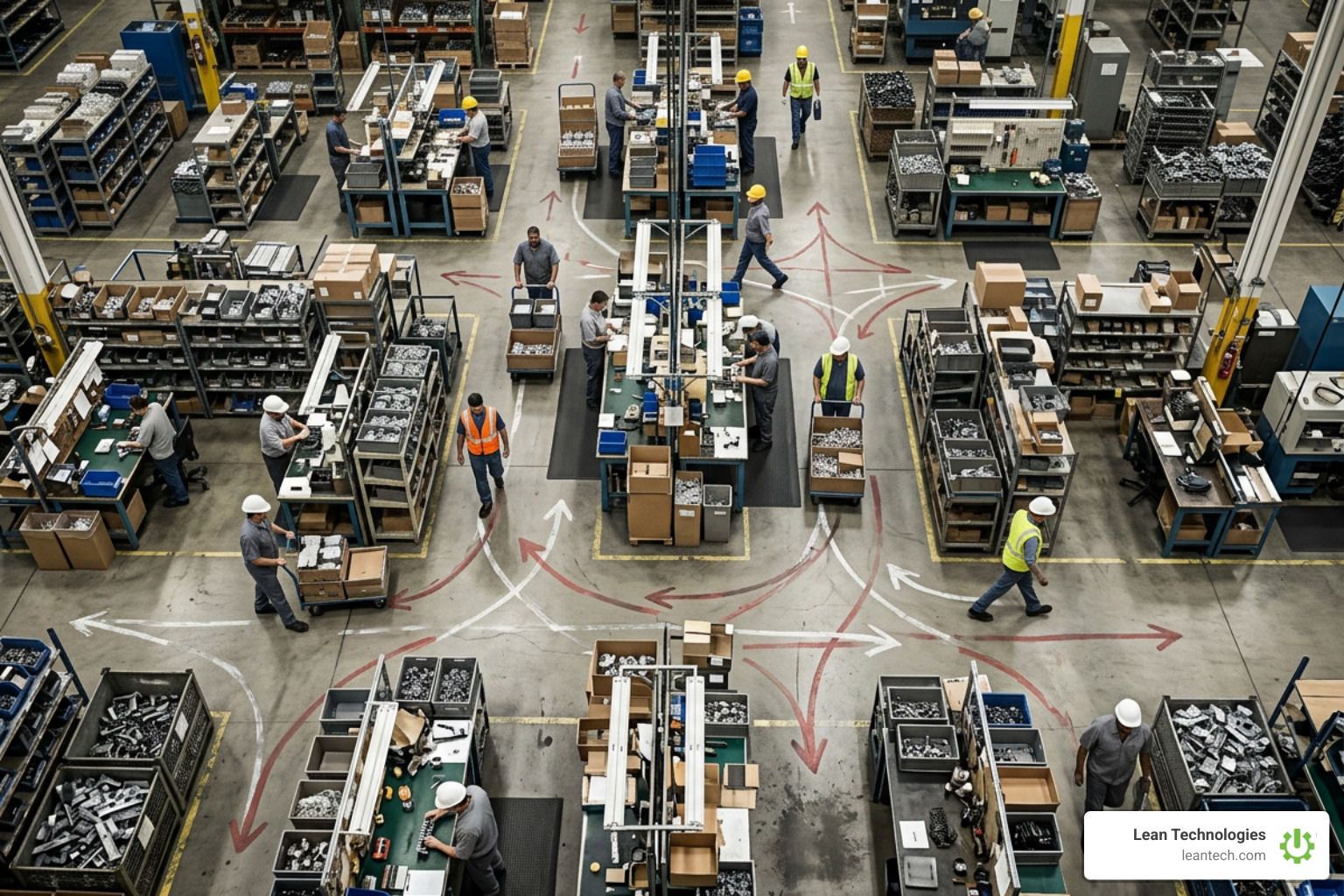
Cut Muda Fast: A Practical Guide to Lean Eliminating Waste
Understanding Muda: The Five Principles of Lean Eliminating Waste
Lean manufacturing centers on a straightforward concept: deliver maximum value to the customer while consuming the absolute minimum of resources. Anything that falls outside that direct value creation is muda (waste). In practice, establishing a successful lean production system requires organizations to look past internal assumptions and evaluate operations through an external lens.
Customer value is defined strictly by the features, form, and timing for which an end buyer is willing to pay. Operations teams often treat internal handoffs, inspections, staging, and buffering as essential steps, yet the customer sees zero benefit in paying for warehouse storage or transport between buildings. By distinguishing between value-adding work, necessary non-value-adding tasks (such as regulatory compliance checks), and pure waste, teams can establish a true target cost baseline.
As detailed in James Womack's Lean Thinking research, applying lean principles transforms operational economics. For instance, homebuilder Doyle Wilson restructured product development around customer-defined value, cutting cycle times dramatically while boosting sales by over 40% and growing gross margins within two years. Setting a target cost requires stripping out visible waste from day one, rather than simply adding a margin on top of inefficient baseline costs. For teams building a roadmap, implementing lean manufacturing begins by mastering the five core principles:
Identify Value: Define what the customer cares about, their required quality standards, and their delivery timeline.
Map the Value Stream: Document every specific step required to bring a product from raw material to delivery, exposing non-value-added delays.
Create Flow: Reorganize workstations, eliminate batch processing, and ensure materials move seamlessly without stopping.
Establish Pull: Produce only what downstream processes or end customers signal they need, preventing unnecessary WIP buildup.
Seek Perfection: Relentlessly drive root-cause problem solving and continuous improvement (kaizen) across all tiers of the organization.
Specifying Value and Mapping the Value Stream
Value stream mapping (VSM) serves as the primary diagnostic tool for uncovering hidden waste in manufacturing operations. A complete VSM captures both material flow and information flow from supplier delivery to customer receipt.
When mapping a value stream, calculate the Value-Added Ratio:
$$\text{Value-Added Ratio} = \left( \frac{\text{Total Value-Added Processing Time}}{\text{Total Process Lead Time}} \right) \times 100$$
In typical unoptimized manufacturing processes, value-added time accounts for only a single-digit percentage of total lead time. A product that takes three weeks to move through a plant often experiences less than two hours of actual hands-on fabrication or assembly. The remaining 99% of the lead time represents staging, queueing, transit, and batch waiting. Mapping this reality gives leadership and frontline operators shared visibility into where lead time actually disappears.
Establishing Flow, Pull, and Continuous Improvement
Once non-value-added activities are mapped, production must shift from isolated "islands" of equipment to continuous flow. Batch-and-queue systems create large piles of work-in-progress (WIP) that hide machine downtime, quality defects, and scheduling errors.
Continuous flow aligns operations to Takt time—the pace of customer demand:
$$\text{Takt Time} = \frac{\text{Available Net Production Time per Shift}}{\text{Customer Demand Units per Shift}}$$
Pacing output to Takt time ensures work flows smoothly from one station to the next without accumulating buffers. Where physical one-piece flow is impossible due to shared equipment or geographical separation, teams implement pull systems (such as visual kanban loops). Downstream steps consume parts, generating an immediate signal for upstream stations to produce an exact replacement batch. This eliminates guesswork and keeps schedules synchronized with real market demand.
The 8 Deadly Wastes on the Modern Factory Floor
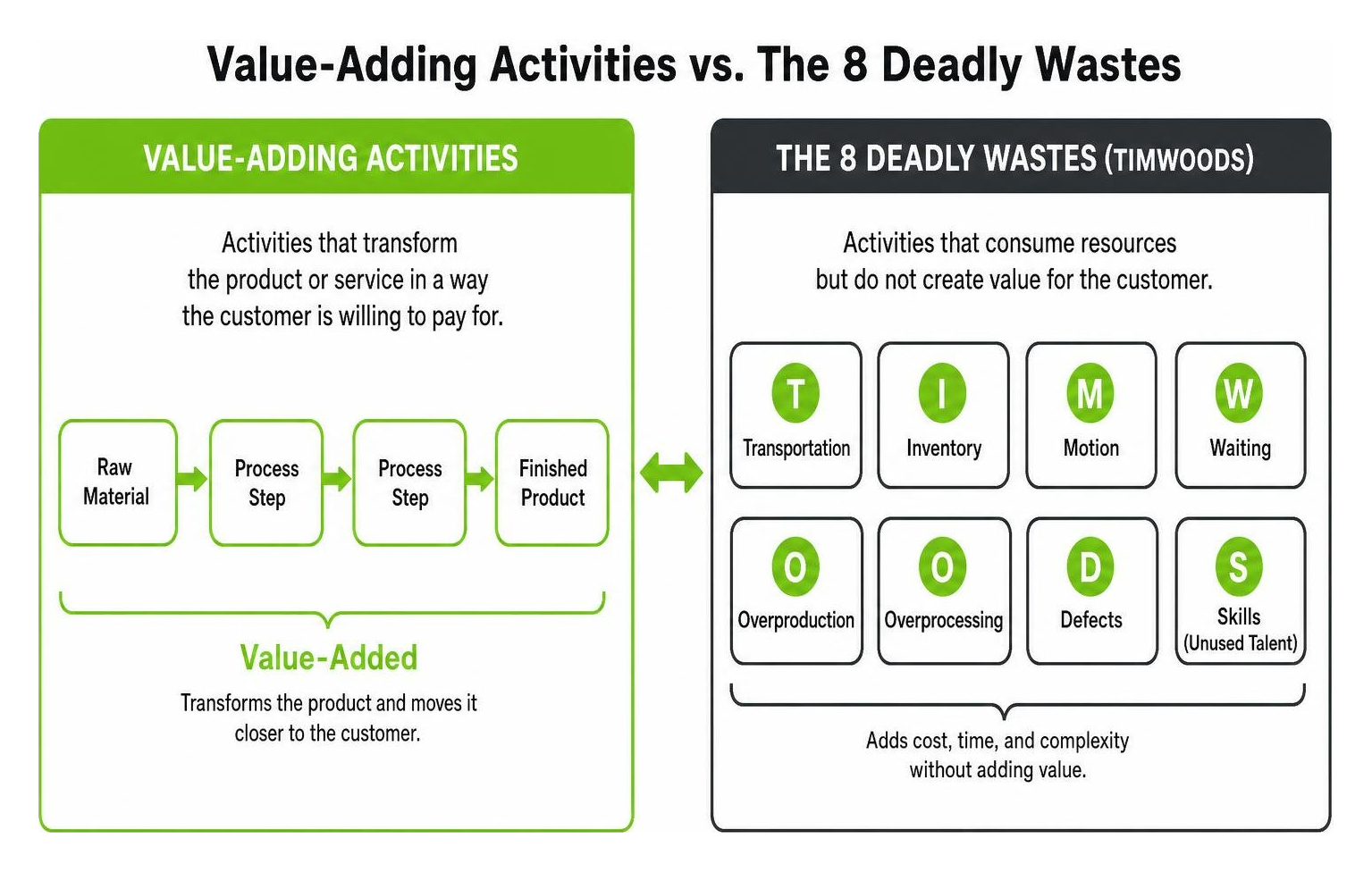
To remove muda, teams must first train their eyes to recognize it during daily gemba walks. The lean methodology groups operational losses into eight categories, commonly remembered using the acronym TIMWOODS:
Transportation
Inventory
Motion
Waiting
Overproduction
Overprocessing
Defects
Skills (Unused Talent)
Facilities that conduct structured loss analysis routinely find that two to three waste categories account for 60% to 80% of their total operational losses. Applying focused manufacturing waste reduction strategies to these vital few categories yields immediate gains in capacity and cash flow.
Overproduction and Excess Inventory
Taiichi Ohno termed overproduction the "mother of all wastes" because producing ahead of demand or in excess quantities triggers almost every other operational loss.
When a machining center produces 5,000 components when downstream assembly only needs 500, the excess parts must be packaged, moved by forklift, stored in warehouse racking, tracked in software, and eventually inspected for corrosion or obsolescence. Applying structured lean inventory management practices prevents excessive capital from being locked up in stagnant raw materials, WIP, and finished goods, while exposing machine reliability problems that large buffers tend to mask.
Waiting, Transportation, and Motion
Time losses frequently hide in plain sight across factory layouts:
Waiting: Operators standing idle while waiting for material deliveries, maintenance repairs, changeovers, or supervisor approvals. In a typical travel value stream, for example, out of 13 total hours of transit time, only 7 hours (54%) represent actual travel, while 6 hours (46%) disappear into queues, ticketing bottlenecks, and boarding delays.
Transportation: Unnecessary movement of materials, parts, or tooling between buildings, mezzanine floors, or distant staging areas. Every forklift transit adds handling cost, increases product damage risks, and consumes floor space without altering the physical form of the product.
Motion: Unnecessary movement of people. Operators bending, stretching, reaching, walking to find misplaced tools, or navigating poorly arranged benches waste physical stamina and increase cycle times. A spaghetti diagram mapping an operator's shift often reveals miles of redundant walking that can be eliminated through ergonomic cell layouts.
Overprocessing, Defects, and Unused Talent
The remaining wastes undermine product quality and employee engagement:
Overprocessing: Performing more work on a part than the customer specified or requested. Examples include polishing internal brackets that require no aesthetic finish, running redundant secondary inspections, or requiring multiple management sign-offs on standard production paperwork.
Defects: Scrap, rework, and repairs that consume raw materials, machine capacity, and labor. Using dedicated defect and scrap tracking systems enables teams to log defect types at the point of occurrence, pinpoint root causes via Pareto analysis, and implement permanent corrective actions.
Unused Talent (Skills): Failing to tap into the problem-solving ability, technical knowledge, and creativity of frontline workers. When operators are treated merely as button-pushers rather than active contributors to continuous improvement, plants lose their most valuable source of process optimization.
Root Cause Sequencing: Tackling Mura, Muri, and Muda
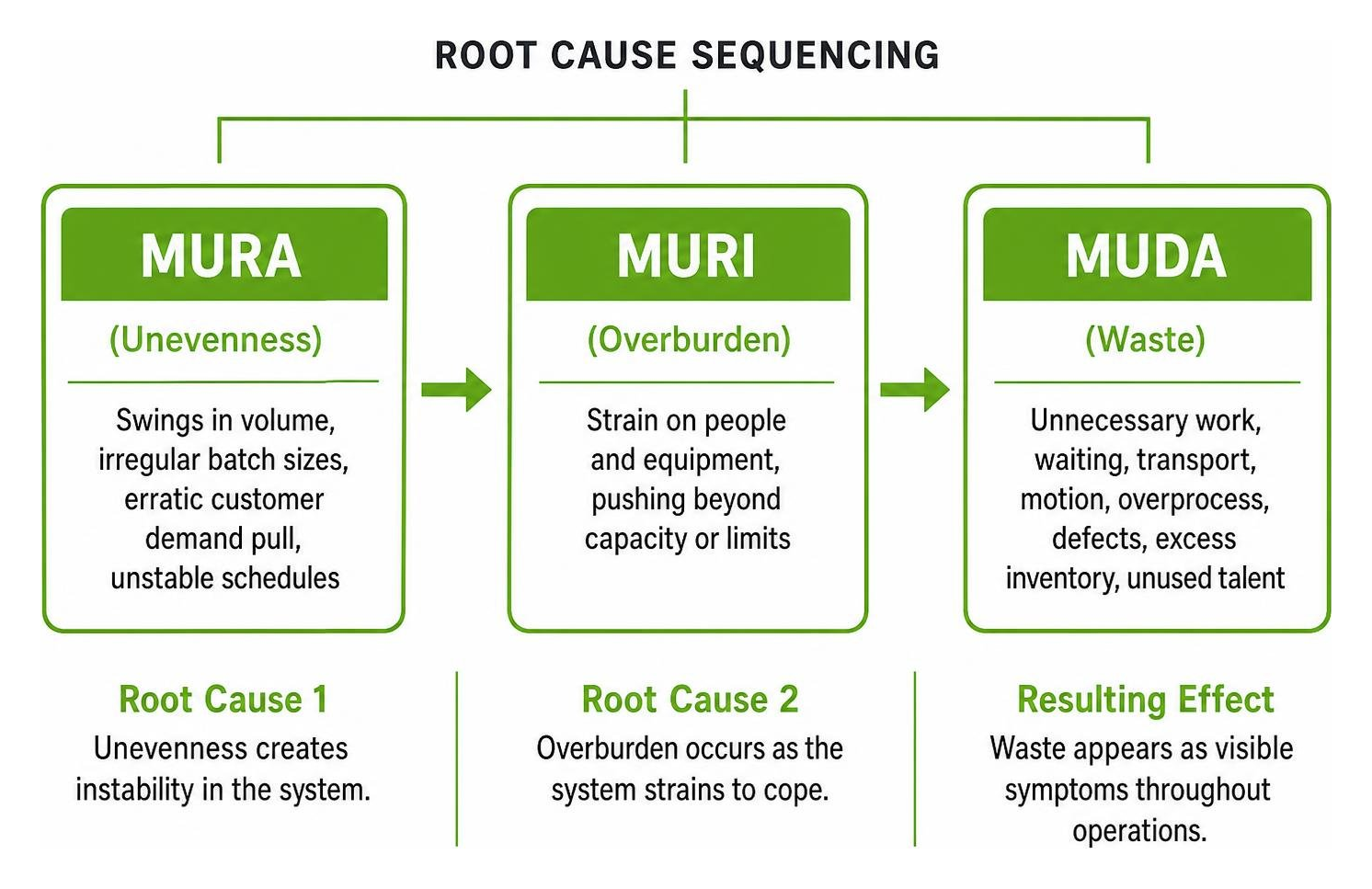
A frequent pitfall in lean transformations is attacking visible waste (muda) as an isolated symptom while ignoring the systemic instability that creates it. Toyota’s operational model establishes that waste stems directly from two root factors: Mura (unevenness/variation) and Muri (overburden).
Concept | Lean Definition | Factory Floor Example | Systematic Countermeasure |
|---|---|---|---|
Mura | Unevenness, irregularity, or schedule instability | Rushing 70% of monthly production volume out the door in the final five days of the month. | Production leveling (Heijunka), mixed-model scheduling, kanban replenishment. |
Muri | Overburden of people, machinery, or systems | Running a stamping press past thermal limits without lubrication stops, or overloading workers with excessive cycle speeds. | Standardized work, line balancing, preventative maintenance schedules, ergonomic design. |
Muda | Non-value-adding activity or resource consumption | Staging 20 bins of WIP because downstream assembly cannot handle an upstream batch spike. | Root-cause removal via 5S, SMED, Poka-Yoke, cellular manufacturing. |
Leveling Unevenness (Mura) and Overburden (Muri)
When production schedules swing wildly from day to day, supervisors respond by stockpiling raw materials and building safety stock. Operators are pushed to work exhausting overtime during peak spikes, leading to fatigue, safety incidents, and human assembly errors (Muri).
Implementing Heijunka (production leveling) smooths out production volume and product mix over time. Instead of running 500 units of Product A on Monday and 500 units of Product B on Thursday, plants sequence smaller, mixed batches daily (e.g., A-B-A-B). Leveling eliminates severe demand spikes, standardizes machine utilization, and removes the artificial need for inventory buffers.
Practical Execution of Lean Eliminating Waste on the Shop Floor
Systematic waste elimination follows a structured, multi-step execution cycle:
Observe at the Gemba: Go to the floor where work happens. Stand in a designated area and observe the complete process cycle without interrupting the operators.
Track Information and Material Flow: Document how instructions reach the floor. Bottlenecks and miscommunications highlighted in waste in information flow often create physical floor delays before metal is even cut.
Capture Environmental and Resource Waste: Identify wasted power, water, compressed air leaks, and chemical discard. Resources such as the EPA Lean and Environment Toolkit demonstrate how eliminating process waste directly slashes environmental compliance costs and utility expenses.
Categorize and Prioritize Losses: Group observed losses by waste type and quantify their financial impact using Pareto analysis.
Execute Rapid Improvement Events: Deploy cross-functional teams to apply targeted countermeasures against the top two root causes.
Lean Tools and Countermeasures for Targeted Waste Removal
Selecting the right tool for a specific operational constraint prevents teams from wasting time on generic solutions. Rather than applying tools at random, match countermeasures directly to the primary waste type to achieve sustainable cost reduction in manufacturing.
Pull Systems, Kanban, and SMED
Overproduction and inventory waste require precise scheduling and rapid tool changes:
Single-Minute Exchange of Die (SMED): Traditional plants run massive batch sizes because changeovers take several hours. SMED separates changeover steps into internal elements (actions that can only be done while the machine is stopped) and external elements (actions performed while the machine is running, such as staging tooling and preheating dies). By converting internal steps to external ones and streamlining mechanical adjustments, SMED brings changeover times into single digits (under 10 minutes). Rapid setups make small-lot production economically viable and eliminate massive WIP buildup.
Kanban Replenishment: Visual replenishment signals (cards, bins, or digital boards) authorize production only when downstream consumption occurs. A two-bin kanban system ensures that when the first bin empties, it serves as an immediate visual production order, while the second bin supports assembly during replenishment.
5S Workplace Organization, Poka-Yoke, and Jidoka
Workplace disorganization, excess motion, and quality defects are resolved through standardization and process control:
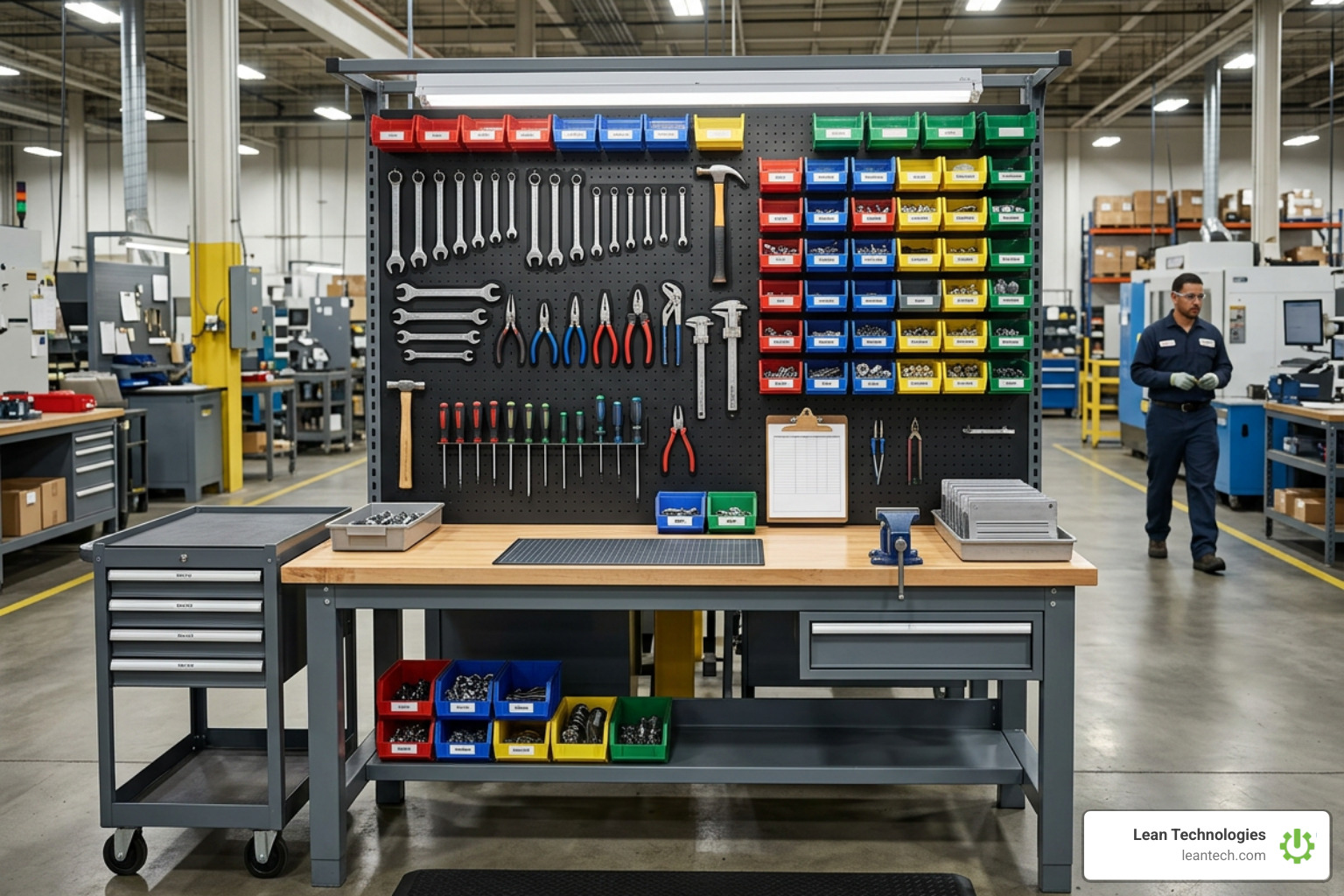
5S Methodology (Sort, Set in Order, Shine, Standardize, Sustain): 5S eliminates motion and waiting waste by organizing work environments. Tools, gauges, and materials receive dedicated, labeled locations with shadow boards and clear floor markings. Operators spend zero time searching for equipment.
Poka-Yoke (Error-Proofing): Inexpensive physical or electrical mechanisms that make it impossible to perform an operation incorrectly. Examples include asymmetrical locating pins that prevent parts from being loaded upside down, limit switches that require all clamps to be engaged before a press cycles, and digital torque wrenches that lock out until the correct fastener sequence is completed.
Jidoka (Autonomation): Building quality checks directly into equipment. When a machine detects an abnormal condition, a broken drill bit, or an out-of-tolerance dimension, it stops automatically and signals the line with an andon light. This prevents the continuous creation of defective parts, freeing operators to manage multiple machines without full-time oversight.
Sustaining Operational Gains and Building Continuous Flow
Eliminating waste is not a one-time clean-up event; it requires operational discipline to prevent bad habits and unnecessary buffers from returning. Maintaining baseline stability ensures that initial kaizen gains become permanent business performance improvements.
Standardized Work as the Baseline for Stability
Standardized work forms the baseline for all continuous improvement. As the saying in lean operations goes, "Where there is no standard, there can be no kaizen."
Standardized work combines three elements:
Takt Time: The required rate of production matching customer demand.
Work Sequence: The exact chronological sequence of steps an operator follows within a single cycle.
Standard Work-in-Progress (SWIP): The minimum number of parts required within the cell to keep the process flowing continuously.
Standard operating procedures must be clear, highly visual, and accessible directly at the workstation. When cycle times or quality metrics drift from the standard, teams investigate the deviation immediately rather than guessing what went wrong days later.
Building a Culture of Lean Eliminating Waste Across Teams
Sustaining continuous flow requires active engagement across production, maintenance, quality, and leadership:
Tiered Daily Accountability: Quick, 10-minute stand-up meetings held at shift start in front of visual management boards. Teams review yesterday’s safety, quality, delivery, and cost metrics, log current bottlenecks, and assign action owners with firm 24- to 48-hour closure windows.
Frontline Problem Logging: Giving operators a frictionless way to flag machine abnormalities, ergonomic strain, and process waste. When workers know their feedback leads to concrete improvements, shopfloor culture shifts from passive acceptance of waste to proactive problem-solving.
Cross-Functional Gemba Problem Solving: Instead of engineering and management debating issues in conference rooms, leaders meet with maintenance techs and line operators directly at the machine to perform 5-Why root cause analysis.
Frequently Asked Questions About Lean Waste Elimination
Why is overproduction considered the most severe lean waste?
Overproduction is the most damaging waste because it creates and conceals almost every other form of operational loss. Producing parts before they are needed ties up critical working capital in raw materials and WIP. It forces plants to purchase extra storage racking, pay for climate-controlled warehousing, and hire forklift drivers to shuffle inventory between staging zones. Crucially, large inventory buffers hide severe equipment defects, process instability, and supplier quality issues until weeks after the bad parts were made, resulting in massive scrap and rework costs.
What is the primary difference between Muda, Mura, and Muri?
The primary difference lies in the relationship between root causes and visible symptoms within the production system:
Mura (Unevenness) is the root operational instability—fluctuating production schedules, inconsistent batch sizes, and erratic customer order patterns.
Muri (Overburden) is the physical stress placed on equipment and workers when forced to absorb severe schedule spikes or operate beyond design limits.
Muda (Waste) is the visible byproduct of unevenness and overburden—manifesting as machine breakdowns, waiting lines, rework, high defect rates, and excessive warehouse inventory.
Sustainable lean programs sequence improvements by leveling Mura first, balancing workloads to prevent Muri, and then applying specific tools to eliminate remaining Muda.
How quickly can a plant expect measurable results from waste elimination?
Most manufacturing facilities achieve measurable results across three distinct phases:
Weeks 1 to 4: Initial gemba observations, value stream mapping, and low-cost 5S workplace organization events produce immediate improvements in workstation order, operator motion reduction, and safety compliance.
Months 2 to 6: Focused kaizen events targeting SMED changeover reductions, kanban pull replenishment, and line balancing deliver significant cycle time reductions, lower WIP levels, and improved first-pass yield.
Years 1 to 3: Achieving mature continuous flow, integrated digital accountability, and widespread employee-driven problem solving cuts end-to-end manufacturing lead times by 30% to 50% while permanently driving down operational overhead costs.
What to Do Next
Sustaining continuous flow and lean eliminating waste across modern manufacturing operations requires replacing manual whiteboards, paper tracking sheets, and late shift logs with structured, real-time accountability. When teams lack a single platform to log downtime, capture defects, and assign corrective tasks, waste quickly creeps back into daily routines.
Thrive is a digital platform built for small to midsize manufacturers to digitize lean work processes in real time without replacing ERPs or MES systems. Designed by manufacturing professionals, Thrive acts as a flexible digital toolbox for logging issues, tracking actions, and driving continuous improvement across the shop floor.
Rather than relying on disjointed paper workarounds or static spreadsheets, Thrive provides real-time visibility only when processes are structured and data is entered at the source via mobile, tablet, or desktop. It does not collect sensor data or run predictive alerts; instead, it organizes action from machine data entered by teams or imported from other systems. By providing a clear structure for daily tiered management, maintenance task tracking, and quality containment, Thrive represents the fastest path to structured, accountable work processes.
To see how modern plants digitize lean workflows and eliminate hidden shopfloor losses, explore our digital lean manufacturing solutions or request a demo with the Lean Technologies team today.