
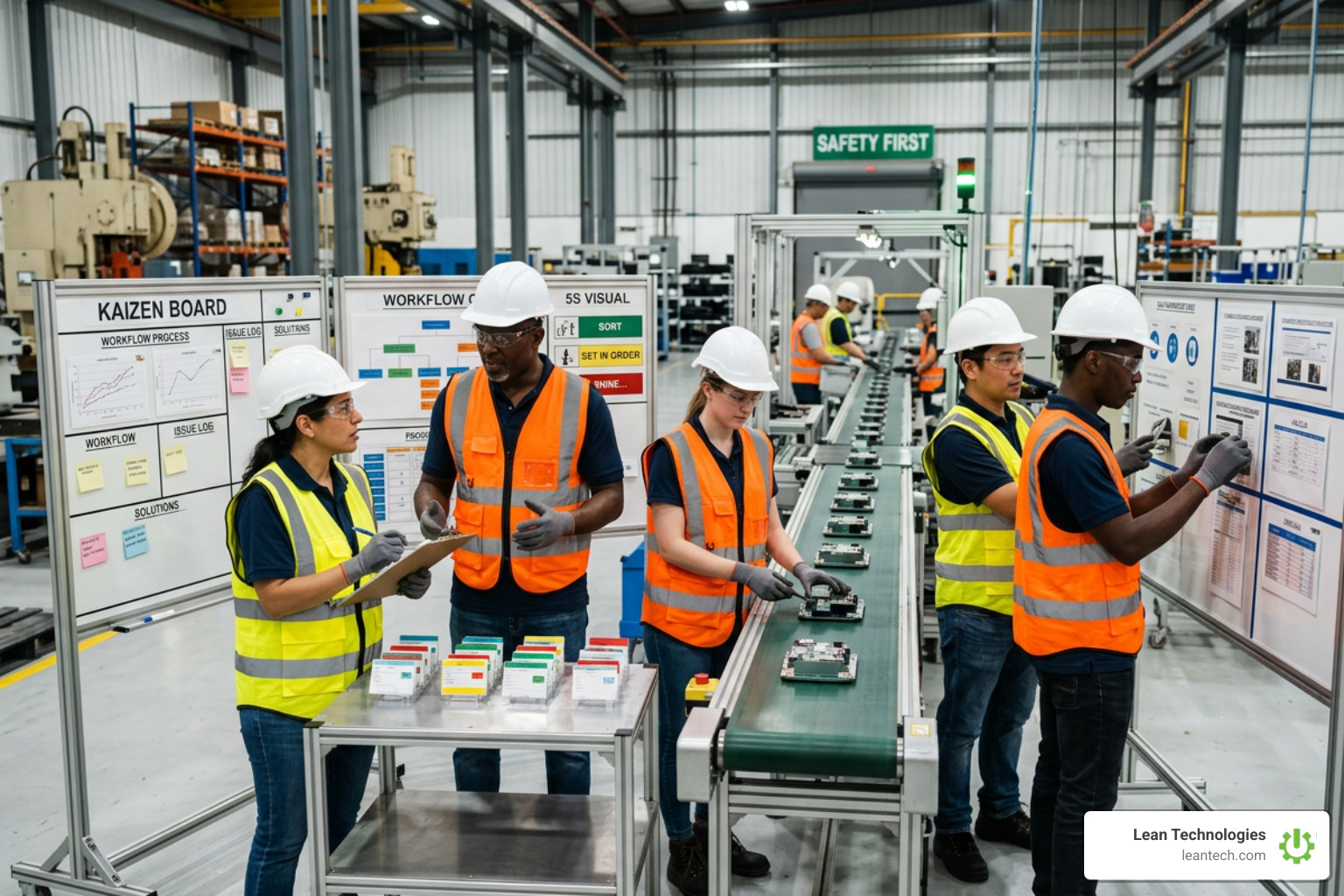
Stop Wasting Time and Start Implementing Lean Manufacturing Today
Why Most Plants Are Leaving Money on the Table With Lean
Implementing lean manufacturing is one of the most proven ways to cut waste, speed up production, and deliver more value to customers — yet roughly 70% of lean initiatives in the U.S. fail.
That's not a small number. It means the majority of plants that commit time, money, and people to lean end up with little to show for it. Not because lean doesn't work. Because most organizations skip the foundational steps, try to roll it out everywhere at once, and never build the digital infrastructure needed to sustain gains beyond the first kaizen event.
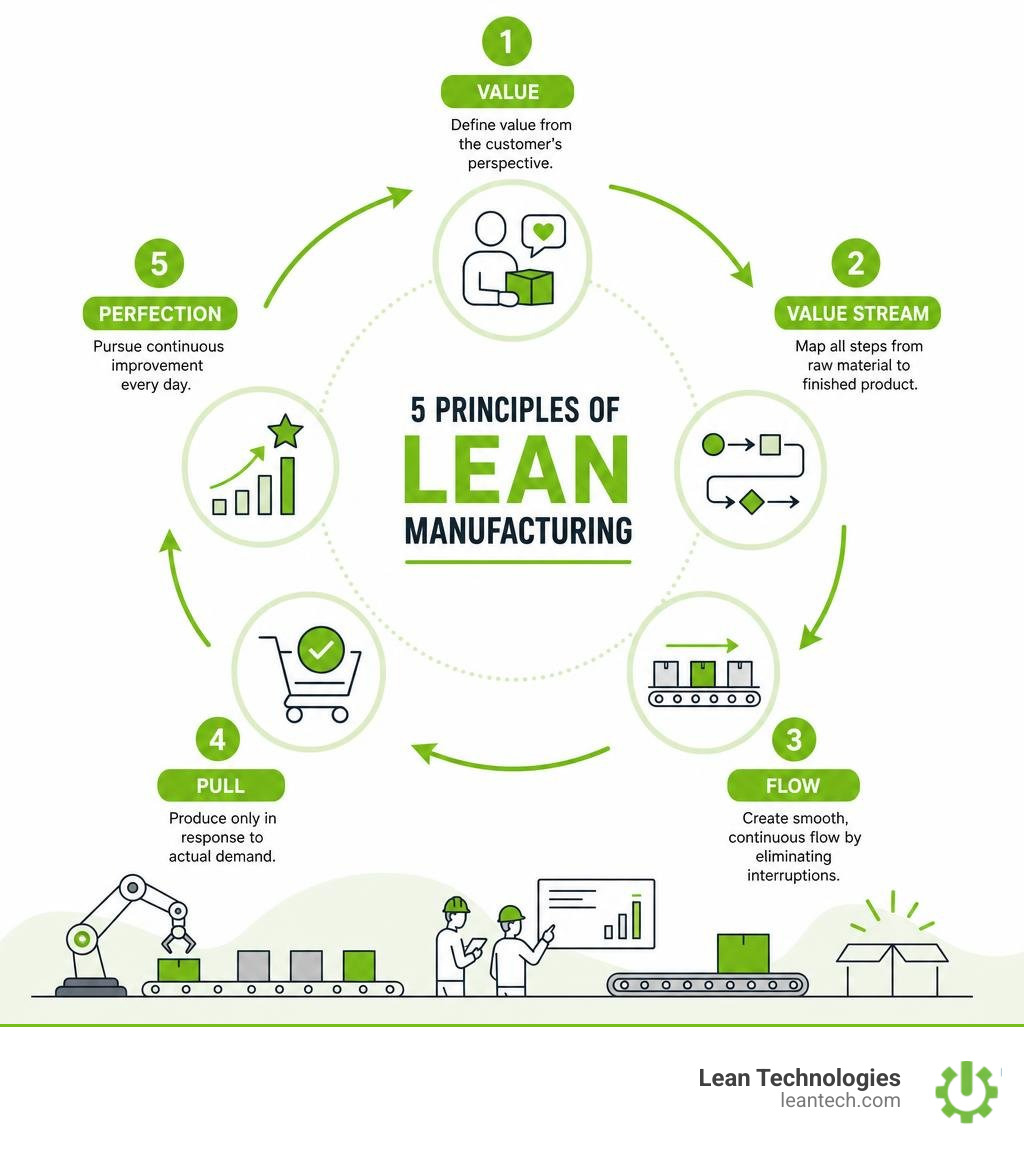
Here's the quick picture of what successful lean implementation actually looks like:
Define value from the customer's perspective — only produce what they're willing to pay for
Map the value stream — document every step from raw material to finished product
Create flow — eliminate interruptions between value-adding steps
Establish pull — produce only in response to real demand, not forecasts
Pursue perfection — treat continuous improvement as a daily habit, not a one-time project
The problem most operations managers run into isn't a lack of lean knowledge. It's the gap between knowing the principles and actually making them stick on the shop floor — especially when data lives in spreadsheets, reporting is manual, and frontline teams aren't part of the process.
This guide walks through a practical, phased approach to lean implementation that reduces risk, builds real buy-in, and delivers measurable results — from your first pilot line to plant-wide transformation.
The High Cost of Waste: Why Most Lean Initiatives Fail
Let’s address the elephant in the shop floor: the staggering 70% failure rate of lean initiatives in the United States. Why do so many well-intentioned operations managers fall flat when implementing lean manufacturing?
It rarely comes down to the tools. A 5S shadow board or a Kanban lane is easy to understand. The failure happens because of organizational resistance, the "flavor of the month" mentality, and a critical lack of real-time digital infrastructure.
When a plant relies on paper logs, dry-erase boards, and spreadsheets compiled at the end of the week, the lean effort is already dead. This lag creates a disconnect. If operators are forced to fill out stack after stack of paperwork to log a single minute of downtime, they will quickly view lean as a bureaucratic burden rather than a helpful tool.
Furthermore, forcing a top-down, rigid framework without auditing your current environment is a recipe for disaster. Before diving headfirst into complex toolsets, smart manufacturers use a Lean Culture Assessment to gauge shopfloor readiness.
To mitigate these common pitfalls and ensure long-term adoption, check out these 5 Essential Tips for Implementing Lean Manufacturing | MOSIMTEC which highlight the necessity of balancing operational changes with employee wellbeing to prevent burnout.
Mapping the Flow: The Foundation of Implementing Lean Manufacturing
At its core, lean is about separating what adds value from what doesn't. In traditional manufacturing, value-adding time typically represents only 1% to 5% of the total lead time. The remaining 95% to 99% is pure waste—materials sitting in queues, waiting for approvals, or being moved from one corner of the facility to another.
Value is defined entirely from the customer's perspective. If a customer isn't willing to pay for a step, that step is waste. According to the Principles of Lean Manufacturing - ASCM , mapping this flow ensures that material and information move smoothly through the plant without hitting bottlenecks.
To bridge the gap between physical processes and modern software systems, operations leaders rely on a Guide to Digital Lean Manufacturing to replace slow, paper-based tracking with live, edge-of-the-shopfloor data entry.
Designing the Future State: Present vs. Future Value Stream Mapping
Before making any physical changes on the floor, you must map the current flow. This is done through Value Stream Mapping (VSM).
Present State Value Stream Map (PSVSM): A raw, unfiltered picture of how your plant currently operates. You walk the floor, clipboard in hand, documenting actual cycle times, changeover durations, scrap rates, and inventory pile-ups.
Identify Bottlenecks: Use Root Cause Analysis (such as the "5 Whys" technique) to dig into why inventory piles up at specific stations. For example, is a die-cutting machine waiting on tooling, or is it a scheduling error?
Future State Value Stream Map (FSVSM): This is your blueprint for the next 6 to 12 months. It maps out your ideal, waste-free flow, showing where Kanban loops, continuous flow cells, and standardized work will be introduced.
The 90-Day Roadmap: A Phased Approach to Lean Success
Attempting a simultaneous, company-wide lean rollout is the fastest way to join the 70% failure statistic. A gradual, phased implementation allows your team to learn, adjust, and celebrate quick wins without disrupting daily shipments.
A structured 90-day roadmap focuses your resources on a single, high-impact area. This "model line" serves as a working laboratory where operators and supervisors can test tools without risking plant-wide performance. For a comprehensive, step-by-step breakdown of this timeline, consult The Ultimate Lean Manufacturing Implementation Guide: Step-by-Step Roadmap for Sustainable Efficiency - Factory Tips .
To ensure that these operational shifts don't trigger employee pushback, active Change Management is critical. If operators don't understand why processes are changing, they will quietly revert to their old ways the second supervisors look away.
Launching a Pilot Program: The First Step in Implementing Lean Manufacturing
Your pilot program is the proving ground. When implementing lean manufacturing, select a pilot line that is highly visible, has manageable complexity, and is run by open-minded team members.
Identify Change Agents: Find influential shopfloor operators and supervisors. Train them first. Once they see that lean makes their daily work easier—reducing physical strain and cutting down on search times—they will advocate for the system to other shifts.
Frontline Training: Avoid dry classroom slide decks. Instead, run short, hands-on kaizen events directly on the pilot line. Let operators help design their own workstations.
Secure Leadership Buy-in: Keep plant managers and executives engaged by showing them immediate, visual progress. Real-time data beats a weekly summary report every single time.
Eliminating the Eight Wastes: Real-World Tools and Techniques
Lean categorizes waste into eight distinct areas, easily remembered by the acronyms TIMWOODS or DOWNTIME:
Waste Type Shop Floor Example Defects Scrap parts, rework, or mislabeled packaging. Overproduction Making parts before the next process is ready for them. Waiting Operators standing idle due to machine breakdowns or missing tooling. Non-Utilized Talent Ignoring frontline operators' ideas for process improvement. Transportation Moving raw materials back and forth between warehouses unnecessarily. Inventory Excess work-in-process (WIP) clogging up aisles and tying up cash. Motion Operators bending, reaching, or walking long distances to find tools. Extra Processing Double-checking measurements because the process is unstable.
For a deep dive into these wastes and how they apply across different sectors, read the Lean Manufacturing: Principles, Tools, Case Studies (2025 Guide) .
Real-World Impact: The Labeling and Packaging Plant Study
To see how these wastes are eliminated in practice, look at a real-world case study of a labeling and packaging plant. By applying targeted lean tools to their operations, they achieved remarkable improvements in their core KPIs:
Internal Complaint Rate (ICR): Reduced by 55% through standardized visual checks.
Customer Complaint Rate (CCR): Plummeted by 83% due to color-coded quality systems and error-proofing at pack-out.
Lead Time: Improved by 7.1% overall.
Waiting Time: Waiting time during die-cutting setups was slashed by 9.6% simply by designing a custom Kanban die rack to keep tools organized and ready.
Standardizing the Shop Floor: 5S, SMED, and Kanban in Action
To eliminate these wastes systematically, you need to master three fundamental shopfloor tools:
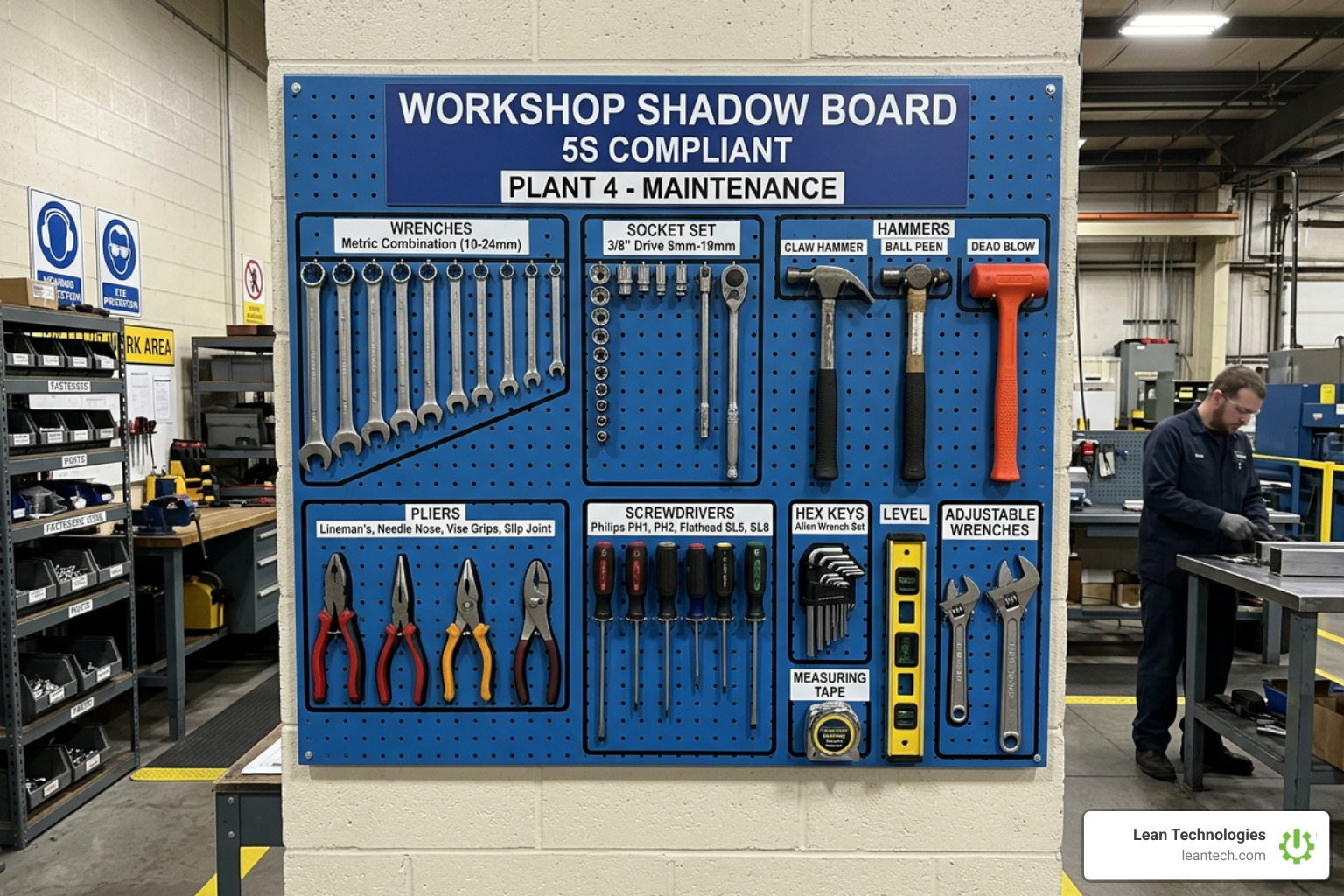
5S Methodology: Sort, Set in Order, Shine, Standardize, and Sustain. This is not just "cleaning up." It is about reducing motion and search time. If an operator takes more than 30 seconds to find a tool, your 5S has failed.
SMED (Single-Minute Exchange of Dies): A systematic method to reduce setup and changeover times to under 10 minutes (single digits). By preparing tooling and materials while the machine is still running (external setup), you maximize run-time.
Kanban: A visual pull signal that authorizes production. Instead of pushing work onto a cell based on a guess, downstream processes "pull" what they need using a physical card or a digital trigger.
To manage your pull signals without losing paper cards on the floor, a digital Kanban Board Tool keeps workflows organized. Additionally, to ensure your machines are actually available when a pull signal arrives, integrate these efforts with Planned Maintenance routines to prevent unplanned stops.
Tracking Performance: Metrics That Prove Lean ROI
You cannot manage what you do not measure. If you want your lean program to survive past its first year, you must tie shopfloor improvements to hard operational metrics.
Traditional accounting metrics often hide waste. Lean metrics, on the other hand, focus on flow, quality, and asset utilization. To keep these metrics front and center for your teams, use Performance Goal Boards to make shift-by-shift performance completely transparent.

Measuring Success: Key Performance Indicators for Implementing Lean Manufacturing
When implementing lean manufacturing, track these four critical key performance indicators (KPIs) to prove your return on investment:
Utilized Equipment Effectiveness (UEE): Measures how effectively your bottleneck machinery runs during scheduled production hours. In the labeling plant case study, UEE improved by 15% after lean implementation.
Units Produced per Labor Hour (UPLH): Tracks labor productivity. The packaging plant saw a 13.30% improvement in UPLH as a direct result of eliminating motion and waiting waste.
Output Dispatch Rate: Slashed backlogs and improved daily output dispatch rates by 13.04%.
Lead Time: The total time from customer order to product delivery. Mature lean systems regularly see lead time reductions of 50% to 90%.
To sustain these metrics long-term, supervisors must practice Leader Standard Work. This ensures that daily gemba walks, process audits, and tiered meetings occur reliably every single shift.
Frequently Asked Questions about Implementing Lean Manufacturing
Why do 70% of lean manufacturing implementations fail?
Most implementations fail because companies treat lean as a cost-cutting exercise or a set of tools to be checked off a list, rather than a cultural shift. They also lack the real-time digital infrastructure to sustain improvements. If operators have to log lean data on paper and wait a week for feedback, the momentum dies.
How long does it take to see results from implementing lean manufacturing?
While a full plant-wide transformation is a multi-year journey, you can expect to see visible, localized results within 3 to 7 days of a focused 5S or SMED event. Measurable improvements on your pilot line's KPIs (like lead time and scrap reduction) are typically achieved within 30 to 90 days.
Can small-to-midsize manufacturers implement lean without a massive budget?
Absolutely. Over 70% of initial waste reduction opportunities require zero capital investment. Lean is about optimizing the resources you already have. Simple changes like reorganizing a workspace with floor tape, standardizing setup steps, and holding daily 5-minute huddles cost nothing but time, yet they yield immediate returns.
Stop Spreadsheet-Based Management and Start Running Lean
Lean manufacturing isn't about working harder; it’s about working smarter by eliminating the friction that slows your team down. But if you’re still trying to manage your continuous improvement ideas, downtime logs, and quality checklists on paper or in complex spreadsheets, you are creating the very waste you’re trying to destroy.
This is where Thrive by Lean Technologies comes in.
Developed by manufacturing experts who have spent decades on the shop floor, Thrive is an all-in-one, customizable shopfloor software built specifically for small to midsize manufacturers. Thrive doesn't replace your ERP or MES. Instead, it digitizes your lean work processes in real time.
With Thrive, your operators can log issues instantly on a tablet, track action items on digital boards, and drive continuous improvement directly from the source. No more lost paper logs. No more "real-late" reporting at the end of the week. Just clear, real-time visibility that helps your team resolve problems faster and protect your bottom line.
Ready to stop managing your shop floor through spreadsheets and wishful thinking? Discover how Thrive CI can simplify your lean journey and help your team sustain operational gains shift after shift.