
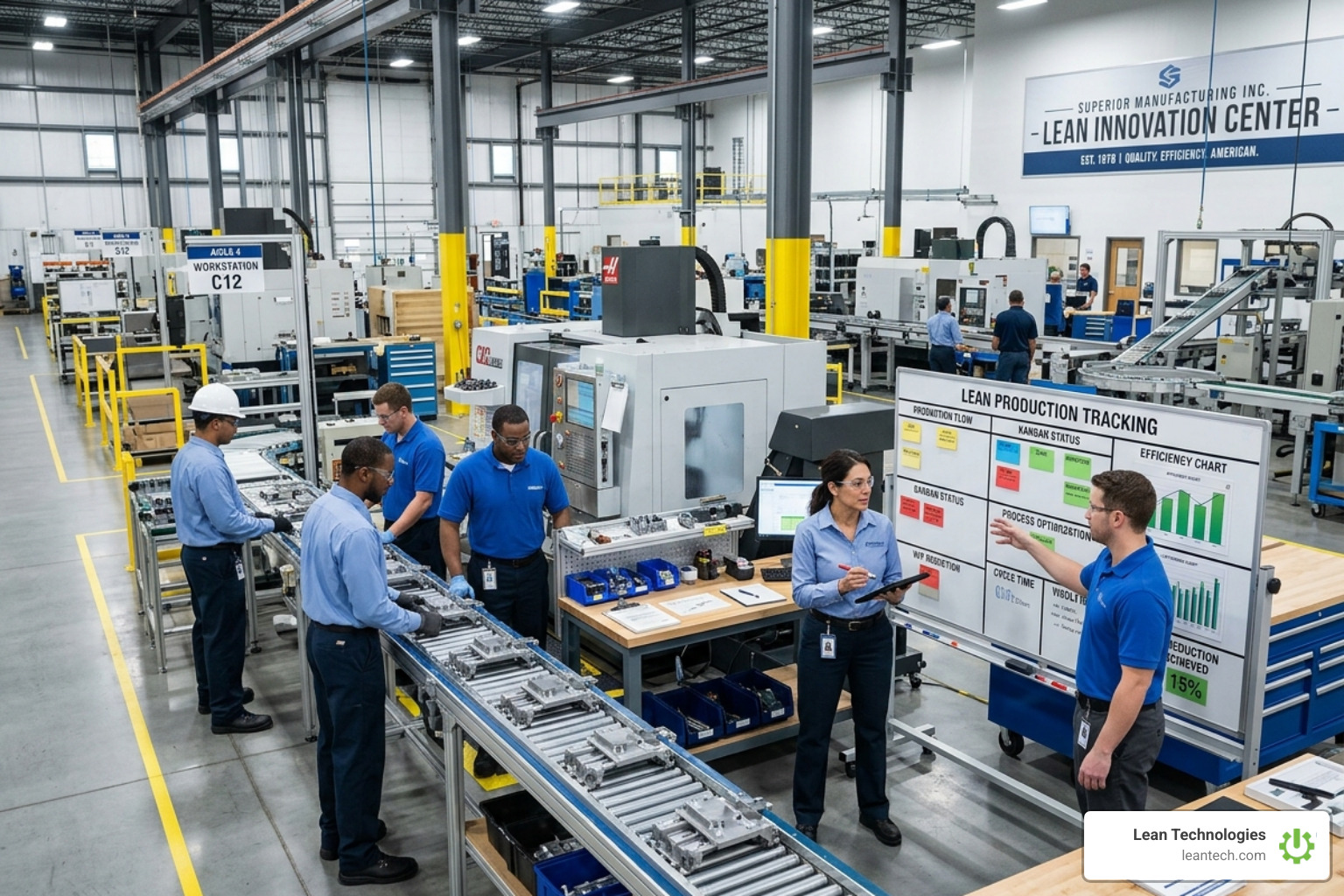
Lean and Mean How to Achieve Cost Reduction in Manufacturing
Why Cost Reduction Manufacturing Is the Survival Skill Every Plant Needs Right Now
Cost reduction manufacturing isn't a nice-to-have — it's how plants stay alive when margins get squeezed from every direction.
Here's the quick answer if you're looking for the fastest ways to cut manufacturing costs:
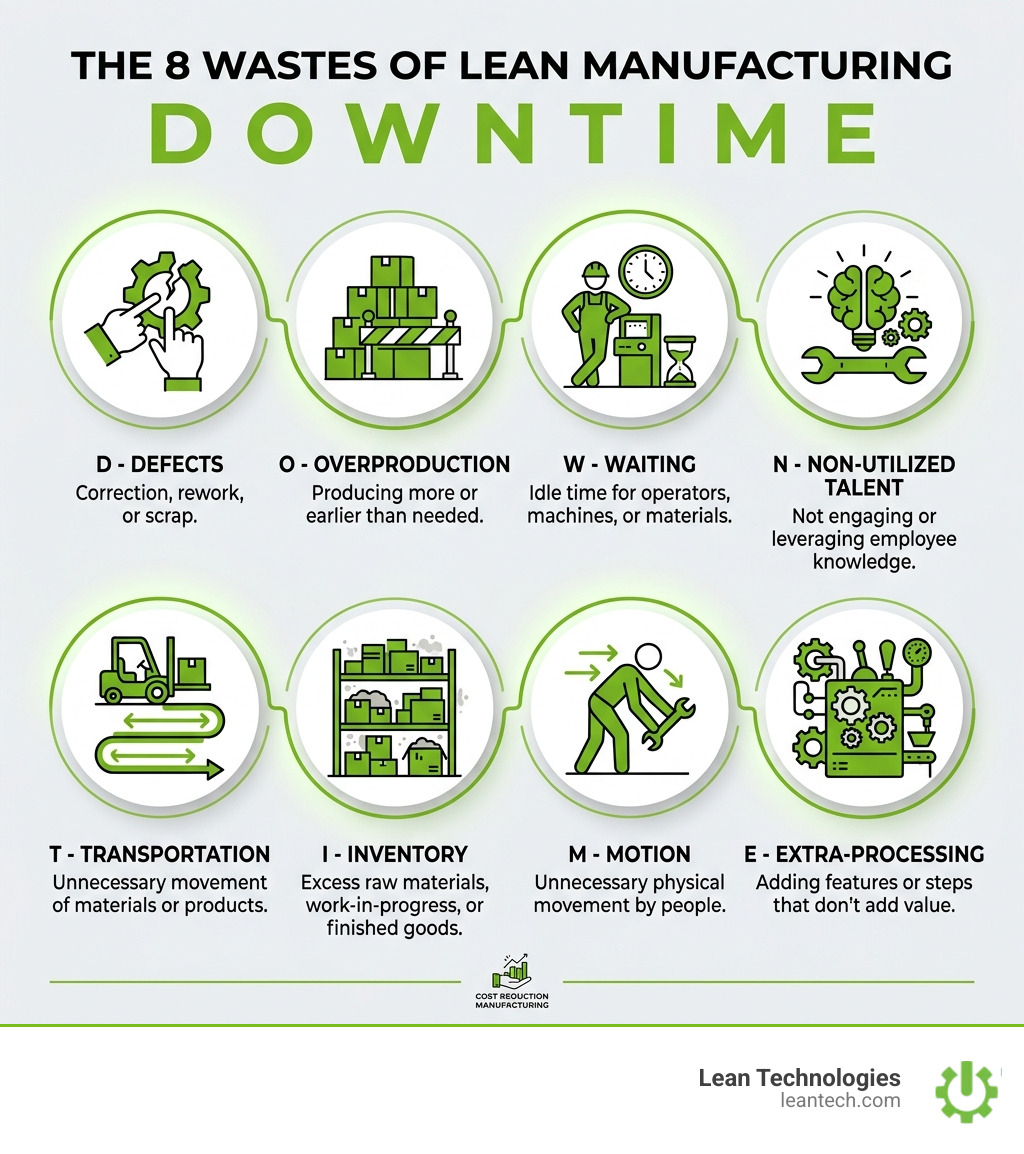
Eliminate waste using lean principles (DOWNTIME: Defects, Overproduction, Waiting, Non-utilized talent, Transportation, Inventory, Motion, Extra-processing)
Optimize material costs through supplier negotiation, smarter inventory management, and alternative sourcing
Boost labor productivity via cross-training, digital work instructions, and better scheduling
Reduce overhead with energy audits, facility optimization, and preventive maintenance
Leverage technology — ERP systems, real-time data dashboards, and predictive maintenance tools
Apply Design for Manufacturability (DFM) early in the product design phase
Run Kaizen events to surface savings fast with minimal capital investment
Measure everything — OEE, cost per unit, first-pass yield, and inventory turns
Now here's what most plant managers don't realize: the problem usually isn't effort — it's visibility.
Inflation has pushed domestic skilled labor to $28–$45 per hour. Energy costs have climbed 18% since 2023. Raw material prices swing without warning. And yet, many shop floors are still running on paper logs, end-of-shift data entry, and gut feel.
That gap between what's happening on the floor and what leadership can actually see — that's where profit disappears.
The research is clear on this. Losses can account for up to 65% of cost of goods sold in manufacturing operations. Companies that implement lean principles report an average 20–30% reduction in operational costs within the first year. And roughly 70% of manufacturing costs are locked in during the design phase — before a single part is ever made.
The opportunity is massive. But capturing it requires more than a one-time cost-cutting initiative. It requires a system.
This guide walks through exactly how to build that system — from eliminating the eight wastes and optimizing materials, to leveraging technology and running a 4-step roadmap for sustainable savings.
The Three Pillars of Cost Reduction Manufacturing
To move the needle on profitability, you have to look at where the money actually goes. In a typical operation, costs are split into three buckets: direct materials, labor, and overhead.
If you aren't tracking these in real-time, you're essentially flying blind. For instance, material costs often represent 50–70% of total product costs. If your scrap rate is creeping up by even 2%, that’s a direct hit to your EBITDA that might stay hidden until the end-of-month financial review.
According to The Ultimate Guide to Manufacturing Cost Reduction: 10 Proven Strategies, sustainable savings come from optimizing the system rather than making desperate, tactical cuts that hurt morale or quality.
Managing Material and Labor Expenses
Materials are your biggest expense, but labor is often your biggest challenge. With 71% of manufacturers citing workforce recruitment and retention as a primary concern, you can't afford to waste the talent you have.
Supplier Negotiation: Don't just settle for the catalog price. Use data to negotiate bulk discounts or better payment terms. Some manufacturers find 5–15% savings just by evaluating alternative sourcing or localized suppliers to dodge shipping volatility.
Inventory Turns: Carrying too much stock is just "frozen cash" sitting on a shelf. Implementing Just-in-Time (JIT) strategies helps keep inventory lean, though you should maintain a small safety buffer (usually 6–8 weeks) to handle supply chain hiccups.
Labor Productivity: Instead of cutting headcount, focus on cross-training. When an operator can run three different machines, you eliminate "waiting" waste.
Visibility Tools: Use Defect Scrap Tracking to see exactly which shift or machine is producing the most waste. When a Nonconformance happens, log it immediately at the source so the root cause doesn't get "forgotten" by Friday.
Minimizing Overhead and Energy Consumption
Overhead is the "silent killer" of margins. Energy consumption alone can account for over 30% of total manufacturing expenses.
Start with a utility audit. In large plants, these audits have identified an average of $1.4 million in savings. Even for small-to-mid-sized shops, the average savings hit around $165,000.
Peak Shaving is another heavy hitter. By shifting high-energy processes (like heat treating or heavy machining) to off-peak hours, you can slash your utility bill by 15% or more. Simple fixes like LED lighting can reduce electricity use by up to 75%, and fixing compressed air leaks—which often account for 20–30% of a plant's total power draw—is a "quick win" that pays for itself in weeks. Don't forget to run regular Safety Audits to prevent expensive accidents and insurance spikes.
Eliminating Waste with Digital Lean Principles
Lean isn't just a buzzword; it’s a math problem. If you eliminate the 8 wastes (DOWNTIME), your costs must go down.
The transition from "Paper Lean" to "Digital Lean" is where the magic happens. If your team is still filling out paper charts that sit in a binder for a week, you aren't running lean—you're just documenting your losses after it’s too late to fix them.
A Guide to Digital Lean Manufacturing shows that when data is entered at the source—on a tablet or mobile device—problems get solved in minutes, not days. Start with a Lean Culture Assessment to see where your team stands. Are they empowered to stop the line, or are they just trying to hit a quota?
Using Kaizen for Rapid Cost Reduction Manufacturing
Kaizen means "change for the better." In the shop floor context, a Kaizen event is a 3-to-5-day sprint focused on a specific problem.
These events deliver average savings of $27,000 per event with almost zero capital investment. Why? Because the people doing the work usually know exactly where the waste is. They see the awkward reach, the unnecessary walking, and the tool that always breaks.
To keep the momentum going, use a Kanban Board Tool to visualize tasks and Leader Standard Work to ensure supervisors are actually on the floor coaching, not stuck in their offices answering emails.
Standardizing Workflows to Reduce Variability
Variability is the enemy of cost control. If Operator A produces 100 parts an hour and Operator B produces 80, you have a process problem, not a people problem.
Standardization captures "tribal knowledge"—that secret sauce your 30-year veteran uses to keep a temperamental machine running—and turns it into a digital work instruction everyone can follow. This reduces the "Re-Learning Tax" that happens every time you hire a new team member.
Design for Manufacturability (DFM) and Tolerance Optimization
You can’t "lean" your way out of a bad design. Roughly 70% of manufacturing costs are determined before the first chips fly.
As noted in the How to Reduce Manufacturing Costs: Complete Guide 2026 - Mitsubishi Manufacturing, over-engineering is a massive profit drain. If a part doesn't need a mirror finish or a +/- 0.001" tolerance to function, don't specify it.
Balancing Precision and Cost Reduction Manufacturing
Tolerance costs follow an exponential curve. Moving from a standard tolerance to a precision tolerance can multiply the cost of a part by 3 to 10 times.
Tolerance Range Relative Cost Impact Standard (+/- 0.010") 1x (Baseline) Precision (+/- 0.001") 3x - 5x Ultra-Precision (+/- 0.0001") 8x - 15x
Every tight tolerance requires more expensive tooling, slower cycle times, and higher scrap rates. By aligning your design with the actual process capability of your machines, you can often find 15–30% savings without changing the product's function. Keep your measurement tools sharp with regular Gage Calibration to ensure you aren't scrapping good parts due to bad data.
Leveraging Technology to Slash Downtime and Maintenance Costs
Unplanned downtime is the ultimate cost multiplier. For some facilities, a single hour of downtime can cost between $25,000 and $500,000.
The goal is to move from "firefighting" (reactive maintenance) to "fire prevention" (planned maintenance). Utilizing a CMMS allows you to track asset history and schedule Planned Maintenance before a bearing seizes and brings the whole line to a screeching halt.
Reducing Unplanned Downtime with Real-Time Data
Real-time visibility is the difference between a minor adjustment and a three-day shutdown. By tracking metrics like Mean Time Between Failures (MTBF) and Mean Time to Repair (MTTR), you can identify the "Bad Actors"—the 20% of your machines causing 80% of your headaches.
Digital tools and Equipment Asset Tracking ensure that when a machine goes down, the right technician is alerted immediately on their mobile device with the correct SOPs and parts list already in hand.
A 4-Step Roadmap for Sustainable Savings
Don't try to boil the ocean. Follow this proven 90-day framework to get results:
Baseline Assessment: Conduct Audits to see where your money is going today. Tally your total losses—scrap, downtime, and energy—and aggregate them to an annual figure.
Loss Prioritization: Use the 80/20 rule. Which three problems, if solved, would put the most money back in the budget?
Model Area Execution: Pick one cell or line. Trial your digital lean tools there first. Prove that it works, then use that success to win over the rest of the plant.
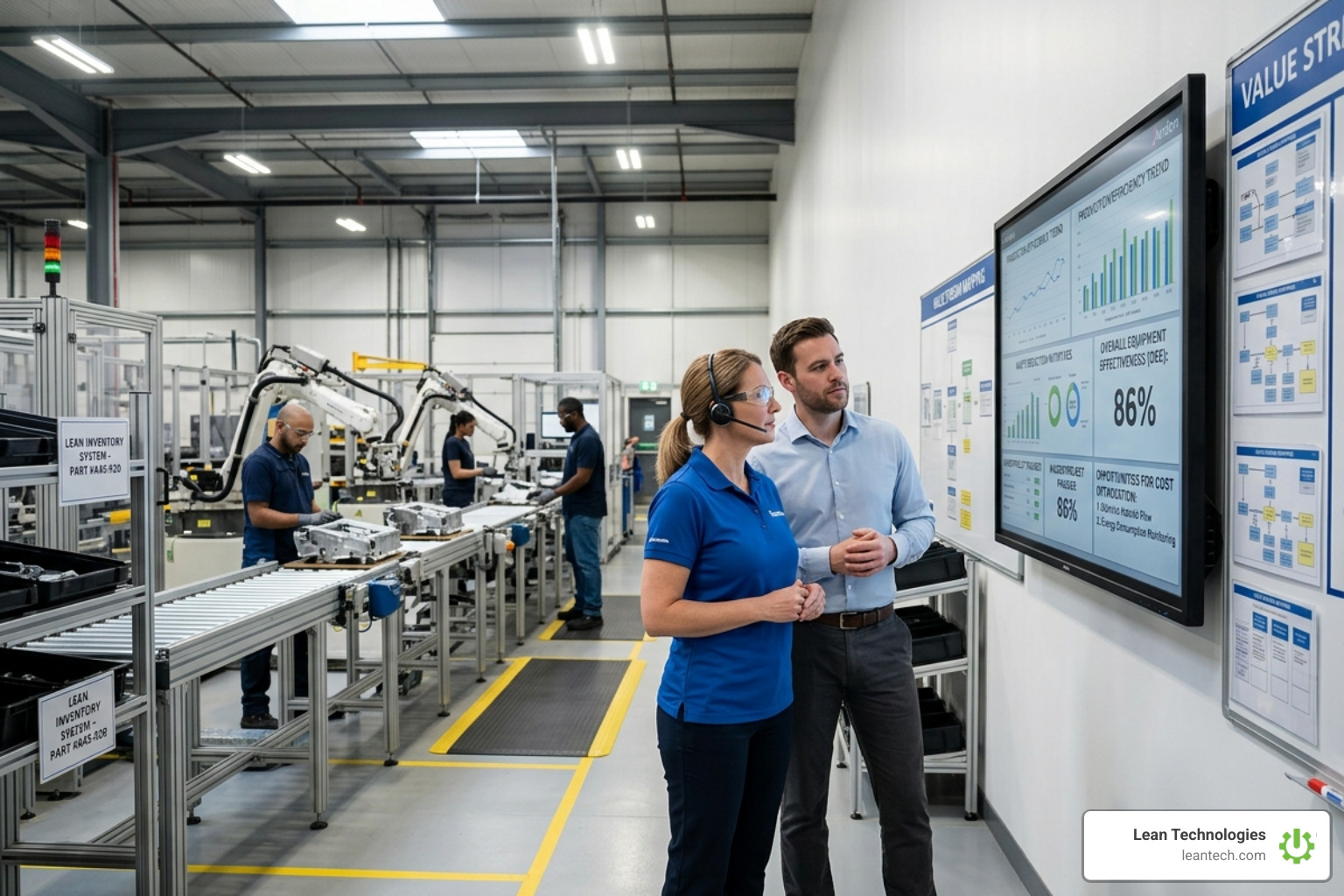
Continuous Monitoring: Once you've cut the waste, you have to keep it out. Use real-time dashboards to ensure the "Hidden Factory" doesn't start creeping back in.
Measuring ROI and Key Performance Indicators
You can't manage what you don't measure. Focus on these leading indicators to track your cost reduction manufacturing progress:
Cost per Unit (CPU): Is it trending down as you eliminate waste?
First-Pass Yield (FPY): Are you making it right the first time? (Quality costs can consume 15–40% of expenses).
Inventory Turns: How fast is your cash moving through the plant?
Overall Equipment Effectiveness (OEE): World-class is 85%; most shops hover around 60%. Every 1% gain in OEE typically yields a 0.5–1% reduction in unit costs.
Frequently Asked Questions about Manufacturing Cost Reduction
What are the most effective ways small manufacturers can reduce costs?
Small manufacturers should focus on "low-capital" wins. This means implementing lean principles to eliminate waste, cross-training staff for flexibility, and using digital tools to replace paper logs. You don't need a million-dollar robot to save money; you just need to stop the $500-an-hour downtime events.
How much can Design for Manufacturability (DFM) actually save?
Effective DFM typically reduces manufacturing costs by 15–30%. By simplifying part geometry and standardizing components, you reduce tooling costs, assembly time, and the risk of quality defects.
Why do most cost reduction programs fail in the first year?
Most fail because they are treated as "one-time events" or "budget cuts" rather than process improvements. If you cut headcount but don't fix the inefficient process, the remaining staff will burn out, quality will drop, and your costs will actually go up in the long run.
What to do next
Sustainable cost reduction manufacturing isn't about working harder—it's about working smarter with the data you already have.
At Lean Technologies, we built Thrive to give you that visibility. It’s an all-in-one, customizable shopfloor software designed by manufacturing experts who have been in your shoes. We don't just help you log problems; we help you drive the actions that solve them.
Stop managing your shop floor through spreadsheets and wishful thinking. Let your team run lean with real-time visibility and fewer workarounds.
Check out Thrive and start your journey to operational excellence today.