
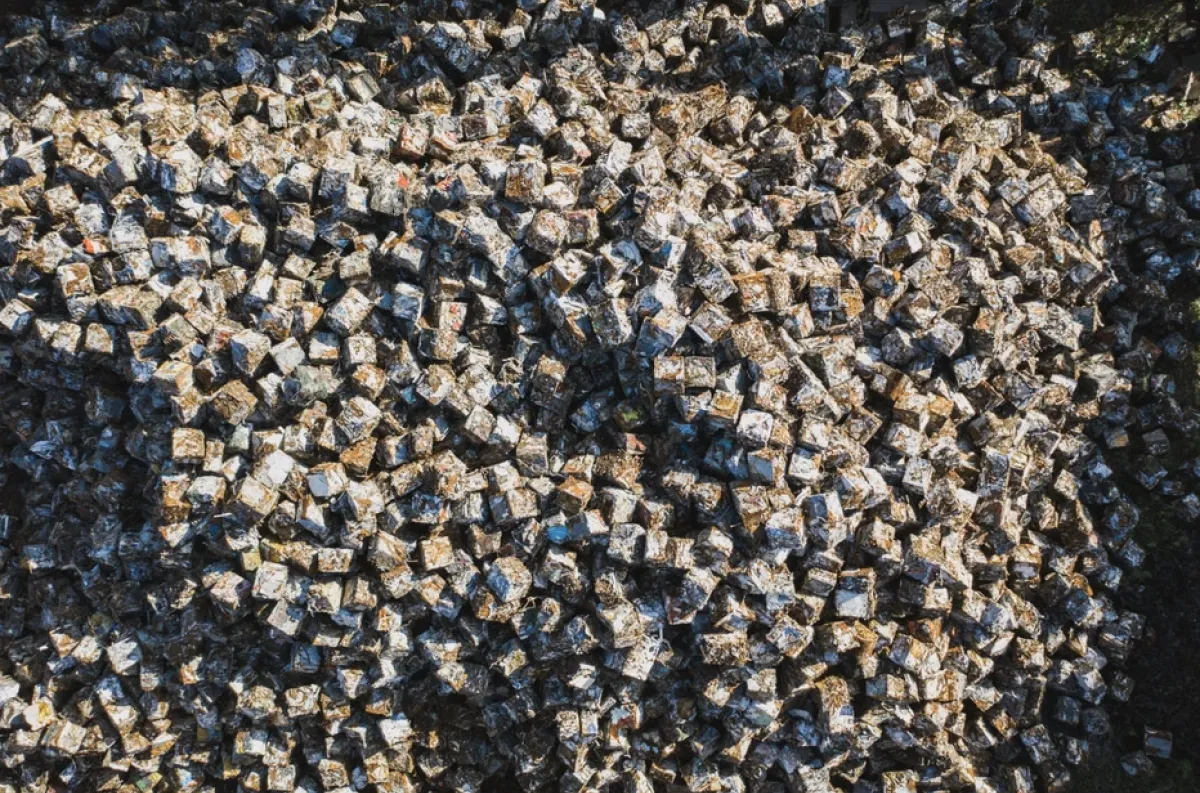
Stop Throwing Money Away with Manufacturing Waste Reduction
Every Shift, Waste Is Costing You More Than You Think
Manufacturing waste reduction isn't just an environmental talking point — it's one of the fastest ways to recover real money that's quietly bleeding out of your operation every single day.
Here's a quick answer to what manufacturing waste reduction actually covers:
What is manufacturing waste reduction?
Manufacturing waste reduction is the systematic process of identifying and eliminating any use of resources — materials, time, energy, labor, or capital — that doesn't add value to the end product. It spans two major categories:
Material waste - excess raw materials, scrap, defective products, excess energy use, and pollution
Operational waste - the 8 lean wastes (defects, overproduction, waiting, non-utilized talent, transportation, excess inventory, unnecessary motion, and extra processing)
Why it matters right now:
The global manufacturing sector generates roughly 1.8 billion tonnes of solid waste annually — and only 30% is currently recovered or recycled
An average 8% of inventory worldwide — totaling around $163 billion — perishes or is discarded every year
Unplanned downtime alone costs Global Fortune 500 companies 11% of their yearly revenue
In 2022, the DOE's Industrial Assessment Centers identified nearly $26 million in potential annual savings across just 142 small and medium-sized businesses
The hard truth? Most of that waste isn't inevitable. It's a process problem — and process problems are fixable.
The challenge for most operations managers is that waste hides well. It hides in spreadsheets nobody reads until Friday. It hides in maintenance logs filled out at the end of a shift. It hides in that stack of rework sitting quietly beside the line, waiting for someone to count it.
By the time the data surfaces, the opportunity to act on it is already gone.
This guide breaks down exactly where manufacturing waste comes from, how to measure it properly, which strategies actually move the needle, and how modern tools — including real-time digital platforms — can help your team catch waste as it happens, not after the damage is done.
The 8 Deadly Sins: Identifying Waste on the Shop Floor
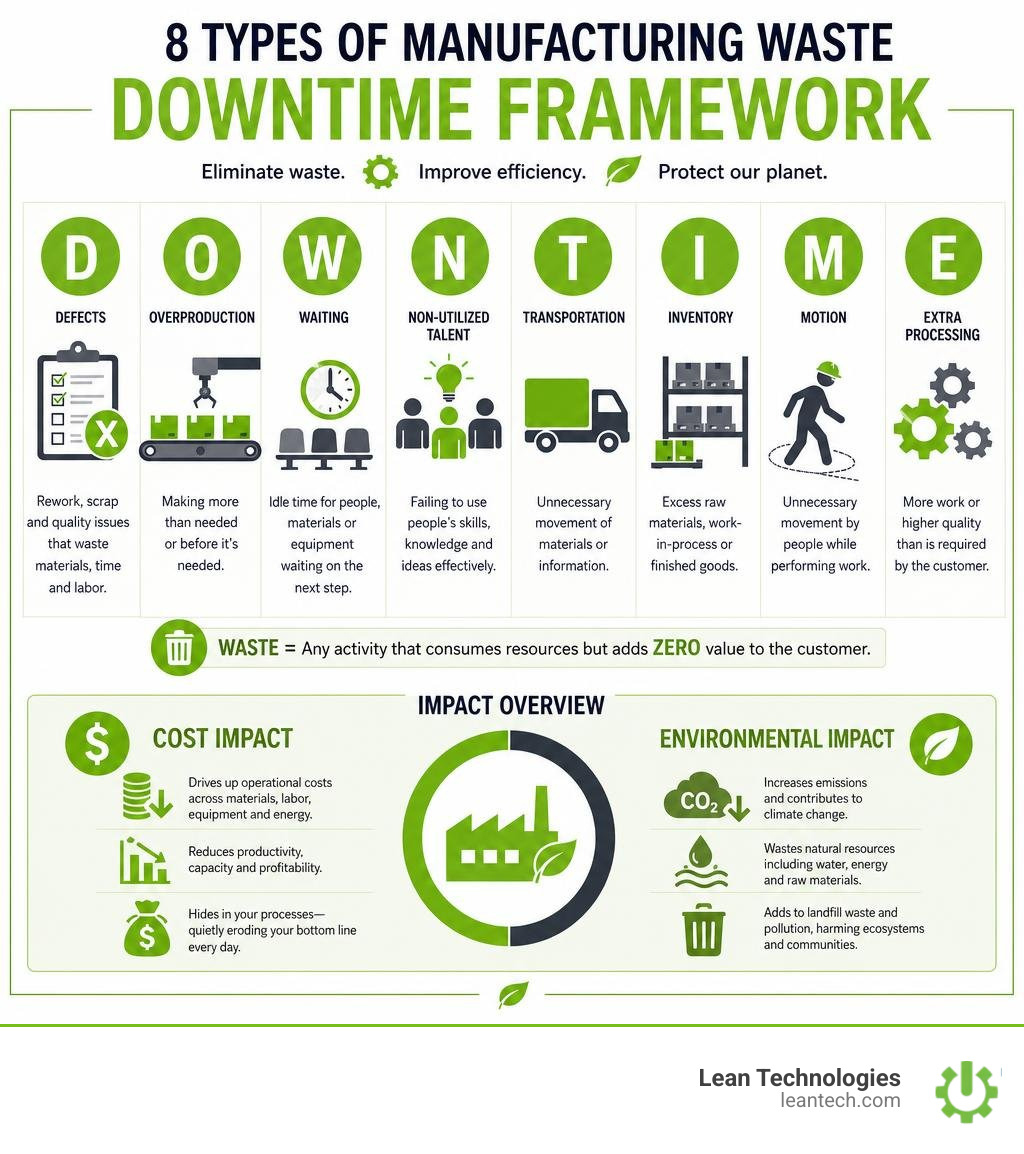
To kill waste, you have to see it first. In lean manufacturing, waste is called muda — any activity that consumes resources but adds zero value for the customer.
To help shop floor teams remember these inefficiencies, the industry uses a simple mnemonic device: DOWNTIME.
Let's look at how these eight wastes actually play out on a real production floor:
Defects: This is the most obvious form of waste. Scrap, rework, and incorrect assemblies cost you both raw materials and double the labor. Tracking these issues immediately with Defect & Scrap Tracking is critical to stopping a bad run before it ruins an entire batch.
Overproduction: Making products before they are actually ordered. This is the "gatekeeper" waste because it triggers other wastes, like excess inventory and unnecessary transportation.
Waiting: Operators standing idle because a machine is down, a material delivery is late, or they are waiting on a supervisor's sign-off.
Non-utilized talent: Underutilizing the skills, experience, and creative problem-solving of your frontline operators. If your team is only hired for their physical labor and not their brains, you are throwing away your most valuable asset.
Transportation: Moving materials, parts, or finished goods unnecessarily between departments, warehouses, or stations.
Inventory: Excess raw materials, work-in-progress (WIP), or finished goods sitting in storage. Not only does this tie up cash, but it also increases the risk of damage and obsolescence.
Motion: Unnecessary physical movement by operators, such as walking ten steps to retrieve a tool that should be stored at arm's length.
Extra processing: Doing more work on a product than the customer actually requires or is willing to pay for. This includes over-polishing a hidden bracket or using tighter tolerances than engineered.
When these wastes are left unchecked, they result in a constant stream of Nonconformance issues that eat away at your operational margins.
Mapping the DOWNTIME Framework to Your Processes
The concept of eliminating muda originated from the Toyota Production System, which laid the foundation for modern lean thinking. To successfully apply this framework, operations managers must shift from reactive firefighting to structured, proactive processes.
One of the most effective ways to make these wastes visible is to use a digital Kanban Board Tool. By visualizing work-in-progress, teams can quickly spot bottlenecks, overproduction, and waiting times in real time.
Understanding the Essence of Lean means realizing that a process should flow smoothly from one step to the next, driven purely by customer demand. If a step doesn't add value, it is waste.
How Waste Manifests in Composite Manufacturing
While the DOWNTIME framework applies to any industry, some sectors have highly specialized waste challenges. Take composite manufacturing, which is heavily utilized in aerospace and shipbuilding.
In these environments, material waste is incredibly expensive. High-performance carbon fiber, fiberglass, and epoxy resins have strict shelf lives and precise storage requirements.
During phases like preform preparation and forming, dry fabrics are cut to shape. If nesting software isn't optimized, massive amounts of expensive carbon fiber end up as scrap.
Furthermore, during the resin infusion phase, any minor process deviation — such as a vacuum leak or incorrect curing temperature — can cause a complete part failure, resulting in thousands of dollars of cured, unrecyclable composite material heading straight to the landfill.
Measuring What Matters: Eco-Efficiency and Process Mapping
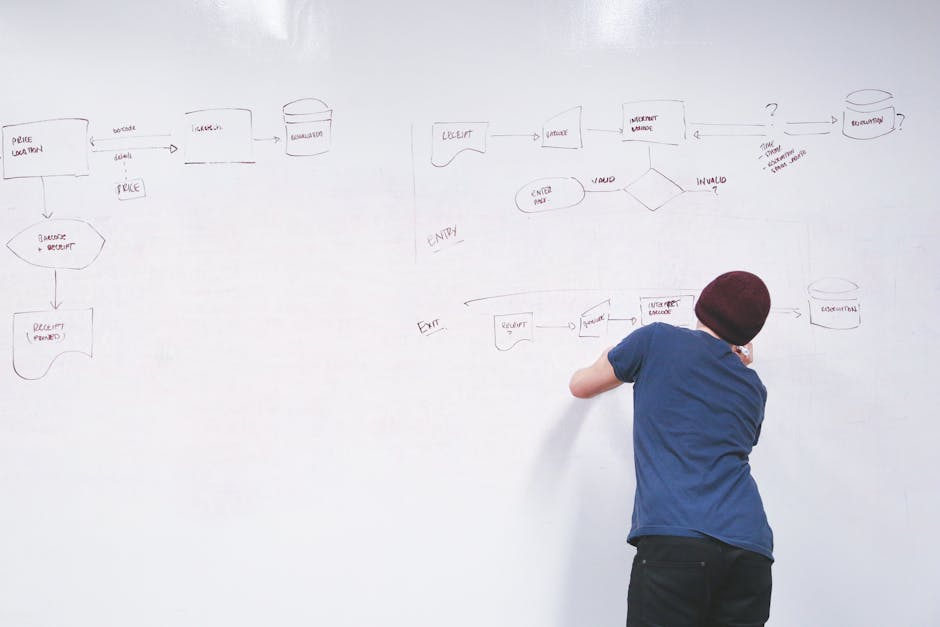
You cannot manage what you do not measure. If you want to build a highly competitive, sustainable production facility, you must track both economic and environmental performance. This is where the concept of eco-efficiency comes in.
An Eco-Efficiency Assessment as an Enabler to Achieve Zero-Waste Manufacturing shows us that economic success and environmental sustainability are not opposing goals. In fact, they are deeply linked.
Eco-efficiency is calculated by comparing the product value (or output) to the environmental influence (or input). By optimizing this ratio, you reduce costs and lower your carbon footprint at the same time.
Integrating Economic and Environmental Performance Indicators
To get a complete view of your shop floor, you need to combine financial metrics with environmental data. This requires tracking:
Economic inputs/outputs: Labor costs, material consumption, utility bills, and scrap costs.
Environmental inputs/outputs: Raw material extraction, energy use per unit, water consumption, carbon intensity, and hazardous waste generation.
By using a detailed Life-Cycle Inventory (LCI), teams can map every single resource stream entering and leaving the facility. This allows you to clearly separate value-added activities from non-value-added activities, ensuring that your capital is spent on processes that actually drive revenue.
Methodologies for Manufacturing Waste Reduction Assessment
To systematically identify and eliminate waste, continuous improvement teams rely on three key methodologies:
Value Stream Mapping (VSM): A classic lean tool used to map the flow of materials and information from supplier to customer. To learn how to digitize this process, check out our Guide to Digital Lean Manufacturing.
Multi-layer Stream Mapping (MSM): An advanced form of VSM that maps multiple resource streams (such as energy, water, materials, and labor) on separate, parallel layers. This makes it easy to see where energy is wasted during process downtime.
Life-Cycle Assessment (LCA): A cradle-to-gate or cradle-to-grave analysis that quantifies the environmental impacts of a product throughout its entire life cycle.
High-Impact Phases: Aerospace and Shipbuilding Case Studies
To understand how these methodologies work in the real world, let's examine high-impact composite manufacturing processes in the aerospace and shipbuilding sectors.
In both industries, labor costs account for more than 50% of total manufacturing costs (with aerospace averaging around 54%). Because these processes are so hands-on and complex, any operational delay or quality issue results in a massive financial penalty.
Cost and Environmental Drivers in Resin Infusion
When looking at the environmental footprint of composite parts, the resin infusion phase contributes more than 70% of the total environmental impact.
This phase is highly resource-intensive and involves significant risks:
Hazardous waste: Unused mixed resins, contaminated vacuum bagging materials, and cleaning solvents must be treated as hazardous waste.
Worker health and safety: Operators are exposed to hazardous volatile organic compounds (VOCs). Human health remains the most critical environmental concern in these environments due to chemical exposure risks.
Energy consumption: Curing ovens and vacuum systems require substantial energy, making any extended cycle times highly inefficient.
Optimizing Preform Preparation and Forming
Before resin is ever introduced, dry fibers must go through preform preparation and forming. In aerospace, skin preform forming is often the most expensive operation, followed by C-shaped-spar forming.
Because these steps are highly manual, they are prone to human error and variation.
By streamlining workflows, optimizing fabric nesting patterns, and establishing clear, digitized visual standards, manufacturers can significantly reduce operational time, lower raw material scrap, and eliminate unnecessary handling motion.
Actionable Strategies for Manufacturing Waste Reduction

Achieving a high waste-diversion rate requires moving away from simple end-of-pipe recycling and focusing on prevention-first strategies.
According to a detailed Case study: How a manufacturing facility achieved 95% waste diversion through prevention-first strategy | Sustainability Atlas, treating waste as a design and procurement failure yields far greater financial and environmental returns than recycling alone.
Strategy Phase Waste Prevention (Source Reduction) Waste Recycling (End-of-Pipe) Primary Focus Eliminating waste before it is created. Managing waste after it has been generated. Financial Impact High cost savings (saves raw material costs, labor, and disposal fees). Moderate savings (reduces landfill fees, may generate small recycling revenue). Operational Impact Streamlines processes, reduces inventory, and improves cycle times. Requires additional space, sorting labor, and logistics management. Environmental Value Conserves resources, lowers carbon footprint, and prevents pollution. Keeps material out of landfills, but still requires energy to process.
Implementing Closed-Loop Systems and Preventive Maintenance
Two of the most powerful weapons in your waste-prevention arsenal are closed-loop systems and structured maintenance.
Closed-Loop Manufacturing: These systems are designed to capture byproducts and feed them directly back into the production cycle. For example, a plastic injection molder might grind up runner scrap and mix it back with virgin resin, or a leather manufacturer might filter and reuse process water.
Preventive Maintenance: Equipment failures are incredibly wasteful. Unplanned downtime costs Global Fortune 500 companies an average of 11% of their yearly revenue. Dull cutting tools, worn seals, and misaligned machines produce defective parts that must be scrapped. Implementing a rigorous, proactive Maintenance schedule ensures machines run at peak performance, preventing defects before they happen.
Standard Work, Employee Training, and Lean Culture
You can buy the best machinery in the world, but if your team doesn't have a structured way to execute tasks, you will still generate waste.
Standard Operating Procedures (SOPs): Write lean, highly visual SOPs. Instead of 50-page binders that collect dust, use digital, interactive checklists that operators can access on tablets right at their workstations.
Employee Training: Train your team to see waste. Operators should be empowered to stop the line if they spot a quality defect, and they should know exactly how to segregate waste streams at the source.
Building a Lean Culture: Waste reduction isn't a one-time project; it is a daily habit. Use a Lean Culture Assessment to see where your team stands, and leverage Thrive HR to track training progress, skills matrices, and continuous improvement ideas submitted by your frontline staff.
Industry 4.0: Data-Driven Optimization and Real-Time Visibility
We are firmly in the era of smart manufacturing. Industry 4.0 is no longer just a buzzword — it is a survival requirement.
According to a study on Manufacturing Waste Reduction Through Data-Driven Process Optimization: Evidence from Smart Production Systems - International Journal of Technology, Health and Sustainability, integrating real-time data analytics with production systems yielded an average 17.6% reduction in material waste, a 12.4% reduction in energy consumption per unit, and an 8.9% improvement in overall equipment effectiveness (OEE).
Crucially, these sustainability gains were achieved without sacrificing throughput or product quality.
Sensor-Based Monitoring and AI-Driven Quality Control
By using sensor-based monitoring, manufacturers can track critical process variables like temperature, pressure, vibration, and flow rate in real time.
When this data is fed into AI-driven quality control systems, the software can spot micro-trends that human eyes would miss — like a slight temperature drift that indicates a curing cycle is about to fail.
By catching these process anomalies early, quality managers using Thrive Quality can prompt operators to take immediate corrective action, preventing costly batch-wide scrap.
Leveraging Digital Twins for Manufacturing Waste Reduction
A digital twin is a virtual replica of a physical production system.
As explored in Digital Twins for Waste Management in Manufacturing: Preliminary Investigation on Possible Uses, these digital models can be applied across equipment, products, processes, and production systems.
By simulating production runs in a virtual environment, engineers can test nesting patterns, chemical mixtures, and cycle times to optimize material usage and energy efficiency before a single physical machine is ever turned on.
The Business Case: Why Waste Reduction is Your Competitive Edge
Every pound of scrap, every minute of waiting, and every wasted kilowatt is a direct hit to your bottom line.
A comprehensive study, Towards Zero Waste Manufacturing: A Comprehensive Analysis of Sustainable Practices and Integration Strategies in Industrial Waste Management, Industrial Engineering, Science Publishing Group, outlines how moving toward a zero-waste model is a massive driver of business profitability and long-term resilience.
Financial and Operational Benefits for Small and Large Businesses
The benefits of manufacturing waste reduction apply across the board, though they manifest differently depending on company size:
For Small Businesses: Every dollar counts. Reducing waste directly improves cash flow. Smaller facilities can achieve rapid wins with minimal capital by focusing on warehouse organization, reducing incoming packaging, and using simple digital Project Management tools to keep tasks on track.
For Large Businesses: At scale, minor efficiency gains add up to millions of dollars. Large enterprises can leverage closed-loop material exchanges, establish industrial symbiosis networks (where one plant's waste becomes another's raw material), and drive massive supply chain optimization.
Navigating Regulatory Frameworks and EU Sustainability Targets
The regulatory landscape is tightening rapidly. In June 2026, manufacturers are facing unprecedented pressure from global environmental standards:
EU Sustainability Targets: The European Union's aggressive push for carbon neutrality by 2050, combined with strict circular economy mandates, means that companies exporting to or operating in Europe must prove their waste-reduction metrics.
Chemical Regulations: Directives like RoHS and REACH globally restrict hazardous substances. In the US, the EPA's Toxics Release Inventory (TRI) keeps chemical waste under a microscope.
The Solution: Integrating lean practices with chemical safety is key. Using resources like The Lean and Chemicals Toolkit helps teams identify hidden chemical overheads, reduce hazardous waste, and maintain a stellar Safety record on the shop floor.
Frequently Asked Questions about Manufacturing Waste
What is the difference between zero waste to landfill and zero waste?
While they sound similar, they are actually quite different:
Zero Waste to Landfill: This means that no solid waste from a facility is sent to a landfill. However, this status can still include sending large volumes of waste to waste-to-energy incineration plants.
True Zero Waste: This is a much more rigorous standard (such as TRUE Zero Waste certification). It focuses on upstream prevention and source reduction. It treats incineration as a form of disposal, requiring at least a 90% diversion rate through reduction, reuse, recycling, and composting, with a commitment to continuous improvement.
How does the DOWNTIME framework apply to chemical waste?
Chemical waste is often hidden in overhead costs. In fact, up to 40% of purchased chemical supplies can go unused and end up as hazardous waste.
Applying the DOWNTIME framework to chemicals means:
Overproduction/Inventory: Buying chemicals in bulk to "save money," only to have them expire on the shelf.
Extra Processing: Using more solvents or cleaning agents than the process actually requires.
Defects: Incorrect chemical mixtures that ruin a batch and create a massive disposal hazard.
By using The Lean and Chemicals Toolkit strategies, such as point-of-use storage and right-sized containers, facilities can easily reduce chemical waste by 20% or more.
What is the average ROI of a manufacturing waste prevention program?
While upfront investments can vary, manufacturing waste prevention programs boast an impressive average ROI of 150% to 300% over five years.
Quick wins, like renegotiating scrap contracts, improving warehouse labeling, and training operators, require almost zero capital and pay off almost immediately. Larger initiatives, such as transitioning to returnable packaging or upgrading to digital shop floor tracking, typically achieve full payback within two to three years.
What to Do Next
Stop managing your shop floor through spreadsheets and wishful thinking.
If your operators are still tracking scrap on paper logs, or if your continuous improvement team doesn't have real-time visibility into why machines are waiting, you are throwing money away.
Lean Technologies offers Thrive, an all-in-one, customizable shop floor software designed by manufacturing experts to streamline operations, boost productivity, and improve profit.
Thrive doesn't replace your ERP or MES. Instead, it gives your team a flexible digital toolbox to log issues, track actions, and manage preventive maintenance in real time. Because on a fast-moving shop floor, real-time visibility beats "real-late" reporting every single day.
Ready to let your team run lean? Explore Thrive CI and take control of your manufacturing waste reduction journey today.