
The Lean Manufacturing Framework for Optimizing Your Shop Floor
Why Most Shop Floors Are Losing 60% of Their Productive Time (And What to Do About It)
A lean production system is a management framework that eliminates waste, delivers value to the customer, and keeps production flowing based on real demand — not guesswork.
Here's the short version of how it works:
Define value — from the customer's perspective only
Map the value stream — identify every step and cut the ones that add no value
Create flow — remove bottlenecks so work moves without interruption
Pull production — make what's needed, when it's needed, based on actual demand
Pursue perfection — continuously improve through small, daily gains
Research shows that in a typical manufacturing operation, 60% of production activities add zero value for the customer. That's not a rounding error. That's the majority of what your team does every day going straight to waste.
The lean production system was built to fix exactly that.
It traces back to post-World War II Japan, where Toyota engineers Taiichi Ohno and Eiji Toyoda developed what became known as the Toyota Production System. The conditions were brutal — no cash, no space, no excess materials. So they built a system that could do more with less. A lot less.
The term "lean production" itself wasn't coined until 1988, when MIT researcher John Krafcik published "Triumph of the Lean Production System" — and showed that lean plants outperformed traditional ones regardless of technology level. What mattered wasn't the machines. It was the method.
Today, 70% of US manufacturing facilities use lean principles to some degree. And among those that implement it seriously, 95% report at least a 20% increase in productivity. The results aren't theoretical — companies have documented cycle time reductions of 97%, inventory cuts of 75%, and lead times slashed from weeks to days.
But here's the problem most operations managers run into: knowing the principles is not the same as running them. Paper-based tracking, siloed data, end-of-shift reporting — these aren't just inefficiencies. They're the exact opposite of what lean demands.
This guide walks through how to actually implement a lean production system on your shop floor — from the foundational tools to the common failure points most teams don't see coming.
Understanding the Lean Production System vs. Traditional Manufacturing
Traditional manufacturing is often built on the "just-in-case" model. You forecast what you think you'll sell, buy a mountain of material, and push it through the factory in massive batches. This "push" system creates a safety net of inventory, but that net is actually a trap. It hides defects, ties up cash, and takes up massive amounts of floor space.
A lean production system flips the script. Instead of mass production focused on machine utilization, lean focuses on customer value. If the customer isn't willing to pay for an activity, it's waste (muda).
The goal of a lean production system is to shorten the timeline from the moment a customer places an order to the moment you collect the cash by removing non-value-added activities.
Feature Traditional Mass Production Lean Production System Inventory High (Just-in-Case) Low (Just-in-Time) Batch Size Large (to "save" on setups) Small (One-piece flow) Quality Inspection at the end Built-in at the source Worker Role Follow instructions only Empowered to stop the line Goal High machine uptime Rapid lead time/Flow
By transitioning to lean, companies like NCR and Hewlett-Packard have seen inventory days drop from 47 to 5, and labor costs cut by 50%. It’s not about working harder; it’s about removing the friction that stops your team from being productive.
The Five Core Principles of a Lean Production System
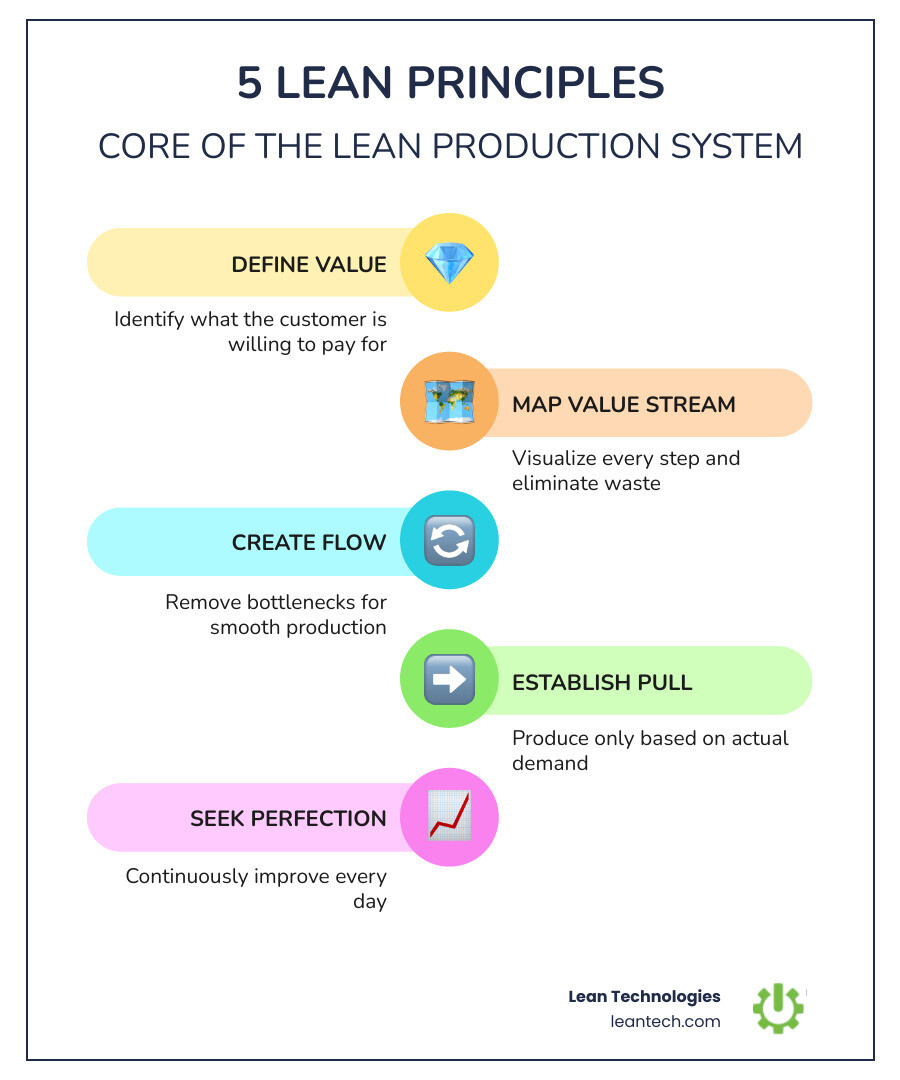
In their seminal book, James Womack and Daniel Jones defined five principles that serve as the North Star for any lean transformation. These principles help move the focus from "how do we keep this machine running?" to "how do we get this product to the customer?"
Identify Value: Value is only defined by the customer. If they don't care about a fancy internal report or a specific movement of a forklift, it’s not value.
Map the Value Stream: This is the "look under the hood" moment. You map every single step required to bring a product from raw material to the customer’s door.
Create Flow: Once the waste is gone, make sure the remaining steps happen in a tight sequence so the product flows smoothly toward the customer.
Establish Pull: Don't make anything until the customer asks for it. This prevents the "overproduction" trap.
Seek Perfection: Lean isn't a destination. It’s the constant, relentless pursuit of removing waste until only value-adding steps remain.
Mapping Value and Creating Flow in Your Lean Production System
To get started, you need to see where the work is getting stuck. Most shop floors have hidden "piles" of work-in-progress (WIP) sitting between stations. These are bottlenecks.
Process mapping involves walking the floor—often called a Gemba walk—to see the actual path a product takes. You’ll likely find that a part spends 90% of its time waiting and only 10% being worked on. By using Workflow Tracking, you can digitize this visibility. Instead of guessing why a job is late, you can see exactly which station is the bottleneck in real-time.
Implementing Pull and Perfection in Your Lean Production System
A "pull" system means your shop floor responds to actual demand. This is often managed by limiting WIP. If Station B is full, Station A stops producing. This feels counterintuitive to traditional managers who want everyone "busy," but it prevents the most dangerous waste: overproduction.
Pursuing perfection requires a culture where everyone—from the operator to the plant manager—is looking for ways to improve. This is where Thrive CI comes in. It gives your team a place to log "opportunities for improvement" the moment they see them, rather than waiting for a monthly meeting that never happens.
Eliminating the 8 Wastes (Muda) on the Shop Floor
Taiichi Ohno originally identified seven wastes, with an eighth (non-utilized talent) added later. A helpful way to remember these is the acronym DOWNTIME.
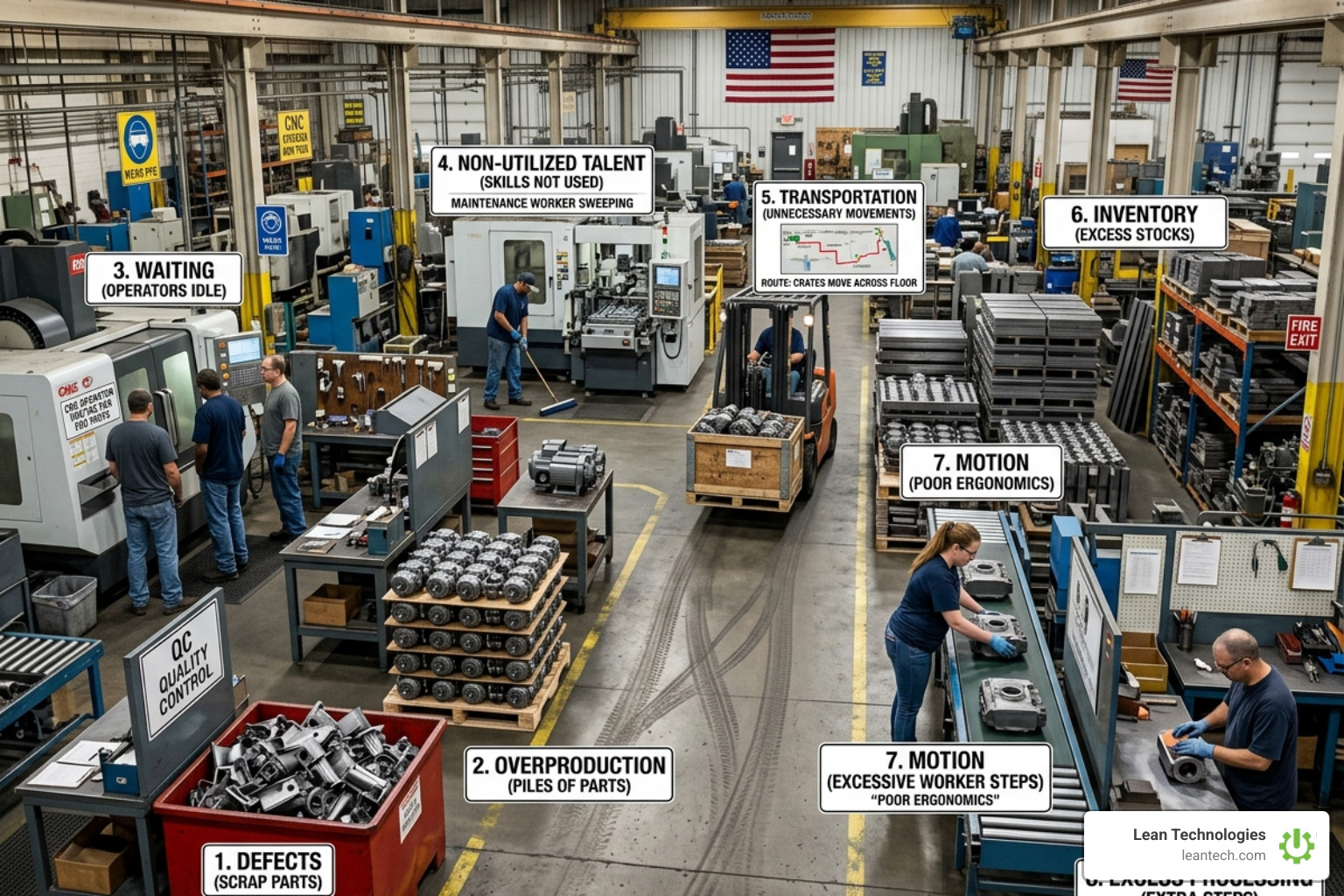
Defects: Rework and scrap. Omark Industries cut scrap and rework by 20% just by focusing on lean basics.
Overproduction: Making more than is needed. This is the "mother of all wastes" because it triggers all the others.
Waiting: Operators standing around while a machine cycles or waiting for a supervisor to sign off on a part.
Non-utilized Talent: Ignoring the ideas of the people actually doing the work.
Transportation: Moving parts from one side of the plant to the other. Daman Products reduced flow distance by 90% through better layout.
Inventory: Excess raw materials or WIP. This is just "frozen cash" sitting on your floor.
Motion: Unnecessary walking or reaching by operators. 5S helps solve this.
Extra-processing: Doing more work than the customer asked for (e.g., polishing a part that will be hidden inside a machine).
For a deeper dive into how to spot these digitally, check out our Guide to Digital Lean Manufacturing.
Essential Tools for Implementing Lean Manufacturing
You don't need a million-dollar software suite to start, but you do need a structured toolkit.
5S (Sort, Set in Order, Shine, Standardize, Sustain): This is the foundation of a clean, safe, and efficient workplace. It’s not just "cleaning up"—it’s about ensuring there is a place for everything so no time is wasted searching.
Kaizen: Small, continuous improvements. A "Kaizen Blitz" can take a process from a week-long lead time to three days in just 40 hours of focused effort.
SMED (Single-Minute Exchange of Die): Reducing setup times. Daman Products cut setup times by 50%, allowing them to run smaller batches profitably.
OEE (Overall Equipment Effectiveness): A metric that combines Availability, Performance, and Quality. An initial target of 85% is a great benchmark for most plants.
5Ms Framework: When troubleshooting, look at Manpower, Machine, Materials, Methods, and Measurement to find the root cause.
To make these tools stick, you need Leader Standard Work. This ensures that supervisors are checking the right things at the right time, moving from "firefighting" to "fire prevention."
Using Jidoka and JIT to Stabilize Operations
The two pillars of the Toyota Production System are Just-in-Time (JIT) and Jidoka.
JIT is about making only what is needed, when it is needed. It relies on Kanban—visual signals (like a card or an empty bin) that tell the previous process to start making more. You can manage this digitally with a Kanban Board Tool to keep everyone on the same page without physical cards getting lost.
Jidoka is "automation with a human touch." It means building quality into the process. If a machine detects an abnormality, it stops automatically. If an operator sees a problem, they pull an Andon cord to stop the line. This prevents defects from moving downstream. It’s better to stop the line for 10 minutes than to spend 10 hours fixing 500 defective parts later.
Overcoming Implementation Risks and Measuring Success
Lean isn't without risks. If you cut inventory too thin without a stable process, you become fragile to supply chain shocks. If you focus only on "speed" without respecting people, you'll burn out your workforce.
The key is a Culture Shift. Lean is a "socio-technical" system—the "human" part is just as important as the "tools" part. You need to move from a culture of "blaming people" to a culture of "blaming the process."
To see where your team stands, try a Lean Culture Assessment.
Finally, traditional cost accounting often hates lean. In the short term, as you clear out old inventory, your "assets" look like they're shrinking on paper. Lean accounting focuses on Value Stream Costing, looking at the total cost of the flow rather than individual machine efficiencies.
Frequently Asked Questions about Lean Production
What is the difference between Lean and Six Sigma?
Lean focuses on speed and waste elimination (flow). Six Sigma focuses on reducing variation and defects (quality). Most modern shops use a combination of both, often called Lean Six Sigma, to ensure processes are both fast and predictable.
How do I start a lean production system with a small team?
Start with 5S. Organize one area—like a tool crib or a single assembly cell. Get a "quick win" to show the team that lean makes their jobs easier, not harder. Once you have buy-in, move to Value Stream Mapping.
What are the most common lean implementation mistakes?
Treating it as a "toolbox" instead of a philosophy: Applying tools without changing the culture leads to "Lean Light," which eventually fails.
Lack of leadership commitment: If the plant manager doesn't go to the Gemba, the operators won't take it seriously.
Focusing only on the shop floor: Waste exists in the office, too (engineering changes, slow order entry). Lean should eventually cover the whole enterprise.
Stop Managing Your Shop Floor Through Spreadsheets
The biggest hurdle to a successful lean production system today isn't a lack of desire—it's a lack of visibility. If your downtime logs are on paper and your Kaizen ideas are in a suggestion box that hasn't been opened since 2019, you aren't running lean. You're running "real-late."
Digital transformation doesn't have to mean a multi-year ERP overhaul. It means giving your operators a way to log issues, track actions, and see their own performance in real-time.
At Lean Technologies, we built Thrive to be the digital backbone of your lean journey. It’s a customizable platform built by manufacturing experts who know exactly what it’s like to stand on a shop floor and wonder why a job is stuck.
Stop managing through "wishful thinking" and start driving real-time accountability.
Start your journey with Thrive and turn your shop floor into a high-performance lean machine.