
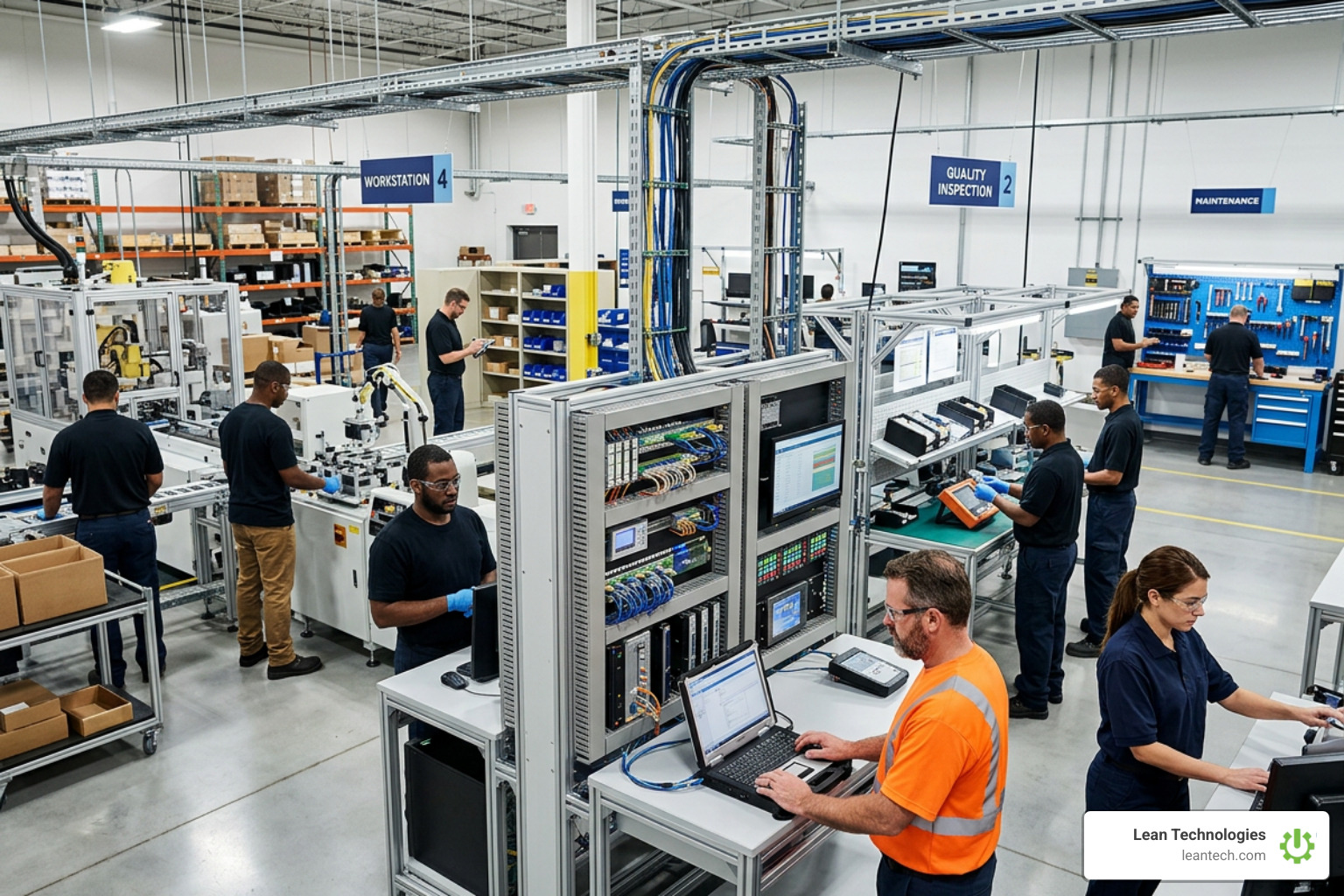
A Practical Guide to Integrated Manufacturing Operations Platforms
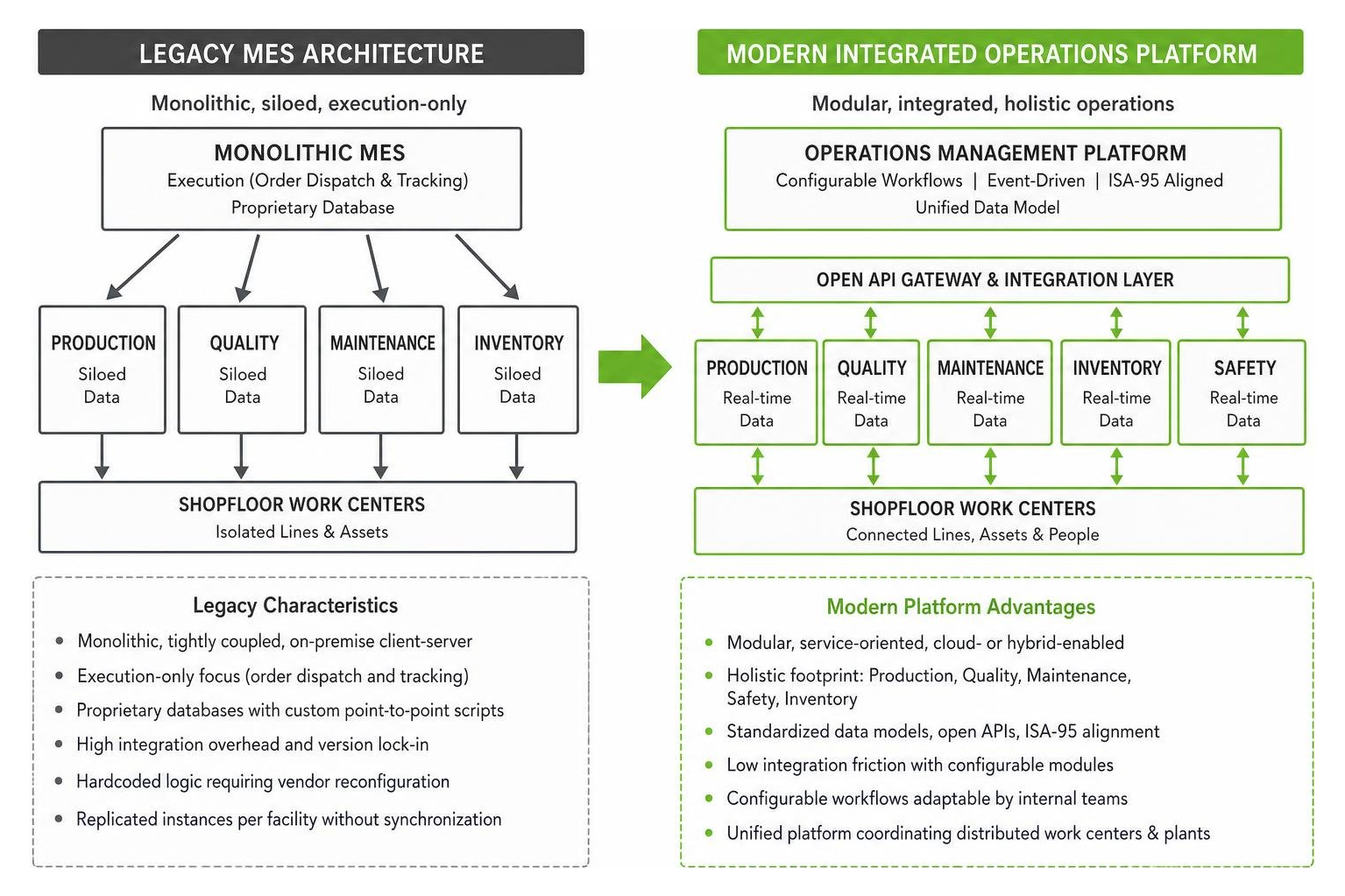
Traditional MES vs. Modern Integrated Operations Management
An integrated manufacturing operations platform unifies production tracking, quality assurance, maintenance workflows, and inventory movement into a single coordinated software environment. When plant operations rely on disconnected spreadsheets and paper logs, frontline supervisors waste hours hunting down machine downtime causes, locating delayed work orders, and reconciling mismatched inventory records. By consolidating operational data across every work center, modern operations platforms deliver real-time operational visibility and bridge the gap between high-level business goals and physical plant execution.
Historically, early execution systems originated from Computer Integrated Manufacturing (CIM) concepts developed in the late 1980s and formalized in the 1990s. These early tools functioned primarily as monolithic, closed-architecture software deployed to track order execution strictly inside four walls. While they replaced paper work instructions on specific lines, they introduced severe maintenance burdens, required heavy custom development, and created isolated information silos.
A modern manufacturing operations management platform shifts the focus from rigid transaction logging to holistic business process coordination. Instead of treating production as an isolated island, an integrated architecture unifies the four core pillars defined by the ISA-95 standard: production, quality, maintenance, and inventory.
Operational Dimension | Traditional Legacy MES | Modern Integrated Platform |
|---|---|---|
System Architecture | Monolithic, tightly coupled, on-premise client-server | Modular, service-oriented, cloud- or hybrid-enabled |
Operational Scope | Execution-only focus (order dispatch and tracking) | Holistic MOM footprint (Production, Quality, Maintenance, Safety, Inventory) |
Data Interoperability | Proprietary databases with custom, brittle point-to-point scripts | Standardized data models, open API gateways, and ISA-95 data alignment |
Integration Overhead | High service-to-software cost ratio; expensive version lock-in | Low integration friction; configurable modules and middleware bridges |
Process Management | Hardcoded logic requiring vendor reconfiguration | Configurable business process workflows adaptable by internal process engineers |
Multi-Plant Scaling | Replicated standalone instances per facility without synchronization | Unified platform architecture coordinating distributed work centers and plants |
Legacy systems often suffer from high data latency. When a machine jams or material quality deviates, the event stays buried in localized line logs or unread shift reports. Modern platforms eliminate this delay by using event-driven architectures to flag nonconformances, re-route tasks, and update schedules instantly across the plant floor.
Core Capabilities of an Integrated Manufacturing Operations Platform
Modern operations platforms combine physical equipment status with enterprise business systems. Achieving this requires robust cyber-physical integration, smart interfaces, and resilient data storage engines. Modern platforms use structured environments such as Microsoft Visual Studio and SQL Server architectures to deliver high data throughput, referential integrity, and rapid querying across millions of transactional records.
At their foundation, these platforms serve as computer integrated manufacturing software ecosystems that coordinate assets, materials, and personnel. By standardizing shopfloor events into unified data structures, platforms bridge the operational gap between tactical execution and strategic planning.
Architecture and Data Flow across the Connected Shop Floor
A resilient architecture connects physical plant hardware with digital management layers through modular middleware. These layers ingest machine states, normalize disparate protocols, and pass contextualized payloads to centralized databases.
On a connected shop floor, bi-directional data flow enables teams to:
Ingest shift events directly from operator terminals and human-machine interfaces (HMIs).
Standardize machine event payloads across diverse equipment models and legacy controls.
Transmit updated work procedures and process adjustments back down to active work centers.
Provide clean, contextual operational logs to high-level planning software without custom code.
Ensure complete traceability across operator actions, maintenance interventions, and production batch records.
Key Modules of an Integrated Manufacturing Operations Platform Architecture
To replace paper binders and fragmented spreadsheets, an integrated platform brings critical operational disciplines into a unified environment:
Production Tracking and Dispatching: Real-time visibility into active job orders, routings, labor allocation, and work center status.
Maintenance Execution: A complete digital work order system that standardizes planned servicing, tracks unplanned repair history, and assigns work requests directly to technicians.
Quality Assurance and Nonconformance: Digital checklists, defect logs, scrap tracking, and root-cause tracing embedded directly into daily production runs.
Material and Inventory Coordination: Clear staging records, work-in-progress (WIP) tracking, and scrap recording to eliminate missing components at startup.
Environmental Health and Safety (EHS): Built-in safety incident logs, hazard observations, and operational compliance audits accessible from mobile devices.
Dynamic Production Scheduling and Cross-Factory Coordination
One of the toughest challenges in multi-plant manufacturing is managing dynamic disturbances: late supplier shipments, sudden machine breakdowns, or urgent order expedites. Traditional schedules generated once a week become obsolete the moment a critical workstation goes down.
Modern platforms resolve this through production scheduling optimization and dynamic re-dispatching. Using predictive-reactive coordination models, the platform maintains a baseline master production schedule while empowering line managers to make localized, reactive adjustments based on true workstation capacity.
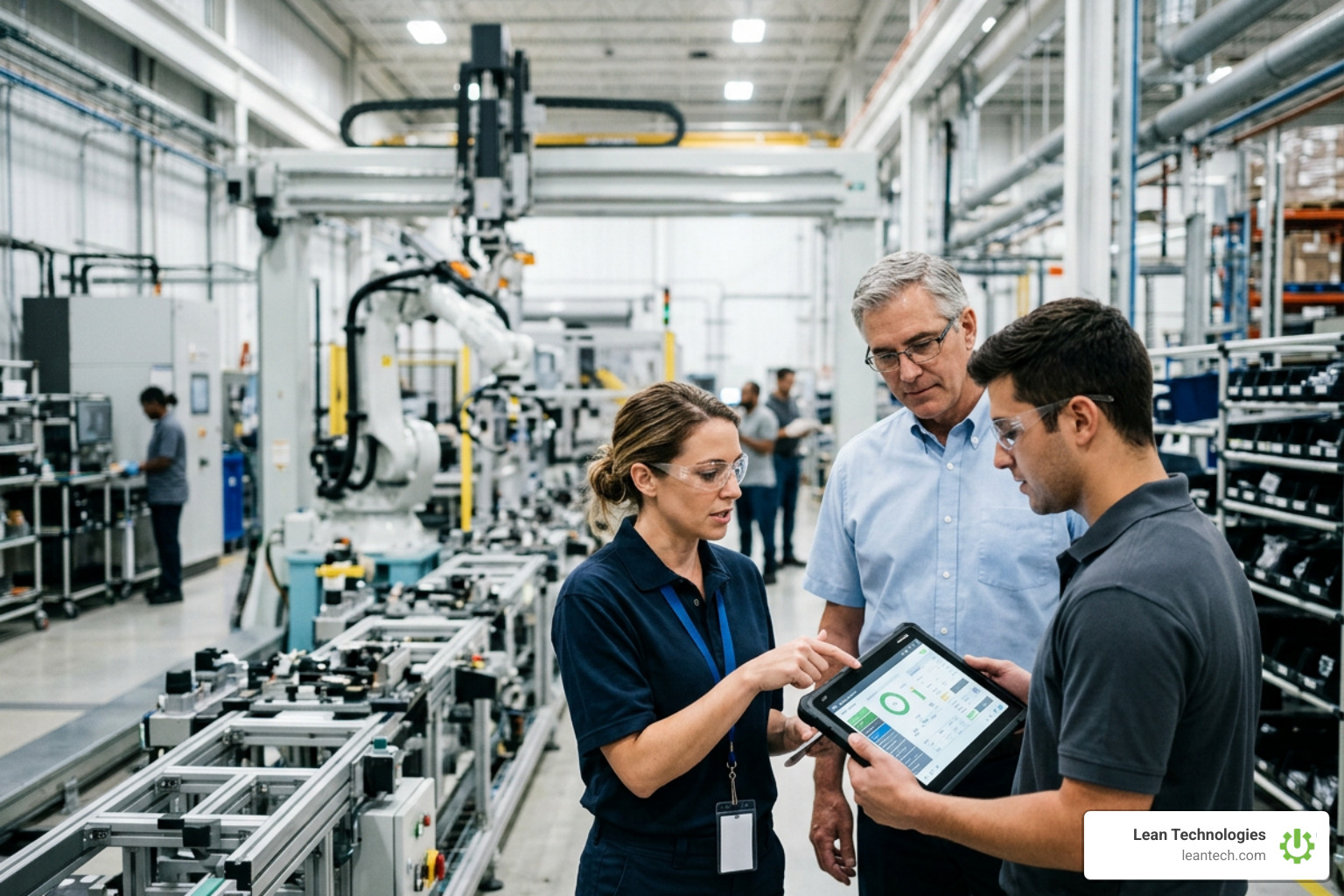
When plants operate within a coordinated manufacturing network, the platform evaluates cross-site capacity, tool availability, and component inventories. If Line A in Plant 1 experiences unexpected downtime, planners can balance open job queues with Plant 2 before bottlenecks stall downstream assembly lines.
Bridging ISA-95 Standards, Continuous Improvement, and Real-Time Control
Long-term plant performance depends on standardizing how data flows between the plant floor and enterprise systems. The ISA-95 standard provides the framework for this alignment by categorizing operational layers:
Level 1 & 2: Sensing, manipulation, and direct physical automation (PLCs, SCADA, machine controllers).
Level 3: Manufacturing operations management (dispatching, maintenance, quality tracking, detailed scheduling).
Level 4: Enterprise business logistics (ERP, order entry, procurement, master planning).
Adopting a digital lean manufacturing framework allows teams to standardize operational data across these layers. When teams identify recurring defects or frequent changeover delays, they can deploy continuous improvement tools in manufacturing such as digital Kaizen logs, 5S audits, and structured problem-solving directly within the software workflow.
Standardized Interoperability from Automation to Enterprise Layers
Standards like ISA-95 and ISA-88 establish common naming structures, data models, and exchange protocols between operations and enterprise IT. By deploying RESTful APIs and standardized schema definitions, modern platforms communicate smoothly with Level 4 ERP systems without bespoke point-to-point connections.
This standardization ensures that when an operator logs a scrap event or closes a maintenance ticket, the data updates inventory valuations and machine availability records across the enterprise data layer in real time, preventing reconciliation errors during shift and month-end closes.
Achieving ROI with an Integrated Manufacturing Operations Platform
Adopting a modern platform delivers direct, quantifiable financial returns by addressing operational waste:
Lower Unplanned Downtime: Faster assignment and tracking of repair tickets prevent minor mechanical issues from becoming catastrophic line stoppages.
Reduced Scrap and Rework: Immediate digital nonconformance logging catches process drift early, saving raw materials and avoiding costly downstream teardowns.
Faster Changeovers: Standardized digital setup checklists and readiness verifications ensure all tooling, documentation, and parts are at the workstation before teardown begins.
Elimination of Administrative Overhead: Automating shift handoffs and daily production reporting frees supervisors to focus on frontline coaching and problem resolution.
Enhanced Labor Productivity: Clear, step-by-step digital standard work instructions reduce operator ramp-up time and eliminate procedural discrepancies across shifts.
Frequently Asked Questions about Manufacturing Platforms
How does a manufacturing operations platform differ from traditional MES?
Traditional MES focuses on executing work orders on specific lines. A manufacturing operations platform covers a broader operational footprint—unifying production, maintenance, quality, inventory, and safety under standardized data models and configurable workflows across multiple facilities.
What role does ISA-95 play in platform interoperability?
ISA-95 defines the data interfaces and terminology shared between business systems (ERP) and operational control systems (MOM/MES). Conforming to these models avoids proprietary vendor lock-in, simplifies enterprise integration, and standardizes operational definitions across sites.
How do platforms handle real-time scheduling disruptions across facilities?
Platforms use dynamic dispatching to balance predictive baseline schedules against real-time shopfloor events. When equipment breaks down or parts run short, planners can immediately evaluate alternate machine routings, adjust priority queues, and re-allocate capacity across workstations or partner plants.
In Summary
Fragmented operational data leads to missed targets, unresolved machine downtime, and poor cross-team coordination. Centralizing operational workflows into a unified environment gives teams the structure they need to maintain accountability and eliminate recurring shop floor waste.
Lean Technologies offers Thrive as a flexible digital toolbox built for small to midsize manufacturers to digitize lean work processes in real time without replacing ERPs or MES systems. Thrive provides real-time visibility only when processes are structured and data is entered at the source via mobile, tablet, or desktop. Instead of collecting raw sensor signals or generating predictive alerts, Thrive organizes clear follow-up actions around machine data entered directly by teams or imported from other systems.
To learn how to modernize your daily shopfloor workflows without complex IT overhauls, explore our comprehensive guide to digital lean manufacturing. Selecting the right integrated manufacturing operations platform gives your workforce the tools, clarity, and accountability needed to drive sustainable continuous improvement.