
An Essential Guide to Comparing Manufacturing Operations Platform Features & ROI
Architectural Foundations: MOM vs. Traditional MES
Understanding where a manufacturing operations management platform fits into your digital stack begins with identifying how architecture has evolved over the past decade. Traditional shop floors relied heavily on isolated systems, leading to paper workarounds, late downtime logs, and IT-manufacturing misalignment.
Key Differences Between MES and a Manufacturing Operations Management Platform
While a traditional Manufacturing Execution System (MES) focuses strictly on executing work orders and tracking unit progress at specific workstations, a modern manufacturing operations management platform covers a much broader operational scope. An MES tracks the "what" and "when" of production execution, but a MOM platform connects production execution directly to auxiliary pillars like quality assurance, equipment reliability, inventory flow, and labor performance.
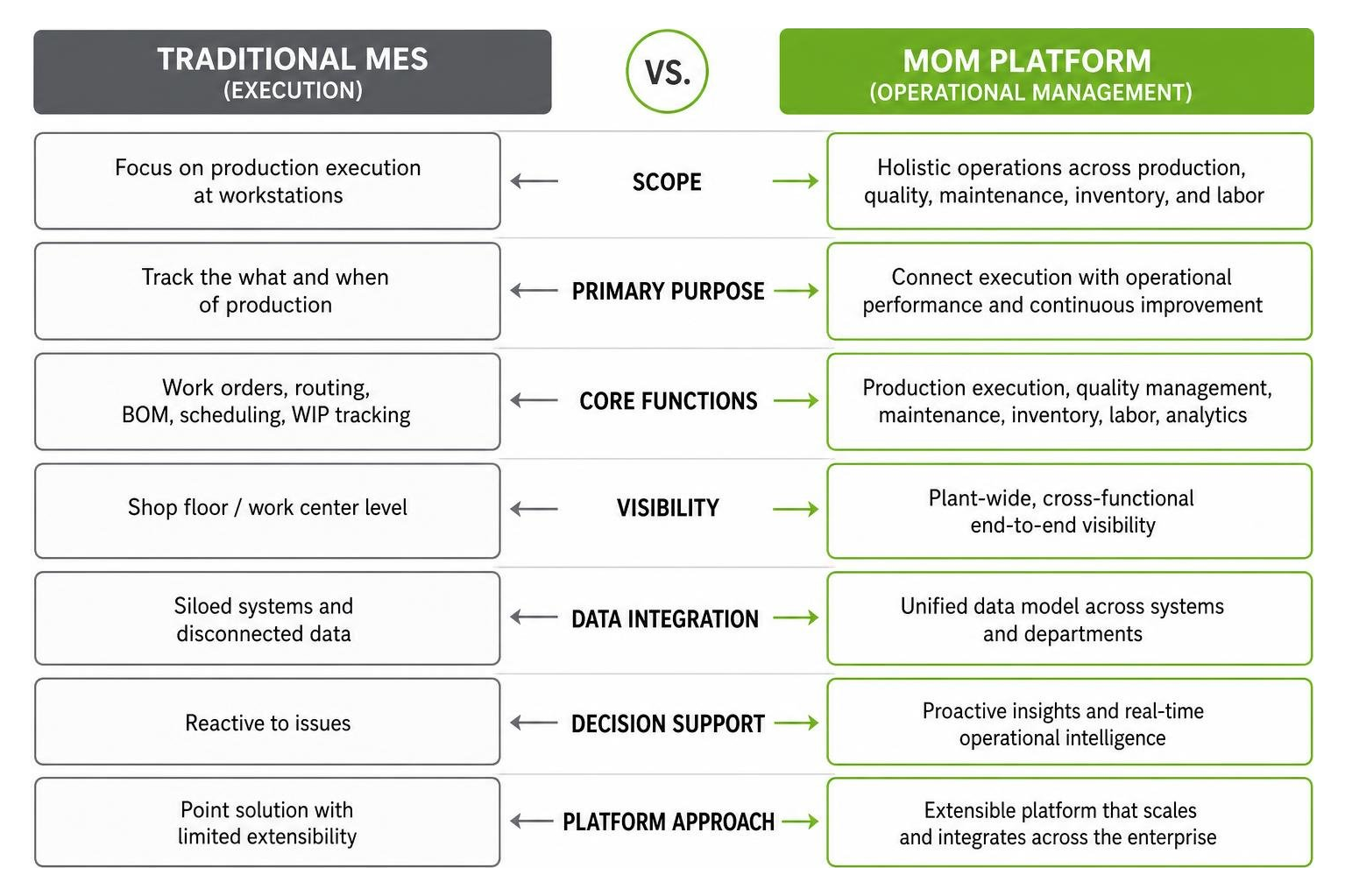
This broader footprint bridges the gap between high-level business planning and plant floor execution. Rather than forcing supervisors to reconcile disparate systems or paper printouts, a MOM environment acts as a cohesive hub that standardizes workflows across departments.
Market Evolution and Industry 4.0 Integration
The shift toward holistic operational systems is accelerating rapidly. The global MOM market size was valued at $11.2 billion in 2023 and is projected to reach $22.5 billion by 2032, expanding at a CAGR of 8.1%. Driven by Industry 4.0 initiatives, cloud-based architectures, and digital twin models, over 60% of manufacturers plan to invest in MOM software within the next two years to improve real-time visibility and operational agility.
In today's 2026 manufacturing landscape, facilities can no longer afford unclosed continuous improvement (CI) loops or scattered compliance data. A platform approach connects daily front-line actions with enterprise goals, giving teams the tools they need to react immediately to shop floor variables.
Evaluating Core Capabilities of a Manufacturing Operations Management Platform

Evaluating potential software requires looking beyond high-level vendor promises. Operations managers must inspect specific modules to ensure they solve everyday floor friction, such as unlogged shift issues or untracked quality defects.
Production Scheduling and Workflow Tracking
Static spreadsheets cannot handle modern order mix changes or sudden machine downtime. Advanced platforms offer dynamic scheduling tools that recalculate task sequencing as conditions change on the floor.
Bottleneck Reduction: Identifies work-in-progress (WIP) build-ups before they stall downstream lines.
Resource Allocation: Matches work orders to available labor, specialized skills, and tooling.
Execution Monitoring: Tracks job progress against planned timelines in real time.
By utilizing dedicated tools for Workflow Tracking, plant supervisors can ensure that work steps follow established standard operating procedures (SOPs) without relying on verbal handoffs.
Integrated Quality Management and Audits
Quality cannot be managed in a silo. Integrating Quality Management capabilities directly into daily routines ensures that defect logging occurs immediately at the point of origin.
Inline Inspections: Operators perform step-by-step checks on mobile devices or tablets, logging dimensional verifications or visual checks directly during production.
Nonconformance Handling: Captures part defects, attaches photos, and triggers immediate hold protocols.
Standardized Audits: Automates layer process audits (LPA), 5S evaluations, and safety inspections with mandatory task completion.
Preventing bad parts from moving down the line protects customer delivery dates and eliminates unneeded rework.
Asset Reliability and Maintenance Management via CMMS
Downtime events quickly destroy operational margins when communication between operators and technicians breaks down. Incorporating a Computerized Maintenance Management System layer bridges the gap between production and technical teams.
Through proactive Maintenance tools, operators can log equipment anomalies the moment they occur. Maintenance teams automatically receive structured work orders with work history and spare parts requirements attached. Additionally, embedding Safety Management protocols and Risk Assessment steps directly inside maintenance routines protects technicians while keeping machines running efficiently.
Measuring ROI, OEE, and Operational Value
Investing in digital infrastructure requires clear financial justification. Evaluating potential ROI involves reviewing historical performance metrics against achievable shop floor improvements.
Performance Metric Traditional Manual Management Platform-Driven Management Impact / Financial Return Overall Equipment Effectiveness (OEE) 55% - 65% (Estimated via paper) 75% - 85% (Verified digital logs) +20% OEE improvement on average Unplanned Downtime High (Delayed reaction times) Low (Instant action workflows) 15% - 30% reduction in downtime Throughput Volume Constrained by bottlenecks Optimized via real-time tracking 10% - 20% improvement Scrap & Rework Costs High (Defects found late) Low (Early inline catching) Up to 25% cost reduction
Calculating Financial Return on a Manufacturing Operations Management Platform
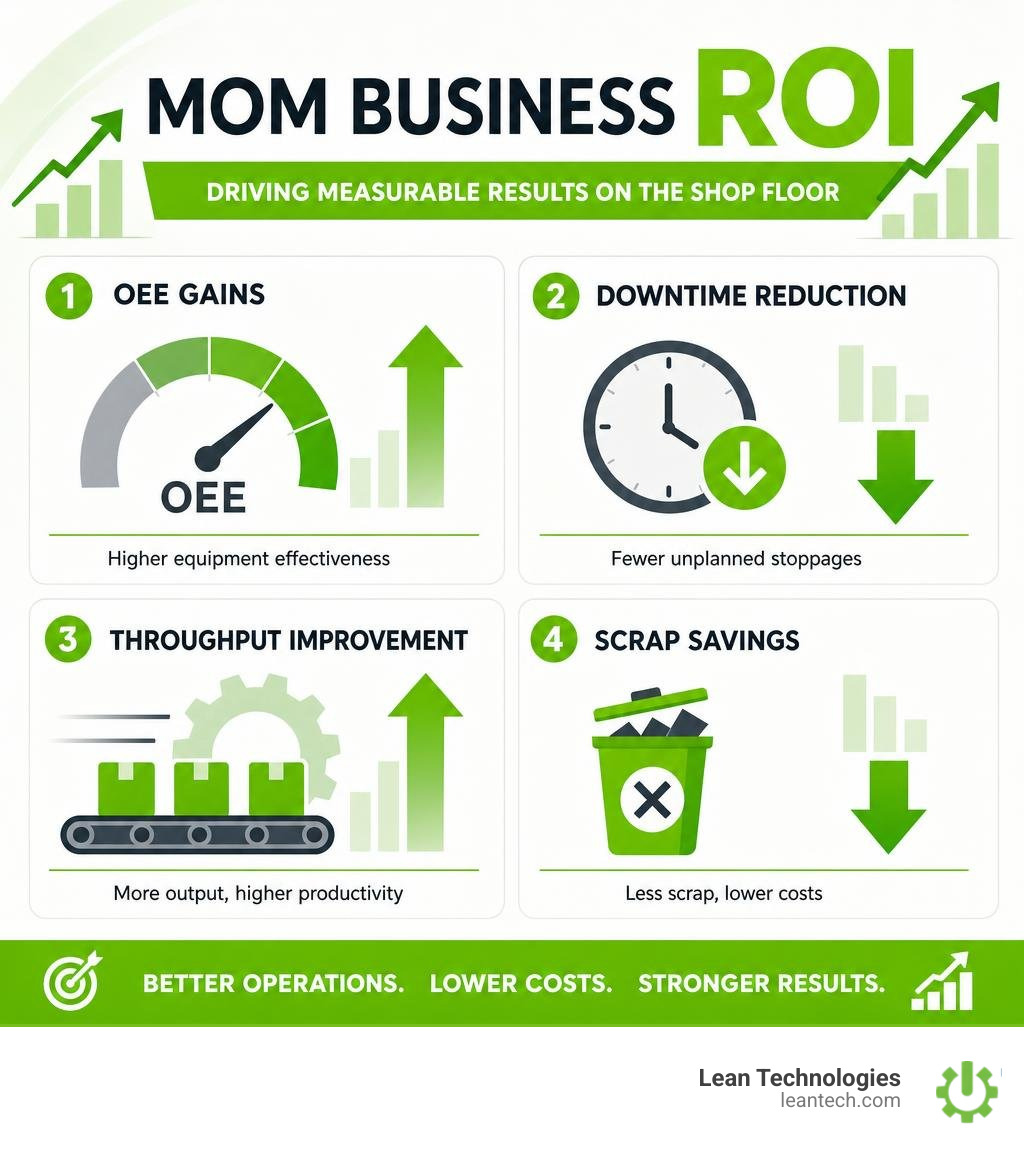
The quantitative value of deploying a manufacturing operations management platform comes from eliminating hidden waste on the shop floor:
OEE Improvement: Facilities using structured operational platforms report an average 20% increase in overall equipment effectiveness (OEE) within the first year of deployment.
Downtime Elimination: Better cross-departmental communication drives a 15-30% reduction in production downtime.
Throughput Gains: Eliminating floor bottlenecks yields a 10-20% improvement in total throughput.
Scrap Reduction: Standardized quality workflows and immediate root-cause tracking reduce scrap and rework costs by up to 25%.
Operational Visibility and Real-Time Decision-Making
Beyond direct cost savings, digital tools eliminate the labor wasted on compiling end-of-shift reports or searching through cabinet drawers for audit trails. Real-time decision-making relies on data entered directly at the source. When teams log work activities, scrap reasons, and stoppage causes on tablets or desktops, management gains immediate visibility into active floor conditions, building accountability and keeping priorities clear across every shift.
Integration Strategies and Deployment Best Practices

A common challenge when modernizing software infrastructure is legacy friction—connecting modern management systems with existing IT architectures without interrupting daily operations.
ERP, PLM, and Shop Floor Integration
To build a seamless operating model, systems must pass data smoothly without creating manual data-entry loops:
ERP Integration: Synchronizes master job orders, raw material inventories, and high-level delivery schedules down to the shop floor while returning completed unit counts and actual labor hours back to financial accounts.
PLM Connectivity: Downloads current product designs, revision histories, and routing instructions directly into job workflows, ensuring operators always build against up-to-date specifications.
Shop Floor Alignment: Translates raw operational events into actionable tasks for front-line teams, ensuring legacy equipment data turns into structured follow-up tasks.
Using digital tools like Lean Manufacturing Software to structure shift routines simplifies overall system architecture while reducing burden on IT teams.
Overcoming Deployment Challenges and Ensuring Adoption
Software implementations frequently fail due to user resistance rather than technical shortcomings. If operators find screens confusing or burdensome, they will revert to paper logs and verbal workarounds.
To secure long-term adoption:
Involve Front-Line Staff Early: Include line leads, technicians, and operators in setup testing to build intuitive, simple interfaces.
Standardize Workflows First: Clean up ambiguous routines and continuous improvement steps before digitizing them.
Iterative Rollout: Implement modules systematically—starting with issue logging or preventative maintenance before expanding across the whole plant.
Frequently Asked Questions
How does a MOM platform differ from an ERP system?
An Enterprise Resource Planning (ERP) system manages high-level business functions like customer orders, accounting, procurement, and high-level inventory balances. It typically operates on hourly, daily, or monthly timeframes. A manufacturing operations management platform operates in real time directly on the production floor. It manages shift workflows, equipment tasks, quality audits, and operator assignments, executing the detailed work needed to fulfill ERP business plans.
What is the expected timeline for realizing ROI from MOM software?
Most operations begin seeing measurable return on investment within three to six months of full deployment. Early gains come from reduced downtime through quicker issue escalation and time saved by eliminating paper logging. Within twelve months, facilities typically achieve sustained increases in overall equipment effectiveness (OEE) and scrap reduction.
Can small to midsize facilities implement MOM solutions effectively?
Yes. Modern digital platforms offer flexible, modular deployments that do not require massive IT infrastructure investments. Small and midsize operations can start by digitizing core problem areas—such as shift handovers, preventative maintenance work orders, or nonconformance logging—and expand functionality as operational maturity grows. Utilizing Project Management principles during rollout keeps timelines short and initial costs low.
In Summary: Modernizing Your Shop Floor Operations
Selecting the right operating environment is a strategic decision that directly impacts daily efficiency, product quality, and long-term profitability. Upgrading operational capabilities does not require tearing out existing enterprise software or spending years on custom IT development.
For small to midsize manufacturers seeking the fastest path to structured, accountable work processes, Thrive offers a digital platform built specifically to digitize lean work processes in real time without replacing ERPs or MES systems. Positioned as a flexible digital toolbox for logging issues, tracking actions, and driving continuous improvement, Thrive is not an ERP or MES system. Instead, it provides real-time visibility only when processes are structured and data is entered at the source via mobile, tablet, or desktop. Thrive does not collect sensor data or run predictive alerts; it organizes action from machine data entered by teams or imported from other systems.
To learn more about transforming your shop floor execution, explore our comprehensive Guide to Digital Lean Manufacturing or request a demo today to see how a flexible manufacturing operations management platform can elevate your plant floor operations.