
Best Program Management Tools: Features, Pricing, and PMO Fit
Core Capabilities of the Best Program Management Tools
The best program management tools give leadership a single operational control tower for multiple connected initiatives. They deliver cross-initiative rollups, shared resource balancing, predictive dependency mapping, and stage-gate governance so a delay in one workstream never silently derails another. Program management differs fundamentally from managing individual projects. While a single project focuses on delivering a specific output on time and within budget, a program coordinates multiple interconnected initiatives to achieve broader strategic objectives. According to the Project Management Institute, organizations that invest in proven project management practices waste 28 times less money than those that do not. As the global project and portfolio management software market expands toward $13.6 billion by 2029, modern platforms must deliver deep portfolio rollups, automated critical path analysis, and flexible governance models.
When selecting among top platforms, several core functional pillars separate basic task trackers from true program platforms:
Portfolio Rollups and Strategic Alignment: High-level dashboards consolidate live status, budget health, and milestone progress across several initiatives into a single executive view.
Cross-Project Resource Management: Visibility into shared resource pools prevents overallocation across concurrent delivery streams.
Predictive Risk and Dependency Mapping: Identifying when a delay on one initiative threatens a milestone on another prevents cascading bottlenecks.
Financial and Budget Variance Tracking: Real-time tracking of planned budgets versus actual expenditures protects program margins.
Independent industry research on portfolio management systems emphasizes that governance traceability and centralized intake are critical for leadership teams evaluating overall program health.
Essential Architecture in the Best Program Management Tools
A robust program platform requires an architecture built for complex multi-tier relationships. Centralized intake processes ensure every new proposal or operational mandate passes through standardized scoring criteria before resources are committed.
From intake, initiatives break down into hierarchical work packages. Having interactive schedule visibility allows coordinators to visualize overlapping timelines, cross-initiative milestones, and resource capacity constraints simultaneously. When field teams update progress directly at the source, steering committees gain real-time visibility rather than relying on stale weekly status decks.
Advanced Governance and Dependency Tracking in the Best Program Management Tools
Governance turns chaotic multi-team efforts into predictable execution. Top-tier tools implement structured stage-gate workflows where an initiative cannot advance to the next phase without meeting explicit deliverable criteria and securing documented stakeholder sign-offs.
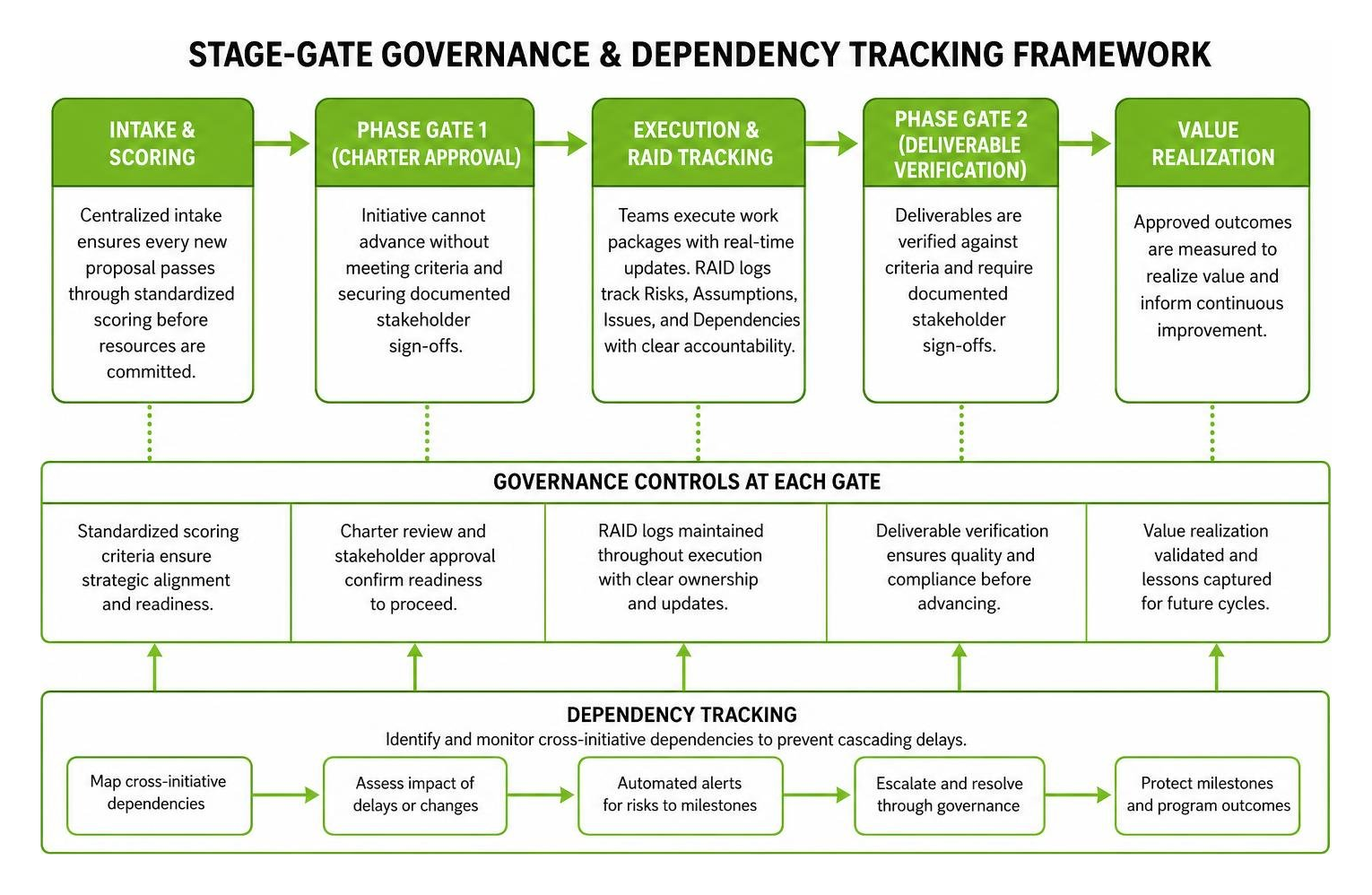
Alongside stage gates, embedded RAID logs (Risks, Assumptions, Issues, Dependencies) maintain clear accountability for blockers. Automated risk-scoring models assign severity metrics to issues, alerting leadership before critical delivery milestones slip off course.
Evaluating Program Management Software vs Project Tracking Tools
A common operational misstep is attempting to force standard task tracking software to manage complex, multi-layered programs. Task-level tools excel at helping individuals check off daily to-dos, update kanban cards, and manage discrete sprint backlogs. However, they lack the native architectural depth required to handle portfolio-wide capacity models, cross-project dependencies, and governance review gates.

Relying on lightweight modern project tracking solutions to steer enterprise-level programs often results in spreadsheet sprawl and disconnected data silos.
Feature / Capability | Task-Level Project Tracking | Multi-Project Program Management Software |
|---|---|---|
Primary Scope | Single deliverables, team tasks, sprints | Multi-project portfolios, strategic initiatives |
Dependency Mapping | Within a single board or task list | Across independent projects, teams, and departments |
Resource Allocation | Individual workload counts per board | Cross-portfolio capacity, soft/hard booking, skills pools |
Governance Structure | Ad-hoc status tags and custom fields | Formal stage-gate approvals and baseline tracking |
Financial Tracking | Basic task-level hourly logging | Program budget variance, cost rollups, and profitability |
Executive Reporting | Static board snapshots | Real-time rollups, BI integrations, and OKR alignment |
Program-Level Governance vs Task Execution
While task execution keeps work moving on a daily basis, program-level governance ensures that work directly advances broader business objectives. In an informative comprehensive project management guide, standardizing delivery criteria across different business units is identified as essential for maintaining consistent performance.
Program management platforms capture earned value management metrics, track cumulative schedule variance, and maintain comprehensive audit trails so leaders can adjust resource commitments before budgets run dry.
Stage-Gate Governance and Traceable Milestones
Traceability means every change in scope, schedule, or staffing links back to documented charter baselines. When a project reaches an approval gate, managers review verified deliverable evidence within the platform rather than hunting through email chains. This creates clear operational accountability and provides steering committees with trustworthy status metrics across every active track.
Pricing Tiers, Licensing Models, and Total Cost of Ownership
Understanding software licensing structures helps teams avoid unexpected cost escalations. Most work management and portfolio platforms offer tiered pricing based on functionality, user volume, and security requirements.
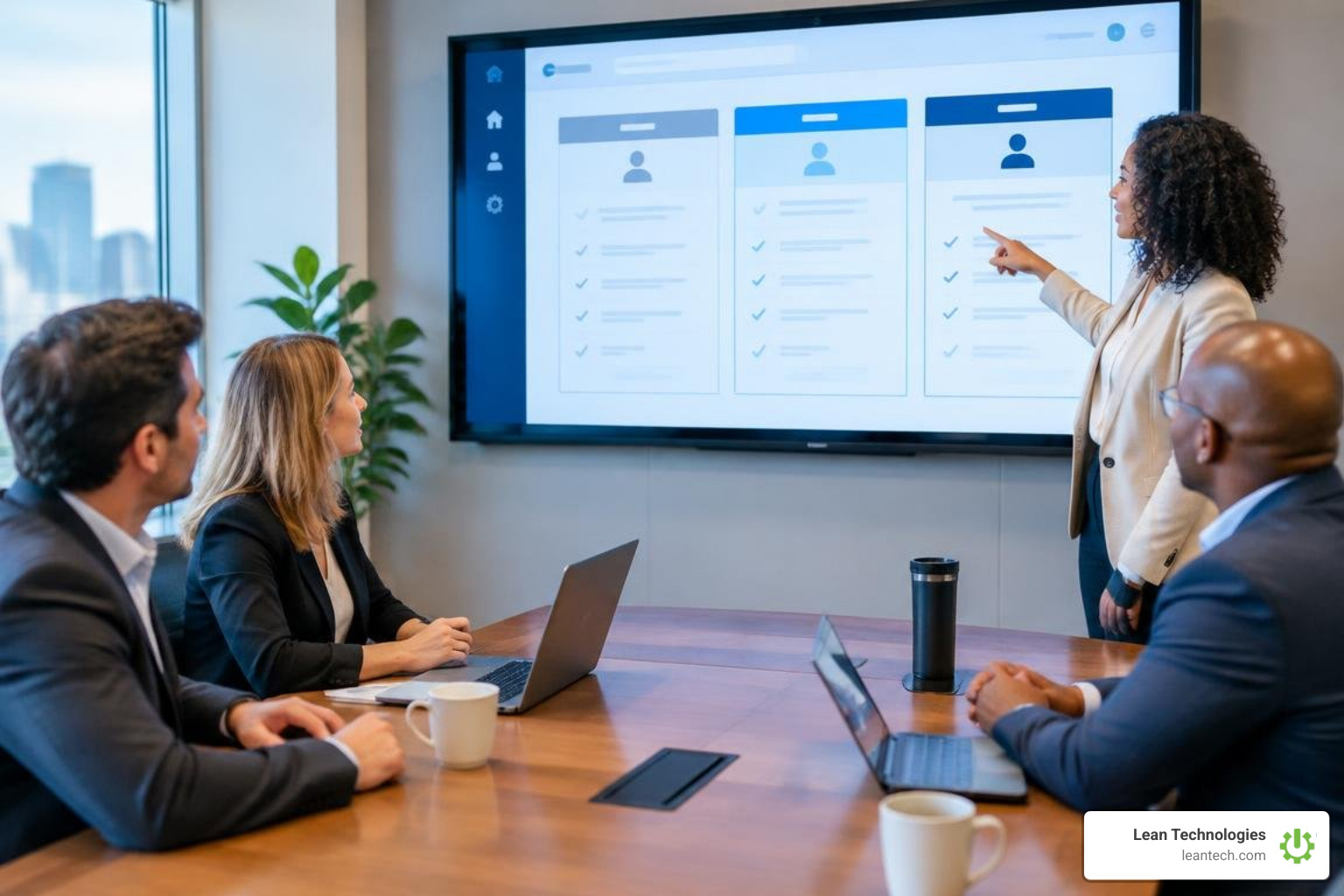
Consulting program management benchmarks reveals that total cost of ownership extends well beyond monthly per-user fees to include implementation, training, and integration expenses.
Entry-Level and Mid-Market Software Costs
Mid-market platforms typically cost between $7 and $35 per user per month. While these entry-tier licenses provide core task management and shared boards, essential program features are often locked behind higher-priced plans:
Workflow Automation Limits: Basic plans cap the number of monthly automated actions across projects.
Portfolio and Cross-Project Views: Interactive roadmaps and roll-up dashboards frequently require upper-tier subscriptions.
Advanced Resource Allocation: Workload heat maps and capacity balancing tools are rarely included in standard packages.
Data and Storage Caps: File attachment limits and historical activity tracking are restricted on lower plans.
Enterprise PPM and Multi-Tier Licensing Breakdown
Enterprise-grade strategic portfolio management platforms often range from $45 to over $100 per user per month. These enterprise agreements provide custom role-based governance, single sign-on (SSO) enforcement, and unlimited API access for deep enterprise resource planning connections.
Many enterprise vendors offer tiered licensing structures, such as full-license creators for program managers, lower-cost contributor seats for team members logging progress, and free or low-cost executive viewer seats. Organizations should factor in onboarding and configuration services, which can add significant initial overhead to the contract value.
Choosing the Right Program Management Solution for Your Organization
Selecting the right platform requires matching your organization’s operational maturity with the software’s governance capabilities. Overly complex tools lead to low user adoption, while overly simplistic systems fail to deliver meaningful portfolio visibility.
Departmental PMOs and Professional Services
For professional services, consulting firms, and agencies, preserving project margins and tracking resource utilization are primary concerns. Tools built for client-facing work incorporate native time capture, automated client billing, and capacity forecasting. Studies indicate that teams using automated time tracking capture 10% to 15% more billable time compared to manual entry methods, protecting project profitability.
Industrial Operations and Lean Shop Floor Programs
In industrial and manufacturing environments, program management takes a hands-on form. Plant managers, continuous improvement coordinators, and maintenance leads do not just manage digital deliverables—they oversee physical plant overhauls, safety rollouts, 5S implementations, and kaizen events. Addressing manufacturing-specific project management needs requires software that simplifies shop floor engagement rather than introducing administrative friction.
When frontline operators and supervisors log equipment issues, safety observations, or continuous improvement ideas at the source using mobile devices or shop floor tablets, leadership gains accurate, real-time visibility. This operational data feeds directly into broader continuous improvement programs without forcing supervisors into tedious administrative data entry.
Frequently Asked Questions about Program Management Tools
What is the difference between program management and project management software?
Project management software focuses on executing individual deliverables, assigning tasks, and managing timelines for a single project team. Program management software aggregates multiple related projects, manages shared resource capacity across departments, tracks cross-project dependencies, and aligns delivery progress with strategic business goals and financial targets.
How do AI-powered features improve program management?
Traditional workflow automation relies on fixed, rule-based triggers (such as moving a card when a date arrives). AI-powered capabilities analyze historical delivery patterns across portfolios to predict resource constraints, identify hidden milestone bottlenecks, and generate automated progress summaries, allowing managers to mitigate risks before they cause delays.
What are the most common capability gaps in program management software?
According to industry surveys, 92% of teams report that their management tools fall short in at least one critical functional area. The most prevalent capability gaps include portfolio data reporting and analytics (50%), shared resource capacity planning (42%), and program-level budget or margin tracking (38%).
What to Do Next
Achieving predictable program delivery requires matching your governance rigor with a tool your team will actually maintain. Enterprise PMOs running formal stage-gate portfolios require deep governance and earned value analysis, while professional services teams prioritize margin visibility and billable capacity tracking.
For manufacturing and industrial operations, success relies on connecting shop floor reality with continuous improvement governance. Platforms like Thrive by Lean Technologies serve as a flexible digital toolbox for small to midsize manufacturers, digitizing lean work processes so operators and supervisors can log issues, track actions, and sustain continuous improvement. Thrive does not collect raw sensor data, run automated machine alerts, or replace your existing ERP or MES systems. Instead, it organizes and drives clear action from machine data when entered by your team or imported from other systems, providing real-time visibility when data is recorded at the source.
When evaluating purpose-built program management software, pilot shortlisted tools with a small cross-functional team using real initiatives. Testing how easily team members update progress and how clearly dashboards display shared resource bottlenecks will help you choose the best program management tools for long-term organizational success.