A Practical Guide to a Continuous Improvement Management System
Why a Continuous Improvement Management System Matters on the Shop Floor
When shift notes live on paper, actions get lost in email, and the same downtime problem returns every week, a continuous improvement management system gives teams one repeatable way to find, fix, measure, and sustain better work.
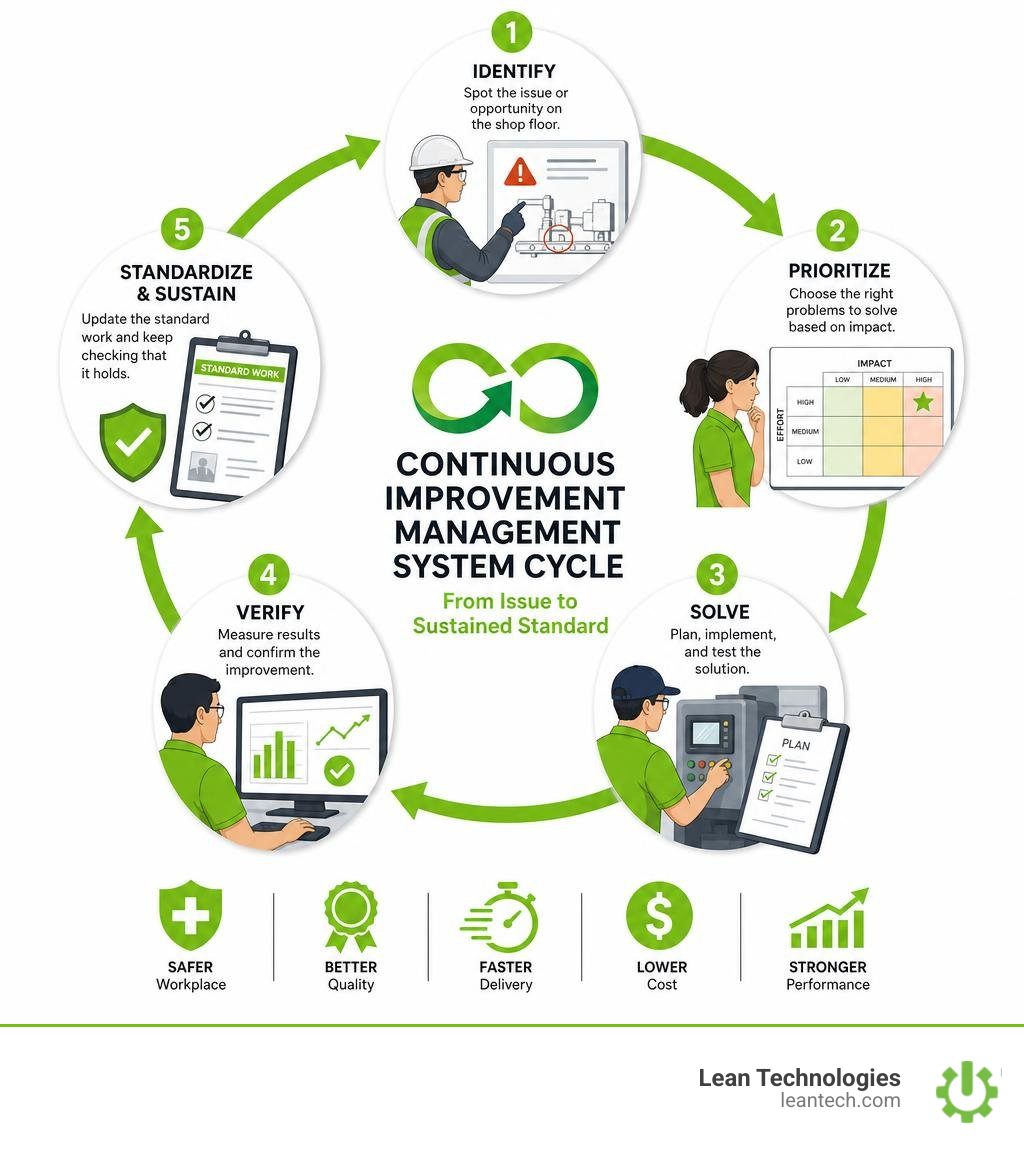
A Continuous Improvement Management System (CIMS) is the management framework that turns improvement from isolated Lean events or quality fixes into daily operational practice. It connects shop floor issues, improvement ideas, assigned actions, performance measures, and follow-up so gains do not disappear when priorities change or a key employee leaves.
In simple terms, a CIMS helps manufacturers:
Identify performance gaps, waste, risks, and opportunities.
Prioritize the work that matters most to safety, quality, delivery, and cost.
Test and implement practical solutions.
Measure whether the change improved results.
Standardize the new process and keep checking that it holds.
For an operations manager, the goal is not more reports or another disconnected program. It is a clear line from a problem on the floor to an owned action, a verified result, and a better standard of work.
Thrive is a flexible digital toolbox for small to midsize manufacturers. It helps teams log issues, track actions, and drive continuous improvement without replacing an ERP or MES system. It organizes action around machine data entered by teams or imported from other systems; it does not collect sensor data or run predictive alerts. Its real-time visibility depends on structured processes and data entered at the source through mobile, tablet, or desktop.
This guide explains how a CIMS fits with Lean, Kaizen, Six Sigma, and a Quality Management System - and how to make improvement work visible, measurable, and durable.
What Is a Continuous Improvement Management System (CIMS)?
A continuous improvement management system is an integrated operational framework designed to systematically identify waste, optimize processes, and raise operational performance baselines across an entire enterprise. While traditional operational methodologies often rely on sporadic kaizen events or individual employee initiative, a CIMS institutionalizes improvement. It ensures that knowledge, accountability, and problem-solving practices remain embedded in daily management workflows.
At its core, a CIMS shifts an organization's focus from firefighting to proactive waste elimination. Rather than waiting for a customer rejection or equipment breakdown to occur, a operating CIMS encourages frontline operators and leadership to actively seek out small inefficiencies, micro-stoppages, and workflow bottlenecks.
Why Every Manufacturer Needs a Continuous Improvement Management System
Manufacturing environments are inherently dynamic. Without a structured management system, operational gains achieved during targeted Lean initiatives frequently fade over time. When key personnel move to new roles or leave the company, the specialized knowledge and personal discipline driving those gains often walk out the door with them.
A robust CIMS protects operational gains by embedding problem-solving routines directly into the organizational standard work. It directly aligns with ISO 9001 Clause 10.3 requirements, which mandate that organizations continually improve the suitability, adequacy, and effectiveness of their quality management systems.
Guidance standards like the CLSI Standard for Continual Improvement outline continual improvement as an essential, ongoing component of effective quality management. Emphasizing root-cause elimination over temporary workarounds, a CIMS systematically reduces physical waste, unnecessary motion, defective processing, and operational downtime.
Comparing CIMS vs Traditional QMS
Many organizations confuse a standard Quality Management System (QMS) with a Continuous Improvement Management System. Although they complement each other, their primary operational goals differ significantly.
A traditional QMS is often backwards-looking and compliance-driven. It establishes strict rules, documents standard operating procedures (SOPs), and enforces corrective action when quality specifications are violated. In many facilities, a QMS risks becoming "compliance theater"—an exercise performed primarily to pass external audits rather than drive operational performance.
Conversely, a CIMS is forward-looking and growth-driven. While a standard QMS asks, "Did we follow the written procedure and contain the defect?", a CIMS asks, "How can we refine this procedure so the defect becomes structurally impossible?"
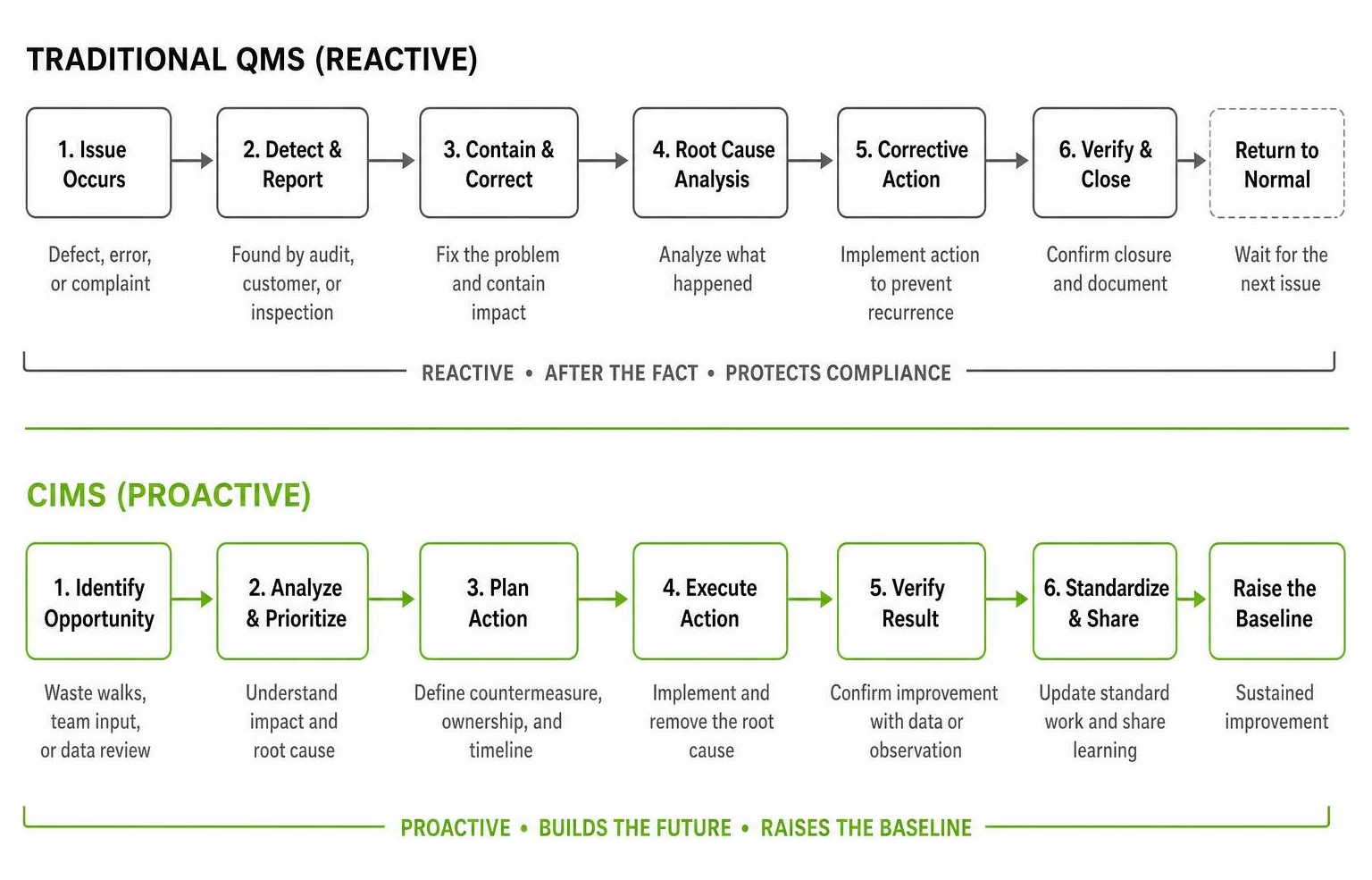
Operational Dimension Traditional QMS Continuous Improvement Management System (CIMS) Primary Focus Regulatory compliance & standard adherence Baseline elevation & waste elimination Trigger Mechanism Reactive (Nonconformances, customer complaints) Proactive (Opportunities for improvement, waste walks) Core Orientation Backwards-looking (Correction & containment) Forward-looking (Optimization & prevention) Frontline Role Following written procedures & logging errors Identifying root causes & suggesting solutions Business Impact Prevents quality regression Drives measurable cost, lead time, and OEE gains
Quality control inspects product outputs, and quality assurance audits system processes. A continuous improvement management system unifies both by constantly updating and elevating standard work based on frontline feedback.
Core Components of a Continuous Improvement Management System
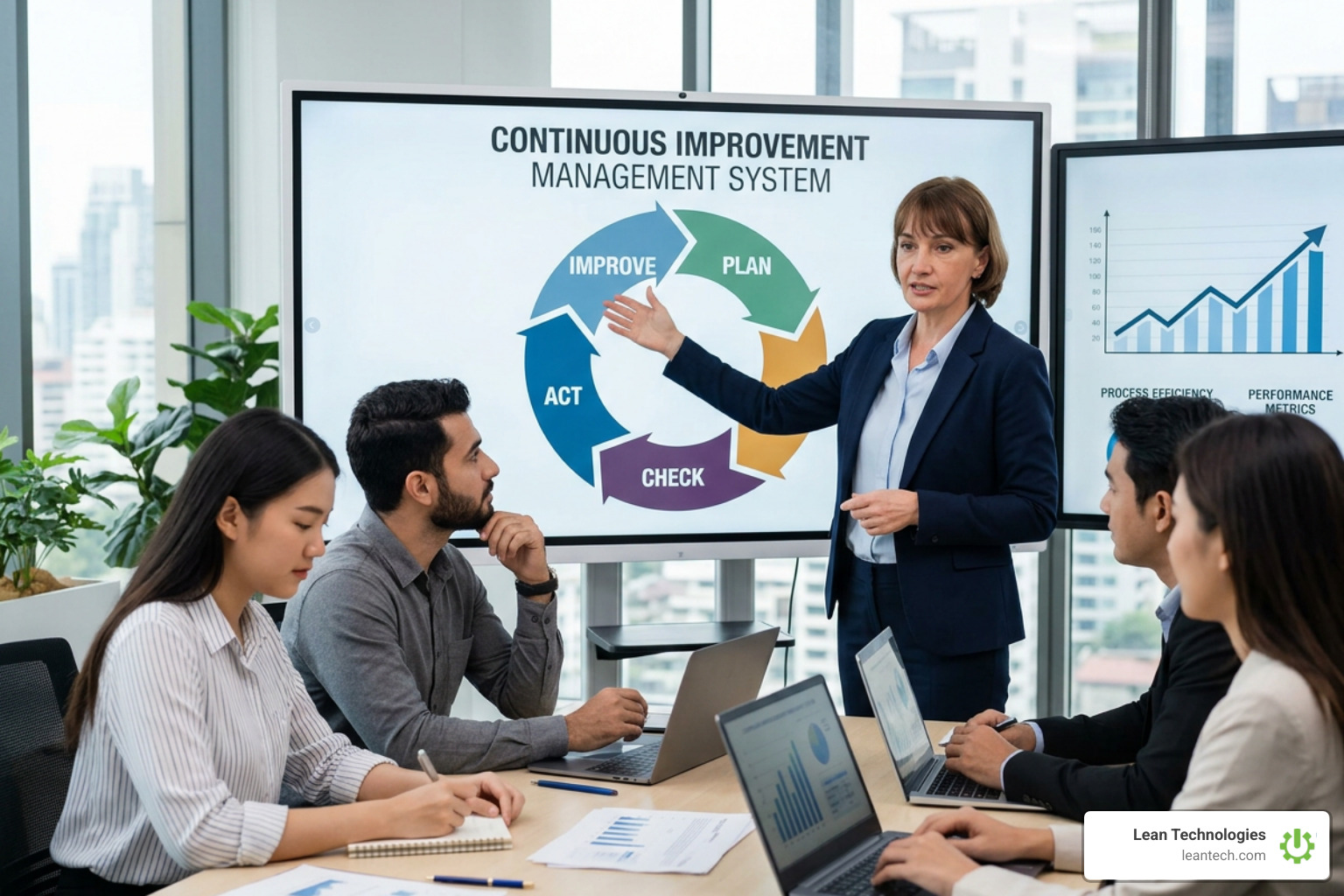
A successful continuous improvement management system relies on a repeatable, six-step cycle. This systematic approach transforms unstructured employee feedback into measurable operational progress:
Identifying Opportunities for Improvement (OFIs): Capturing input from frontline operators, safety observations, waste walks, internal audits, and shift handovers.
Selecting and Prioritizing Opportunities: Evaluating identified problems based on safety impact, financial value, operational feasibility, and customer risk.
Generating Practical Solutions: Utilizing cross-functional teams to develop targeted countermeasures using tools like 5 Whys, Ishikawa (fishbone) diagrams, and mistake-proofing (poka-yoke).
Implementation and Tracking: Assigning clear single-point ownership, direct action items, target completion dates, and resource commitments.
Evaluating Solution Effects: Comparing post-implementation performance metrics directly against original baseline metrics to confirm genuine progress.
Sustaining Operational Gains: Updating standard operating procedures (SOPs), training material, and visual management controls to lock in improvements permanently.
For a deeper look into structuring shop floor workflows digitally, review our Guide to Digital Lean Manufacturing.
To prevent improvement initiatives from stalling, organizations must maintain rigorous task accountability. Utilizing dedicated Follow Up Tools on Action Items ensures that assigned countermeasures are executed on time rather than forgotten in static spreadsheet logs.
Integrating CIMS with Lean, Six Sigma, and DMAIC Methodologies
A common operational failure mode in manufacturing is the creation of parallel, competing improvement tracks. Quality teams may run isolated corrective action logs, operations teams manage kaizen event trackers, and engineering conducts separate Six Sigma projects. This fragmentation leads to duplicated effort, conflicting priorities, and frontline confusion.
A continuous improvement management system serves as the single overarching registry that connects and orchestrates all improvement frameworks under one roof.

Instead of treating Lean, Six Sigma, and DMAIC as separate programs, a unified CIMS routes operational problems to the appropriate methodology based on complexity and risk:
Simple, localized operational waste is addressed immediately through frontline employee suggestions or quick 5S actions.
Moderate, cross-functional process gaps are tackled via dedicated 3- to 5-day rapid Kaizen events.
Complex, high-cost quality defects with unknown root causes are assigned to dedicated project leads following the DMAIC framework.
Centralizing all projects within one management framework gives operations leaders complete visibility into resource allocations, active project timelines, and verified financial returns. Learn more about organizing cross-functional shop floor initiatives in our guide to Project Management.
Structuring DMAIC and Kaizen within a Continuous Improvement Management System
The DMAIC Methodology and Phases—Define, Measure, Analyze, Improve, and Control—provides a rigorous structure for solving persistent manufacturing challenges. Within a CIMS, nonconformities logged on the production line directly seed the DMAIC project backlog.
When a recurring quality nonconformance occurs, the CIMS triggers root cause analysis rather than settling for operator retraining. If the issue requires multi-departmental focus, it is escalated to a structured Kaizen event or DMAIC project.
Once the Improve phase validates a solution, the CIMS enforces the Control phase by immediately linking updated standard work back to daily tier meetings and visual goal boards.
Leadership, Management Review, and Building a Lean Culture
A continuous improvement management system cannot survive on software or procedures alone; it demands leadership commitment and an active lean culture. Without top-down executive support and bottom-up operator engagement, continuous improvement rapidly devolves into a passive paper-pushing exercise.
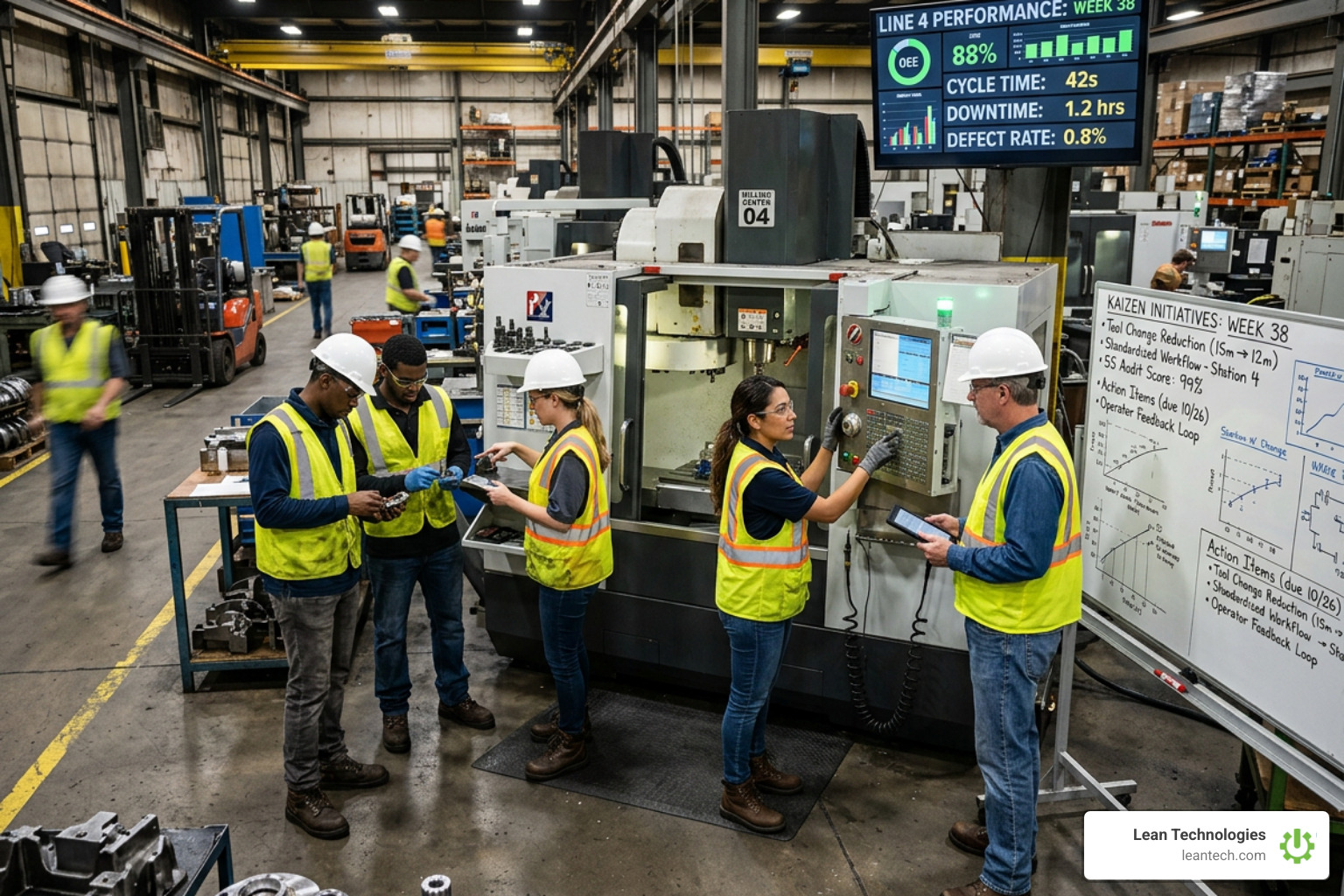
Building an authentic improvement culture requires moving visual management out of executive conference rooms and directly onto the plant floor. Daily shift huddles around physical or digital boards give operators a platform to voice daily friction, review process performance, and own tactical action items.
Driving Executive Accountability and Management Review
Under ISO 9001 Clause 9.3, leadership must conduct periodic management reviews of the QMS. However, traditional management reviews are often unproductive, 40-slide PowerPoint presentations delivered by quality managers to disengaged executives once a year.
To turn management review into a strategic decision-making driver, leading organizations structure reviews around a disciplined 90-minute agenda that translates technical quality metrics into direct financial and operational impacts:
10 Minutes: Review of strategic Quality Objectives and financial scrap costs.
20 Minutes: Evaluation of active continuous improvement project portfolios and resource bottlenecks.
20 Minutes: Review of nonconformities, audit findings, and corrective action effectiveness.
20 Minutes: Assessment of operational risk registers, capacity limits, and equipment performance.
20 Minutes: Direct resource allocation logging, task owner assignment, and target completion dates.
Placing clear visual accountability at the center of reviews using Performance Goal Boards drives top-level buy-in and ensures leadership remains aligned on key operational targets.
Overcoming Pitfalls to Make Continuous Improvement Stick
Operational gains frequently regression because improvements depend on individual enthusiasm rather than institutionalized management discipline. When the enthusiastic continuous improvement leader moves to another facility, the gains regress.
To gauge your plant's readiness for long-term cultural stability, conduct a structured Lean Culture Assessment.
As detailed in industry literature like the Continuous Improvement Management System Book, sustainable operational excellence requires balancing three core facets: Get It Done, Do It Right, and Make It Stick.
Get It Done: Empower frontline teams to rapidly pilot practical countermeasures without bureaucratic delays.
Do It Right: Ensure root causes are systematically verified, standards are updated, and changes comply with safety and quality requirements.
Make It Stick: Embed the new standard into daily leader standard work, audit schedules, and automated daily tracking tools so old habits cannot return.
Measuring CIMS Impact: KPIs and Key Metrics
To justify resource investment and keep teams aligned, a continuous improvement management system must track clear, actionable Key Performance Indicators (KPIs).
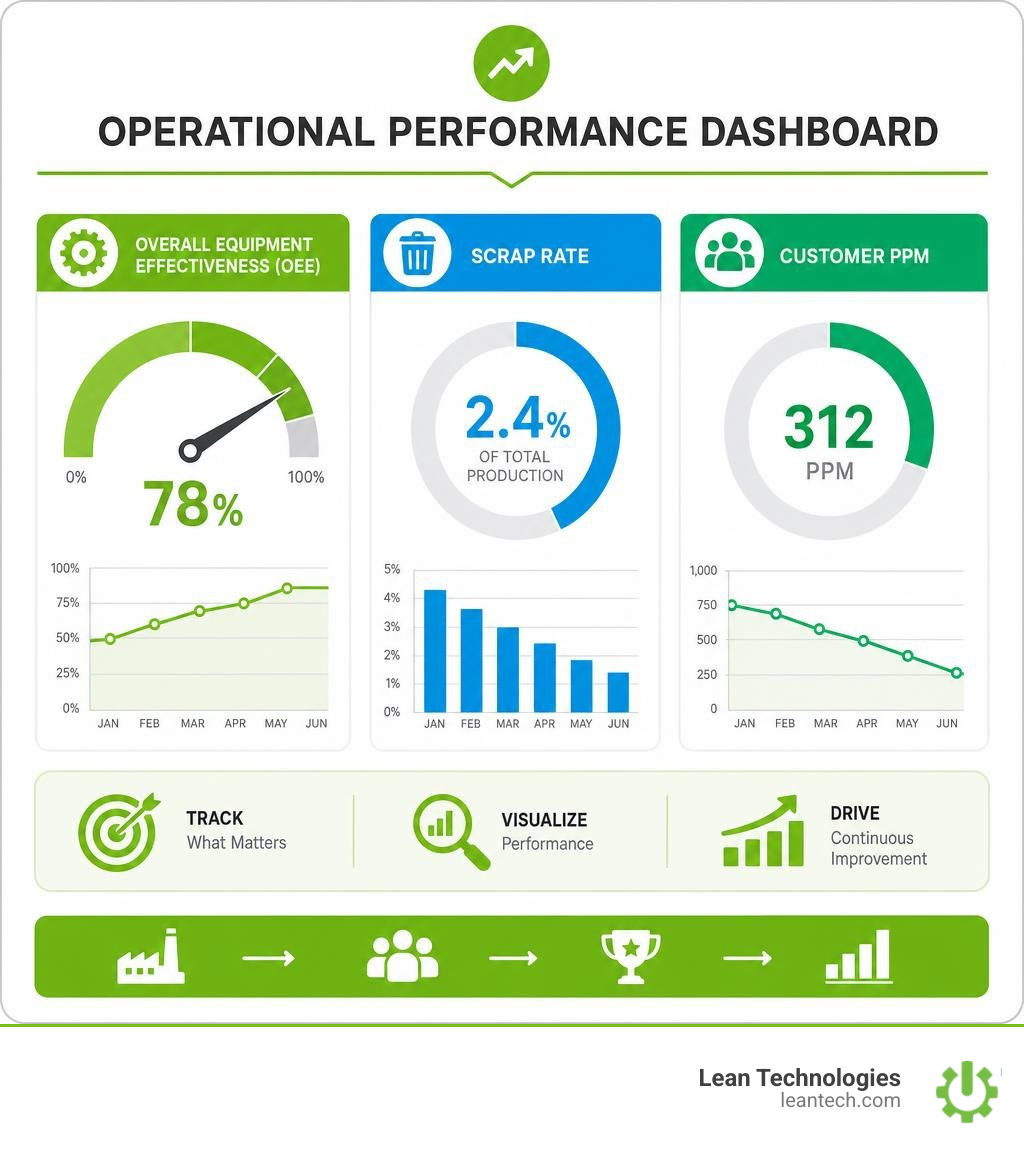
Key metrics every manufacturing CIMS should track include:
Overall Equipment Effectiveness (OEE): Tracking availability, performance, and quality rates on critical equipment constraints.
Parts Per Million (PPM) Defect Rate: Measuring external customer rejections and internal rework volumes.
On-Time Delivery (OTD): Evaluating schedule adherence and operational lead-time performance.
Minor Audit Nonconformities: Tracking internal and external audit observations.
Open Action Closure Lead Time: Measuring average days required to move an identified opportunity from logged status to verified closure.
When organizations build an integrated CIMS, they systematically address root causes of operational friction to drive sustainable progress across quality, delivery, and equipment utilization. To streamline how quality departures and corrective actions feed into your CIMS metrics, utilize dedicated software modules for Nonconformance Tracking.
Digitizing Continuous Improvement with CIMS Software

Paper suggestion boxes, whiteboards, and disconnected spreadsheets work well when initiating Lean practices. However, as organizations scale, paper systems introduce severe operational friction:
Shift handover notes get lost or mislaid.
Action items lack clear accountability and deadline tracking.
Operational data collected on paper must be manually re-entered into spreadsheets, delaying decision-making.
Plant managers lack real-time visibility into active project statuses across shifts and departments.
Digitizing the continuous improvement process solves these barriers by creating a single, accessible workspace for the entire shop floor. Modern software platforms provide a flexible digital toolbox where operators can instantly log an issue, upload photos of a broken fixture, and assign an action directly from a tablet or mobile device.
Through direct digital Workflow Tracking, management gains immediate visibility into active initiatives, pending approvals, and overdue tasks without having to chase project managers down in person.
Frequently Asked Questions About CIMS
What is the main difference between a CIMS and a standard QMS?
A traditional Quality Management System (QMS) focuses primarily on regulatory compliance, standard adherence, and reactive corrective actions following nonconformances. A Continuous Improvement Management System (CIMS) is a forward-looking operational framework focused on systematically identifying waste, eliminating process friction, and proactively elevating baseline performance enterprise-wide.
How do you measure the effectiveness of a continuous improvement management system?
CIMS effectiveness is measured using operational metrics such as Overall Equipment Effectiveness (OEE), customer complaint defect rates (PPM), On-Time Delivery (OTD), average action-item closure lead times, and reduction in audit nonconformities. Sustained improvement across these core operational KPIs indicates a mature, high-functioning CIMS.
How does a digital toolbox support continuous improvement on the shopfloor?
A digital toolbox replaces fragile paper records and scattered spreadsheets with structured, real-time input tools on tablets, mobile devices, or desktops. It allows operators to log issues instantly at the source, assign clear task ownership, send automatic notification escalations, and give operations leaders complete visibility into open continuous improvement initiatives across all shifts.
In summary
Building a mature continuous improvement management system is the most effective way for small to midsize manufacturers to transition from reactive firefighting to systematic operational excellence. By creating clear routines for identifying waste, empowering frontline operators, executing root-cause countermeasures, and measuring real performance gains, manufacturers ensure their hard-won operational progress holds strong over time.
Thrive is a digital platform built for small to midsize manufacturers to digitize lean work processes in real time without replacing ERPs or MES systems. It serves as a flexible digital toolbox for logging issues, tracking actions, and driving continuous improvement across the shop floor. Thrive provides real-time visibility only when processes are structured and data is entered at the source via mobile, tablet, or desktop. It organizes action from machine data entered by teams or imported from other systems, offering the fastest path to structured, accountable work processes.
Ready to elevate your continuous improvement management system and lock in operational gains? Explore the Thrive Continuous Improvement Platform to discover how digitizing shop floor workflows can transform your plant operations today.