
How to Choose the Right Lean Six Sigma Software Tools for Your Team
Why the Right Lean Six Sigma Software Tools Can Make or Break Your Improvement Program
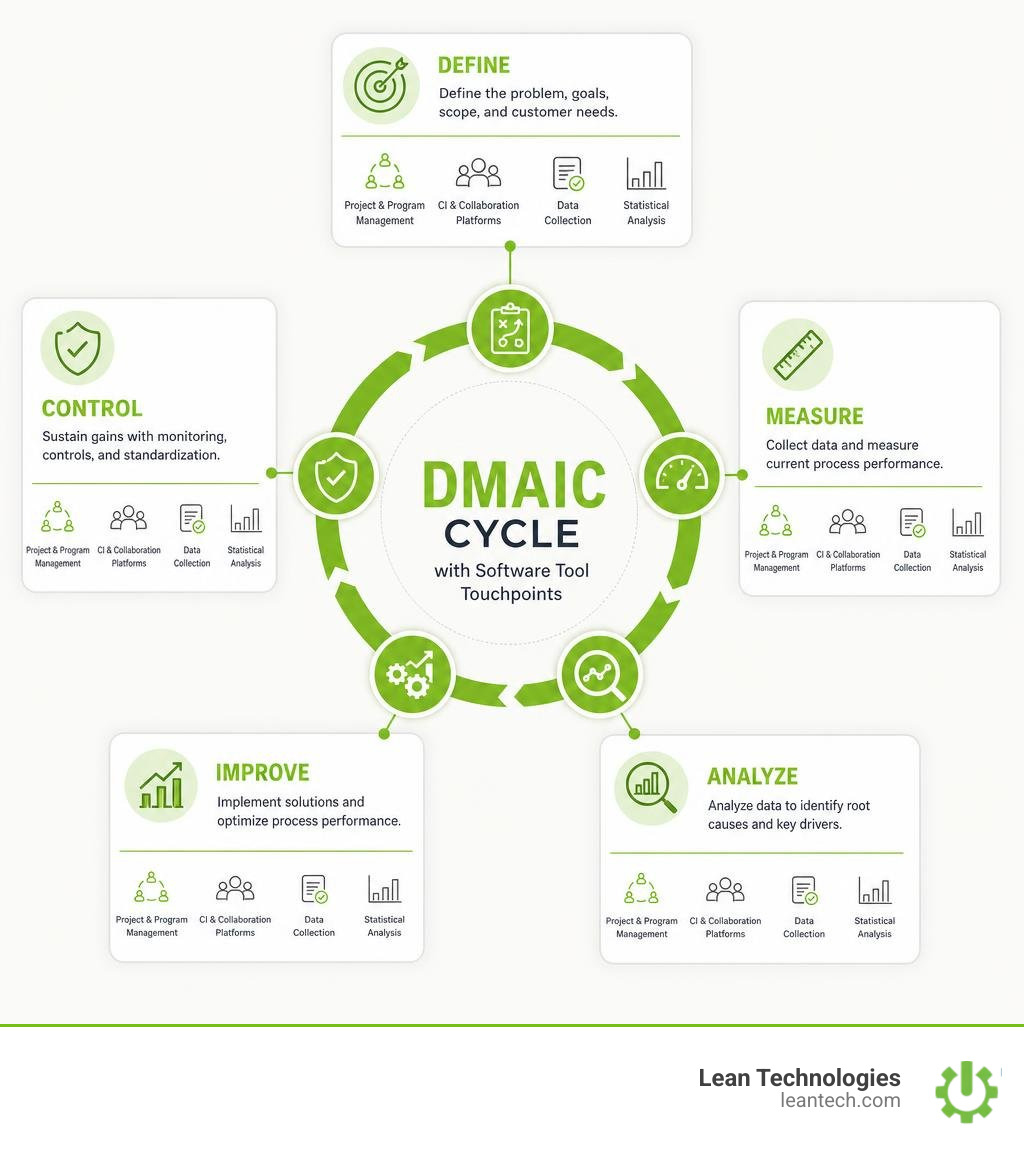
Lean Six Sigma software tools are purpose-built platforms and applications that help manufacturing teams execute DMAIC projects, analyze process data, track improvements, and sustain gains over time. Here's a quick breakdown of the main categories:
Category Purpose Examples Statistical Analysis Process capability, SPC charts, hypothesis testing Minitab, JMP, Statgraphics Project & Program Management DMAIC roadmaps, tollgate reviews, savings tracking Dedicated DMAIC trackers, corporate PMO tools CI & Collaboration Platforms Team workflows, action tracking, real-time visibility Thrive CI, digital kaizen boards Data Collection Digital forms, audits, inspections, shop floor capture Thrive Quality, mobile audit apps
If you're a plant operations manager, you already know the pain. Projects stall. Data lives in three different spreadsheets. Your Black Belt is chasing down status updates instead of solving problems. And by the time a report reaches leadership, the numbers are already a week old.
That's not a people problem. It's a tooling problem.
The gap between knowing Lean Six Sigma methodology and actually executing it consistently at scale is wider than most organizations expect. As one industry perspective puts it bluntly: knowing the tools is easy — the real challenge is using them consistently across an organization with the right supporting infrastructure.
The good news? The software landscape has matured significantly. Organizations using dedicated Lean Six Sigma platforms report 30–50% reductions in project cycle time and 10–20% gains in Black Belt and Green Belt productivity compared to teams cobbling together generic tools. That's a measurable difference on your bottom line.
This guide walks through every major category of Lean Six Sigma software, compares dedicated platforms against spreadsheets and open-source options, and gives you a practical framework for choosing the right stack for your team's size, complexity, and goals.
The Four Core Categories of Lean Six Sigma Software Tools
To build an efficient operational excellence program, you cannot rely on a single software tool to do everything. A robust continuous improvement (CI) architecture requires tools across four distinct functional classes. When these classes work in harmony, you eliminate the friction that typically kills project momentum.

Understanding where each tool fits prevents your team from using a statistical sledgehammer to crack a simple shopfloor communication nut, or using a basic whiteboard tool to analyze complex process variation. For a deeper look at how to structure these systems, check out our Guide to Digital Lean Manufacturing.
Statistical Analysis and Analytical Lean Six Sigma Software Tools
The "Six Sigma" side of the methodology is heavily quantitative. It is designed to isolate process variation, identify defect root causes, and mathematically validate that your changes actually made a difference.
The most common statistical analyses used in DMAIC projects include:
Process Capability Analysis (Cp, Cpk, Pp, Ppk): Determines if your manufacturing process is capable of producing parts within customer specification limits.
Statistical Process Control (SPC) Charts: Monitors process stability over time, allowing operators to spot trends and process drift before defects occur.
Hypothesis Testing & ANOVA: Statistically proves whether changes in input variables (like temperature or speed) have a significant impact on the output quality.
Failure Mode and Effects Analysis (FMEA): Prioritizes risks based on severity, occurrence, and detection ratings to prevent failures before they happen.
To execute these analyses, teams rely on dedicated statistical engines. Platforms like Statgraphics provide deep toolkits for measurement systems analysis (MSA/Gage R&R), process capability, and design of experiments (DOE). Similarly, JMP and Minitab offer powerful graphical interfaces that make complex statistical modeling accessible to Black Belts and Green Belts.
For a comprehensive index of options, you can browse the List of Six Sigma software packages - Wikipedia or explore standard Six Sigma Tools And Templates to understand how these statistical frameworks map to your daily quality checks.
Continuous Improvement (CI) and Action Tracking Platforms
If statistical tools handle the "Analyze" phase of DMAIC, CI and action tracking platforms handle the "Improve" and "Control" phases. These tools are the operational engine of your program. They manage the workflow of your projects, enforce tollgate reviews, track financial impacts, and make sure action items don't die in a notebook.
A dedicated CI platform ensures that:
Tollgate Reviews are Enforced: Projects cannot advance from Measure to Analyze without formal champion sign-off.
Financial Tracking is Defensible: Savings (hard savings, soft savings, and cost avoidance) are calculated uniformly and validated.
Role-Based Access is Maintained: Champions, Sponsors, Black Belts, and operators have tailored views of the portfolio.
This is where Thrive CI changes the game for midsize manufacturers. Instead of keeping project management isolated in a corporate PMO tool, Thrive CI integrates continuous improvement directly with daily shopfloor execution. It bridges the gap between high-level DMAIC projects and the frontline operators who actually need to sustain the improvements.
Dedicated Lean Six Sigma Software vs. Spreadsheets and Open-Source Tools
Many organizations start their Lean Six Sigma journey using Microsoft Excel or free, open-source programming languages. While this approach has low upfront software licensing costs, it quickly leads to what CI leaders call "Excel Hell."
Here is how dedicated lean six sigma software tools stack up against spreadsheets and open-source R packages:
Feature/Capability Dedicated LSS Software (e.g., Thrive CI) General-Purpose Spreadsheets (Excel) Open-Source R Packages (SixSigma, qcc, qualityTools) Version Control Single source of truth; automatic cloud updates. High risk of duplicate files and broken formulas. Code-based; highly secure but requires Git/repository management. Statistical Validation Built-in, automated, and mathematically verified. Manual formula creation; highly prone to calculation errors. Robust statistical libraries, but requires programming expertise. User Learning Curve Low to moderate; guided workflows and templates. Low; everyone knows Excel (but few can build advanced macros). High; requires R programming knowledge. Tollgate & Governance Automated workflows and sign-offs. None; tracked manually via emails and meetings. None; strictly analytical. Collaboration Real-time co-authoring of FMEAs, Fishbones, and VSMs. Static files emailed back and forth. Code collaboration only. Productivity Impact 10–20% increase in Belt productivity. High administrative overhead chasing updates. High setup time for non-programmers.
Relying on spreadsheets for your continuous improvement program creates a fragile infrastructure. If the one engineer who built your custom macro-enabled Excel workbook leaves the company, your entire tracking system breaks.
Furthermore, spreadsheets do not provide real-time visibility. If an operator logs a process deviation on a paper sheet that is entered into Excel at the end of the week, you are looking at historical data. By then, the scrap has already been produced, the customer order is late, and your opportunity to correct the process in real time has passed.
For teams with heavy coding capabilities, open-source R packages (like SixSigma, qcc, qualityTools, and IQCC) provide an incredibly powerful, zero-cost analysis engine. They can generate perfect SPC control charts and process capability reports. However, the steep learning curve makes them impractical for the vast majority of shopfloor teams, supervisors, and busy operations managers.
How to Choose the Best Lean Six Sigma Software Tools for Your Team
Choosing the right software stack isn't about buying the most expensive, feature-heavy platform on the market. It is about matching the software's capabilities to your team's size, technical maturity, and operational reality.

When evaluating your options, use this selection framework:
Assess Your Team’s Technical Maturity: Do you have dedicated, full-time Master Black Belts who need advanced multi-variable DOE capabilities? Or do you have frontline supervisors and Green Belts who need guided DMAIC roadmaps and simple, collaborative visual tools?
Define Your Project Complexity: If your primary struggle is high process variation in complex chemical manufacturing, prioritize statistical engines. If your struggle is project execution, task accountability, and sustaining basic shopfloor gains, prioritize a collaborative CI platform like Thrive CI.
Evaluate Integration Needs: Your Lean Six Sigma tools shouldn't exist on an island. They need to connect with where the work actually happens. Look for platforms that can integrate with your shopfloor quality management systems, like Thrive Quality, to feed real-time nonconformance data directly into your continuous improvement pipeline.
Look for Core Feature Alignment: Ensure the platform natively supports standard LSS artifacts—such as DMAIC roadmaps, live collaborative FMEAs, Fishbone diagrams, and structured control plans—rather than forcing you to build them from scratch in a generic Project Management tool.
By focusing on these areas, you ensure that your software investment supports active Project Tracking and drives real cultural adoption rather than becoming shelfware.
Evaluating AI and Automation in Modern Lean Six Sigma Software Tools
The integration of Artificial Intelligence and automation into lean six sigma software tools has fundamentally changed how operations teams approach process improvement. Historically, a Green Belt would get stuck on a statistical analysis, wait days for a coaching session with a busy Master Black Belt, and lose project momentum.
Today, AI-powered platforms are dramatically reducing this coaching bottleneck:
AI Coaching Assistants: Modern AI-powered assistants provide real-time, on-demand coaching. They guide practitioners through methodology questions, validate statistical assumptions, and suggest next steps in the DMAIC workflow. This can lead to an up to 50% reduction in Master Black Belt coaching dependency, saving thousands of dollars per belt annually.
Automated Root Cause and Process Mapping: Open-source AI projects like simaba/lean-ai-ops demonstrate how teams can turn messy, unstructured process logs into structured DMAIC frameworks, automated Fishbone diagrams, and initial action plans in seconds.
Quantifying Missed Impacts: Modern mapping tools apply DMAIC thinking directly to information flows. In real-world applications, digital mapping has helped organizations uncover missed process impacts that increased the calculated value of change by 40% in a single hour, and identified hundreds of wasted work hours per month across specific roles.
These technologies don't replace human problem solvers. Instead, they handle the administrative and analytical heavy lifting, allowing your team to focus entirely on executing improvements.
Overcoming Implementation Challenges and Sustaining Improvements
The graveyard of continuous improvement programs is filled with software tools that teams simply stopped using. The initial excitement of a new platform launch often gives way to cultural resistance, and before long, the team drifts back to their comfortable paper logs and siloed spreadsheets.
To prevent this process drift and ensure long-term adoption, focus on three critical pillars:
Implement Leader Standard Work: Software is only as good as the discipline surrounding it. Establish clear Leader Standard Work to ensure that managers and supervisors are actively checking dashboards, reviewing open action items, and using the software as the central "source of truth" during daily huddles.
Standardize Change Management: Treat the software rollout itself as a Lean Six Sigma project. Utilize structured Change Management principles to address employee concerns, communicate the "why" behind the digital shift, and run thorough pilot programs on a single line before scaling across the entire plant.
Connect CI to Daily Shopfloor Audits: Sustaining a process improvement requires constant verification. By linking your continuous improvement platform to digital Audits and automated Risk Assessment workflows, you can instantly flag when a process begins to drift from its newly established standard.
When operators see that leadership uses the software daily to solve real shopfloor frustrations—rather than just to generate executive reports—they take ownership of the data. This active participation at the source is what transforms continuous improvement from a corporate mandate into a self-sustaining culture.
Frequently Asked Questions About Lean Six Sigma Software
What is the difference between general project management software and dedicated Lean Six Sigma software tools?
General project management software (like Trello, Asana, or Jira) is designed for task tracking and general milestone management. It does not understand Lean Six Sigma methodology.
Dedicated lean six sigma software tools are built specifically around the DMAIC, DMADV, or Kaizen frameworks. They include specialized features like automated tollgate reviews, financial impact tracking (categorized by hard and soft savings), built-in statistical analysis, and collaborative quality templates (like FMEAs and Fishbone diagrams).
Using a dedicated platform like Thrive CI ensures your team follows the mathematical and structural rigor of the methodology without having to manually build those constraints into a generic task manager.
Can small to midsize manufacturers use open-source R packages for Six Sigma analysis?
Yes, but with a major caveat. Open-source R packages (such as SixSigma, qcc, and qualityTools) are incredibly powerful and completely free. They can easily handle complex statistical process control, process capability analysis, and experimental designs.
However, they require a solid understanding of the R programming language. For most midsize manufacturing plants, the steep learning curve makes them impractical for daily shopfloor use by operators, supervisors, and busy operations managers who need fast, visual, and intuitive interfaces.
How do software tools help sustain process improvements over time?
Software tools prevent process drift by digitizing the "Control" phase of DMAIC. Instead of documenting a new standard operating procedure (SOP) on a piece of paper that gets filed away and forgotten, modern software integrates the new standards into daily digital workflows.
It enables real-time alerts when process metrics fall outside established control limits, schedules automated audits, and tracks task accountability. This ensures that the new way of working becomes the path of least resistance for the shopfloor team.
In Summary: Stop Managing Your Shop Floor Through Spreadsheets
Managing a modern manufacturing facility through paper logs, disconnected spreadsheets, and weekly status meetings is a recipe for stalled projects, high defect rates, and frustrated teams.
If your continuous improvement efforts are trapped in "Excel Hell," it is time to upgrade your toolkit. Dedicated lean six sigma software tools provide the structure, statistical validation, and real-time visibility your team needs to eliminate waste and drive measurable bottom-line savings.
At Lean Technologies, we built the Thrive platform to solve this exact problem for small to midsize manufacturers. Thrive isn't a bloated corporate ERP or a hyper-complex statistical engine designed only for academic researchers. It is a practical, customizable, and mobile-friendly shopfloor execution platform built by manufacturing experts.
With Thrive, you can digitize your lean workflows, track continuous improvement initiatives, manage quality standards, and ensure frontline accountability in real time.
Stop managing your shop floor through spreadsheets and wishful thinking. Let your team run lean with real-time visibility, fewer manual workarounds, and a single, unified source of truth.
Ready to see how digital lean tools can transform your operations? Explore Thrive CI today or schedule a live tour with our team.