
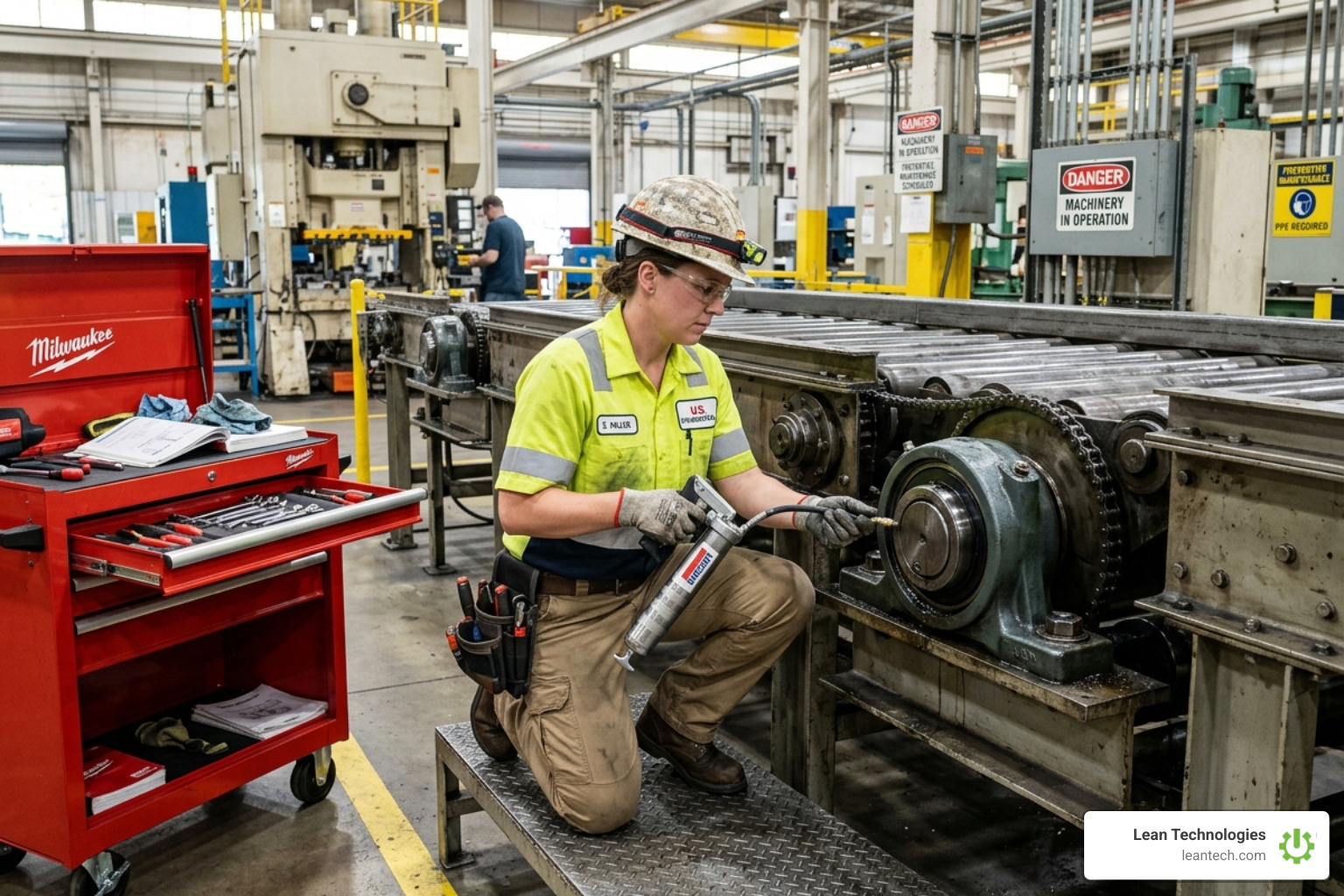
Don't Wait for the Bang with a Preventive Maintenance Program
The Real Cost of Waiting for Something to Break
A preventive maintenance program is a structured system of scheduled inspections, servicing, and repairs designed to stop equipment failures before they happen -- keeping production running, costs predictable, and your team out of firefighting mode.
Here's what a solid PM program includes:
Asset inventory -- a complete list of every piece of equipment, its location, age, and maintenance history
Criticality ranking -- prioritizing assets by their impact on production, safety, and cost
Maintenance triggers -- time-based, usage-based, or condition-based schedules for each asset
Digital checklists and SOPs -- standardized procedures so every tech does the job the same way
KPI tracking -- metrics like MTBF, MTTR, and PM compliance to measure and improve over time
Most manufacturing operations don't choose to be reactive. They drift there. One emergency eats into scheduled PM time. Then another. Then another. Before long, the whole maintenance strategy is just running from one breakdown to the next.
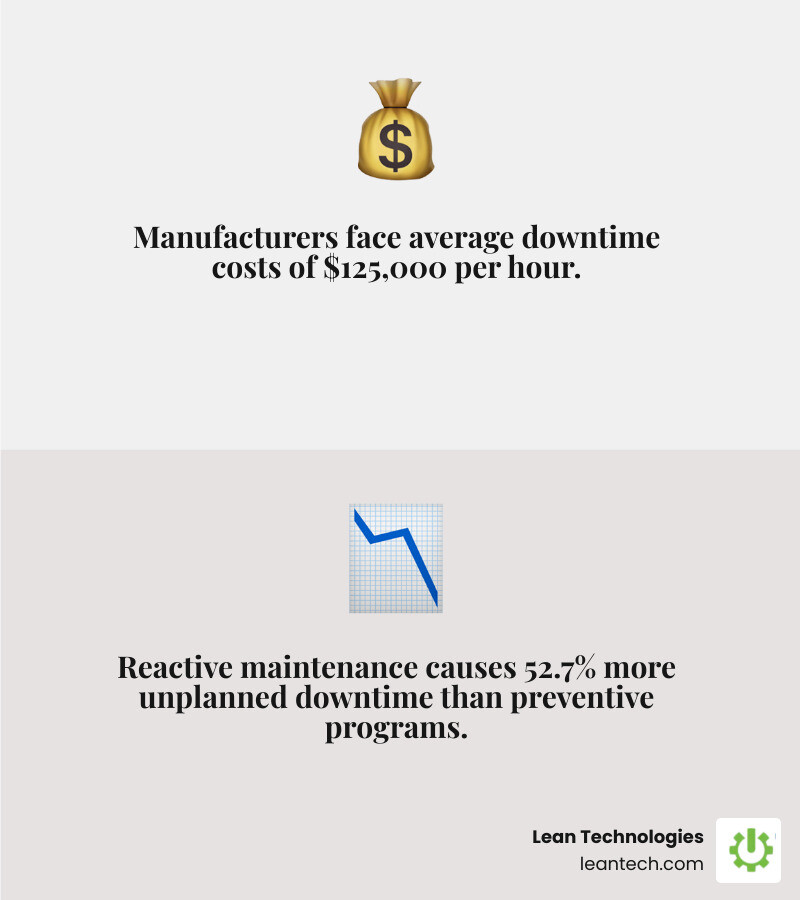
That drift is expensive. According to research from Aberdeen Strategy & Research, manufacturers face average downtime costs of $125,000 per hour. And organizations that lean heavily on reactive maintenance experience 52.7% more unplanned downtime than those with strong preventive programs in place.
There's a quote from an operations manager at a concrete company that cuts right to the point:
"It's not about cost cutting. It's about training your team and maintaining your equipment so that you don't incur the costly downtime."
That's the mindset shift at the heart of any good PM program. Maintenance isn't just a line item to minimize -- it's a lever that protects your margins, extends your asset life, and keeps your people safe.
This guide walks through exactly how to build, run, and continuously improve a preventive maintenance program on a real shop floor -- including the common mistakes that derail even well-intentioned teams.
Why a Preventive Maintenance Program is Your Best Defense
If you're running a shop floor, you already know the "bang." It's that sound a gearbox makes right before the line stops and the screaming starts. Reactive maintenance -- fixing things only after they break -- is the most expensive way to run a business. It's unpredictable, it's dangerous, and it kills your throughput.
A strategic preventive maintenance program transforms maintenance from a cost center into a growth engine. By investing in proactive care, you aren't just "fixing machines"; you are protecting your production capacity. When your equipment is reliable, you can hit your deadlines, keep your labor costs stable, and stop paying for emergency shipping on spare parts.
The Financial Impact of Proactive Care
The math behind a preventive maintenance program is staggering. Research from the U.S. Department of Energy shows that every $1 spent on preventive maintenance saves $4 to $5 in future repair costs. That's a 400% return on investment just by being organized.
Think about the $125,000 hourly downtime cost mentioned earlier. If a $400 quarterly inspection prevents just one hour of downtime, it has paid for itself 300 times over. Adopting a proactive strategy can increase equipment life by 20% to 40% and achieve overall maintenance savings of 30% to 40%.
Feature Reactive Maintenance Preventive Maintenance Predictive Maintenance Trigger Equipment fails Schedule or Usage Data/Sensor Trends Cost High (Emergency repairs) Moderate (Planned) Higher initial, lower long-term Downtime Unplanned & Long Planned & Short Optimized & Minimal Safety Risk High Low Lowest
Improving Shop Floor Safety and Compliance
Beyond the balance sheet, a preventive maintenance program is your primary tool for risk mitigation. Equipment that is poorly maintained is equipment that is dangerous. Hydraulic lines that spray hot fluid, motors that catch fire, or safety interlocks that fail are all symptoms of a reactive culture.
By standardizing inspections, you ensure that safety checks are actually performed, not just "pencil-whipped" when someone has a spare minute. This keeps you in line with OSHA standards and ensures you are always audit-ready. When a safety officer asks for the service history of a forklift or a crane, having a digital record ready to go is the difference between a "thank you" and a massive fine. Explore how structured processes improve safety across the plant.
Breaking Down the Types of Proactive Maintenance
Not all maintenance is created equal. A "one-size-fits-all" approach usually leads to over-maintaining some assets while ignoring others. To run a lean planned maintenance strategy, you need to understand the different flavors of proactive care:
Time-Based Maintenance (TBM): Tasks performed on a calendar schedule (e.g., changing HVAC filters every 3 months).
Usage-Based Maintenance (UBM): Tasks triggered by equipment meters (e.g., servicing a forklift every 200 operating hours).
Condition-Based Maintenance (CBM): Tasks performed based on the actual health of the machine (e.g., replacing a bearing because vibration levels spiked).
Risk-Based Maintenance: Focusing resources on the assets that would cause the most damage if they failed.
Setting Triggers for Your Preventive Maintenance Program
Determining when to pull the trigger on a maintenance task is part science and part history. You start with the Original Equipment Manufacturer (OEM) guidelines. They built the machine; they know when the oil needs changing.
However, OEM guidelines are often conservative because they assume worst-case operating environments. To truly optimize, you need to layer in your historical failure data. If the manual says to change a belt every 6 months, but your data shows they always snap at month 5, you adjust. This is where a PM Gap Report becomes invaluable—it highlights the space between what you should be doing and what is actually happening on the floor.
Moving Toward Condition-Based Monitoring
The "Holy Grail" of maintenance is doing work only when it is actually needed. This is where condition-based monitoring comes in. Instead of replacing a part because the calendar says so, you use tools like thermal imaging to detect overheating electrical panels or vibration analysis to find worn bearings.
For precision-heavy industries, this also includes gage calibration. If your measurement tools are off, your whole production run might be scrap. Monitoring the "condition" of your gages is just as critical as monitoring the "condition" of your motors.
Executing Your Preventive Maintenance Program Step-by-Step
Building a program from scratch feels like a mountain, but it’s really just a series of small hills. You can’t maintain everything at once. If you try, you’ll burn out your team and the program will fail within 90 days.
Step 1: Asset Inventory and Criticality Ranking
You can't maintain what you don't track. Your first step is a complete equipment asset tracking audit. This isn't just a list of names; you need the manufacturer, model, serial number, location, and maintenance history.
Once you have the list, apply the Pareto Principle (the 80/20 rule). Typically, 20% of your assets cause 80% of your downtime and costs. Use RPN (Risk Priority Number) scoring to rank them:
Safety impact: Will someone get hurt if this fails?
Production impact: Does the whole plant stop if this machine goes down?
Repair cost: Is this a $50 fix or a $50,000 replacement?
Focus your initial PM efforts on the "A-Critical" assets first. If you're unsure where your biggest risks are, take the PM Gap Report Quiz to find your blind spots.
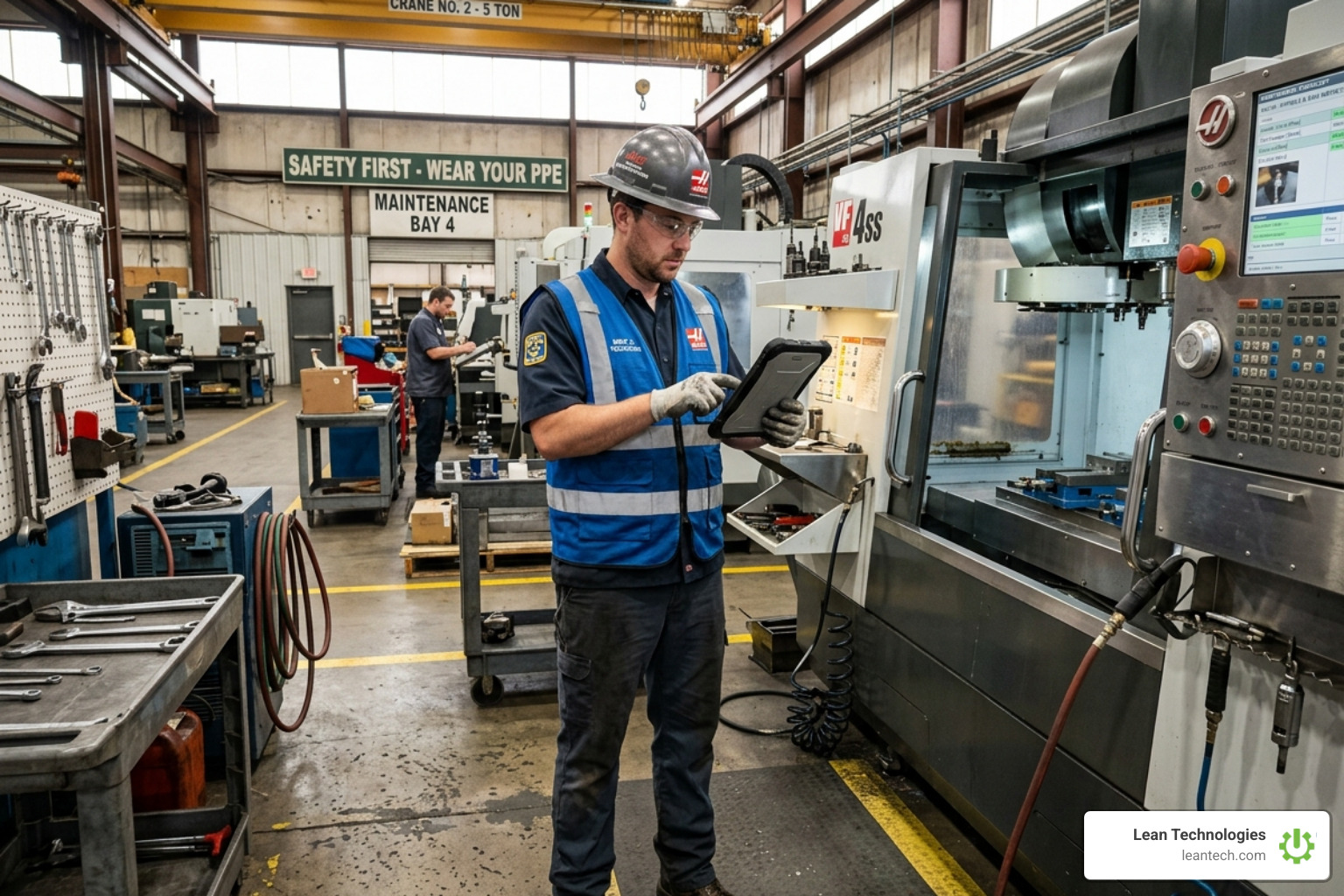
Step 2: Building Actionable Digital Checklists
The "Standardized Work" of maintenance is the checklist. But a paper checklist that says "Check Motor" is useless. What does "check" mean? Look at it? Smell it?
A high-quality digital checklist includes:
Clear Instructions: "Check belt tension; deflection should be between 1/4" and 1/2"."
Acceptance Criteria: Specific measurements or "Pass/Fail" toggles.
Required Tools: Don't make the tech walk back to the tool crib three times.
Photographic Evidence: Require a photo of the new filter installed. This ensures the work was actually done and provides a visual history for the next tech.
Avoiding the "Death Spiral" of Maintenance Mistakes
Even the best preventive maintenance program can fall into the "Maintenance Death Spiral." This happens when deferred PMs lead to more breakdowns, and those breakdowns pull technicians away from their scheduled PMs, leading to even more breakdowns.
To avoid the spiral, you must protect your PM time. World-class operations target 80% to 85% planned work and only 15% to 20% reactive work. If your "emergency" work is consistently over 30%, your program is failing.
Why Most CMMS Implementations Fail
Many plants buy expensive Computerized Maintenance Management Systems (CMMS) only to have them become "digital graveyards" of data. Why?
User Resistance: The software is too hard for the guys on the floor to use.
Information Overload: The system sends 500 alerts a day, so everyone ignores them.
Lack of Buy-in: Management sees it as a "tracking tool" to punish people rather than a tool to help them.
The solution is to keep it simple. If it takes a technician longer to log the work than to do the work, he won't use the system.
Solving the Parts Availability Problem
You can have the best schedule in the world, but if the technician opens the cabinet and the $10 seal isn't there, the machine stays down. 25% to 35% of maintenance delays are caused by missing parts.
Link your Bill of Materials (BOM) directly to your PM tasks. When a PM is scheduled, the system should automatically check inventory or reserve the parts. This prevents "stockouts" and ensures that planned downtime doesn't turn into a week-long waiting game for a shipping container.
Measuring Success and Continuous Optimization
A preventive maintenance program is not "set it and forget it." It is a continuous improvement loop. You need to track specific Key Performance Indicators (KPIs) to know if you're actually getting better:
MTBF (Mean Time Between Failures): Are your machines running longer without breaking? (Higher is better).
MTTR (Mean Time To Repair): When things do break, are you getting them back up faster? (Lower is better).
PM Compliance: What percentage of your scheduled PMs are actually getting done on time? Target 90%+.
Planned Maintenance Percentage (PMP): How much of your total labor is spent on proactive work?
Connecting Maintenance Metrics to the Bottom Line
Maintenance managers often struggle to get budget approval because they talk about "bearings" while the boss talks about "margins." To get buy-in, you must connect maintenance to OEE (Overall Equipment Effectiveness).
When you reduce unplanned downtime, you increase production throughput. When you increase throughput without adding more machines or shifts, your profit per unit goes up. That is how you protect your margins. For a deeper dive into these strategies, see our guide to digital lean manufacturing.
Frequently Asked Questions about Preventive Maintenance
How often should preventive maintenance be performed?
There is no single answer. It depends on the manufacturer's specs, your operating environment (a dusty sawmill needs more frequent cleaning than a clean-room electronics plant), and usage intensity. Start with the OEM recommendation and adjust based on your failure history. If you've never had a failure in three years of monthly checks, try moving to every two months.
Is a preventive maintenance program actually cost-effective?
Absolutely. The $1:$5 savings ratio is a conservative industry standard. Beyond direct repair savings, you also save on energy efficiency (well-maintained motors use 10-20% less power) and avoid the massive "opportunity cost" of lost sales during downtime.
What is the difference between preventive and preventative maintenance?
In the maintenance world, they are used interchangeably. "Preventive" is more common in technical writing, while "preventative" is often used in general conversation. Both describe the same proactive strategy of scheduled care to avoid failure.
Stop Managing Through Spreadsheets and Wishful Thinking
If your maintenance plan currently lives in a three-ring binder or a spreadsheet that hasn't been updated since 2022, you are playing a dangerous game of "wait for the bang."
Real-time visibility is the only way to run a modern shop floor. You need to know—right now—which machines are running, which ones are due for service, and which technicians are assigned to the job. Paper is too slow. By the time someone types a paper log into Excel, the data is already "real-late."
Lean Technologies offers Thrive, an all-in-one, customizable shopfloor software built by manufacturing experts. We don't just give you a place to store data; we give you a platform to drive action. Thrive helps your team log issues, track maintenance tasks, and close the loop on continuous improvement—all from a tablet or mobile device on the floor.
Don't let your maintenance strategy be defined by the next emergency. Take control of your uptime, empower your technicians, and start building a preventive maintenance program that actually works.
Ready to see how digital lean can transform your plant? Explore Thrive Maintenance and stop the firefighting today.