Standard Work Software Buyer's Guide: Core Features and Comparison
What Is Standard Work and Why Modern Operations Require Digital Tools
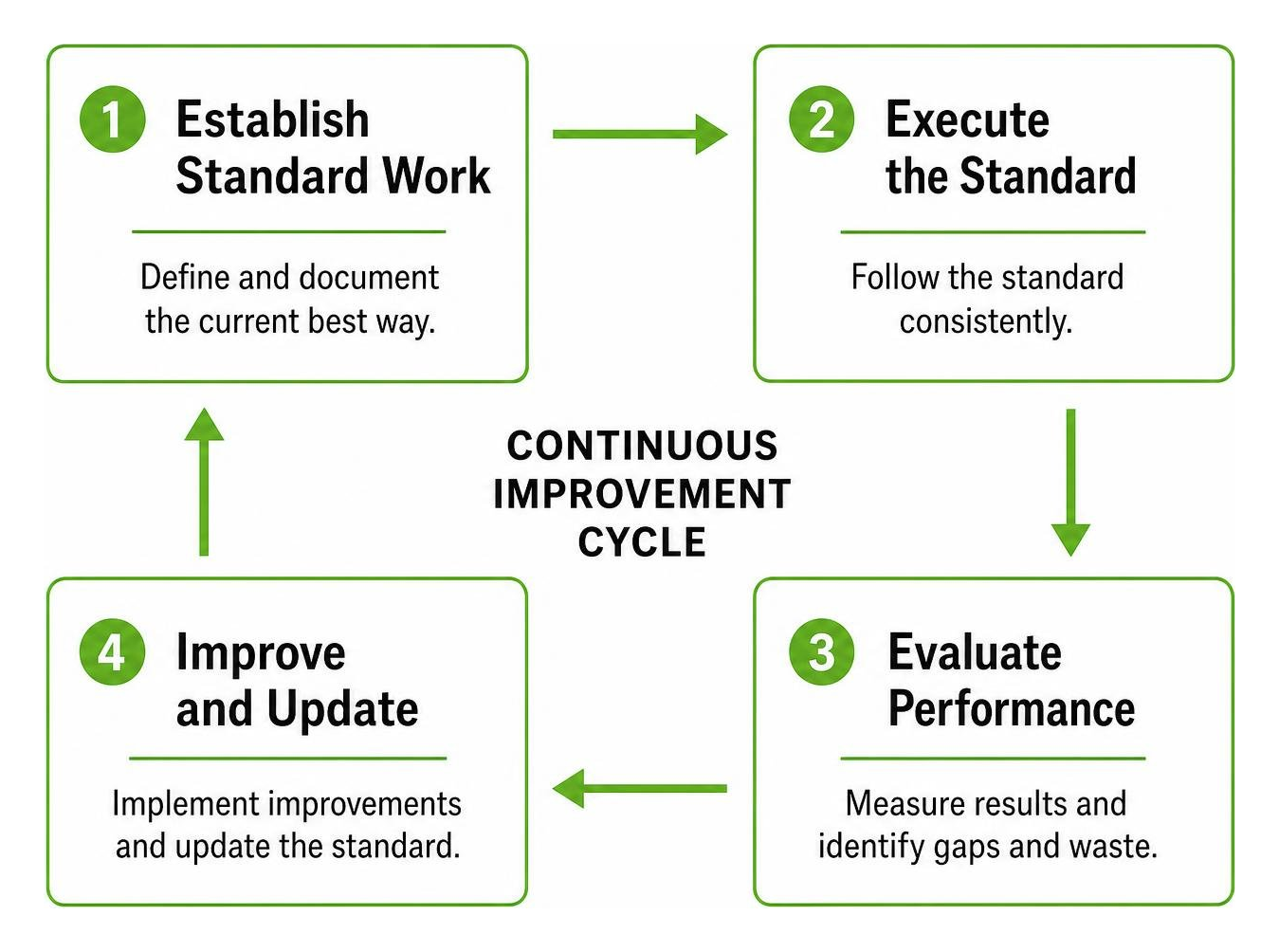
Standard work is the practice of establishing, communicating, and maintaining the current best way to execute a given task. Far from being an unchangeable rulebook, standard work serves as the operational baseline—the "floor" below which quality cannot drop, rather than a ceiling that caps progress. Without a clear standard, there can be no true continuous improvement; if a process fluctuates across shifts and operators, measuring the impact of any change becomes impossible.
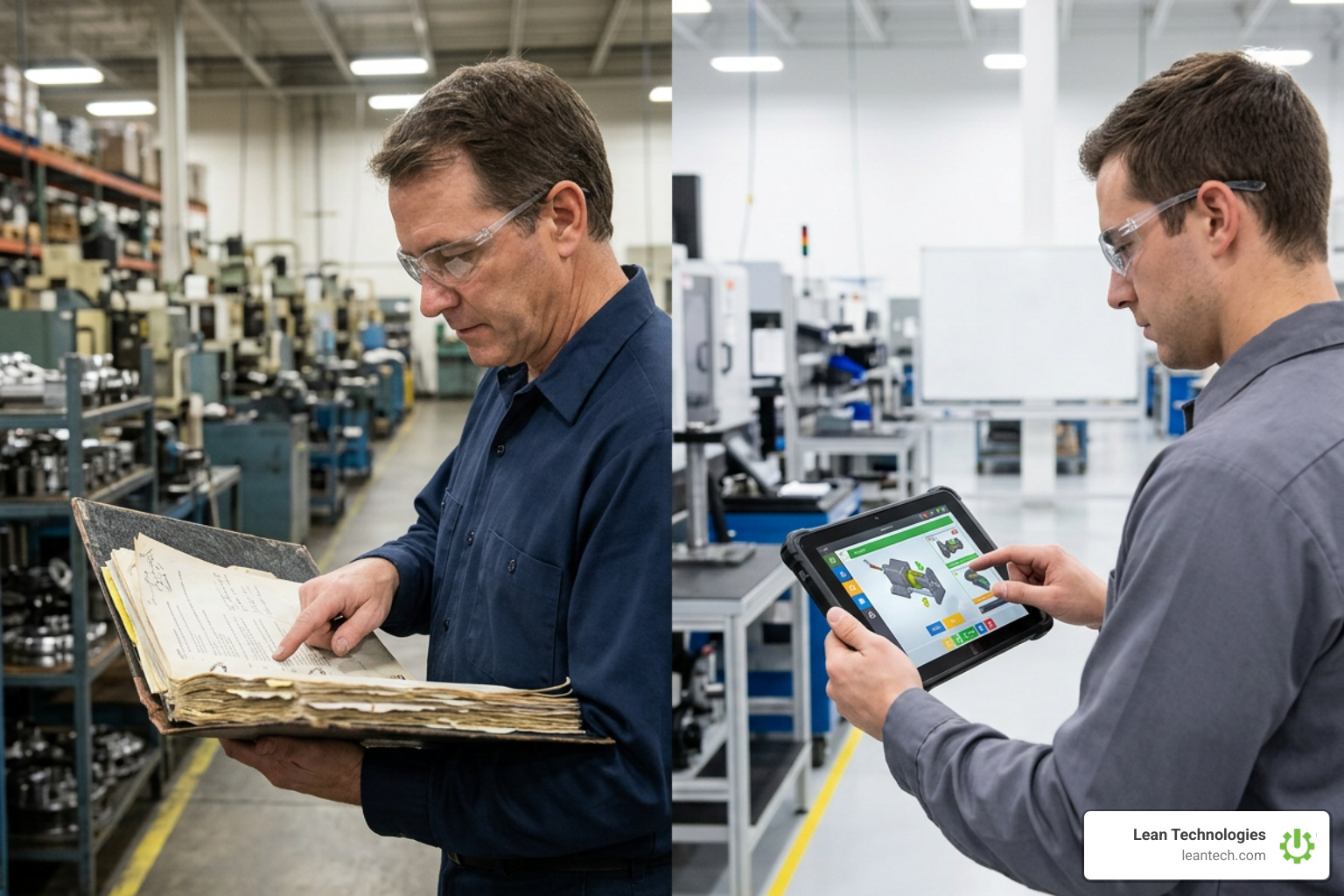
Traditional shop floor environments often struggle with immense process variation. When procedures rely on memory or outdated binders, operational waste accumulates rapidly. Modern manufacturing requires dynamic documentation that reflects reality on the plant floor. Utilizing digital lean tools and why they matter in shop floor management gives operations the ability to eliminate paper workarounds, reduce onboarding friction, and establish repeatable, high-quality execution across every cell.
The Evolution from Static SOPs to Dynamic Standard Work Software
The concept of standardized operations traces back to early industrial engineering principles popularized by figures like Frederick W. Taylor. However, early industrial standardization often led to rigid, unchanging procedures dictated solely from the top down.
In traditional plants, Standard Operating Procedures (SOPs) often become "shelfware"—massive three-ring binders tucked away on a shelf, out of date the moment they are printed. Operators encounter unrecorded workarounds, maintenance tweaks remain unlogged, and management operates under the illusion of compliance.
Modern standard work software transforms static SOPs into interactive, living documents. When frontline workers identify a safer technique, a faster sequence, or a defect root cause, dynamic digital platforms allow standard work to be revised through governed workflows. This bridges the gap between management expectations and shop floor reality, supporting genuine kaizen efforts.
Essential Elements of Standard Work Documentation
Effective standard work documentation breaks every process into its smallest discrete tasks to eliminate ambiguity. To maintain stability, your digital standard work must include:
Step-by-Step Task Sequence: The precise, logical order in which operations must be executed.
Takt Time and Cycle Time: The required pace of production to meet customer demand matched against target operational speeds.
Standard Work-in-Process (WIP): The minimum inventory required to keep the process flowing smoothly without excessive buffering.
Safety Checkpoints: Clear visual warnings and mandatory safety actions embedded directly at the point of risk.
Quality Inspection Standards: Exact acceptance criteria, critical dimensions, and visual defect boundaries.
Rationale Transparency: Explanations detailing why a step is performed a certain way, building buy-in and deeper process understanding.
Visual Aids: High-resolution photos, brief video clips, and annotated diagrams that make instructions intuitive and concise.
Core Features to Look for in Standard Work Software
When evaluating standard work software platforms, focus on usability, responsiveness, and how easily the software integrates into daily shop floor routines.
Real-Time Process Adherence and Workflow Tracking
Software must go beyond passive document viewing to support active operational guidance. Operators should be able to step through structured sequences, confirm safety checks, and verify cycle parameters right at their workstations.
Look for tools that offer robust workflow tracking to provide real-time operational status. When a deviation occurs—such as a component fit issue or a quality check failure—the software must allow operators to log an anomaly immediately rather than waiting for an end-of-shift debrief.
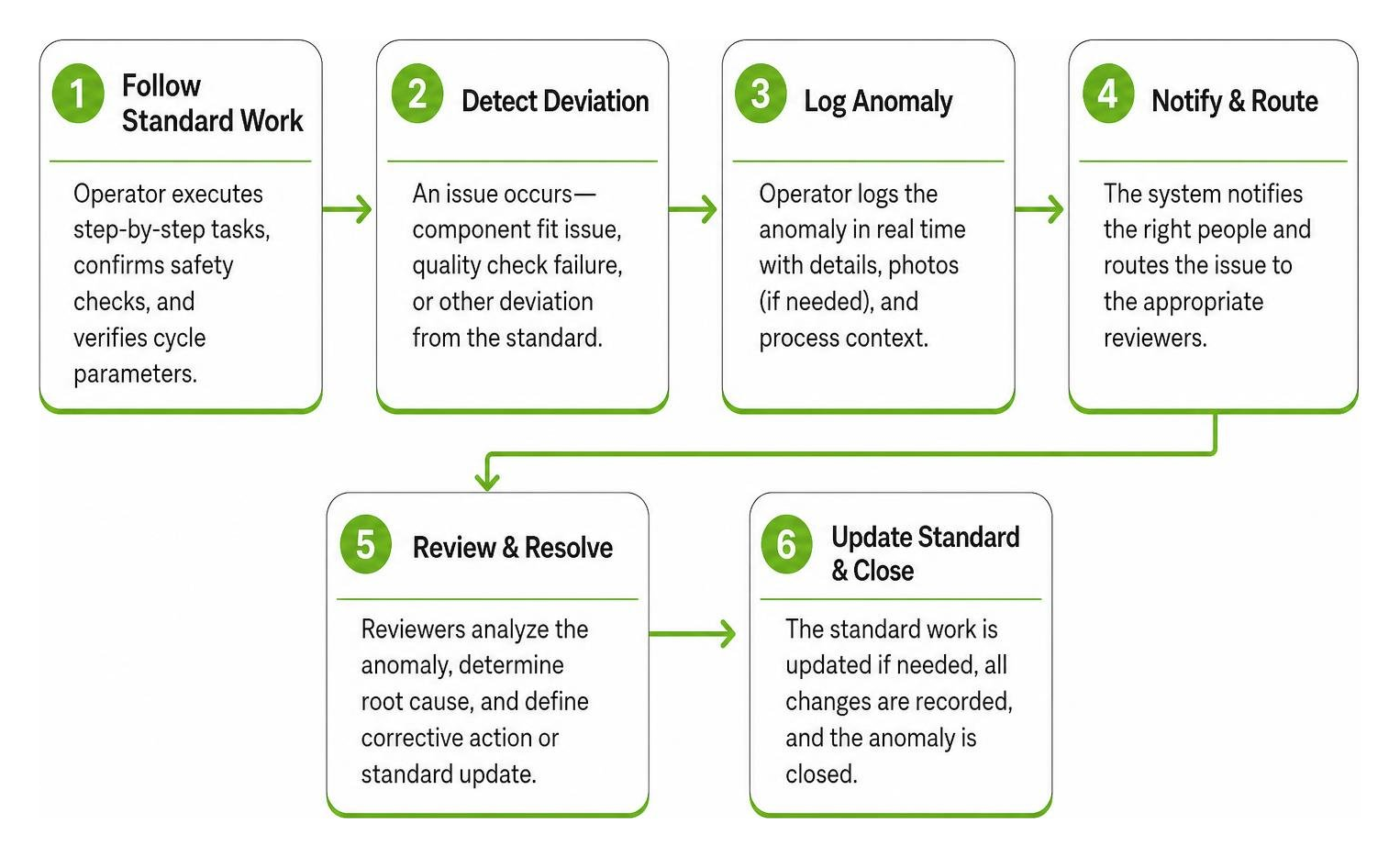
Structured data capture at the source ensures that cycle times, quality metrics, and process execution notes accurately represent what is happening across every line.
Frontline Ownership, Auditing, and Continuous Improvement Integration
A standard work tool succeeds only when frontline workers own the standard. The software should make it easy for operators to submit improvement suggestions, log micro-stoppages, and highlight confusing instructions directly from a mobile device or tablet.
For leadership, the platform should facilitate structured leader standard work and Layered Process Audits (LPAs). Leaders conducting Gemba walks can use standardized digital audits to verify whether standards are being followed, identify friction points, and coach operators. When audits or frontline feedback reveal gaps, built-in follow up tools on action items ensure that corrective measures are assigned, tracked, and completed rather than forgotten in spreadsheet logs.
Aligning Standard Work with Engineering Standards and Mission-Critical Safety
Standard work documentation must align with broader industrial governance, systems engineering, and software safety frameworks. This is especially true for manufacturers managing complex digital workflows, embedded systems, or regulated products.
Applying Standard Work Software to ISO Life Cycle and Review Frameworks
Modern engineering and technical operations rely on international standards to govern process life cycles. Software systems supporting standard work must mirror these principles:
ISO/IEC/IEEE 12207:2026 - Systems and software engineering — Software life cycle processes: This standard establishes a common framework for software life-cycle processes. Standard work software aligns with its technical management processes—including configuration management, verification, and measurement—while fully supporting iterative and agile execution models.
ISO/IEC TR 19759:2015 - Software Engineering — Guide to the software engineering body of knowledge (SWEBOK): Provides a comprehensive baseline across core engineering disciplines, helping organizations formalize quality, maintenance, and testing workflows.
ISO/IEC 20246:2017 - Software and systems engineering — Work product reviews: Outlines structured frameworks for reviewing work products, design artifacts, and technical specifications, ensuring that process changes undergo structured peer reviews before being deployed to production lines.
Aligning shop floor execution with these frameworks ensures full traceability and consistent governance across your technical ecosystem.
Safety-Critical Compliance and Assurance Standards
For mission-critical environments, process adherence is directly tied to system safety and risk control. High-reliability operations frequently draw upon rigorous standards such as the NASA SOFTWARE ASSURANCE AND SOFTWARE SAFETY STANDARD (NASA-STD-8739.8B).

NASA-STD-8739.8B establishes strict criteria for software assurance, safety analysis, hazard tracking, and independent verification and validation (IV&V). When applied to manufacturing operations, standard work software enforces these safety controls by embedding non-negotiable verification gates into digital procedures, maintaining comprehensive change audit trails, and ensuring that no safety-critical step can be bypassed.
Implementation Best Practices: Avoiding Pitfalls and Measuring ROI
Transitioning to digital standard work requires a structured rollout focused on user adoption and clear communication.
Implementation Dimension | High-Impact Best Practice | Common Failure Mode |
|---|---|---|
Frontline Involvement | Involve operators in capturing and refining standard tasks directly at the Gemba. | Engineering writes procedures in isolation without consulting frontline workers. |
Documentation Format | Keep steps concise, visual, and focused on key safety/quality points. | Walls of text that obscure critical actions and overwhelm new hires. |
Document Accessibility | Provide real-time access via mobile tablets and workstation touchscreens. | Storing files in complex network folders that operators cannot access during tasks. |
Process Maintenance | Treat standards as living baselines; review and update regularly. | "Set it and forget it" mindset where documents are never updated after launch. |
Action & Accountability | Link audits directly to digital action-tracking boards with assigned owners. | Logging audit issues on paper forms without any follow-up mechanism. |
Overcoming Common Standard Work Pitfalls
Failing to Engage Frontline Teams: If standards are written without operator input, they will not reflect real-world conditions and will be quickly ignored.
Missing Critical Details or Rationales: Simply listing an action without explaining why it matters (e.g., torque specifications or thermal cooling times) leads to casual non-compliance.
Hidden Documentation: Digital tools must place instructions directly in front of the worker. If finding an SOP requires ten clicks through an intranet portal, operators will rely on guesswork.
Treating Standardization as a One-Time Event: Standard work must be weeded and tended like a garden. Establish regular review cadences to keep procedures fresh and accurate.
Key Performance Indicators for Evaluating Standard Work Success
To gauge the effectiveness of your standard work software rollout, monitor these core operational KPIs:
First-Pass Yield and Defect Rates: Reductions in assembly errors and rework indicate that standards are clear and consistently followed.
Onboarding Speed and Training Lead Time: Measure how quickly a new operator achieves target cycle times and autonomous quality compliance.
Cycle Time Variation: Consistency across shifts and operators shows that the optimal method has taken root.
Audit Completion and Action Closeout Rate: High audit execution and rapid resolution of flagged items demonstrate healthy operational accountability.
Frontline Improvement Suggestions: Tracking the volume of bottom-up suggestions submitted and implemented reflects active workforce engagement.
Frequently Asked Questions About Standard Work Platforms
What is standard work and how does it differ from rigid procedures?
Standard work defines the current best method for performing a task to achieve maximum safety, quality, and efficiency. Unlike rigid, top-down procedures that remain static for years, standard work represents an operational baseline that is designed to be challenged, refined, and improved by the team over time.
How does standard work software support continuous improvement?
Standard work software provides direct feedback loops from the shop floor to process owners. When an operator encounters a bottleneck or discovers an efficiency improvement, the platform captures this feedback, routes it for review, and updates the standard work across the organization instantly once approved.
How do organizations measure the effectiveness of standard work tools?
Organizations measure success by tracking operational stability metrics: reduced scrap and rework, tighter cycle time standard deviations, faster onboarding for new hires, higher audit adherence rates, and continuous growth in completed Kaizen actions.
What to Do Next: Building a Sustainable Continuous Improvement Culture
Selecting the right platform is the fastest path to structured, accountable work processes. Success on the shop floor comes down to empowering your workforce with clear, living standards and closing the loop on daily operational issues.
For small to midsize manufacturers, Thrive provides an all-in-one, customizable platform designed by manufacturing experts to digitize lean work processes in real time without replacing ERPs or MES systems. Thrive serves as a flexible digital toolbox for logging issues, tracking actions, and driving continuous improvement across operations, maintenance, safety, and quality teams.
Rather than relying on automated sensor streams, Thrive organizes action around machine data entered directly by your teams or imported from other systems. It provides true real-time visibility across your plant whenever processes are structured and data is entered at the source via mobile, tablet, or desktop.
To see how you can replace static binders, eliminate paper workarounds, and empower your frontline with intuitive standard work software, explore the Thrive continuous improvement platform and take the next step toward operational excellence.