
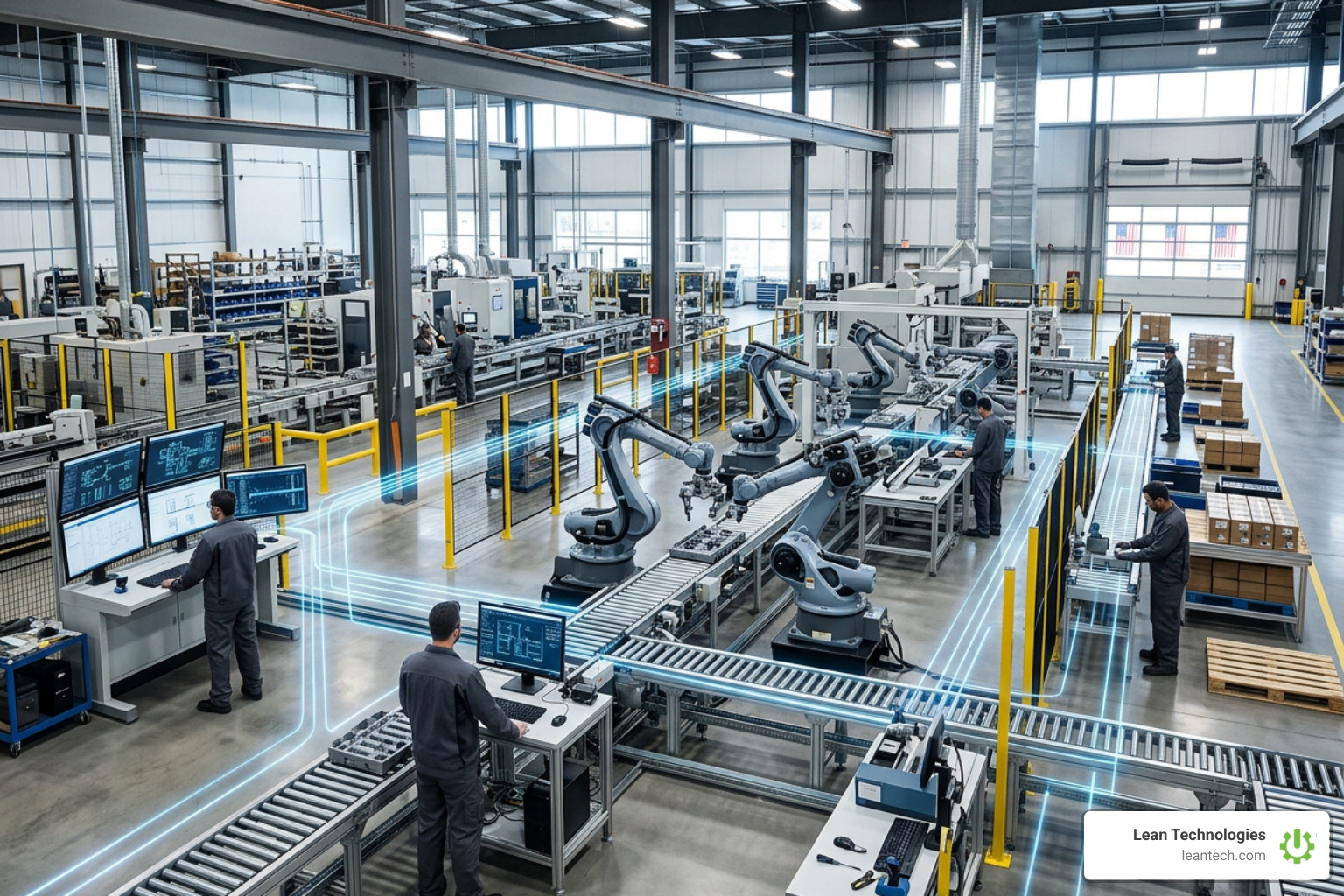
A Comprehensive Guide to Computer Integrated Manufacturing Definition and Basics
Understanding the Computer Integrated Manufacturing Definition and Core Philosophy
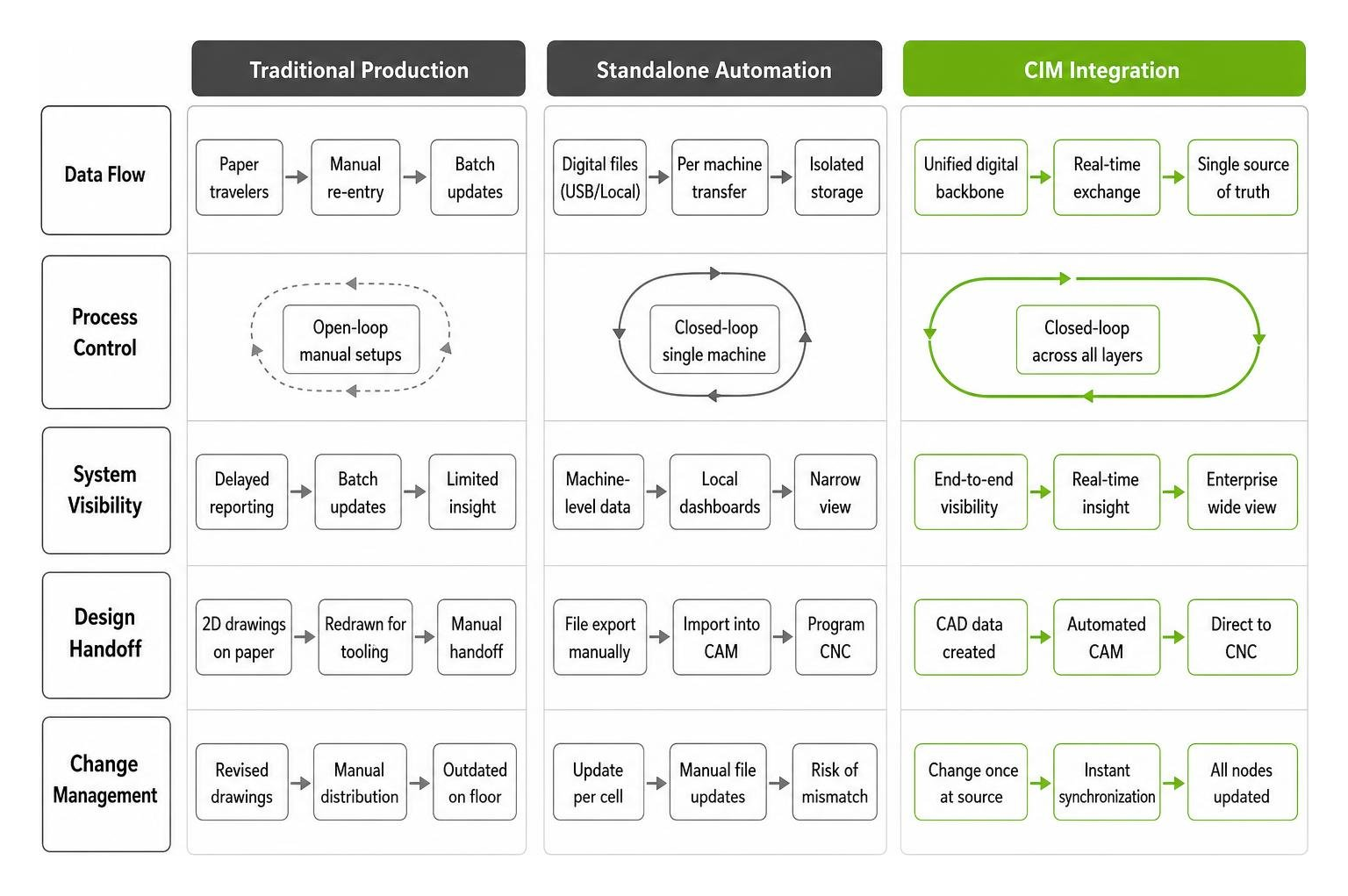
To understand the core computer integrated manufacturing definition, you have to look beyond individual automated machines and focus on total enterprise integration. In traditional manufacturing setups, engineering creates a design, prints drawings, and hands them to planners. Planners manually input schedules into an administrative tool, machinists program equipment at the machine console, and quality teams record defects on paper clipboards. Every handoff creates an opportunity for transcription errors, outdated revisions, and communication lag.
CIM replaces these fragmented handoffs with a unified digital backbone. Under a CIM methodology, every phase of production is linked through computers, establishing closed-loop control across the entire workflow. When engineering modifies a part specification, that change automatically cascades to computer-aided manufacturing tools, production planning schedules, and quality inspection parameters.
According to Britannica's analysis of CIM systems, this data-driven automation coordinates all enterprise functions—linking not just shopfloor machinery, but also inventory management, purchasing, cost accounting, and field service support into a single operational architecture.
Attribute | Traditional Manufacturing | Isolated Point Automation | Computer-Integrated Manufacturing (CIM) |
|---|---|---|---|
Data Flow | Paper travelers, manual re-entry | Disconnected digital files (USB/Local) | Unified digital backbone and real-time exchange |
Process Control | Open-loop, manual machine setups | Local closed-loop on single machines | Plant-wide closed-loop feedback across all layers |
System Visibility | Delayed reporting, batch updates | Machine-level dashboards only | End-to-end visibility across business and shop floor |
Design Handoff | 2D drawings redrawn for tooling | Manual file import into CAM packages | Automated CAD-to-CAM-to-CNC pipeline |
Change Management | High risk of outdated floor drawings | Manual updates per automated cell | Instant synchronization across all connected nodes |
Historical Origins: Joseph Harrington and the Early Computer Integrated Manufacturing Definition
The foundation of CIM began well before modern cloud computing and high-speed networks existed. The term was first coined in 1974 by Dr. Joseph Harrington in his seminal book, Computer-Integrated Manufacturing. Harrington recognized that manufacturing was not a collection of isolated trade crafts, but a monolithic, continuous information-processing activity that resulted in physical goods.
During the late 1970s and 1980s, industry associations like the Computer and Automated Systems Association of the Society of Manufacturing Engineers (CASA/SME) advanced Harrington's vision through the well-known "CIM Wheel." This conceptual framework placed shared enterprise data management at the hub, surrounded by design, manufacturing planning, physical execution, and business management rings.
As noted in this Encyclopedia.com overview on manufacturing automation, academic leaders such as August-Wilhelm Scheer expanded the concept with the "Y-CIM Model," dividing enterprise activities into a business planning axis and a technical production axis that converge on the shop floor.
Expanding the Computer Integrated Manufacturing Definition Across Enterprise Subsystems
Early implementations often struggled because 20th-century computers lacked the processing power and open networking protocols needed to execute such expansive visions. However, the definition of CIM evolved from theoretical monolithic mainframes into modular, interconnected standards governed by international frameworks such as ISO/IEC 2382-24.
Today, modern computer integrated manufacturing software enables high-speed data interoperability across cross-functional departments. Rather than forcing an enterprise into a single rigid software stack, current CIM frameworks maintain unified master data across specialized engineering, enterprise resource planning, and shopfloor execution systems.
Core Subsystems and Architectural Layers of a CIM Framework
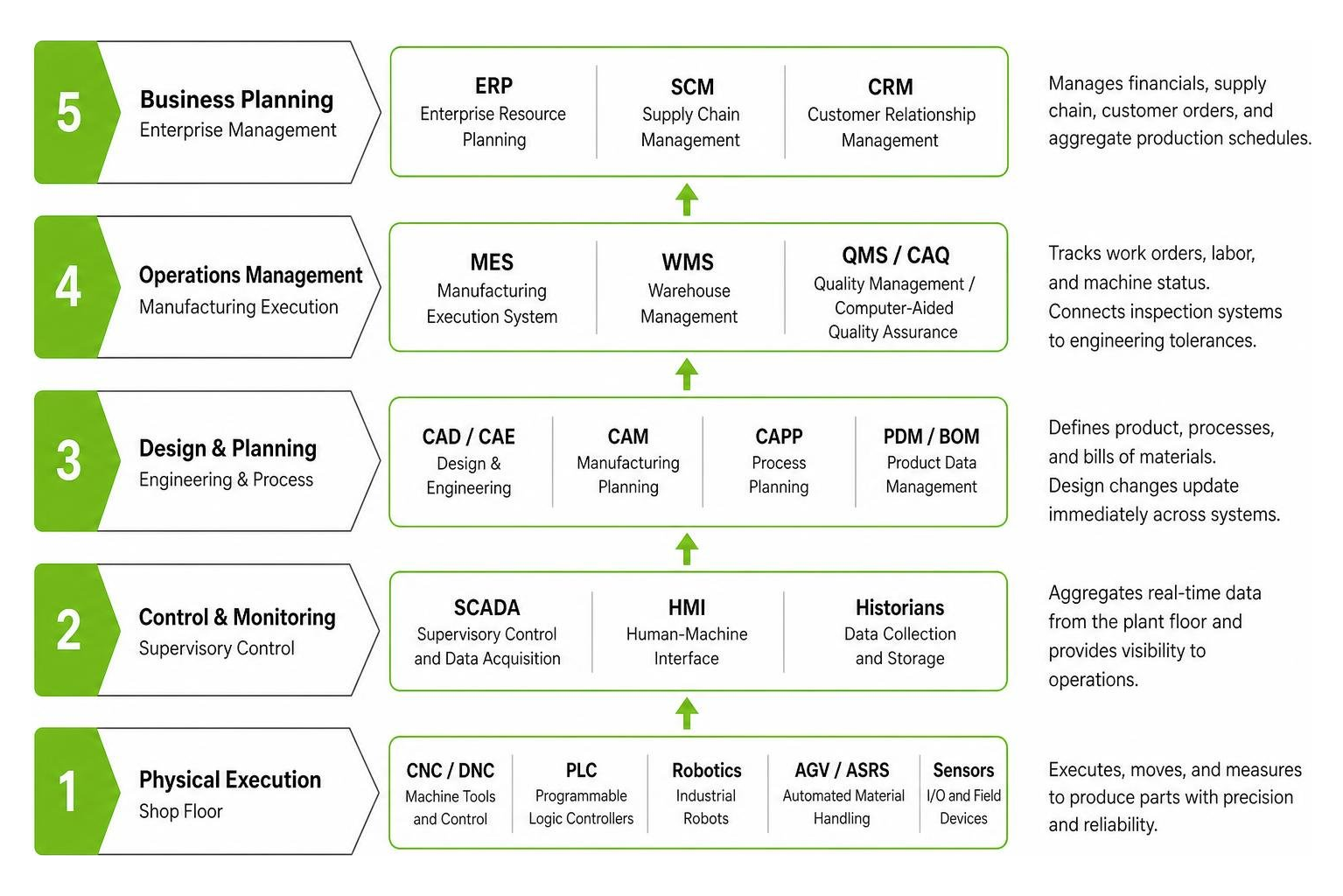
A functional CIM implementation coordinates hardware and software across distinct operational layers. The architecture ensures that top-floor strategic planning aligns directly with machine-level execution on the physical floor.
Design, Planning, and Execution Layers (CAD, CAM, CAPP, ERP, MES)
The upper architectural tiers govern product definition, resource allocation, and operational tracking:
Computer-Aided Design (CAD) & Computer-Aided Engineering (CAE): Engineers create parametric 3D models and conduct stress, thermal, and kinematic simulations virtually, eliminating costly physical prototyping.
Computer-Aided Manufacturing (CAM) & Computer-Aided Process Planning (CAPP): CAM systems translate CAD geometry into numerical control toolpaths, while CAPP software determines the optimal sequence of production operations, machine routing, and tooling selection.
Computer-Aided Quality Assurance (CAQ): Connects automated inspection devices, such as Coordinate Measuring Machines (CMM) and laser scanners, directly to engineering tolerances for automated pass/fail verification.
Enterprise Resource Planning (ERP): Manages high-level financials, supply chain procurement, customer order processing, and aggregate production schedules.
Manufacturing Execution Systems (MES): Bridges business management and plant-floor operations, delivering detailed manufacturing operations management capabilities to track work orders, labor, and machine status in real time.
When companies orchestrate these tiers using an integrated manufacturing operations platform, design changes update bills of materials (BOMs) instantly, and order modifications adjust shop schedules without human delays.
Physical Automation and Control Layers (CNC, PLC, Robotics, SCADA)
The lower tiers convert digital instructions into physical products:
Computer Numerical Control (CNC) & Direct Numerical Control (DNC): Microprocessor-driven machine tools execute precision cutting, milling, and turning paths fed directly across central DNC networks.
Programmable Logic Controllers (PLCs): Ruggedized industrial computers manage real-time machine sequences, interlocking safety sensors, actuators, and pneumatic drives.
Industrial Robotics: Modern manufacturing relies heavily on automated handling. In 2023, the global operational stock of industrial robots reached 4.28 million units, performing high-speed welding, painting, assembly, and pick-and-place tasks. Advanced regions have integrated these systems deeply; robot density in the Republic of Korea stands at 1,012 robots per 10,000 employees, the highest in the world.
Automated Material Handling (AGVs & ASRS): Automated Guided Vehicles and Automated Storage and Retrieval Systems transport raw stock, tooling, and work-in-progress (WIP) between workstations without manual forklift dependence.
SCADA Systems: Supervisory Control and Data Acquisition platforms aggregate telemetry from distributed PLCs and remote terminal units, feeding continuous operational data to central engineering dashboards.
Key Operational Benefits and Common Implementation Challenges
Deploying a computer-integrated manufacturing ecosystem transforms facility performance, but realizing those gains requires overcoming clear integration hurdles.
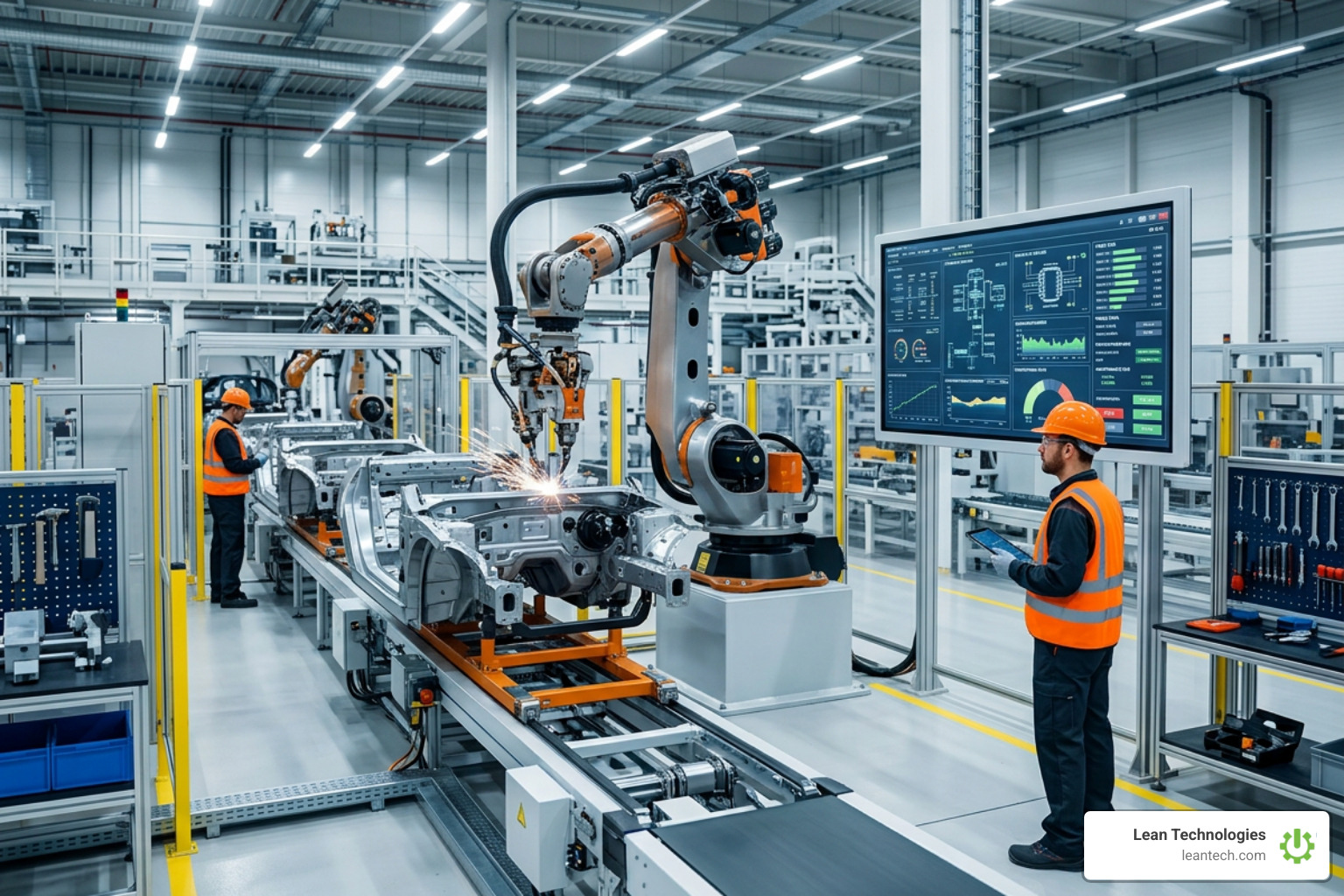
Measurable Business and Productivity Impacts
The primary justification for CIM adoption is substantial, measurable operational improvement across the entire value stream:
Drastic Lead-Time and WIP Reduction: By coordinating machine scheduling with raw material movements, facilities regularly cut work-in-process inventory by 30% to 60% and reduce customer lead times by 20% to 60%.
Superior Quality and Error Elimination: Automated toolpath transfers and direct CMM feedback loops minimize operator setup errors, slashing scrap rates and eliminating manual rework.
Optimized Asset Uptime: Implementing structured Industry 4.0 maintenance within a connected environment delivers major gains; predictive maintenance can reduce unplanned downtime by up to 50% and cut maintenance costs by 10% to 40%.
Productivity Gains: The U.S. National Research Council documented factory-wide productivity gains of 40% to 70% following full digital integration, driven by faster engineering-to-production cycles and higher machine utilization.
Integration Hurdles, Workforce Gaps, and Cost Realities
Despite these advantages, the path to a fully connected plant floor has clear challenges:
Technology Selection and System Interoperability: 50% of manufacturers struggle to identify the right technology for automation, and nearly half report major integration challenges when trying to connect legacy machinery to modern networks.
Budgetary Constraints: Heavy upfront capital expenditures for hardware, software licenses, and field wiring can strain finances; 32% of manufacturers experience budget overruns during automation deployments.
Workforce and Talent Shortages: Advanced automation requires skilled programming, integration, and controls talent. In recent surveys, 74.4% of manufacturers cited the inability to attract and retain workers as their primary business concern.
Shopfloor Realities and Process Gaps: Many digital transformations stall because plants attempt automated solutions before standardizing simple floor-level communication. Unresolved paper workarounds, late downtime logs, unclosed continuous improvement loops, and disconnected safety data cannot be solved simply by adding software.
For plants seeking the fastest path to structured, accountable work processes, establishing disciplined front-line problem logging and structured data capture is an essential prerequisite before attempting large-scale automated integration.
The Modern Evolution: Bridging CIM with Industry 4.0, IoT, and Digital Lean
The historical dream of CIM—a seamless, responsive production ecosystem—is fully realized in the modern smart manufacturing era. Today, 80% of manufacturing executives plan to invest 20% or more of their improvement budgets into smart manufacturing initiatives.

Digital Twins, AI, and Collaborative Robotics in Modern Plants
Modern CIM systems leverage open industrial standards like OPC UA and MQTT to bridge physical operations with advanced analytical tools:
Digital Twins (ISO 23247): Manufacturers build synchronized virtual models of physical lines. Using live operational telemetry, engineers perform virtual commissioning—testing and debugging PLC logic and robot kinematics in software before installing physical assets.
Collaborative Robotics (Cobots): While traditional industrial robots operate isolated behind safety cages, flexible cobots work directly alongside human technicians. The global collaborative robot market is projected to grow from $1.26 billion in 2024 to $3.38 billion by 2030, registering a CAGR of 18.9%.
AI-Driven Quality and Parameter Control: Computer vision systems powered by neural networks inspect parts at line speed, flagging sub-millimeter defects and feeding offset adjustments back to CNC controllers in real time.
Lean Manufacturing Convergence and Practical SME Implementation
Large conglomerates often possess the capital to deploy enterprise-scale CIM stacks, but small and midsize enterprises (SMEs) must approach digitization through an incremental, value-first lens. Coupling technology with a practical digital lean manufacturing framework prevents the trap of digitizing waste.
Instead of deploying massive, disruptive IT projects, smaller facilities succeed by building a foundation using digital lean for small manufacturers. This approach focuses on standardizing operator routines, capturing shopfloor downtime at the source, and ensuring that continuous improvement actions are closed out systematically.
Frequently Asked Questions About Computer-Integrated Manufacturing
How does CIM differ from standalone CAD/CAM or industrial automation?
Standalone CAD/CAM and automated machine tools operate as isolated point solutions, often called "islands of automation." While a standalone CNC cell or CAD workstation automates a specific technical step, it still requires human intervention to export files, interpret drawings, schedule orders, and report scrap.
CIM integrates these separate islands into an enterprise data network, allowing engineering changes, order priorities, and floor execution metrics to flow automatically without manual re-entry.
What international standards and architectures govern CIM systems?
Key standards include:
ISO/IEC 2382-24: Defines standardized international terminology for computer-integrated manufacturing.
CIMOSA (CIM Open System Architecture): A European reference architecture designed to create open, vendor-independent integration across enterprise systems.
ANSI/ISA-95 (IEC 62264): The global standard for integrating enterprise management systems (ERP) with shopfloor control operations (MES, SCADA, PLCs).
ISO 23247: Defines digital twin frameworks for manufacturing facilities.
How do digital twins and AI fit into modern CIM operations?
Digital twins and AI enhance CIM from a deterministic, rule-based execution system into an adaptive, self-optimizing environment. Digital twins allow plant engineers to simulate line modifications, validate CNC toolpaths, and predict throughput constraints virtually. AI algorithms analyze process data from PLCs to predict tool wear, dynamically adjust machine speeds, and detect quality defects before parts move downstream.
What to Do Next
Transitioning your factory toward the computer integrated manufacturing definition does not require an immediate, high-risk overhaul of your entire technology stack. The most reliable path to operational excellence is an incremental, disciplined strategy:
Audit Shopfloor Data Handoffs: Identify where paper workarounds, disconnected spreadsheets, and manual re-entry slow down your order execution.
Standardize Work Processes: Clean up your master data, establish consistent standard operating procedures (SOPs), and build clear routines for logging shift handovers and equipment stoppages.
Digitize the Frontline First: Deploy user-friendly tools that allow floor operators and maintenance technicians to enter structured data directly at the source.
Lean Technologies offers Thrive, an all-in-one, customizable shopfloor software built for small to midsize manufacturers. Thrive provides a digital platform to digitize lean work processes in real time without replacing ERPs or MES systems. It serves as a flexible digital toolbox for logging issues, tracking actions, and driving continuous improvement.
Thrive does not collect raw sensor data or run automated predictive alerts; rather, it organizes action from machine data entered by teams or imported from other systems. By ensuring that shopfloor data is entered accurately at the source via mobile, tablet, or desktop interfaces, Thrive gives leadership the real-time operational visibility required to build a modern, connected production facility.
To build a structured digital foundation for your plant, explore our comprehensive guide to digital lean manufacturing and start eliminating shopfloor friction today.