

A Practical Guide to Building a Factory Data Collection System for Operators
Core Architecture of a Modern Factory Data Collection System
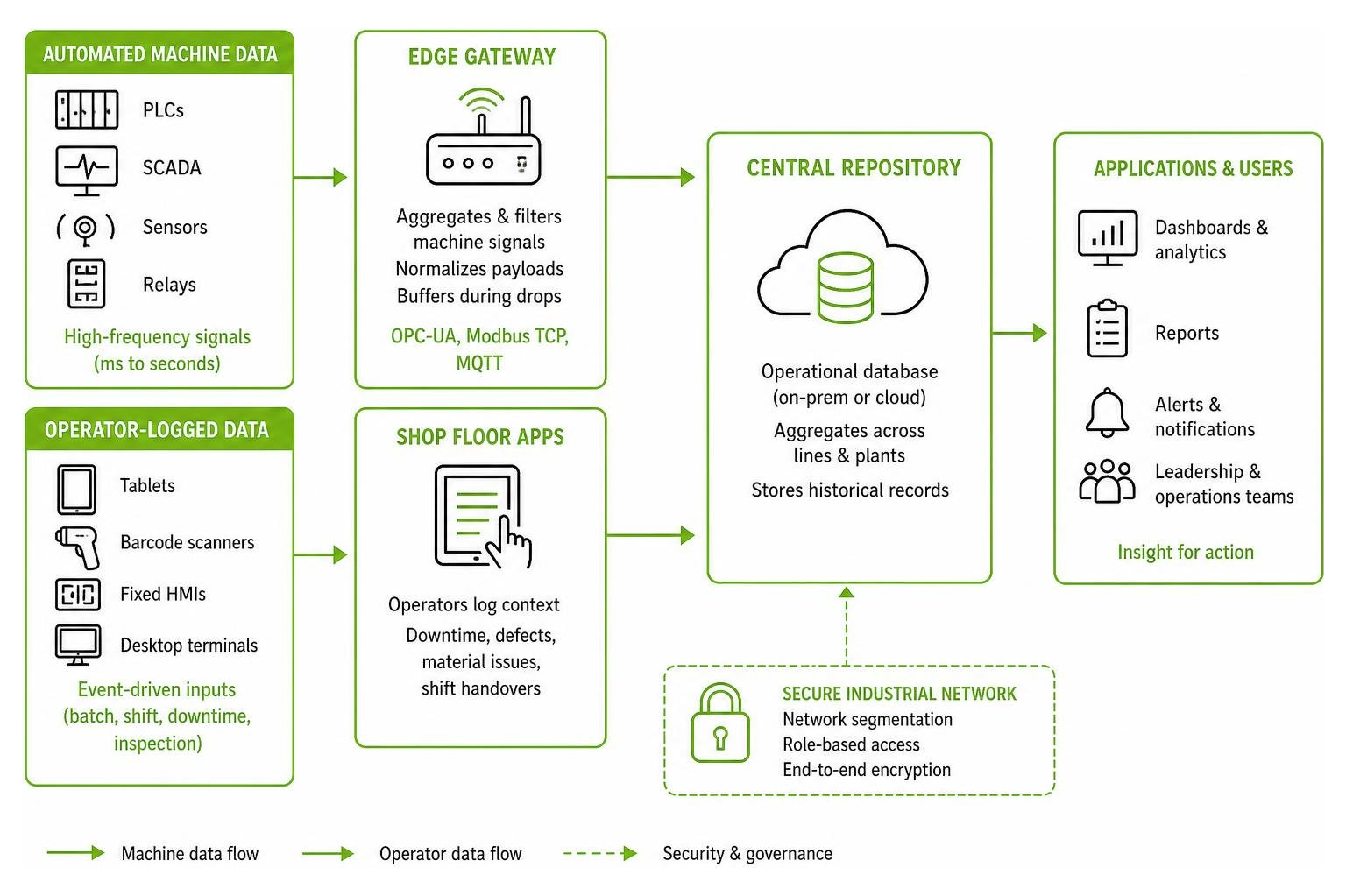
A modern factory data collection system connects shop floor reality with leadership decision-making. At its base, the system captures two distinct streams of operational intelligence: automated signals generated directly by equipment and context-rich observations logged by operators.
In automated architectures, Programmable Logic Controllers (PLCs) and digital equipment interfaces read physical parameters like spindle speeds, cycle completions, line stoppages, and operating temperatures. Edge gateways aggregate these high-frequency machine signals locally, filtering noise before pushing normalized payloads into central operational databases. Paired alongside this hardware layer, modern factory monitoring software provides intuitive visual touchpoints where operators can log context, report material shortages, or flag maintenance issues directly at the line.
Data Dimension | Automated Machine Signals | Operator-Logged Shop Floor Data |
|---|---|---|
Primary Sources | PLCs, optical sensors, relays, edge gateways | Mobile tablets, barcode scanners, fixed HMIs, desktop terminals |
Data Captured | Stroke counts, running state, motor current, cycle duration | Downtime root cause, defect classifications, shift handovers |
Capture Frequency | Milliseconds to seconds (continuous streaming) | Event-driven (per batch, shift, downtime incident, or inspection) |
Primary Strength | Unbiased precision regarding exact timestamps and speeds | Operational context detailing why an anomaly occurred |
Key Limitation | Lacks context behind procedural delays or tool setup issues | Vulnerable to logging delays if manual interfaces are cumbersome |
Machine-Level vs. Human-Generated Data Capture
Automated machine data is great for raw numbers, but it cannot tell the whole story. A photoelectric sensor can register that a packaging line stopped for 12 minutes, but it cannot tell you whether the stoppage happened because of a jammed carton, a missing operator, or raw material running out of spec.
Operators provide critical context to machine events. When teams automate manual data entry through digital forms instead of relying on paper logs, operators can quickly record scrap reasons, tag micro-stoppages, and complete shift handovers in seconds. Combining machine status logs with frontline human insight eliminates finger-pointing between production and maintenance, pinpointing the actual root causes of recurring line bottlenecks.
Edge Computing and Industrial Cloud Repositories
As industrial operations modernize, system architecture balances local responsiveness with centralized analytical horsepower. Edge computing devices sit directly on the plant network, communicating over industrial protocols such as OPC-UA, Modbus TCP, and MQTT. By processing raw telemetry at the machine edge, these gateways prevent network congestion, buffer information during network drops, and ensure zero loss of critical production counts.
Centralized repositories—whether hosted on local plant servers or secure industrial cloud infrastructure—aggregate historical records across multiple production lines. IT and operational teams must enforce robust industrial cybersecurity practices, such as network segmentation, role-based permissions, and end-to-end encryption, ensuring that production records remain safe and accessible across the enterprise.
Where Thrive Fits in the Data Workflow
Lean Technologies' Thrive serves as a flexible digital toolbox for small to midsize manufacturers. Built to digitize lean work processes, Thrive helps machine operators, continuous improvement coordinators, and shift supervisors log issues, track corrective actions, and drive daily operational progress.
To be clear on its role: Thrive is not an Enterprise Resource Planning (ERP) platform or a Manufacturing Execution System (MES), and it does not replace those systems. Furthermore, Thrive does not collect raw sensor signals or run automated predictive machine alerts.
Instead, Thrive organizes and drives structured action from shop floor and machine data when entered directly by your team or imported from other factory systems. By replacing paper clipboards and spreadsheet workarounds with mobile, tablet, and desktop interfaces, Thrive provides real-time operational visibility the moment your frontline team logs data at the source. For a broader look at how digital tools support lean execution, see this digital lean manufacturing framework.
Key Data Types: What Operators and Supervisors Must Track
A reliable factory data collection system tracks a focused set of operational parameters that directly impact line performance, product quality, and operator safety. Rather than overwhelming the frontline with hundreds of mandatory fields, world-class plants focus on standardizing high-value metrics through consistent manufacturing shop floor data collection.
Production Counts and OEE Tracking
Overall Equipment Effectiveness (OEE) remains the baseline metric for manufacturing productivity, combining Availability, Performance, and Quality into a single score:
Availability: Compares planned operating time against actual runtime, capturing both planned changeovers and unplanned breakdowns.
Performance: Measures operating speed against the standard ideal cycle time, highlighting micro-stops, machine idling, and minor speed losses.
Quality: Compares total parts produced against units that meet specification on the first pass.
Research shows that manufacturers adopting real-time data collection systems achieve a 20% average increase in OEE and 5–10% higher production output simply by illuminating hidden line losses through real-time production monitoring.
Quality Control, Scrap, and Rework Metrics
Tracking defects at the end of a shift makes containment expensive and slow. Collecting quality data at the line allows operators to catch defects early. Key quality metrics include:
First-Pass Yield (FPY): Percentage of incoming units manufactured correctly without rework.
Defect Pareto Classifications: Standardized defect categories (e.g., flash, short shot, dimensional warp, burrs) to isolate top root causes.
Scrap and Non-Conformance Logs: Real-time logging of scrapped material weight or part counts.
Corrective Action Tracking: Closed-loop tracking to verify that containment, root-cause investigation, and procedural countermeasures are completed.
Automating these records helps operations reduce scrap and rework expenses by 15–20%, preventing bad parts from making their way downstream to the customer.
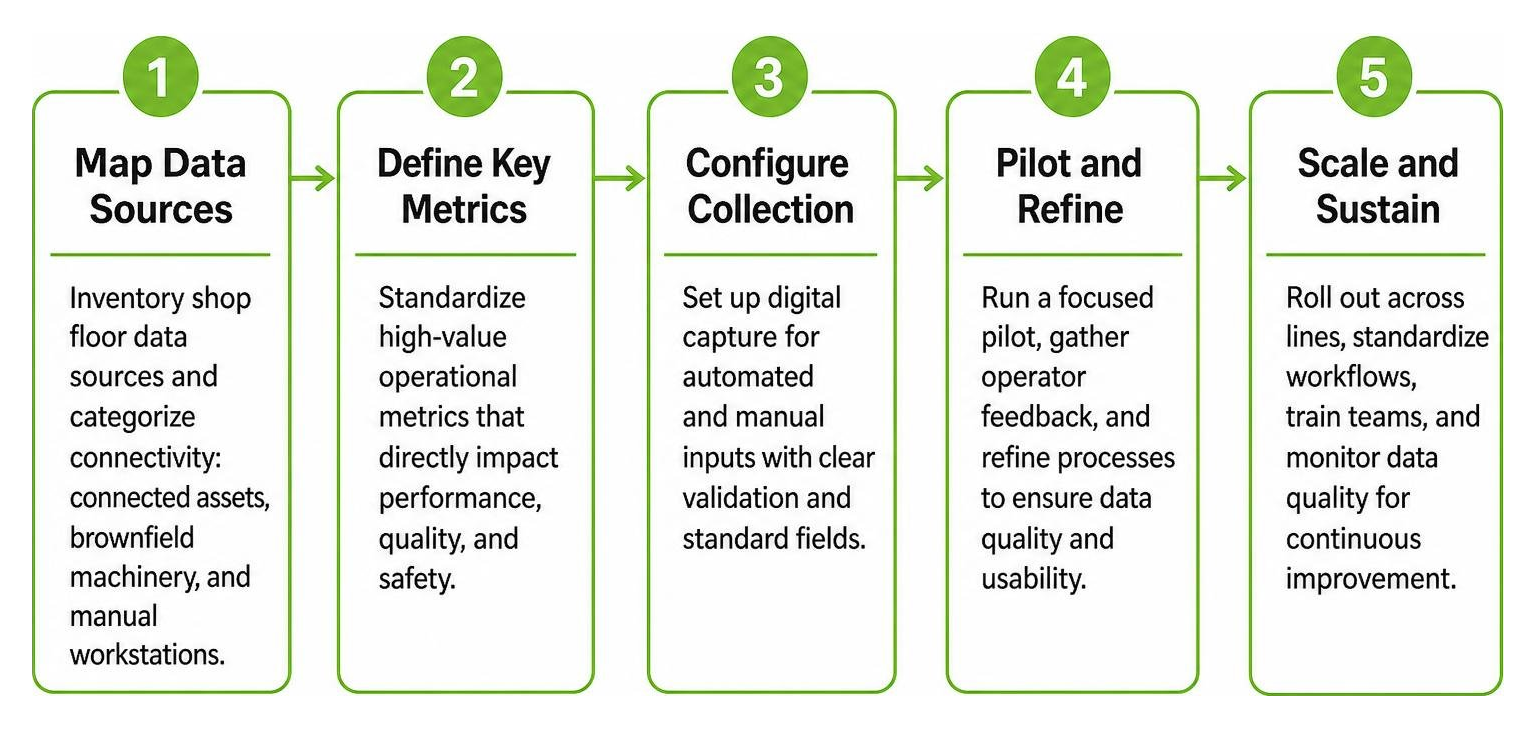
5 Practical Steps to Implement a Factory Data Collection System
Deploying digital data capture on the shop floor requires a practical, operator-first approach. Rushing into a plant-wide rollout without standard processes often results in low adoption, dirty data, and frustrated frontline workers. Aligning implementation with a proven digital lean manufacturing framework keeps the project focused on bottom-line results.
Step 1: Mapping Shop Floor Data Sources and Legacy Equipment
Begin by walking the plant floor to inventory your data sources. Categorize machinery by connectivity readiness:
Connected Assets: Modern PLCs with native Ethernet, OPC-UA, or Modbus capabilities.
Brownfield Machinery: Reliable legacy assets lacking digital outputs.
Manual Workstations: Assembly, packing, and inspection benches requiring manual operator entries.
Identify the exact data points required to solve operational blind spots, avoiding the temptation to capture every available register just because you can.
Step 2: Designing Frictionless Interfaces for Machine Operators
Frontline buy-in depends on interface simplicity. When choosing between a manual process vs automated process, design digital screens that require minimal taps:
Use rugged touchscreen tablets mounted directly at the workstation.
Implement barcode or QR scanners for rapid job tracking, work order lookups, and lot validation.
Provide simple dropdown menus and big, readable buttons for downtime tagging, eliminating the need to type detailed text during an active run.
Step 3: Deploying a Factory Data Collection System on the Line
Select a single pilot line or bottleneck cell to validate your configuration. Run digital collection alongside legacy paperwork for one to two weeks to confirm that cycle counts match physical production. Involve operators directly during shift handovers to gather feedback on screen layouts and adjust forms before expanding the rollout to adjacent cells.
Step 4: Connecting Frontline Data to Daily Lean Workflows
Data collection only delivers value when teams act on what they see. Connect daily shop floor entries into your operational cadence:
Tier 1 Stand-Ups: Shift leads review hourly target-versus-actual output and assign immediate countermeasures for recurring micro-stops.
Gemba Walks: Operations and CI managers review logged downtime categories to verify that standard operating procedures are being followed.
Continuous Improvement Projects: Lean coordinators analyze historical downtime trends to uncover how to optimize production with lean manufacturing software during formal Kaizen events.
Step 5: Auditing, Standardizing, and Scaling
Once the pilot line demonstrates stable data capture and strong operator engagement, document standard operating procedures for data entry. Roll the standardized digital setup across remaining lines, tracking operational gains at each milestone to maintain project momentum.
Overcoming Critical Implementation Challenges on the Shop Floor
Modernizing factory operations involves real-world technical and cultural hurdles. Overcoming these common challenges helps manufacturers maintain momentum and secure frontline buy-in.

Managing Legacy Machinery in a Factory Data Collection System
Most facilities run a mix of brand-new machines and equipment that has been operating reliably for decades. Upgrading entire machine lines simply to gather run signals is rarely cost-effective.
Instead, plants can bridge the gap using low-cost external sensors:
Current Transducers: Clip-on current sensors track motor electrical draw to detect running, idle, and off states without modifying machine control cabinets.
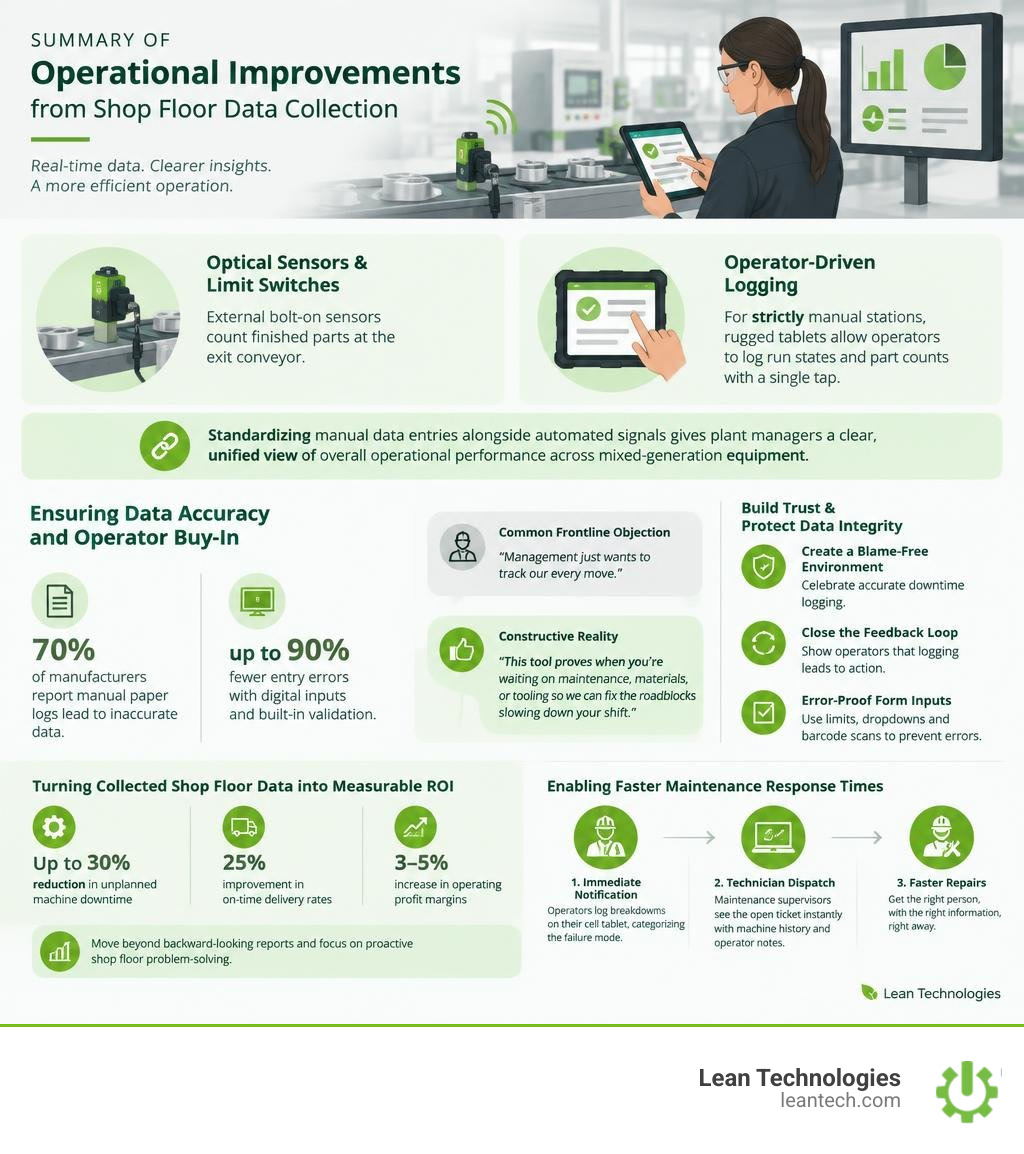
Optical Sensors & Limit Switches: External bolt-on sensors count finished parts at the exit conveyor.
Operator-Driven Logging: For strictly manual stations, rugged tablets allow operators to log run states and part counts with a single tap.
Standardizing manual data entries alongside automated signals gives plant managers a clear, unified view of overall operational performance across mixed-generation equipment.
Ensuring Data Accuracy and Operator Buy-In
Studies show that 70% of manufacturers report manual paper logs lead to inaccurate data, whereas digital inputs with built-in validation reduce entry errors by up to 90%. However, frontline teams may push back if digital tracking feels like micromanagement.
To build trust and protect data integrity:
Create a Blame-Free Environment: Celebrate accurate downtime logging. If an operator flags a 45-minute delay due to material shortages, treat it as an actionable supply-chain insight rather than an operator performance issue.
Close the Feedback Loop: Show operators that logging an issue leads to action. When maintenance resolves a recurring tooling issue logged in the system, point out that fix during the next shift standup.
Error-Proof Form Inputs: Use reasonable numerical limits, mandatory dropdown fields, and barcode scans to prevent typos and invalid entries.
Turning Collected Shop Floor Data into Measurable ROI
Investing in a factory data collection system delivers measurable improvements across key production metrics. Moving from delayed paper tracking to real-time shop floor software helps manufacturers achieve:
Up to 30% reduction in unplanned machine downtime by spotting recurring micro-stops and alerting support teams immediately.
25% improvement in on-time delivery rates through accurate job scheduling and real-time order tracking.
3–5% increase in operating profit margins within the first year of deployment by eliminating administrative overhead and reducing scrap.
Using purpose-built manufacturing analytics tools, continuous improvement leaders can move beyond backward-looking reports and focus on proactive shop floor problem-solving.
Enabling Faster Maintenance Response Times
When an asset goes down, every minute spent searching for a technician adds to lost production. Digital collection shortens Mean Time to Repair (MTTR) by streamlining the escalation workflow:
Immediate Notification: Operators log machine breakdowns on their cell tablet, categorizing the failure mode (e.g., electrical, pneumatic, tooling).
Technician Dispatch: Maintenance supervisors see the open ticket instantly on their shop floor dashboard, complete with machine history and operator notes.
Action Tracking: Technicians document work orders, replaced components, and root causes directly at the machine.
Tracking open maintenance tasks in a centralized digital system ensures that small mechanical issues are addressed before they cause catastrophic line failures, as detailed in our real-time data software guide 2026.
Customizing Data Collection for Discrete vs. Process Manufacturing
Every manufacturing environment operates with unique parameters, requiring a flexible approach to shop floor data collection:
Discrete Manufacturing: Focuses on part counts, cycle times, serial number tracking, changeover durations, and unit-level defect classifications.
Process Manufacturing: Centers on recipe parameters, batch yields, tank temperatures, mix viscosities, and continuous flow rates.
Selecting a customizable smart manufacturing platform allows teams to tailor digital forms, shift handovers, and tracking fields to fit their specific production processes without requiring complex coding or IT overhauls.
Frequently Asked Questions About Factory Data Collection
What is a factory data collection system?
A factory data collection system is an integrated setup of hardware and software tools designed to record, structure, and display production, machine, quality, and maintenance data from the plant floor. It replaces paper clipboards and static spreadsheets with digital interfaces and automated feeds, giving operators and supervisors actionable visibility into shift performance.
How can small and midsize manufacturers collect data from legacy machinery?
Manufacturers can capture data from legacy machinery by attaching non-invasive bolt-on devices—such as clip-on current sensors, vibration monitors, and external optical counters—or by giving operators simple digital tablets to log machine status and downtime reasons manually. This approach delivers deep operational visibility without the cost of complex control retrofits.
How does real-time shop floor data collection improve OEE?
Real-time data collection improves Overall Equipment Effectiveness (OEE) by highlighting the primary sources of availability, performance, and quality losses as they occur. Instead of analyzing yesterday's shift logs after production has stopped, supervisors and operators can identify minor line jams, slow run speeds, and quality drifts immediately, allowing them to apply countermeasures during the shift.
What to Do Next
Modernizing manufacturing operations does not require a complex, multi-year IT overhaul. Building a practical factory data collection system starts with giving machine operators, maintenance techs, and line supervisors simple tools to capture shop floor reality accurately at the source.
By moving away from paper clipboards, teams eliminate administrative burden, standardize daily Gemba routines, and uncover the real root causes of scrap and line downtime.
Lean Technologies' Thrive provides a flexible digital toolbox tailored for small to midsize manufacturers. Thrive helps your team digitize lean routines, log shop floor issues, track corrective actions, and drive continuous improvement. Remember: Thrive is not an ERP or MES, does not collect raw sensor telemetry, and does not run predictive machine algorithms. Instead, it organizes and drives clear action from shop floor and machine data entered by your team on mobile devices, tablets, or desktop terminals, giving everyone the real-time visibility needed to hit daily operational targets.
To start standardizing your shop floor operations, explore our comprehensive Guide to Digital Lean Manufacturing and discover practical tools to empower your frontline team today.