
Demystifying OEM Manufacturing for Growing Hardware Brands
Understanding the OEM Meaning in Manufacturing and Core Operations
To grasp the full oem meaning in manufacturing, you need to look at how modern industrial supply chains split design from physical assembly. An original equipment manufacturer is an enterprise that manufactures parts, sub-assemblies, or complete devices based strictly on the buyer's proprietary engineering design.
In this B2B ecosystem, the purchasing business (frequently termed a value-added reseller or brand owner) retains the intellectual property (IP), custom branding, and distribution channels. The OEM supplies the production infrastructure, specialized machinery, workforce, and process control.
Unlike general job shops that tackle one-off fabrication tasks, OEMs operate as specialized, long-term production partners. They convert technical schematics into physical goods across high-volume production cycles. By outsourcing execution to an OEM, hardware startups and scaling manufacturers bypass multi-million-dollar capital investments in industrial plant equipment, cleanrooms, and automated assembly cells.
Technical OEM Meaning in Manufacturing Workflows
From an engineering perspective, initiating an OEM contract requires exhaustive product documentation. A factory cannot build what you have not explicitly defined down to the micron. The core workflow relies on several technical handoffs:
Product Requirements Document (PRD): This outlines performance parameters, operating environments, regulatory certifications (such as CE, UL, or FCC), and cosmetic finishes.
Computer-Aided Design (CAD) Models and 2D Drawings: Detailed 3D CAD files paired with 2D drawings that specify geometric dimensioning and tolerancing (GD&T), critical-to-quality (CTQ) dimensions, and draft angles.
Bill of Materials (BOM): A granular breakdown listing raw materials, surface treatments, commercial off-the-shelf (COTS) fasteners, and electronic components.
Standardized Quality Protocols: Defining precise acceptance quality limit (AQL) standards, inspection checkpoints, and testing routines helps ensure incoming shipments match your tolerances.
Where OEMs Sit Within Global Supply Chains
OEMs sit right at the beginning of the conversion cycle. Upstream, an OEM coordinates with Tier-2 and Tier-3 suppliers for raw resins, metal stock, specialized microcontrollers, and chemical treatments. Downstream, the OEM delivers finished sub-assemblies or fully packaged units directly to the brand owner's distribution hub or final assembly line.
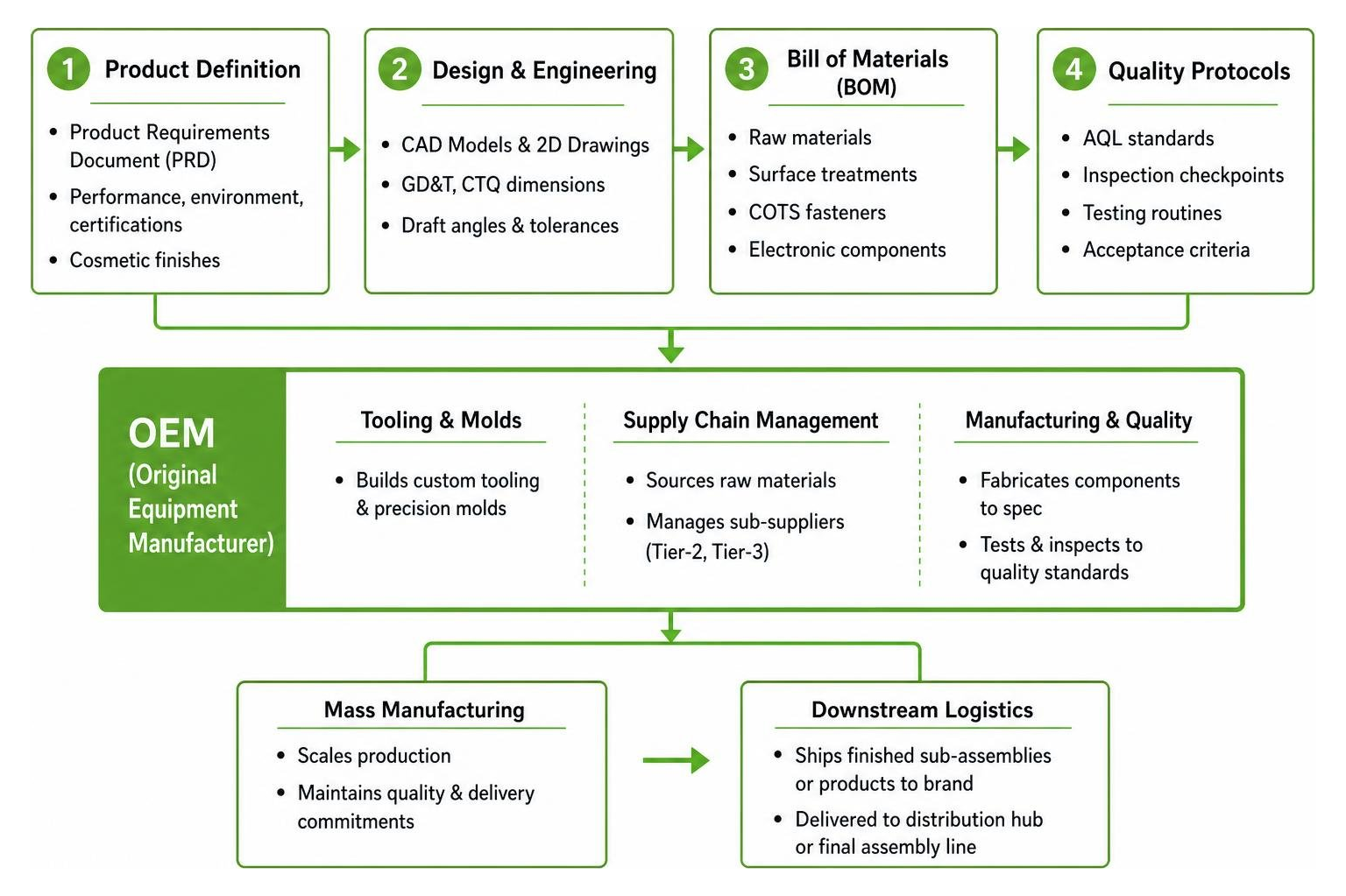
Because OEMs serve as this critical middle link, any hiccup on their production floor cascades throughout your distribution network. Maintaining reliable manufacturing operations management requires close coordination with your OEM, making sure delivery windows, engineering changes, and quality audits remain completely aligned.
OEM vs. ODM vs. CM: Selecting the Right Manufacturing Model
Navigating outsourced production requires choosing the engagement model that matches your product complexity, budget, and IP protection goals. Businesses generally evaluate three distinct manufacturing structures: Original Equipment Manufacturing (OEM), Original Design Manufacturing (ODM), and Contract Manufacturing (CM).
Understanding the rundown on OEM, CM, and JDM models allows engineering and procurement teams to balance capital risk against product customization.
Feature / Criteria | Original Equipment Manufacturer (OEM) | Original Design Manufacturer (ODM) | Contract Manufacturer (CM) |
|---|---|---|---|
Design Ownership & IP | Buyer owns 100% of the design, blueprints, and IP. | Factory owns base design; buyer gets private-label rights. | Buyer owns 100% of design, IP, and firmware. |
Tooling & Setup Cost | High ($2,000 to $50,000+ for custom molds/tooling). | Minimal to none (utilizes existing factory tooling). | Medium to High (dependent on process engineering needs). |
Time to Market | Slower (60–120 days from tooling to first production run). | Rapid (15–45 days using pre-validated platforms). | Moderate (varies with supply chain readiness). |
Unit Economics | Low per-unit cost once tooling is amortized over volume. | Moderate; margins remain flat across order volumes. | Low per-unit cost; optimized for large-scale economies. |
Minimum Order Quantity (MOQ) | High (typically 500 to 5,000 units to amortize tooling). | Low (typically 100 to 500 units). | Variable (often requires enterprise-level production runs). |
Customization Level | Complete design freedom down to component tolerances. | Limited to cosmetic tweaks, logos, and packaging. | Complete control over assembly steps and parts sourcing. |
The Strategic Value of the OEM Meaning in Manufacturing for Proprietary Brands
Opting for an OEM model offers clear strategic advantages when product uniqueness defines your competitive moat. If you have patented a novel mechanical transmission, engineered a specialized medical diagnostic sensor, or designed an architectural consumer appliance, an OEM relationship guarantees that your physical product reflects your exact engineering specifications.
Furthermore, direct design oversight simplifies regulatory compliance. In heavily regulated spaces like medical hardware or aerospace, brands must prove end-to-end material traceability and testing compliance. Because you specify every single line item in the BOM, an OEM setup gives your QA engineers total control over raw material selections and testing regimens.
Evaluating ODM and Contract Manufacturing Alternatives
While OEM manufacturing grants absolute creative and technical freedom, it is not always the best path for every hardware initiative.
Original Design Manufacturers (ODMs): An ODM designs, tools, and manufactures a product in-house. Buyers pick an existing catalog item, add their custom logo and packaging, and take it to market as a "white-label" or "private-label" good. This approach minimizes upfront tooling expenses and slashes launch timelines down to weeks. However, because the factory owns the underlying design, competitors can license the exact same core hardware.
Contract Manufacturers (CMs): CMs specialize in turnkey printed circuit board assembly (PCBA), sub-component integration, and final box-build packaging. CMs frequently provide design for manufacturability (DFM) feedback to streamline assembly lines, but they rarely produce the specialized, custom-tooled sub-components that dedicated mechanical or electrical OEMs fabricate.
Economics, Tooling, and Lead Times in OEM Production
Building a custom physical product requires navigating steep upfront capital investments and extended development cycles. Unlike buying off-the-shelf catalog products, OEM partnerships demand rigorous financial planning before the first production run ever kicks off.
Managing Upfront Capital and Tooling Ownership Disputes
The primary barrier to entry for OEM manufacturing lies in non-recurring engineering (NRE) fees and tooling costs. Custom injection molds, progressive stamping dies, extrusion fixtures, and automated test rigs typically run from $2,000 to over $50,000, depending on mechanical complexity, cavity count, and tool steel grade (such as hardened H13 or P20 steel).
Tooling amortization dictates the OEM's Minimum Order Quantity (MOQ). Factories set MOQs between 500 and 5,000 units to justify the downtime required to mount, calibrate, and run custom tooling setups.
A critical business hazard in contract manufacturing involves tooling ownership rights. Data from international trade bodies indicates that tooling ownership disputes account for roughly 15% of all legal and operational disagreements between foreign hardware brands and overseas factories.
When contracting an OEM:
Ensure the manufacturing agreement explicitly states that the buyer retains 100% legal ownership of all custom molds, dies, and assembly jigs.
Mandate that the factory affix unique asset metal nameplates to your tooling.
Execute a bilingual NNN Agreement (non-disclosure, non-use, non-circumvention) governed by local courts in the factory's home jurisdiction. Relying on an English-language Western NDA offers virtually no enforceable protection in overseas hubs where patent applications exceed 1.5 million filings annually.
Lead Times and Production Milestones
A standard OEM production ramp requires deliberate stage-gate approvals to avoid costly scrap runs. Engineering and procurement teams must manage several production milestones:
Design for Manufacturability (DFM) Review: Collaborative adjustments to wall thicknesses, radii, draft angles, and material selections.
Sample and Prototype Iteration: Prototype verification generally costs $1,000 to $5,000 and spans 4 to 8 weeks for initial CNC samples or 3D-printed mockups.
Tooling Fabrication (T0 to T1): The factory mills and EDMs the production molds over 30 to 60 days.
First Article Inspection (FAI): The factory pulls initial test shots (T1 samples) off the line to run coordinate measuring machine (CMM) dimensional checks against your 2D blueprints. The approved run becomes the "Golden Sample."
Mass Production and Delivery: Full mass manufacturing typically requires 60 to 120 days from design approval to initial warehouse delivery.
Operational teams keep these timelines on schedule by maintaining organized parts management systems, ensuring that bills of materials and supplier part numbers remain synchronized across development phases.
OEM Parts vs. Aftermarket Components Across Major Industries
Understanding the difference between OEM components and aftermarket alternatives is just as crucial for plant maintenance technicians and field service engineers as it is for product design teams.

OEM Parts: Components produced by the original manufacturer that built the equipment, using the exact blueprints, material blends, and tolerance limits. They guarantee seamless fitment, maintain OEM warranty validity, and minimize unexpected equipment downtime.
Aftermarket Parts: Third-party components manufactured via reverse engineering. While aftermarket parts are often cheaper or more readily available during supply shortages, quality and dimensional precision can fluctuate wildly.
For plant engineers and maintenance managers, using authentic OEM components on critical production line equipment prevents catastrophic failures. When enterprise equipment unexpectedly fails, the stakes are massive. Research from industrial surveys shows that one-third of manufacturing companies report an hour of unplanned downtime costs them between $1 million and $5 million.
Industry-Specific OEM Implementations
The OEM model operates across multiple sectors, as highlighted by IBM's overview of manufacturing ecosystems:
Automotive: Tier-1 suppliers like Bosch or Brembo operate as OEMs, manufacturing fuel injection systems and braking hardware tailored to specific vehicle platforms. The automaker assembles these components into the finished automobile sold under their brand name.
Consumer Electronics: Tech companies frequently rely on specialized OEMs for camera modules, OLED panels, and high-density battery packs, integrating proprietary silicon with custom-tooled external enclosures.
Healthcare and Medical Devices: Medical OEMs manufacture diagnostic sensors and robotic surgical actuators under strict ISO 13485 cleanroom certifications.
Industrial Machinery & Aerospace: Turbines, hydraulic valves, and avionics assemblies depend on specialized OEMs to satisfy rigorous flight-readiness and high-pressure safety standards. Keeping track of these high-value components requires active equipment asset tracking on the factory floor.
The Rise of Industry 4.0, IoT, and Digital Twins in OEM Sourcing
Modern OEM partnerships are moving well beyond static blueprints. Today’s industrial landscape uses digital connectivity to unify supplier quality control with in-house operations:
Industrial IoT (IIoT): OEMs are embedding intelligent sensors directly into components, allowing operational teams to track performance metrics, cycle counts, and thermal loads in real time.
Digital Twins: Virtual 3D models of OEM components allow engineers to simulate stress, wear, and fluid dynamics long before cutting physical steel tooling.
Connected Shopfloor Ecosystems: Small to midsize manufacturing plants are moving away from manual paper logs, binders, and disconnected spreadsheets. Modern manufacturing software connects floor personnel directly to the production process, driving immediate accountability when incoming OEM components hit receiving inspection stations.
What to Do Next
Effectively executing an OEM manufacturing strategy requires bridging the gap between external supplier handoffs and internal shopfloor discipline. When custom-tooled sub-components, stampings, or assemblies arrive at your facility, success comes down to how quickly your operations, quality, and maintenance teams can catch defects, log deviations, and maintain throughput.
Operational visibility should not rely on whiteboards, scattered clipboards, or cumbersome enterprise software that takes months to configure. Small to midsize manufacturers need flexible digital tools on the plant floor that empower operators and shift supervisors to capture observations at the point of work.
Lean Technologies offers Thrive, an all-in-one, customizable shopfloor software platform built by manufacturing experts to streamline daily operations, boost team productivity, and protect operating margins.
Thrive acts as a flexible digital toolbox that digitizes lean work processes—helping operators, QA engineers, safety officers, and plant supervisors log issues, track corrective actions, and drive continuous improvement (CI) directly from mobile devices, tablets, or shopfloor PCs.
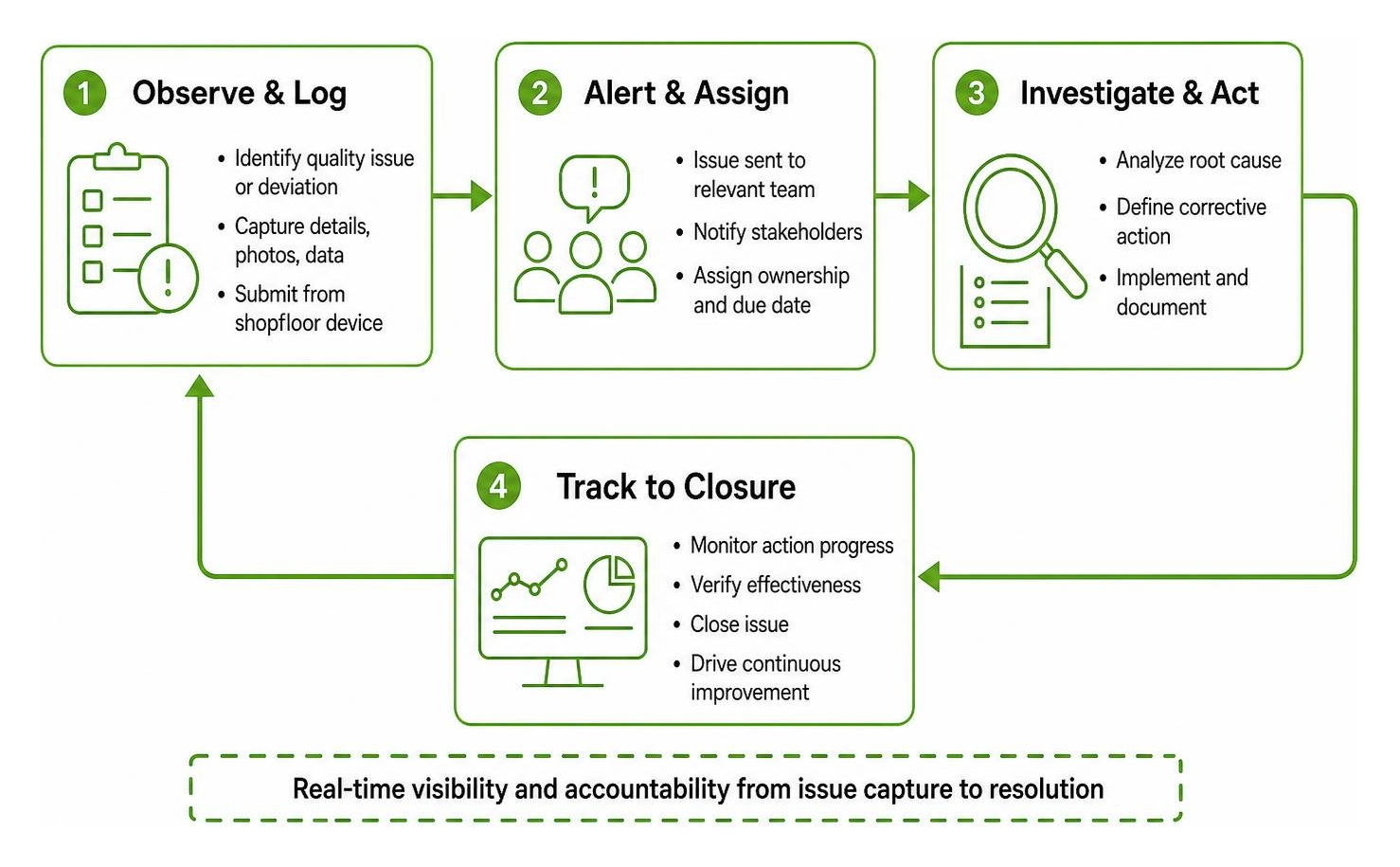
Thrive organizes and drives real action from machine data and process observations entered by your team or imported from other systems. By giving teams real-time visibility when data is recorded at the source, Thrive eliminates paper workarounds and keeps cross-functional teams accountable.
Whether you are standardizing receiving inspections for incoming OEM shipments, managing shopfloor TPM routines, or driving Kaizen initiatives across your assembly lines, exploring our guide to digital lean manufacturing will help you establish consistent, scalable operational excellence.
For growing brands and scaling production plants, mastering the technical oem meaning in manufacturing is step one; building an agile, digitally enabled shop floor to execute that vision is what turns designs into profitable, market-leading products.
Frequently Asked Questions About OEM Manufacturing
What is the primary difference between OEM and aftermarket parts?
OEM parts are manufactured by the original component supplier according to the exact engineering drawings, material specifications, and dimensional tolerances of the base system. They guarantee identical fit, preserve manufacturer warranties, and ensure consistent operational performance. Aftermarket parts are built by third-party companies via reverse-engineering; they are typically less expensive but may carry broader manufacturing tolerances and varying levels of reliability.
Can a business transition from an ODM to an OEM model as it scales?
Yes. Many consumer brands start by selecting an off-the-shelf product from an Original Design Manufacturer (ODM) to validate consumer demand with minimal upfront capital. Once sales volume proves viable and cash flow allows, businesses often transition to an OEM model. This allows them to invest in custom tooling, protect unique IP, achieve brand differentiation, and lower long-term per-unit production costs.
How do businesses protect intellectual property when working with overseas OEMs?
To protect proprietary IP when contracting with overseas manufacturing facilities:
Register local design and utility patents in the country of manufacture before sharing detailed CAD files.
Execute an enforceable, bilingual NNN agreement (Non-disclosure, Non-use, Non-circumvention) specifically tailored to the local jurisdiction.
Segment your manufacturing by having critical proprietary sub-components produced by separate factories, completing final assembly and firmware programming in-house or with a trusted integration partner.
Perform unannounced on-site supplier audits to verify that the factory is not running unauthorized production shifts with your proprietary tooling.