
Why Computer Integrated Manufacturing Still Defines Smart Factory Operations
The Strategic Role of Computer Integrated Manufacturing in Operations Management
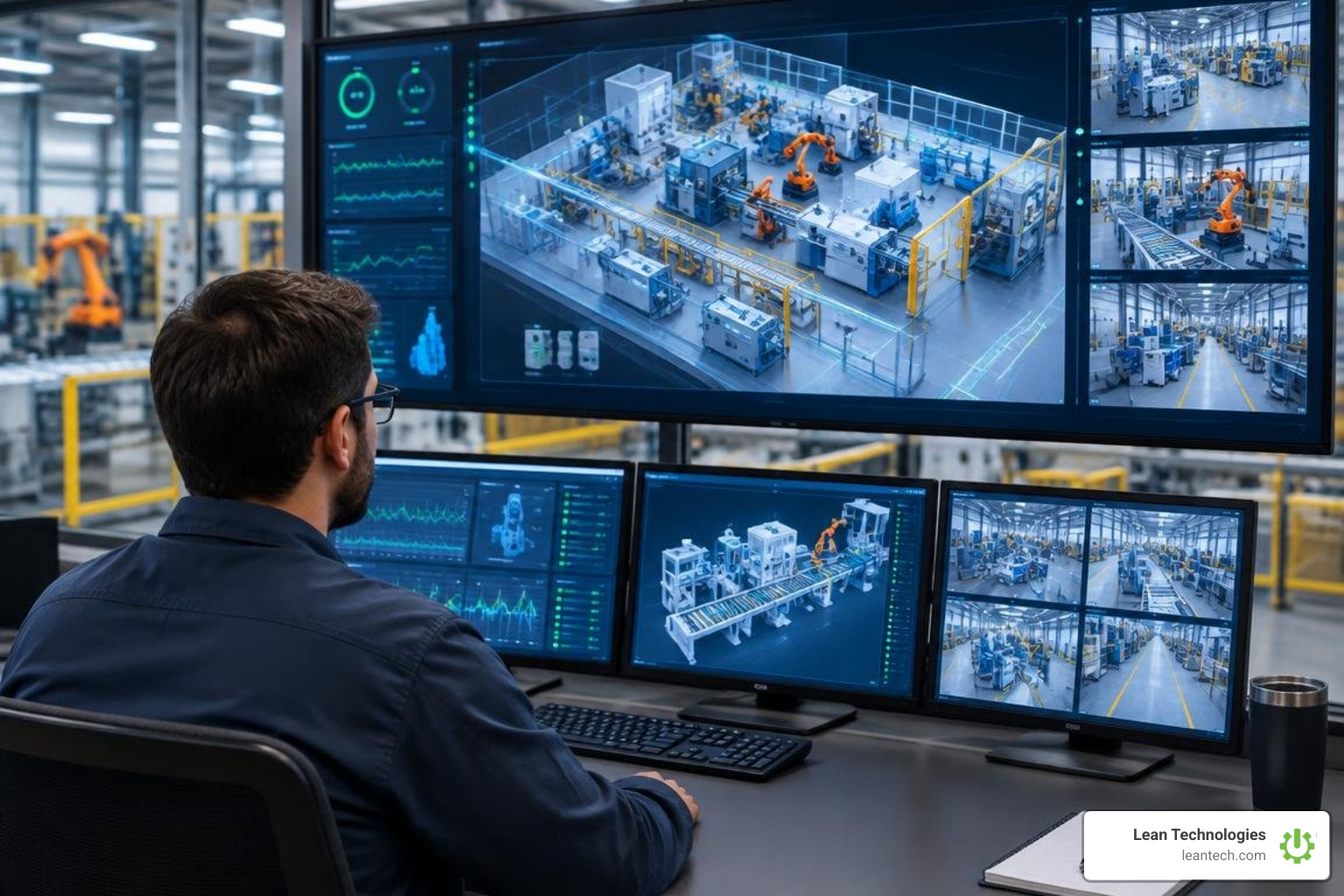
Computer integrated manufacturing in operations management connects engineering, production planning, and shop-floor execution into one synchronized operational loop. Instead of treating computer-aided design (CAD), computer-aided manufacturing (CAM), and computer-aided process planning (CAPP) as independent software silos, an integrated environment ensures design revisions automatically propagate down to machining routines, tooling schedules, and quality inspection criteria. That closed-loop visibility is what separates a truly smart factory from a collection of automated machines.
Modern industrial operations balance fluctuating customer demand against strict quality standards and volatile supply chains. In this environment, relying on disconnected systems creates costly bottlenecks. Global market adoption reflects this reality: the computer integrated manufacturing market was valued at USD 2,530 million in 2024 and is on track to reach USD 4,321.07 million by 2032, demonstrating a steady CAGR of 6.92%.
Regional investments highlight where smart factory transformations are moving fastest. North America leads the global landscape with a 35% market share, propelled by extensive modernization in automotive, aerospace, and defense plants. Meanwhile, the Asia-Pacific region commands 25% of the market, fueled by rapid industrialization, high-volume electronics assembly, and heavy robotics investments across major manufacturing hubs.
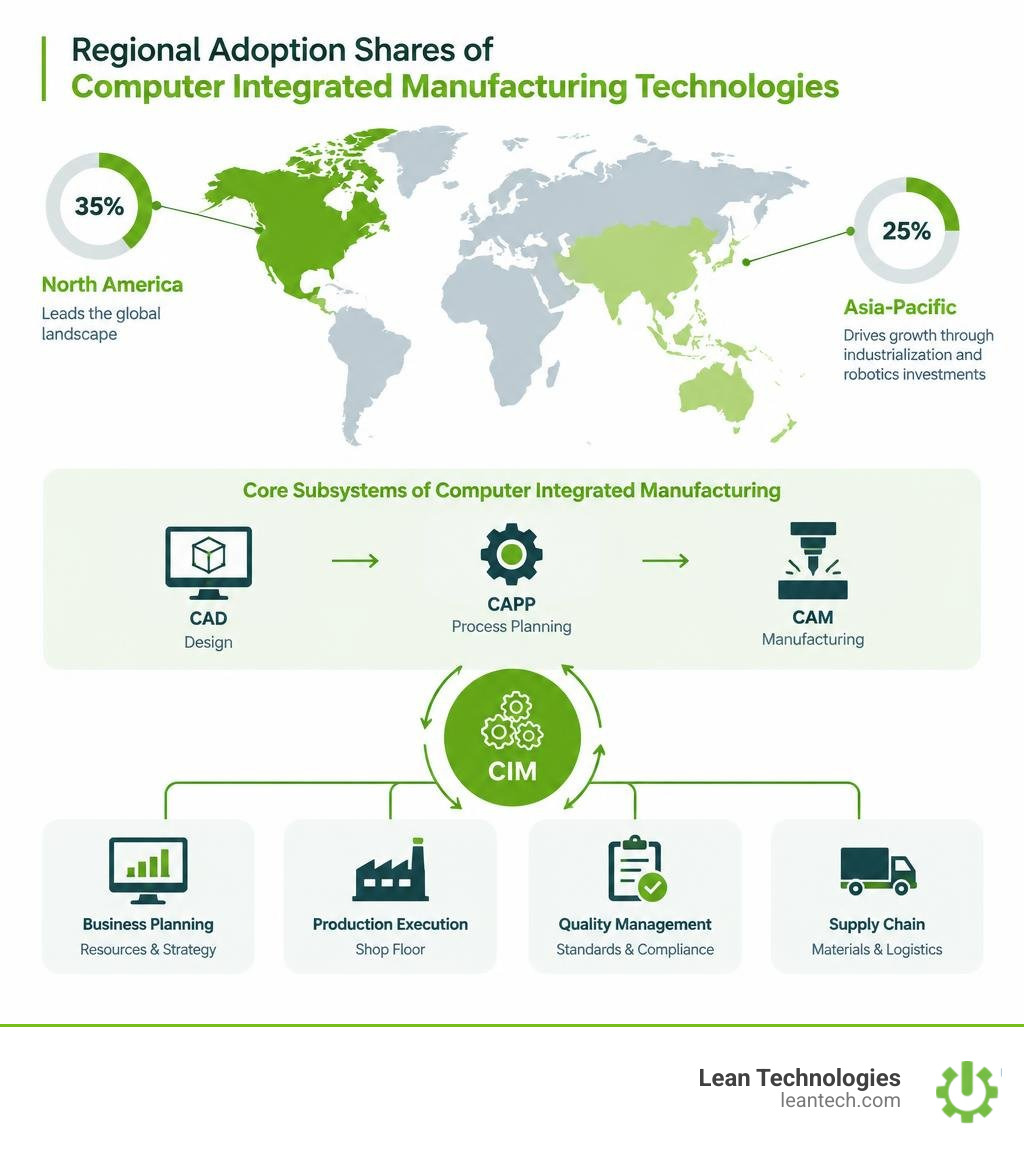
Operations leaders should anchor these investments in top-down strategic governance. Decades of plant-floor implementations prove that when manufacturing automation is introduced through isolated, bottom-up initiatives, companies create "islands of automation" that fail to share data across functional borders. Establishing a cohesive foundation aligns shop-floor execution with business-level resource management. For an architectural breakdown of enterprise integration history, see the foundations of Computer-Integrated Manufacturing. To see how these structural principles apply to day-to-day production control, explore modern manufacturing operations management workflows.
Core Subsystems of Computer Integrated Manufacturing in Operations Management
A fully integrated production facility coordinates several hardware and software layers:
Direct Digital Control & Machining: High-precision CNC machinery and automated tooling centers driven directly by unified CAD/CAM files.
Control & Logic Layers: Programmable logic controllers (PLCs) executing low-level cycle logic, safety interlocking, and process sequencing.
Intralogistics Automation: Automated guided vehicles (AGVs) and automated storage and retrieval systems (ASRS) that move raw materials, work-in-progress (WIP), and finished inventory across work centers without manual staging delays.
Closed-Loop Quality Control: Automated optical inspection, coordinate measuring machines (CMM), and in-line metrology systems that feed dimensional verification back into machine controllers to correct tool wear before parts drift out of tolerance.
Operational Dimension | Traditional Automated Islands | Integrated CIM Subsystems |
|---|---|---|
Data Latency | Batch updates; paper shift logs; manual end-of-day ERP entries | Real-time transaction propagation across scheduling, routing, and inventory databases |
Labor Allocation | Heavy reliance on direct machine minders, paper runners, and manual schedulers | Reallocated to setup optimization, engineering tasks, process troubleshooting, and lean problem-solving |
System Adaptability | Rigid routings; lengthy physical retooling; manual replanning during disruptions | Dynamic routing, automated recipe distribution, and flexible capacity rebalancing |
Labor Allocation and Organizational Impact in Modern Plants
Integrating automation reshapes plant labor dynamics. Empirical research shows that adopting integrated manufacturing technologies reduces repetitive direct manual labor while increasing the demand for engineering, maintenance coordination, and continuous improvement roles.
This transition changes how front-line teams interact with plant data. When manual tracking and spreadsheet handoffs are eliminated, operators stop acting as paper clerks and focus on process health. Logging operational delays, quality deviations, and maintenance issues at the source—using mobile tablets or workstation interfaces—gives engineers and supervisors clean, contextual information to resolve systemic downtime.
Architectural Foundations: Bridging Planning, Execution, and Maintenance
To eliminate data latency and functional silos, computer integrated manufacturing relies on standardized enterprise frameworks like the Computer Integrated Manufacturing Open System Architecture (CIMOSA). CIMOSA establishes a vendor-independent structure that maps operational processes across four key views: function, information, resource, and organization.
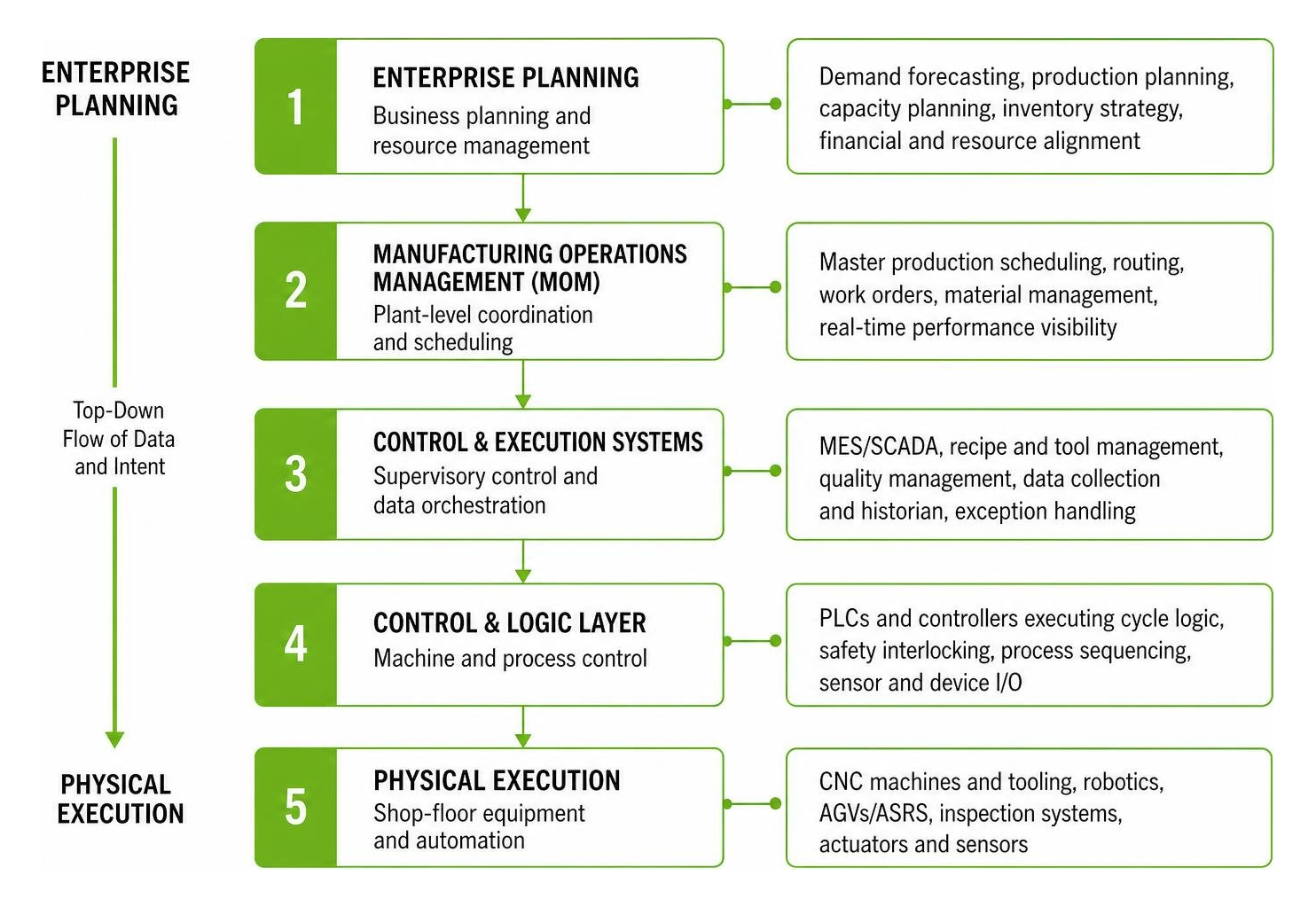
Achieving seamless communication across these views requires robust database design and network topology management:
Unified Relational Structures: Production schedules, bills of materials (BOM), tool life data, and maintenance records must link to shared master data records to prevent version mismatches.
Low-Latency Industrial Networking: Physical machine layouts and network cabling directly dictate communication performance. Standardized protocols ensure heterogeneous equipment—from CNC milling cells to robotic palletizers—communicates reliably across the plant floor.
Data Integrity and Governance: Sensor networks and field devices generate massive transactional volume. Strict validation routines prevent corrupted or out-of-order data from triggering inaccurate automated scheduling routines.
Connecting these layers bridges the gap between top-floor business goals and bottom-floor execution. You can review how modern systems structure these operations in our guide to the integrated manufacturing operations platform. For academic research on synchronizing production schedules with maintenance windows, review this study on integrated manufacturing and maintenance planning.
Operational Research Models in Computer Integrated Manufacturing in Operations Management
Operational research (OR) provides the mathematical models that translate production targets into daily machine schedules. Without OR algorithms, flexible manufacturing systems (FMS) quickly stall under combinatorial complexity.
Key operational research applications include:
Integer Programming for Tool Loading: Balancing tool magazine capacities across parallel machining centers to minimize expensive changeover delays.
Queueing Theory for Material Transport: Modeling AGV transit times, buffer sizes, and part-pallet availability to eliminate starvations and blockages.
Dynamic Makespan Optimization: Continually recalculating job sequences across work centers when high-priority rush orders or unexpected machine stoppages occur.
To explore the mathematical formulations that power these techniques, examine the literature on operational research models in CIM.
Closed-Loop Maintenance and Production Synchronization
Unplanned downtime breaks automated production chains. In traditional operations, maintenance and production operate on separate schedules, leading to conflicts over machine availability.
Integrated Planning (IPL) resolves this friction by treating maintenance windows as scheduled production constraints within the planning algorithm. Modern architectures employ multi-agent coordination frameworks:
Production Agents: Monitor work order progress, routing requirements, and customer due dates.
Maintenance Agents: Track operational run hours, component wear cycles, and technician availability.
Coordination Agents: Evaluate machine condition data alongside order priority to schedule preventive maintenance during natural process changeovers or low-demand windows.
This coordinated approach protects Overall Equipment Effectiveness (OEE) while preventing severe breakdowns. For a detailed breakdown of multi-agent shop-floor architectures, refer to this study on multi-agent distributed operations planning.
Digital Twins and Next-Generation Integration for Complex Products
For complex assemblies such as aerospace components, power generation equipment, and electric drivetrains, integration must extend beyond factory walls. Digital twin frameworks create a high-fidelity virtual replica of physical assets, unifying product lifecycle management (PLM), shop-floor manufacturing execution, and post-sale maintenance, repair, and overhaul (MRO) telemetry into a single feedback loop.
Integrating virtual and real-world data closes the loop across three critical stages:
Design & Validation: As-designed CAD models and finite element simulations validate structural requirements before tooling begins.
As-Built Verification: Plant-floor data fusion maps actual machining tolerances, torque curves, and welding parameters directly to the specific serial number's digital twin.
Operational Feedback (MRO): Field service teams feed operating hours, thermal loads, and component wear history back into the central model. This post-sale data updates fault-prediction libraries and informs design engineers about structural stress points on future revisions.
To explore how virtual-real modeling transforms complex industrial manufacturing, read this research on digital twin integration for complex products. For a broader timeline of these advancements, see our computer integrated manufacturing guide 2026.
Cloud-Native Scalability and Supply Chain Transparency
While foundational control loops remain on localized edge hardware for sub-millisecond response times, the overarching management architecture is shifting toward cloud-native ecosystems.
Cloud-based architectures give enterprise leaders real-time visibility across multi-plant manufacturing networks. Production planners can balance capacity between facilities, monitor supplier inventory tiers, and standardize engineering change orders globally.
In enterprise deployments, contract manufacturers using cloud-integrated manufacturing frameworks have documented 15% reductions in production costs and 25% improvements in on-time delivery performance. To review how modern cloud ecosystems structure these workflows, explore our deep dive into the manufacturing operations management platform.
Overcoming Legacy Integration Barriers and High Capital Outlays
Despite clear operational benefits, full-scale system modernizations carry real implementation challenges:
Capital Expenditure Constraints: Custom engineering, robotic cells, and extensive software licensing require substantial upfront investment, often presenting high financial hurdles for small to midsize enterprises (SMEs).
Heterogeneous Communication Standards: Brownfield facilities contain machinery spanning multiple decades, utilizing proprietary communication protocols that require specialized gateways and middleware to translate.
Data Integrity Failures: Automated scheduling algorithms produce chaotic results when fed unvalidated, inconsistent, or duplicate shift records from the shop floor.
To mitigate these risks without taking on massive, high-risk IT overhauls, operations leaders should adopt modular rollout strategies:
Rather than attempting to automate every process at once, successful plants prioritize operational standardization first. Equipping frontline teams with intuitive digital tools to capture scrap reasons, maintenance requests, and standard operating procedures (SOPs) creates clean data at the source. This structured human input forms the backbone needed to support higher-level software platforms.
Frequently Asked Questions about Computer Integrated Manufacturing
What is the primary difference between CIM and traditional factory automation?
Traditional factory automation focuses on mechanizing individual tasks—such as using a PLC to cycle a stamping press or an isolated robotic arm to weld a seam. Computer integrated manufacturing connects those physical automated tasks to upstream engineering models (CAD/CAM), operational scheduling algorithms, inventory databases, and quality management systems through a unified digital architecture.
How do operational research models enhance production control within CIM?
Operational research models apply mathematical algorithms—such as mixed-integer linear programming, queueing networks, and dynamic heuristics—to resolve complex manufacturing trade-offs. They optimize tool allocation across machining centers, minimize pallet wait times across AGV networks, and dynamically recalculate production sequences when shop-floor disruptions occur.
Why do some CIM implementations fail to deliver strategic business value?
Most failures stem from bottom-up implementations that optimize localized machine cells without establishing enterprise-level data governance. When technical teams deploy isolated software tools that cannot share data with production planning, plant-wide visibility suffers, creating rigid "automation islands" that fail to support broader strategic goals.
In Summary: Transforming CIM from Complex Architecture to Shopfloor Action
Advanced algorithms, multi-agent frameworks, and robotics deliver maximum return on investment only when plant-floor teams have the visibility and tools to act on operational data. For small to midsize manufacturers, executing computer integrated manufacturing in operations management does not require ripping out existing infrastructure or deploying multi-million-dollar software packages.
Lean Technologies provides Thrive, an all-in-one, customizable shopfloor software platform designed by manufacturing professionals. Thrive acts as a flexible digital toolbox that digitizes lean work processes—empowering machine operators, maintenance technicians, quality engineers, and plant managers to log downtime, track corrective actions, coordinate maintenance workflows, and drive continuous improvement.
Thrive is not an ERP or MES, and it does not replace your existing enterprise systems. It does not gather direct sensor telemetry or generate automated predictive machine alerts. Instead, Thrive organizes and drives actionable accountability from data entered directly by your team on tablets, phones, or desktops, or imported from your other operational systems. By eliminating paper forms and whiteboard workarounds, Thrive bridges the gap between top-floor strategy and frontline execution.
To discover how modern digital toolboxes streamline shop-floor execution, explore our comprehensive breakdown of computer integrated manufacturing software.