
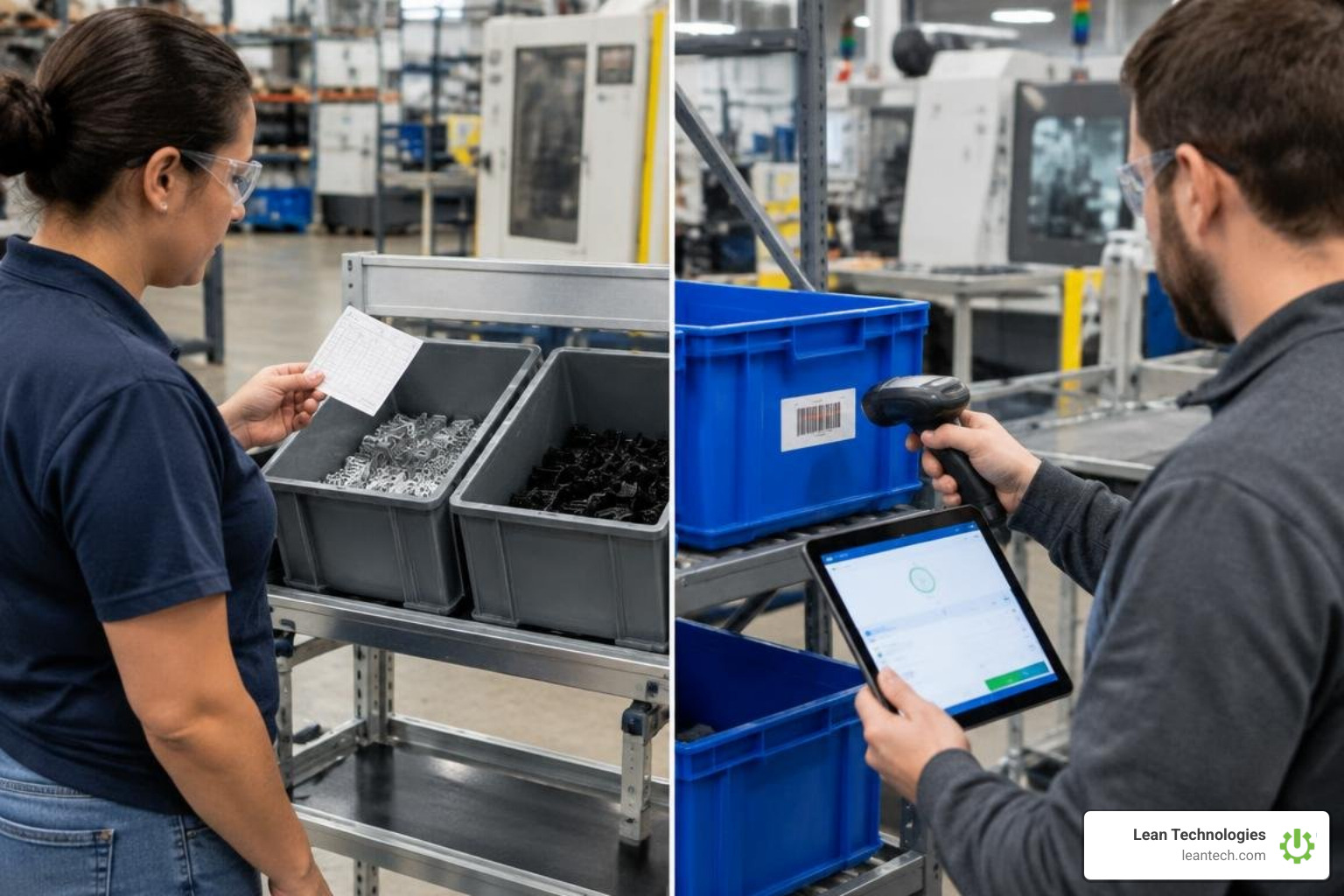
Step-by-Step Guide to Digitalized Lean Inventory Control
Fundamentals of Digitalized Lean Inventory Control
To implement digitalized lean inventory control, start by mapping the physical material flow and identifying where operators, material handlers, and supervisors can log consumption, scrap, and transfers directly at the point of use. Then replace static min/max buffers with dynamic reorder points based on actual lead times and demand variability. Finally, give the team mobile or tablet-based logging so replenishment signals are triggered in real time instead of waiting for paper count sheets or batch ERP updates. This keeps the core lean objective intact: eliminate the classic seven wastes, particularly excess inventory, waiting, motion, and defects.
At its core, lean inventory management is about eliminating waste (Muda) while maintaining uninterrupted flow. Traditional lean relies heavily on physical mechanisms—such as two-bin systems, color-coded floor markings, and laminated paper cards. While these visual controls revolutionized manufacturing in the 20th century, modern production environments face higher SKU counts, compressed customer lead times, and global supply chain volatility. Discovering how Lean isn't dead, it's digital: Rethinking inventory in smart ... operations allows manufacturers to bridge the gap between physical shopfloor execution and strategic material planning.
When teams modernize these principles into digitalized lean inventory control, the foundational objective remains unchanged: eliminate the classic seven wastes, particularly excess inventory, waiting, motion, and defects. However, the execution shifts from static, manual triggers to responsive, closed-loop digital workflows. By applying proven manufacturing waste reduction techniques at the machine and workstation level, production teams eliminate the latency that causes stockouts and bloated buffer stocks.
Dimension | Traditional Lean Inventory (Paper / Physical) | Digitalized Lean Inventory Control |
|---|---|---|
Data Capture | Manual logging, physical kanban card handoffs, paper count sheets | Direct-at-source mobile entry, tablet inputs, barcode/RFID scans |
Visibility | Localized only to the immediate cell or stockroom bin | Plant-wide and cross-functional visibility updated as events occur |
Safety Stock Logic | Static min/max formulas reviewed annually or during crises | Dynamic buffer sizing adjusted for demand shifts and lead-time variability |
Replenishment Triggers | Physical card collection, batch reorders, delayed PO creation | Real-time pull signals routed directly to buyers or integrated suppliers |
Discrepancy Detection | Discovered during annual stock counts or stockout incidents | Daily variance tracking between actual physical stock and recorded balances |
Continuous Improvement | Manual whiteboards, disconnected clipboards, delayed Kaizen loops | Action tracking assigned to owners with auditable resolution histories |
Why Traditional ERP Falls Short of Digitalized Lean Inventory Control
Enterprise Resource Planning (ERP) platforms are designed for financial accounting, transactional record-keeping, and high-level Master Production Scheduling (MPS). They excel at balancing balance sheets and processing general ledger entries, but they are notoriously ill-equipped for day-to-day shopfloor lean execution.
Standard ERP modules operate on batch updates, running nightly Material Requirements Planning (MRP) cycles. If an operator scraps 40 stamped brackets at 9:00 AM and records it on a paper traveler, the ERP will not recognize that shortage until someone manually enters the transaction hours—or days—later. This delay creates "phantom stock," where the central system reports inventory that is physically damaged, missing, or already consumed.
To survive, operators, material handlers, and supervisors create informal spreadsheet trackers and clipboards. These offline workarounds create disconnected data silos. Adopting modern digital lean management bridges this divide: rather than replacing the central transactional database, a digital lean toolbox captures operational actions at the workstation and provides the team with immediate clarity on physical material state.
Calculating Hidden Costs: Walk-and-Wait Time to PO Processing
Manual inventory management carries substantial administrative overhead and hidden labor costs that rarely appear on standard financial variance reports:
Purchase Order Overhead: In typical industrial environments, the fully loaded administrative cost of processing an individual purchase order—from requisition, manager approval, PO dispatch, line-item matching, receiving, and invoice reconciliation—can exceed $100 to $150 (or roughly DKK 1,000 in high-wage regions) per order. Processing 200 separate order lines each week across disparate vendors results in significant hidden operational costs.
Walk-and-Wait Time: When components are stored centrally rather than at the point of use, operators and maintenance technicians walk across the plant floor to locate parts, check paper logs, or wait for an inventory clerk to issue hardware. In facilities where fully burdened labor rates run high, ten minutes of daily transit time per operator accumulates into thousands of wasted productive hours annually.
Manual Stock Counting: Pen-and-paper cycle counts require manual transcription into spreadsheets, introducing transcription errors, delayed stock reconciliation, and disrupted production schedules.
Implementing structured raw material management processes eliminates these recurring administrative bottlenecks by establishing structured replenishment intervals and standardizing material handoffs.
Key Technologies and Optimization Logic in Lean Inventory
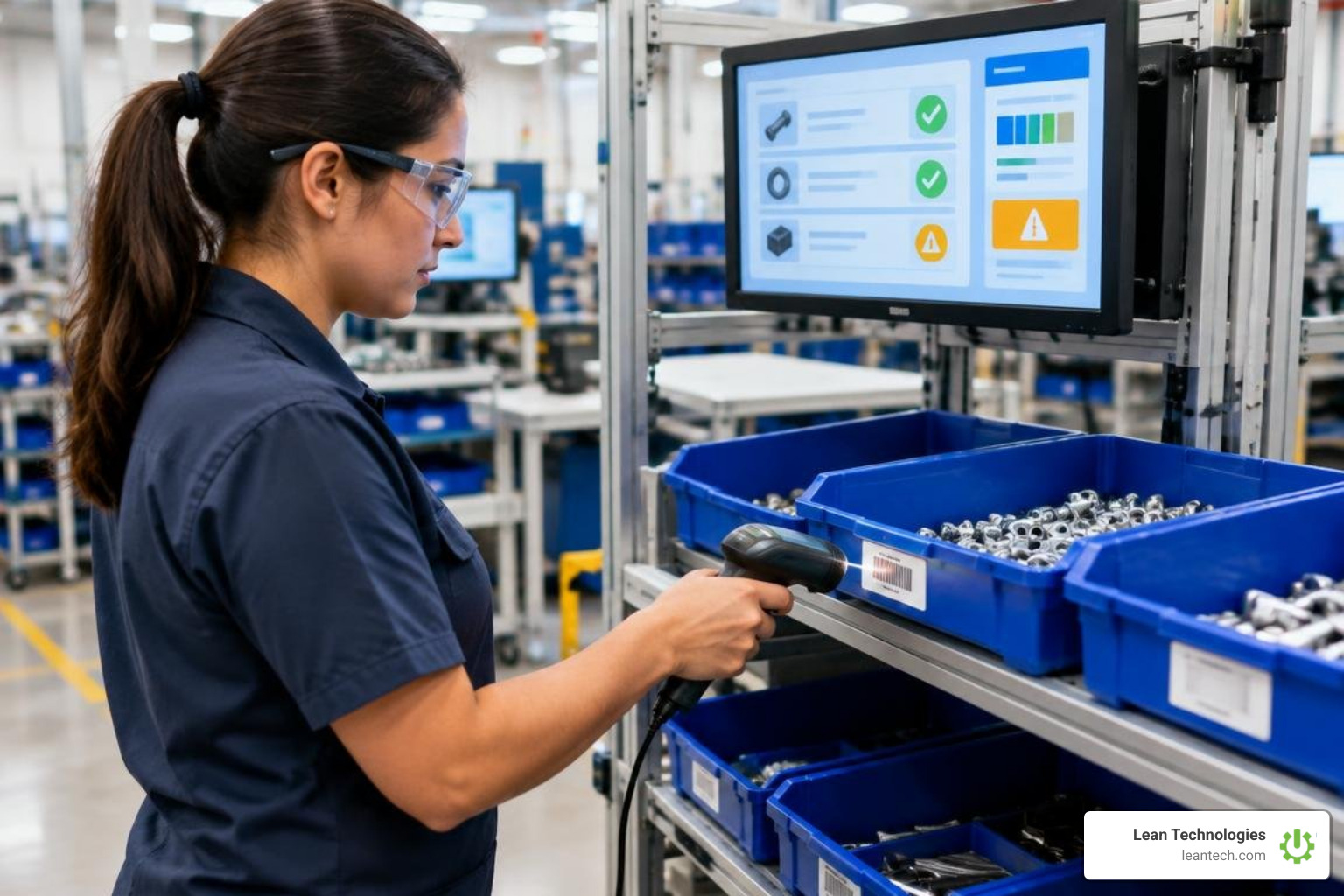
Transforming inventory control requires combining practical shopfloor tools with proven optimization logic. Rather than deploying overly complex automation for its own sake, lean practitioners select tools that directly support visual management, error-proofing (Poka-Yoke), and flow. Understanding how digitalized lean inventory control reshapes modern manufacturing reveals how organizations merge operational disciplines with digital workflows and kanban system software to automate routine material replenishment.
Smart VMI, Mobile Counts, and Real-Time Pull Signals
High-performing manufacturing floors use focused digital workflows to eliminate manual tracking friction:
Vendor Managed Inventory (VMI) and Replenishment Workflows: Providing authorized suppliers with direct consumption visibility and establishing standardized staging buffers reduces excessive consumption by 15% to 25% through clear accountability and structured replenishment intervals. Consolidating ad-hoc purchase requests into regular scheduled orders drastically cuts transaction overhead.
Mobile Counting and Direct Digital Inputs: Replacing paper clipboards with dedicated mobile or tablet-based inventory entry allows operators to perform guided cycle counts up to 3x faster while catching discrepancies between theoretical system stock and physical bins immediately.
Digital First-In, First-Out (FIFO) and Batch Traceability: Digital logging of lot numbers and shelf-life expiration dates ensures operators rotate time-sensitive adhesives, resins, or perishable materials correctly, preventing scrap and resolving quality holds within minutes.
ABC/XYZ Segmentation and Dynamic Buffer Calculations
One-size-fits-all min/max inventory rules inevitably fail because different parts behave differently. Advanced lean inventory control combines ABC analysis (value contribution) with XYZ analysis (demand predictability):
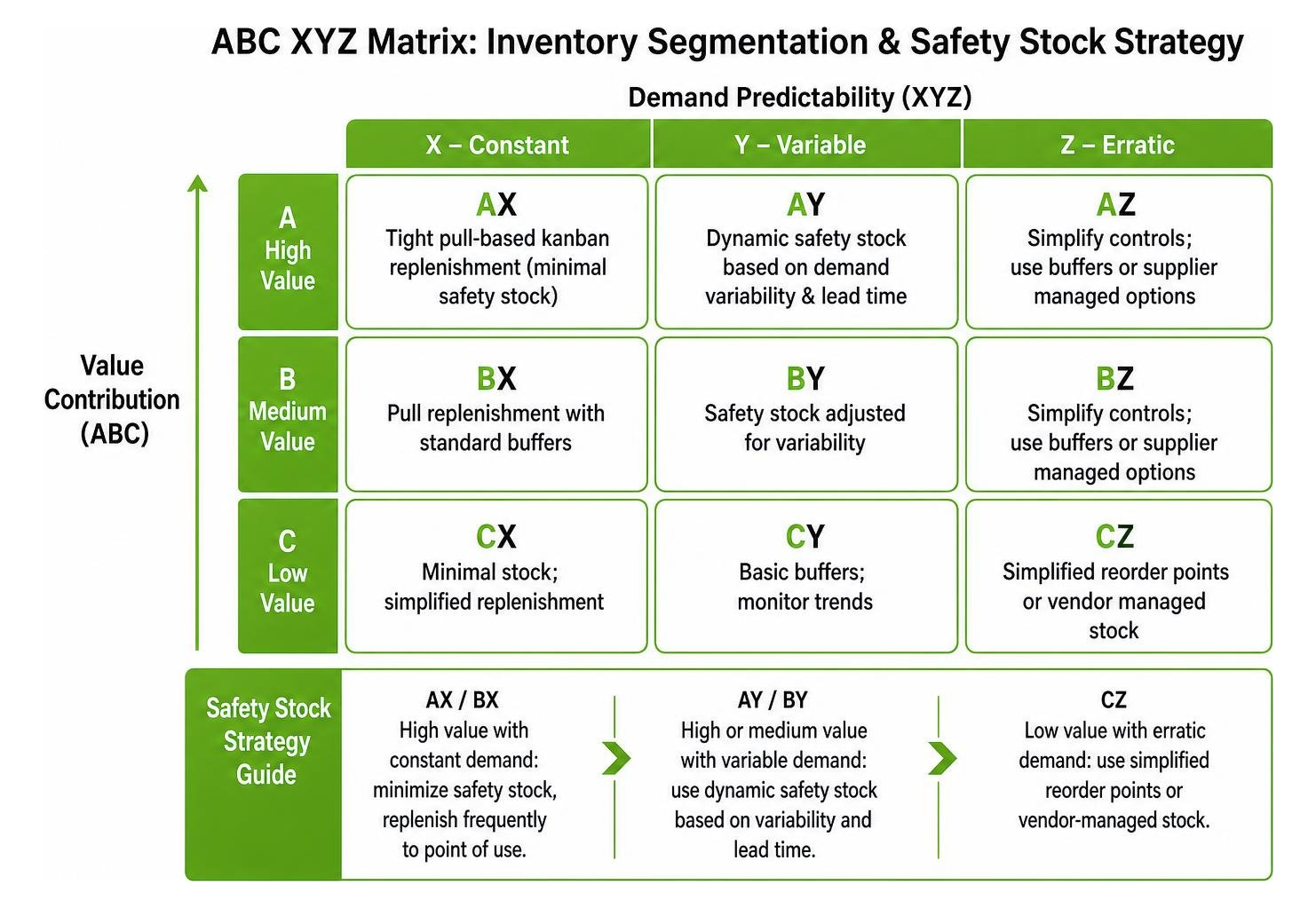
AX/BX Items (High Value, Constant Demand): Require tight, pull-based kanban replenishment, minimal safety stocks, and frequent deliveries directly to point-of-use bins.
AY/BY Items (High Value, Variable Demand): Require dynamic safety stock calculations that factor in supplier lead-time fluctuations and historical usage patterns.
CZ Items (Low Value, Highly Erratic Demand): Benefit from simplified visual reorder points or vendor-managed stock, avoiding complex forecasting calculations for low-cost hardware.
Reviewing a detailed lean inventory guide 2026 helps continuous improvement leaders set mathematically sound buffer sizes rather than relying on gut feel.
5 Steps to Implement Digital Lean Inventory Management
Deploying a digitalized lean inventory framework does not require a risky multi-year IT overhaul. It follows a structured, phased rollout focused on shopfloor reality. Following the digital lean manufacturing framework ensures the focus stays on standard work, employee adoption, and measurable waste reduction.
Step 1: Map Physical Workflows and Identify Data Capture Points
Begin on the shop floor (the Gemba). Map the physical path that raw materials, work-in-progress (WIP), maintenance spare parts, and finished goods travel through the facility:
Identify where materials sit idle, where operators experience transit delays, and where inventory transactions are currently recorded on paper logs or physical travelers.
Define exact point-of-use capture points where operators or material handlers can log part consumption, scrap, or transfers directly using tablets or mobile interfaces.
Identify process bottlenecks, high-scrap operations, and stockrooms prone to inventory inaccuracies.
Step 2: Establish Dynamic Reorder Points and Buffer Logic
Next, replace static reorder points with dynamic calculation models:
Base buffer parameters on actual lead times, supplier on-time delivery metrics, and production consumption rates.
Establish minimum-maximum intervals that alert supervisors when inventory reaches warning thresholds, before a hard stockout stops the line.
Establish distinct inventory segments so critical assembly parts have tighter buffer policies than generic consumables.
Step 3: Run What-If Simulations to Balance Working Capital and Availability
Before updating production parameters in your operational planning schedules, evaluate the trade-offs:
Model the impact of reducing batch sizes or safety stock buffers against historical demand spikes to ensure target service levels remain stable.
Calculate the working capital released against potential stockout risks.
Validate proposed reorder adjustments across cross-functional teams (production, purchasing, quality) before changing standard execution routines.
Step 4: Connecting Shop Floor Execution to Digitalized Lean Inventory Control
Roll out intuitive, digital standard work to machine operators and material handlers:
Equip team members with role-based mobile or tablet interfaces that allow rapid logging of material issues, stock variances, and maintenance part usage right at the source.
Standardize root-cause problem solving by enabling operators to log why an inventory adjustment occurred (e.g., supplier defect, improper handling, machine jamming).
Set clear accountability: assign digital action items and corrective tasks directly to maintenance leads, continuous improvement coordinators, or material planners.
Step 5: Integrate Operational Data with Existing ERP Systems
Complete the loop by creating a structured handoff between shopfloor operational execution and corporate financial systems:
Maintain your existing ERP as the central system of record for financial ledgers, purchase orders, and global MRP calculations.
Use the digital lean execution layer to organize day-to-day shopfloor events (variance reporting, scrap tracking, standard work verification).
Feed clean, verified operational actions back into your ERP via standard integration points (REST APIs, CSV/EDI batch transfers), ensuring that purchasing decisions are based on what is physically happening on the line.
Measurable Outcomes and Long-Term Value Creation
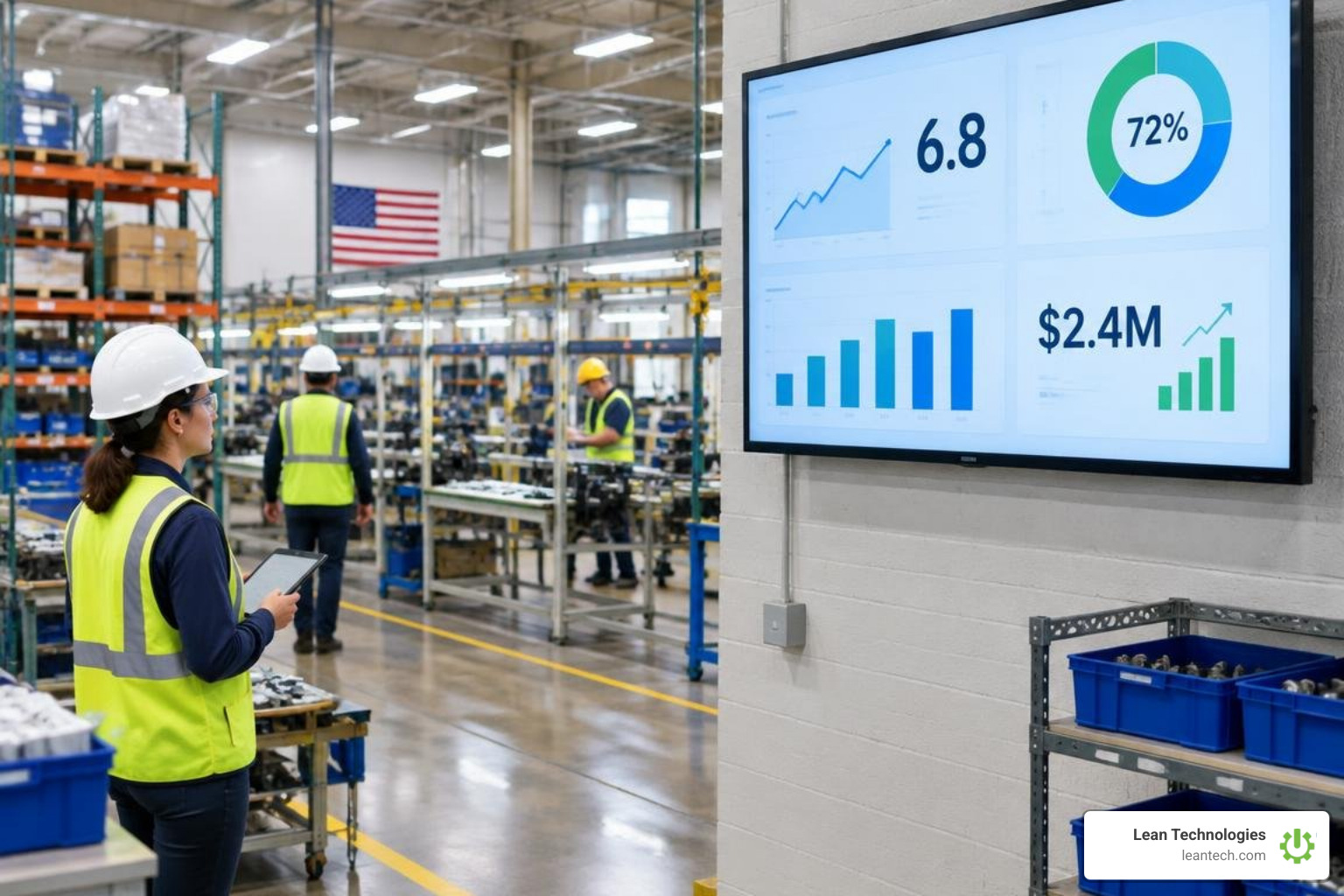
Digitizing lean inventory workflows delivers rapid, quantifiable improvements across production, supply chain, and administrative functions. Tracking these performance metrics through a structured continuous improvement guide 2026 helps organizations maintain momentum and sustain their operational gains over time.
Expected Reductions in Excess Stock, Lead Times, and Labor
Facilities that transition from manual spreadsheets and static ERP buffers to active, source-captured inventory management routinely achieve measurable operational benchmarks:
20% to 30% Reduction in Excess Inventory: By eliminating obsolete buffer stock through dynamic safety stock sizing and clear ABC/XYZ segmentation, plants free up significant working capital.
10% to 20% Reduction in Storage and Holding Costs: Streamlined inventory levels directly reduce warehouse footprint requirements, off-site storage rentals, and the carrying costs associated with damaged or expired materials.
5% to 15% Improvement in Service Levels and Line Availability: Early warning alerts for low-stock conditions prevent line shutdowns and eliminate frantic, premium-freight expediting.
Up to 4 Hours of Manual Work Saved per Week per Planner: Automating manual cycle counting, eliminating paper data transcription, and prioritizing replenishment recommendations gives planners and supervisors time back to focus on root-cause problem solving.
Scaling Continuous Improvement Across Multi-Site Operations
As manufacturing enterprises scale across multiple plants, maintaining standard inventory practices becomes increasingly challenging without a unified digital framework. A digitalized execution platform establishes standard work across diverse facilities, allowing management to compare inventory velocity, track continuous improvement projects, and share best practices across plants.
Thrive by Lean Technologies provides small to midsize manufacturers with a practical, modular toolbox to digitize lean work routines. Thrive is not an ERP or MES, and it does not replace existing ERP or MES systems. Instead, it works alongside them as a flexible execution layer that helps operators, maintenance technicians, and supervisors log issues, track actions, and drive continuous improvement. By giving teams a straightforward tool to log operational events, assign action items, and manage shift handoffs, Thrive ensures shopfloor discipline remains strong without adding complex administrative burdens.
Frequently Asked Questions About Lean Inventory Digitization
How does digital lean inventory control differ from traditional JIT?
Traditional Just-In-Time (JIT) relies on physical visual controls (like paper kanban cards or designated floor squares) that function only within line-of-sight and struggle when demand or lead times fluctuate unexpectedly. Digitalized lean inventory control retains the pull-based, waste-elimination focus of JIT but enhances it with direct-at-source digital logging, dynamic safety stock formulas, and instant communication across departments, preventing phantom shortages and delayed replenishment.
Can digital lean inventory control work without replacing our current ERP?
Yes. Modern digital lean systems operate alongside your current ERP rather than replacing it. The ERP remains the financial system of record, while the digital lean tool acts as the execution layer on the shop floor. Operators and supervisors use the mobile or tablet interface to track daily actions, log variances, and manage workflows at the machine, feeding accurate data back to the core ERP.
How quickly can a manufacturer realize ROI from digitizing inventory workflows?
Most manufacturing plants see measurable returns within 60 to 90 days. Rapid wins typically stem from eliminating administrative purchase order processing overhead, reducing operator walk-and-wait time for parts, identifying scrap causes faster, and preventing stockout-related production downtime.
What to Do Next
Transitioning to digitalized lean inventory control does not require an enterprise-wide system overhaul or months of custom software development. It starts by targeting friction points on your current shop floor: eliminate paper count sheets, replace static buffer parameters with dynamic rules, and give your teams an intuitive way to log issues and trigger actions at the source.
To take the next step in modernizing your production and inventory workflows:
Conduct a Shopfloor Inventory Audit: Walk your lines to identify where operators experience waiting time for parts, where physical buffers mismatch ERP balances, and where paper travelers cause administrative lag.
Standardize Work Routines: Establish clear ABC/XYZ segmentation for critical production components and define structured daily deviation reviews.
Explore Practical Shopfloor Tools: Learn how a modular, shopfloor-focused platform can support your team's daily standard work by exploring digital lean manufacturing solutions.
By combining sound lean thinking with responsive digital execution, your operations will reduce working capital, protect production uptime, and build a culture of continuous improvement across every shift.