
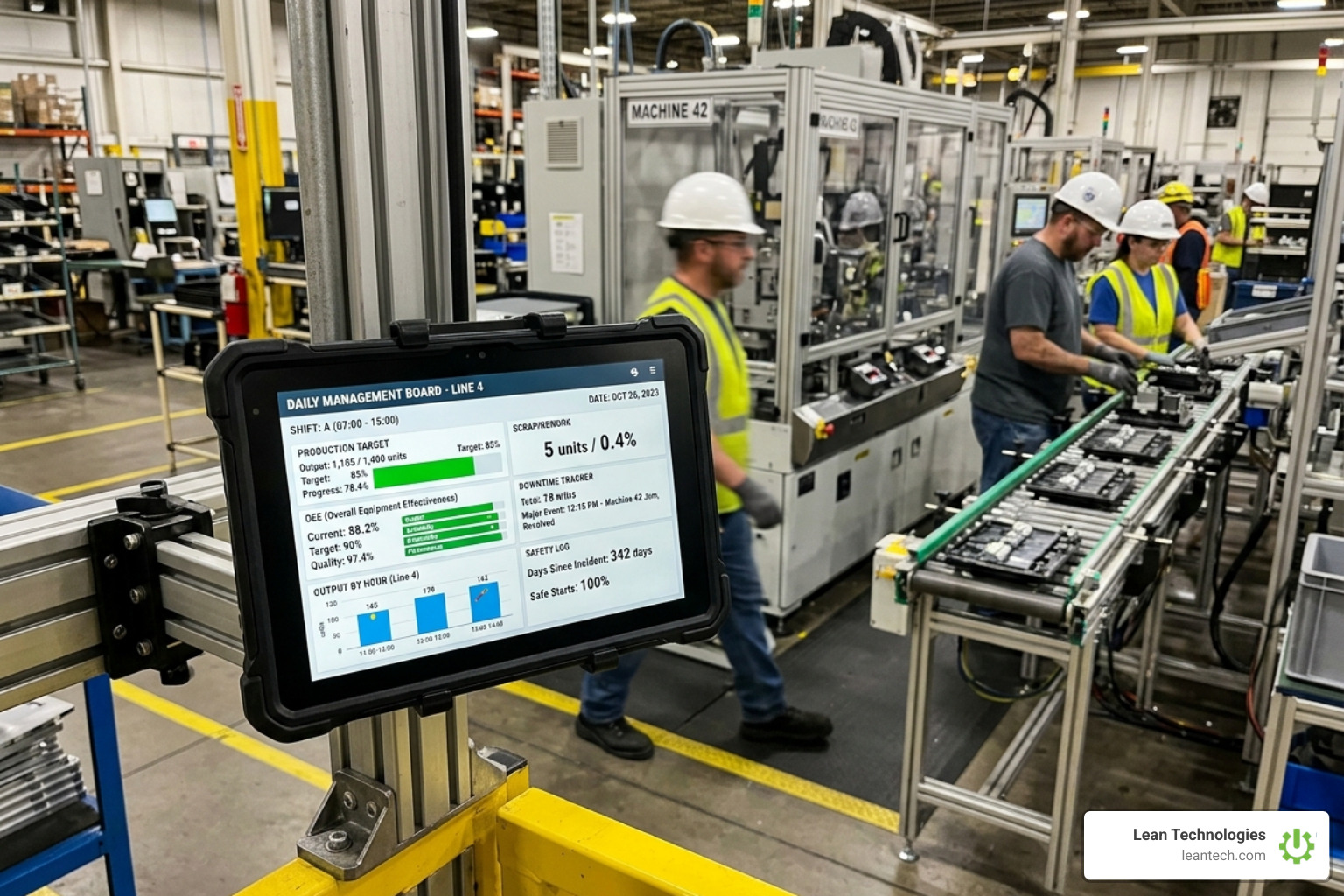
Why Your Lean Strategy Needs a Digital Upgrade
What is Digital Lean Management?
At its core, digital lean management is the evolution of the Toyota Production System for the modern era. Often referred to as Lean 2.0, it integrates the foundational principles of waste elimination and continuous improvement with the power of Industry 4.0 technologies.
While traditional Lean relies on the "Go to Gemba" philosophy—physically walking the floor to see problems—Digital Lean provides a "Digital Gemba." It uses IoT sensors, mobile applications, and cloud-based dashboards to provide a high-definition view of operations that was previously impossible. According to the Center for Lean Excellence, this fusion allows organizations to achieve results that neither Lean nor digital projects could reach on their own.
By creating a data-driven culture, companies move away from "gut feel" decision-making. Instead of arguing over whose version of an Excel sheet is correct, teams look at a single source of truth. This transparency empowers operators to own their data and supervisors to manage by exception rather than micromanaging every minute of the shift.
Traditional Lean vs. Digital Lean Management
The difference between traditional and digital lean management isn't just about swapping a whiteboard for a TV screen; it’s about the speed and quality of the information.
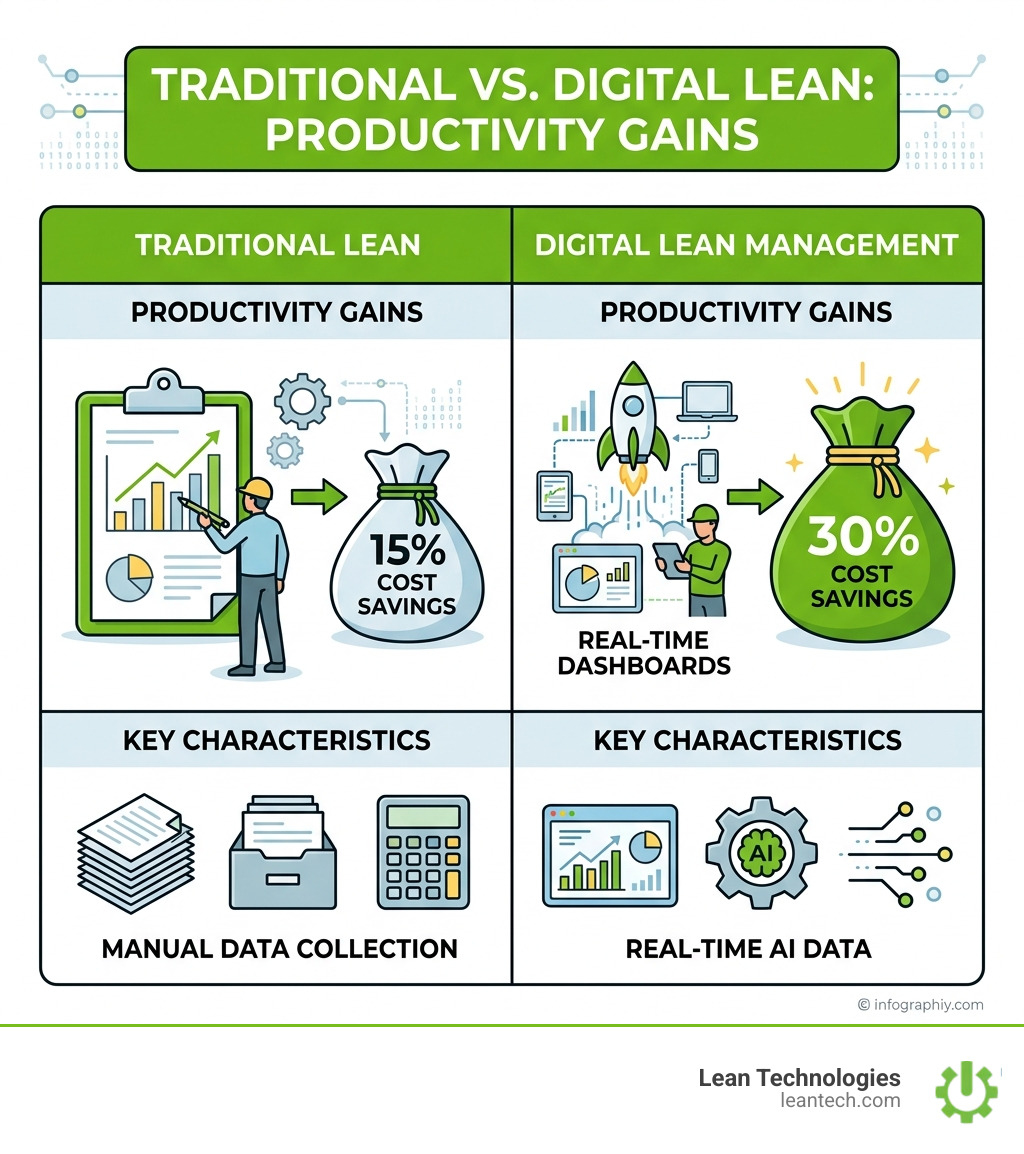
Manual Tracking vs. Real-time Visibility: In a traditional setup, an operator might log a machine jam on a paper sheet. That sheet sits in a folder until the end of the shift, is entered into a spreadsheet the next morning, and reviewed by a manager three days later. With a Guide To Digital Lean Manufacturing, that jam is logged on a tablet instantly. The supervisor gets a notification, and the downtime is categorized automatically.
Paperless Operations: Digital systems eliminate the "paper trail" that often leads to nowhere. Centralized digital storage ensures that historical data is actually accessible for trend analysis, rather than gathering dust in a filing cabinet.
Collaboration: Traditional Lean can suffer from "silos" where the morning shift doesn't know what the night shift struggled with. Digital tools ensure that notes, photos, and shift handovers are visible to everyone, everywhere, in real time.
The Role of AI in Augmenting Lean Practices
AI isn't just a buzzword in manufacturing; it’s the "brain" that makes Lean tools proactive instead of reactive. According to Deloitte Insights, AI and machine learning are the new vanguards of the shop floor.
Predictive Maintenance: Instead of waiting for a machine to break (reactive) or changing parts based on a calendar (preventive), AI analyzes vibration and temperature data to predict exactly when a failure will occur.
Automated Root Cause Analysis: AI can sift through thousands of data points to find correlations humans miss. For example, it might notice that defect rates spike only when a specific raw material batch is used on a high-humidity day.
Copilot Agents: Modern platforms now use AI agents to analyze a Skills Matrix. If a bottleneck occurs, the AI can instantly identify which available operators have the right certifications to jump in and help, or even auto-generate a training plan to close the gap.
The ROI of Upgrading Your Lean Strategy
The business case for digital lean management is backed by heavy-hitting numbers. Research shows that while traditional Lean projects might save 15% on costs, digital Lean can push that number to 30%.
For a mid-sized manufacturer, a full digital transformation is expected to generate an annual EBITDA improvement of roughly $20 million. Beyond the big-picture financials, the day-to-day metrics are just as impressive: a 15% reduction in cost per line and an 11% annual improvement in Overall Equipment Effectiveness (OEE).
Eliminating the 8 Wastes with Digital Lean Management
Lean practitioners live by the TIMWOODS acronym (Transportation, Inventory, Motion, Waiting, Overproduction, Over-processing, Defects, and Skills). Digital tools target these wastes with surgical precision.
Overproduction: By connecting production data directly to customer demand, you avoid building "just in case" inventory that eats up cash flow.
Motion and Transportation: Using Equipment Asset Tracking, you can see if fork trucks are taking inefficient routes or if operators are walking too far to find tools.
Underutilized Talent: This is the "8th Waste." Digital Workflow Tracking frees up your smartest people from manual data entry and "spreadsheet gymnastics," allowing them to focus on actual problem-solving.
Improving OEE and Quality Control
When data is entered at the source—on the shop floor, in real time—quality improves instantly. Instead of finding 500 defective parts at the end of a run, a digital system can trigger a "stop ship" alert the moment the first three defects are logged.
Integrating a digital cmms ensures that Planned Maintenance isn't just a checkbox, but a data-driven strategy. When maintenance technicians have digital SOPs and history at their fingertips, Mean Time to Repair (MTTR) drops, directly boosting your OEE scores.
Digitizing Your Lean Toolset for Real-Time Action

Visual management is the heartbeat of Lean. But a physical board is only useful if you are standing right in front of it. Digital lean management takes these tools and makes them accessible from the breakroom, the front office, or a tablet on the line.
Digital Kanban: Tools like a Kanban Board Tool allow for dynamic scheduling. If a part is delayed, the board updates for everyone instantly, preventing the "waiting" waste.
Tiered Meetings: Digital Performance Goal Boards allow for seamless escalation. An issue identified in a Tier 1 (operator) meeting can be "pushed" to the Tier 2 (supervisor) board with one click, ensuring accountability doesn't get lost in an email chain.
SQCDP Boards: Safety, Quality, Cost, Delivery, and People (SQCDP) tracking becomes automated. Instead of a supervisor coloring in a box with a red marker at the end of the day, the box turns red the moment a safety incident or quality defect is logged.
Digital Skills Matrix and Workforce Development
One of the biggest hurdles in manufacturing today is the skills gap. A paper-based skills matrix is almost always out of date. By using a digital version, you can perform a Lean Culture Assessment in real time.
Digital systems track who is trained on which machine and when their certifications expire. This "skills intelligence" allows production managers to staff lines based on actual competency, not just who showed up for work that day.
Standardizing Leader Standard Work
Operational excellence fails when leadership isn't consistent. Leader Standard Work (LSW) provides the framework for what leaders should be doing to support the floor.
Digitizing LSW means that Gemba walks aren't just "strolls." They become structured audits where leaders can log observations, take photos of issues, and assign corrective actions on the spot. This creates a closed-loop system where operators see that their problems are being heard and acted upon.
A Practical Roadmap for Digital Transformation
You don't need a $500,000 IT budget to start. The best approach is the "Think Big, Start Small, Scale Fast" model.
Think Big: Define what "winning" looks like for your plant. Is it a 10% jump in OEE? A 20% reduction in scrap?
Start Small: Choose one cell or one specific problem (like downtime logging) and digitize it. Use Project Management principles to ensure this pilot has clear goals.
Scale Fast: Once the team sees the value—and realizes the digital tool makes their job easier, not harder—roll it out to the rest of the facility.
Effective Change Management is critical here. If operators feel like the digital tool is "Big Brother" watching them, they will resist. If they see it as a tool that gets them the maintenance help they need faster, they will champion it.
Common Pitfalls and How to Avoid Them
Why do 70% of digital transformations fail? Usually, it’s because the company bought expensive software without fixing their broken processes first.
Technology-First Bias: Don't buy a tool just because it has "AI" in the name. Buy a tool because it solves a specific shop floor pain point.
Lack of Data Culture: If your team doesn't trust the data, they won't use it. Ensure your Project Tracking involves the people actually doing the work.
Near-Term Focus: Digital Lean is a journey, not a one-time event. It requires ongoing commitment to data quality and process discipline.
Integrating Digital Lean Across Industries
While born in automotive, digital lean management is now a cross-industry powerhouse.
Pharmaceuticals: Companies have used digitization to move OEE scores from a dismal 37% to over 60% by identifying hidden bottlenecks in packaging lines.
Mining: Modern operations are replacing manual logs with ruggedized tablets to track equipment health in harsh environments.
Services: Banks and hospitals use digital Kanban and Digital Lean Management - AI applied to Management to streamline document workflows and patient flow, reducing wait times by 30%.
Frequently Asked Questions about Digital Lean
Is digital lean management only for large-scale manufacturers?
Absolutely not. In fact, small to midsize manufacturers often see the fastest ROI because they are more agile. Digital tools allow smaller teams to punch above their weight by automating the administrative "grunt work" that usually requires a large overhead staff.
How does digital lean differ from a standard MES or ERP?
Think of your ERP as the "system of record" for finances and orders. An MES is the "system of execution" for production. Digital Lean (like Thrive) is the "system of improvement." It sits on top of these systems to help your people actually solve the problems the other systems merely report. It’s flexible, user-friendly, and built for the person wearing steel-toed boots, not just the IT department.
What are the first steps for a beginner in digital lean?
Start with your biggest headache. If it's downtime, digitize your downtime logs. If it's quality, digitize your scrap sheets. Use a simple platform that doesn't require weeks of coding. Once your team sees that "real-time beats real-late," the momentum will carry the rest of the transformation.
In Summary
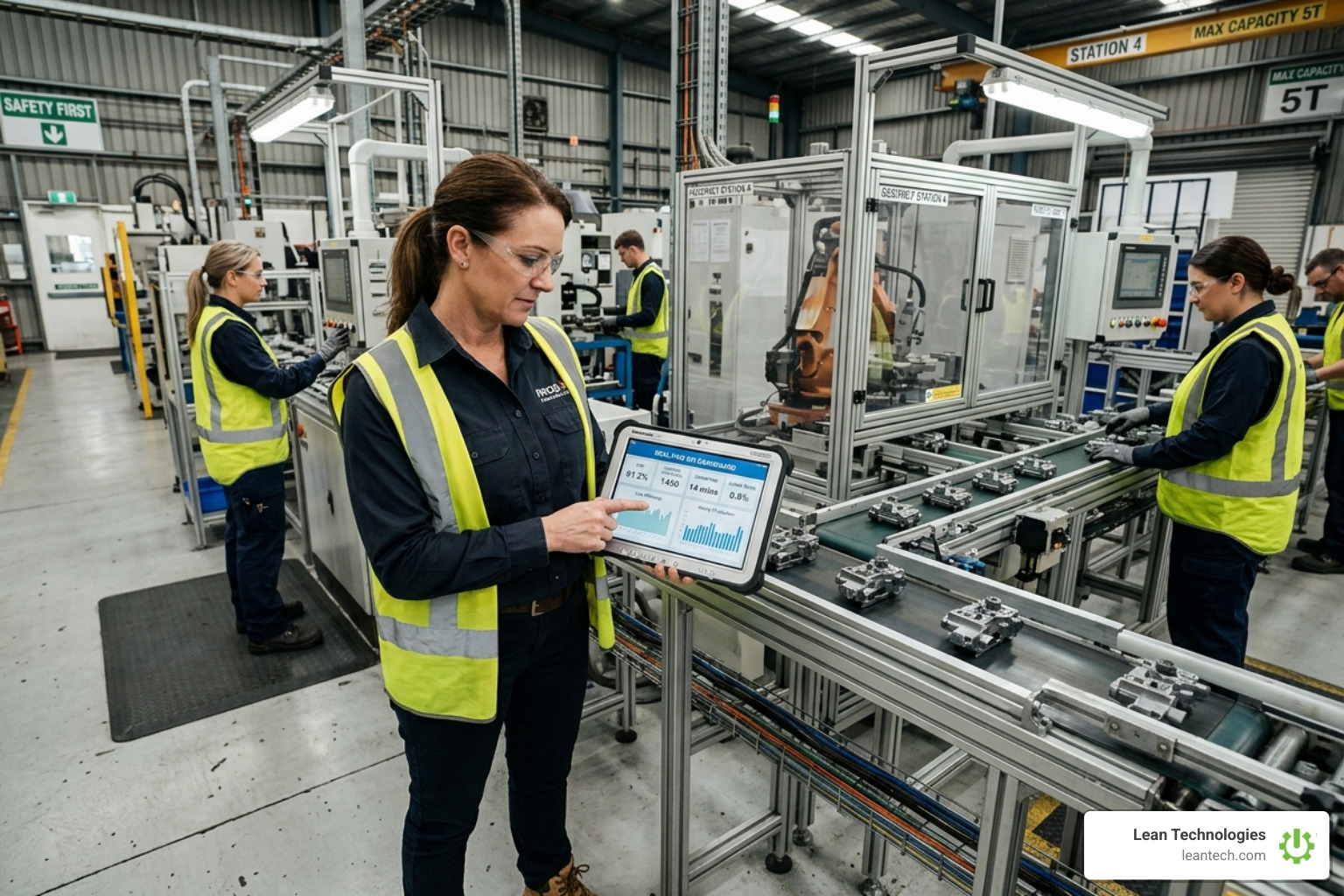
The days of managing a multi-million dollar manufacturing facility with a dry-erase marker and a prayer are over. Digital lean management isn't a luxury; it's a survival requirement in a world of fluctuating supply chains and labor shortages.
At Lean Technologies, we built Thrive because we are manufacturing experts who were tired of seeing great Lean strategies die in a messy spreadsheet. Thrive is a customizable, all-in-one shopfloor software designed to give you real-time visibility without the "real-late" headaches of traditional data entry.
Stop managing your shop floor through spreadsheets and wishful thinking. Let your team run lean with a platform that actually works as hard as they do. When your processes are structured and your data is entered at the source, operational excellence isn't just a goal—it’s your new reality.