The Ultimate Software Guide to Boost Your Manufacturing Throughput
Your Shop Floor Is Losing Output Right Now — Here Are the Tools to Fix It
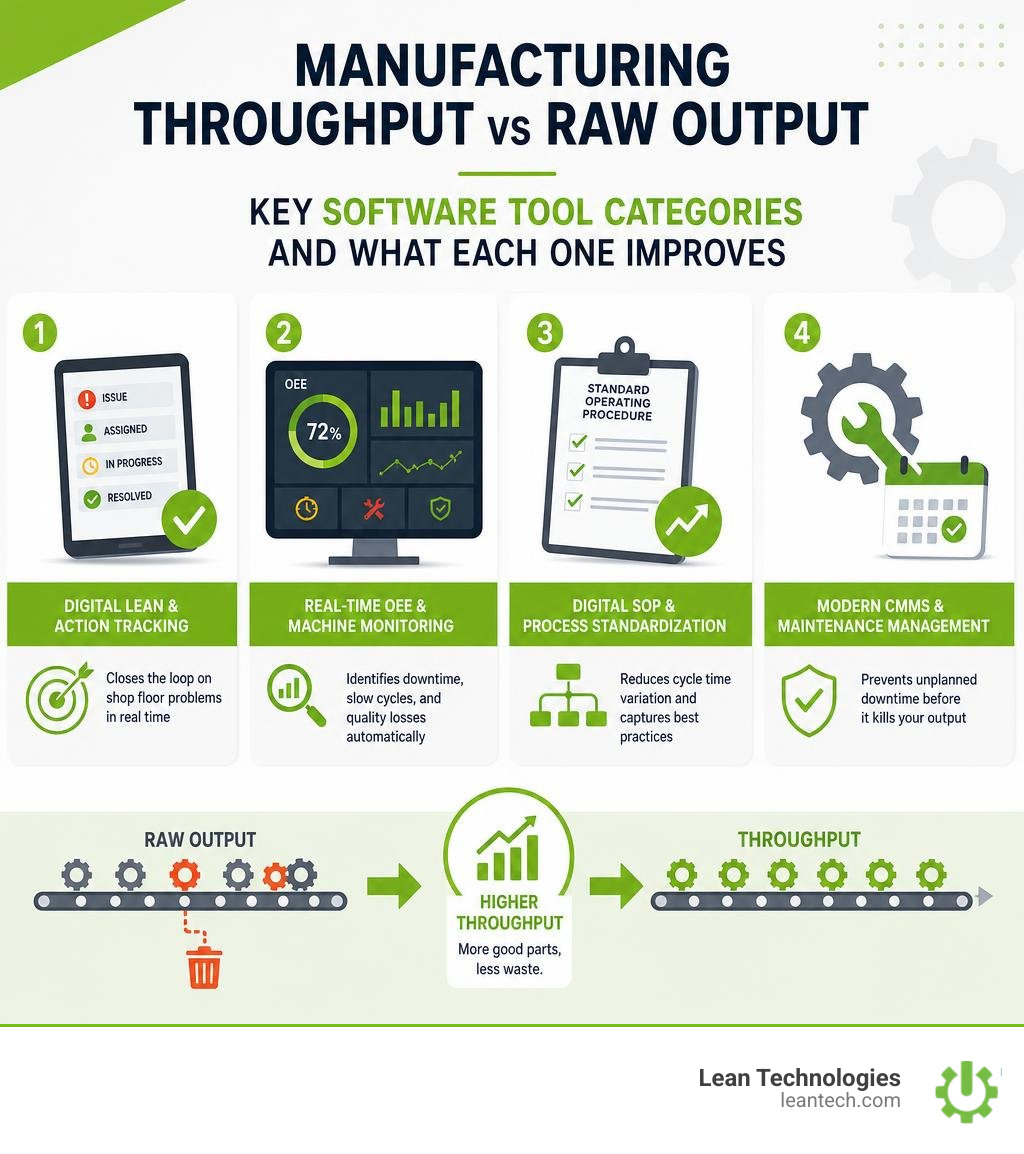
The best manufacturing throughput improvement tools available in July 2026 include:
Digital lean and action-tracking software (e.g., Thrive CI) — closes the loop on shop floor problems in real time
Real-time OEE and machine monitoring platforms — identify downtime, slow cycles, and quality losses automatically
Digital SOP and process standardization tools — reduce cycle time variation and capture best practices across shifts
Modern CMMS and maintenance management software — prevents unplanned downtime before it kills your output
Here's a hard truth most operations managers already feel in their gut: a typical two-shift factory runs fully productive only 48% of the time. That means more than half your available hours are quietly bleeding capacity — through small stops, slow cycles, scrap, rework, and communication gaps nobody logged in time to fix.
The problem isn't effort. Most shop floor teams work hard. The problem is visibility — or the lack of it.
When defects get written on paper, shift notes sit in a binder, and bottlenecks only get reported at the end of the week, the data is already too late to act on. By the time a production manager sees the numbers, the damage is done, and the opportunity to course-correct is gone.
Real-time beats real-late. Every time.
That's why more manufacturers are replacing manual reporting and disconnected spreadsheets with purpose-built digital tools that give frontline teams — operators, supervisors, and CI leads — the visibility they need to catch problems as they happen, not after the shift ends.
This guide breaks down the top software categories and specific tools that help manufacturing operations managers do one thing: get more accepted parts out the door from the same people, equipment, and floor space they already have.
Why Throughput is the Ultimate Metric for Shop Floor Profitability
Many plant managers mistake raw output for throughput. They are not the same. Raw output counts everything that rolls off the line, including the parts destined for the scrap bin or the rework station. Throughput, however, only counts good, accepted products that successfully pass through the system and are ready to ship to the customer.
Focusing purely on raw output is a fast track to high operating costs and hidden waste. For instance, if a machine produces 500 parts per hour but suffers from a 10% rejection rate, it is wasting 50 parts every hour. Over an 8-hour shift, that is 400 wasted parts. The factory spent energy, raw materials, and labor on 400 parts that cannot be sold. By utilizing proper strategies from the 6 Ways to Improve Manufacturing Throughput , such as identifying quality defects at the source, cutting that rejection rate to 5% instantly adds 200 salable parts per shift back to the bottom line without speeding up the machines by a single RPM.
Throughput directly drives profitability because it exposes the true efficiency of your assets. This is where Overall Equipment Effectiveness (OEE) and capacity utilization come into play. A world-class OEE benchmark is generally considered 85% or higher, yet the average factory hovers closer to 60%. Meanwhile, the average capacity utilization in the United States remains around 79%. The gap between where your factory sits and where it could be represents pure, untapped profit.
The financial cost of ignoring these gaps is staggering. According to industrial surveys, unplanned downtime costs fast-moving consumer goods (FMCG) manufacturers around $36,000 per hour. In the automotive industry, that number skyrockets to a massive $2.3 million per hour. When a critical machine goes down, every minute spent searching for the right technician or waiting for paper-based work orders to clear is money vaporized.
By tracking throughput metrics in real time, shop floor teams can isolate availability, performance, and quality losses immediately. Instead of reacting to a bad shift report on Monday morning, supervisors can spot a downward trend in throughput rate at 8:15 AM and deploy corrective actions before the morning coffee break.
How to Evaluate and Improve Manufacturing Throughput Tools
Choosing the right manufacturing throughput improvement tools requires a clear, practical strategy. Throwing expensive software at a broken, disorganized process will not fix your shop floor. In fact, it usually just digitizes the chaos.
To avoid this trap, operations managers must evaluate software based on three critical pillars:
Integration Requirements: Does the tool play nicely with your existing tech stack? You do not need to rip and replace your Enterprise Resource Planning (ERP) or Manufacturing Execution System (MES). The best throughput tools act as a flexible digital layer that connects to your existing SCADA, PLC, or historian systems, translating raw data into actionable front-line tasks.
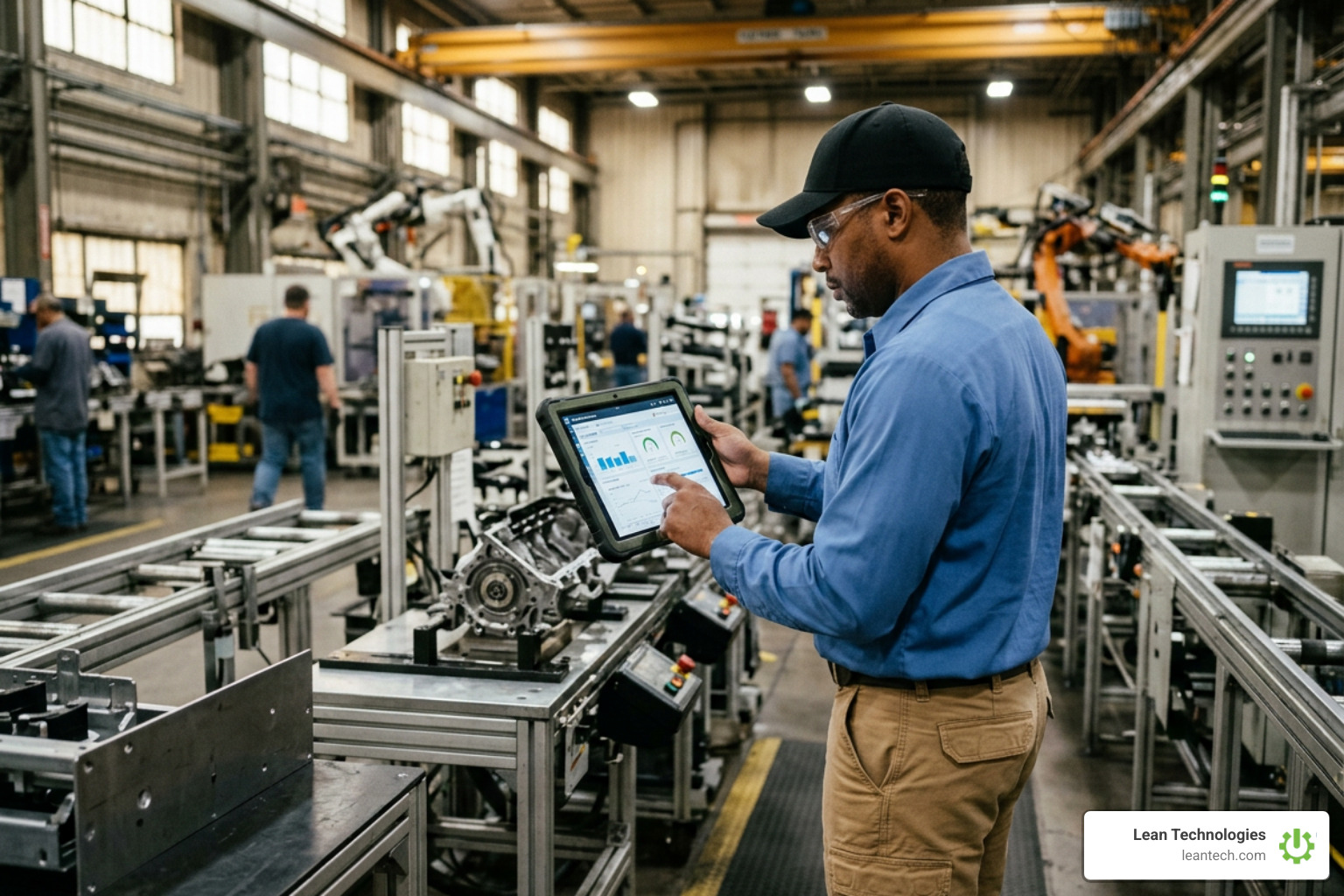
Frontline User Adoption: If your operators find the software difficult to use, they will "pencil-whip" the entries or ignore the tool entirely. Frontline workers need clean, simple interfaces—ideally accessible via rugged tablets or mobile devices right at their workstations.
Data Accuracy (The "Garbage In, Garbage Out" Rule): Automated systems are only as good as the context surrounding their data. If a machine monitoring system flags a stop but cannot capture why it stopped, the data is functionally useless for continuous improvement. The software must make it effortless for operators to add context in real time.
When deploying digital solutions, the goal is to build a structured environment where frontline insights flow naturally to the management team. To understand how to design these digital workflows without overcomplicating your IT architecture, read our comprehensive Guide to Digital Lean Manufacturing.
By combining real-time machine data with human-entered context, modern digital tools help manufacturers improve manufacturing throughput by automating bottleneck analysis and normalizing production losses into a single, standardized metric of lost time. This standardized view allows plant managers to benchmark performance across multiple lines or even different manufacturing sites, making it obvious where capital expenditures should be allocated to drive the highest return on investment.
The Top Software Categories to Maximize Your Production Output
To help you navigate the landscape of throughput software, here is a breakdown of how manual tracking compares to modern digital solutions:
Tracking Method Core Focus Operator Effort Time to Action Impact on Throughput Whiteboards & Paper Logs Historical recording of hourly counts and downtime High manual effort, prone to errors and "pencil-whipping" End of shift or end of week (Real-late) Minimal; only useful for post-mortem analysis Real-Time OEE & Machine Monitoring Automatic tracking of machine states and cycle times Low effort; direct connection to PLCs and sensors Instantaneous alerts for down machines Moderate; highlights where the issues are but doesn't track who is fixing them Modern CMMS Platforms Managing preventive maintenance and repair work orders Medium effort; technicians log work on mobile devices Minutes; direct dispatch to maintenance techs High; keeps critical bottleneck equipment running consistently Digital Lean & Action-Tracking (Thrive) Connecting frontline teams, logging issues, and closing the loop Low-to-medium; operators log problems in seconds on tablets Real-time structured workflows (Real-time) Very High; drives immediate accountability and continuous improvement
1. Digital Lean and Action-Tracking Software: The Best Improve Manufacturing Throughput Tools for Frontline Teams
If you want to make a permanent dent in your throughput metrics, you have to empower the people who actually touch the product. The most effective improve manufacturing throughput tools do not just monitor machines—they organize human action.
This is where a digital lean execution platform like Thrive shines. Thrive is not an ERP or an MES. It is a flexible, highly customizable digital toolbox built specifically for operators, supervisors, and continuous improvement (CI) managers who are tired of managing their shop floors through dry-erase boards and wishful thinking.
When an operator spots a recurring quality defect or a minor mechanical issue, they cannot wait for the next weekly meeting to bring it up. With a digital Kanban Board Tool, the operator can log the issue on a tablet in less than ten seconds. This action instantly triggers a visual card on a shared digital board, notifying the shift supervisor and the maintenance team.
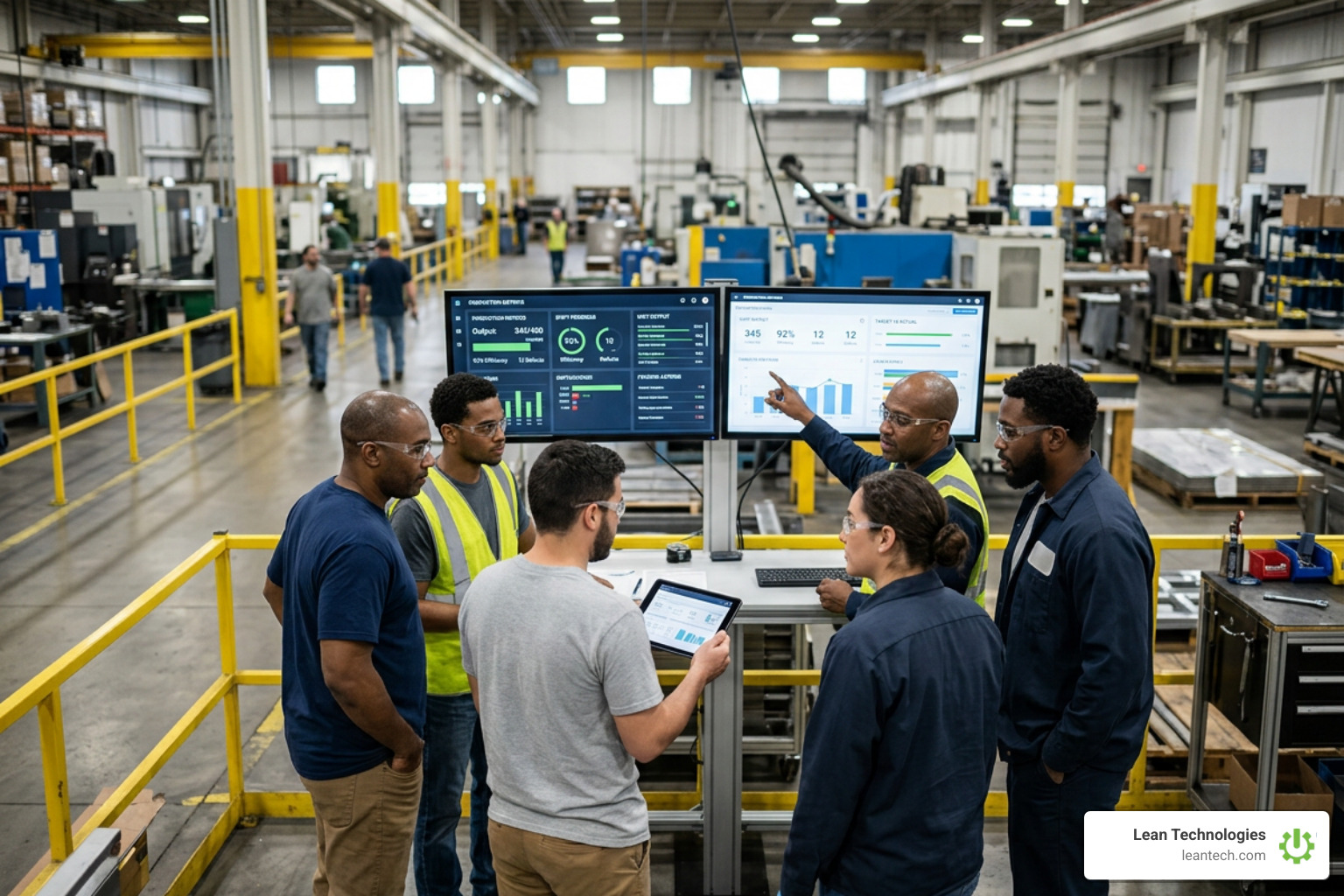
Instead of letting problems get lost in translation, teams use digital Workflow Tracking to assign tasks, set deadlines, and track the progress of every corrective action. This structured accountability ensures that small, daily headaches on the line do not turn into major, multi-hour downtime events.
For CI leaders who struggle to prove the ROI of their initiatives, the Thrive CI module provides a single source of truth. It tracks every single improvement idea from submission to completion, linking frontline problem-solving directly to throughput gains. When operators see that their suggestions are actually acted upon and resolved, it builds a culture of ownership that drives long-term operational excellence.
2. Real-Time OEE and Machine Monitoring: Data-Driven Tools to Improve Manufacturing Throughput
To achieve consistent throughput, you must understand exactly how your equipment is performing second by second. Machine monitoring platforms connect directly to machine PLCs and sensors to automate the collection of production data.
Historically, operators had to manually log every time a machine stopped. This led to inaccurate data, as busy workers naturally grouped micro-stops (stops lasting less than two minutes) into single, vague categories like "adjustments." However, micro-stops are often the hidden killer of cycle efficiency. If a packaging line stops for 30 seconds, twenty times an hour, that is ten minutes of lost production every hour—yet it rarely gets captured on a paper log.
By implementing automated machine monitoring, factories can gain up to 20% efficiency improvements through real-time visibility alone. These tools can automatically classify up to 80% of downtime events by reading PLC fault codes directly.
When you pair automated machine monitoring with a frontline action-tracking tool, you create a powerhouse for throughput optimization. The machine detects the stop and classifies the technical fault, while the operator uses a tablet to log the human context (e.g., "material quality issue from batch X"). This combined data gives CI teams the exact insights they need to eliminate recurring bottlenecks permanently.
3. Process Standardization and Digital SOP Tools
Process stability is the foundation of high throughput. If Shift A completes a changeover in 30 minutes, but Shift B takes 90 minutes, your throughput is at the mercy of the schedule. This variation is often driven by a reliance on paper-based Standard Operating Procedures (SOPs) that sit forgotten in binders, or tribal knowledge that leaves the building when senior operators retire.
Digital SOP tools solve this by delivering context-aware, visual work instructions directly to tablets at the workstation. Instead of reading a dry, text-heavy document, operators can watch 10-second video clips of the exact adjustment they need to make.
For highly complex, multi-variable industrial processes, advanced digital systems take process standardization to the next level. These systems analyze live and historical production data to model complex cause-and-effect relationships that are difficult for human operators to detect manually. By prescribing optimal machine setpoints in real time, they prevent process drift before it results in scrap or downtime. In specialized environments, this predictive optimization has been shown to reduce scrap rates by an average of 40%, directly boosting the volume of accepted parts moving through the line.
4. Modern CMMS and Maintenance Management Software
You cannot maintain high throughput if your critical machines are constantly breaking down. However, relying on reactive maintenance—waiting for a machine to break before fixing it—is incredibly expensive. Reactive maintenance typically costs three to nine times more than a structured preventive maintenance program, not to mention the chaotic scheduling conflicts and missed customer deadlines it causes.
Modern Computerized Maintenance Management Systems (CMMS) allow maintenance managers to transition from firefighting to proactive planning. Technicians use mobile CMMS apps to access work orders, check spare parts inventory, and view equipment history right at the machine. This dramatically reduces the Mean Time to Repair (MTTR). For example, some facilities have successfully reduced their MTTR from hundreds of hours down to double digits simply by digitizing their maintenance workflows and capturing tribal knowledge.
To keep maintenance goals aligned with production targets, leading plants integrate their CMMS with Project Management tools and highly visible Performance Goal Boards. This ensures that maintenance tasks are scheduled during planned windows of least business impact, protecting the facility's overall throughput.
If you are ready to stop reacting to equipment failures and start predicting them, explore our specialized solutions for Thrive Maintenance and learn how to build a reliable, high-uptime shop floor.
Best Practices for Deploying Throughput Software Without the Chaos
Deploying new improve manufacturing throughput tools does not have to be a painful, multi-month ordeal that disrupts your operations.
To ensure a smooth, successful rollout, follow these proven best practices:
Start Small, Scale Fast: Do not try to digitize your entire multi-plant network on day one. Pick one pilot line—ideally your primary bottleneck line where throughput improvements will have the most immediate financial impact.
Focus on Operator Buy-In: Involve your frontline operators from the very beginning. Explain why you are introducing the tool. Show them that the software is not there to micromanage them, but to make their lives easier by eliminating frustrating paper forms and fast-tracking their requests for support.
Assess Your Shop Floor Culture: Technology only works if your team is culturally ready to embrace transparency and continuous improvement. Before writing a check for software, run a Lean Culture Assessment to identify potential roadblocks in communication or accountability.
Keep Daily Huddles Action-Oriented: Use your new digital dashboards to run short, 10-minute stand-up meetings at the start of each shift. Focus on the red items on your digital Kanban boards, assign clear owners, and use the data to drive immediate action.
Frequently Asked Questions About Throughput Optimization
What is the difference between manufacturing throughput and raw output?
Raw output measures every unit your machines produce, regardless of quality. Throughput measures only the good, accepted units that successfully pass through your entire production process and are ready to be shipped to the customer. Reducing scrap and rework is the fastest way to increase throughput without needing to run your machines faster.
How do digital lean tools help reduce shop floor bottlenecks?
Digital lean tools replace slow, paper-based reporting with real-time issue logging and visual action tracking. When an operator spots a bottleneck or a quality issue, they can log it instantly on a tablet. This immediately alerts supervisors and maintenance, allowing teams to resolve the root cause of the slowdown in minutes rather than waiting for a weekly review meeting.
Can we improve throughput without buying expensive new machinery?
Absolutely. Most factories already own untapped capacity that they are losing to minor stops, slow cycles, and communication delays. By using digital tools to gain real-time visibility and streamline your frontline workflows, you can easily unlock 2% to 5% more production output from the exact same equipment, people, and floor space you already have.
In Summary: Stop Managing Your Shop Floor Through Spreadsheets
At the end of the day, manufacturing is a game of numbers. If you are still relying on paper logs, weekly spreadsheet updates, and end-of-shift post-mortems, you are leaving capacity—and profit—on your shop floor.
Real-time beats real-late.
By equipping your operators, supervisors, and maintenance technicians with the right improve manufacturing throughput tools, you transform your factory from a reactive environment into a self-optimizing, highly accountable operation.
Stop managing your shop floor through spreadsheets and wishful thinking. Let your team run lean, drive real-time accountability, and close the loop on daily production issues with the Thrive CI platform.
Ready to see how simple, expert-built digital lean tools can transform your operations? Visit Lean Technologies today to schedule a personalized demo and start unlocking your plant's true capacity.