
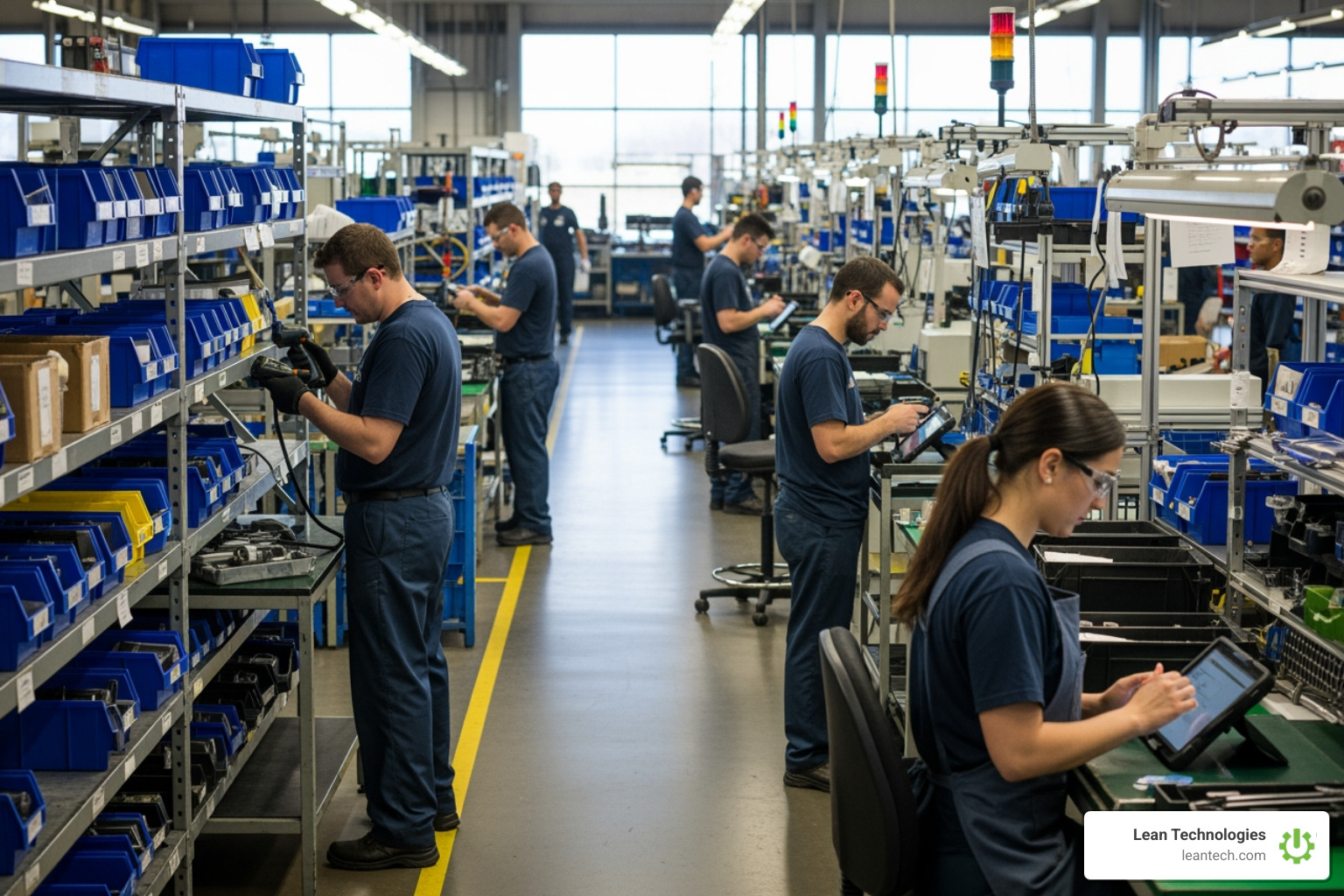
Precision in Production: Top Inventory Tools for the Shop Floor
The Hidden Cost of Not Knowing What's on Your Shop Floor
Inventory tracking shop floor systems are the difference between a production line that runs like clockwork and one that bleeds time, money, and opportunity every single shift.
Here's what operations managers should prioritize when evaluating digital tracking solutions in May 2026:
Capability | Why It Matters | Impact |
|---|---|---|
Real-Time Sync | Eliminates "end-of-shift" data lag | 100% visibility |
Mobile Scanning | Removes manual entry errors | 99%+ accuracy |
Offline Mode | Works in Wi-Fi dead zones | Zero downtime |
ERP Integration | Connects floor data to finance | Single source of truth |
Cycle Counting | No need to stop production | Continuous accuracy |
Think about this scenario for a second. Your team can't find a part. A picker spends 15 minutes searching. A work order stalls. A customer order slips. And nobody knows it happened until the end-of-shift report lands on your desk — hours too late to fix anything.
That's not a staffing problem. That's a visibility problem.
Manual systems — spreadsheets, clipboards, whiteboard tallies — don't just slow teams down. They create a dangerous gap between what's actually happening on the floor and what leadership believes is happening. According to Lean manufacturing principles, manufacturers who move from paper-based tracking to structured digital systems report 10–30% reductions in work-in-progress (WIP) inventory, with payback periods that typically run under 12 months.
The strategies covered in this guide are built specifically for shop floor realities — dead zones, fast-moving parts, operators without desks, and production schedules that don't wait for anyone.
Why Real-Time Inventory Tracking Shop Floor Systems are Non-Negotiable
In the manufacturing world of May 2026, "real-late" data is as good as no data. If an operator finishes a batch at 10:00 AM but the inventory isn't updated until the end of the shift at 5:00 PM, the system is lying to the production planner for seven hours. That’s seven hours of potential over-ordering, missed sales, or scheduling machines for jobs that don't have the materials ready.
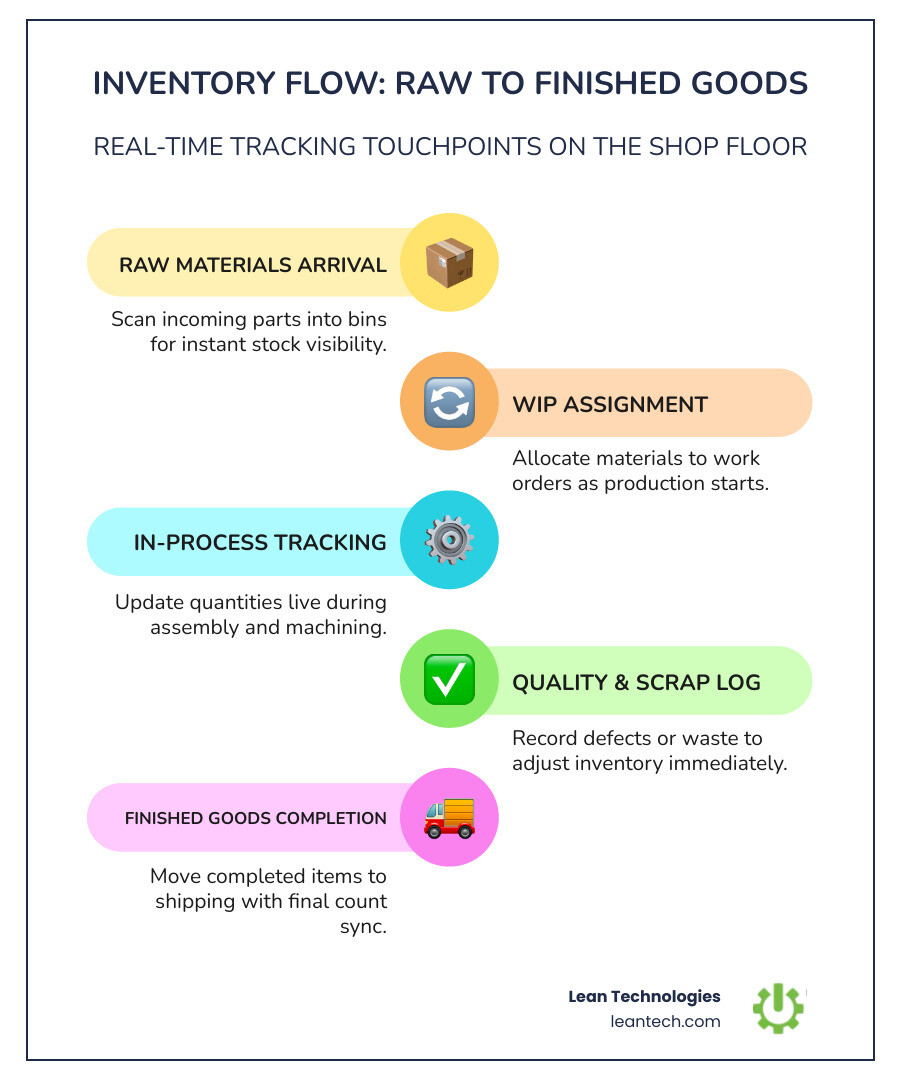
Implementing a robust system for inventory tracking shop floor operations isn't just about counting widgets; it’s about controlling the heartbeat of the factory. When visibility is live, the benefits cascade through the entire organization:
WIP Reduction: Transitioning from manual tracking to structured shop floor control typically results in a 10–30% drop in work-in-progress inventory. By knowing exactly where every sub-assembly sits, teams stop over-producing "just in case."
Scrap and Waste Reduction: Real-time tracking allows managers to spot quality trends immediately. If a specific lot of raw material is causing defects, the system flags it before the entire batch is ruined.
Labor Savings: A single picker spending 15 minutes looking for a misplaced item might seem small. But if five pickers do that once a shift, that’s over $90,000 a year in wasted labor costs just for "searching."
Stockout Prevention: Live production overviews allow procurement teams to see material levels drop in real-time, triggering reorders before the line goes dark.
Modern workflow tracking bridges the gap between the high-level planning of an ERP and the gritty reality of the production line. Industry 4.0 is no longer a luxury for the "big guys." Mid-market manufacturers are now using these tools to achieve a 12-month payback, primarily driven by reduced expediting costs and fewer production disruptions.
Key Features of Modern Shop Floor Inventory Management
What makes a shop floor tool different from a standard warehouse system? It’s the environment. A shop floor is chaotic, dirty, and fast. The software has to keep up.
Effective parts management on the floor requires a specific set of features:
Barcode and QR Scanning: This is the industry standard for accuracy. Manual entry has a 2-5% error rate, while scanning drops that to nearly zero. Whether it's raw materials arriving or finished goods leaving, every movement should be a "scan-and-go" event.
Bin Location Tracking: "Aisle 4" isn't specific enough. Modern systems use a standardized "Aisle-Bay-Shelf-Bin" format (e.g., A12-B3-02). This allows a new hire to find any item in 10 seconds instead of 10 minutes.
Audit Trails: Every movement needs a timestamp and a name attached to it. If inventory goes missing, you don't need a "whodunnit" mystery; you need a digital log.
Offline Functionality: Many plants are essentially giant Faraday cages where Wi-Fi goes to die. Software must allow operators to scan in "dead zones" and sync automatically once they're back in range.
Mobile Technology and Inventory Tracking Shop Floor Accuracy
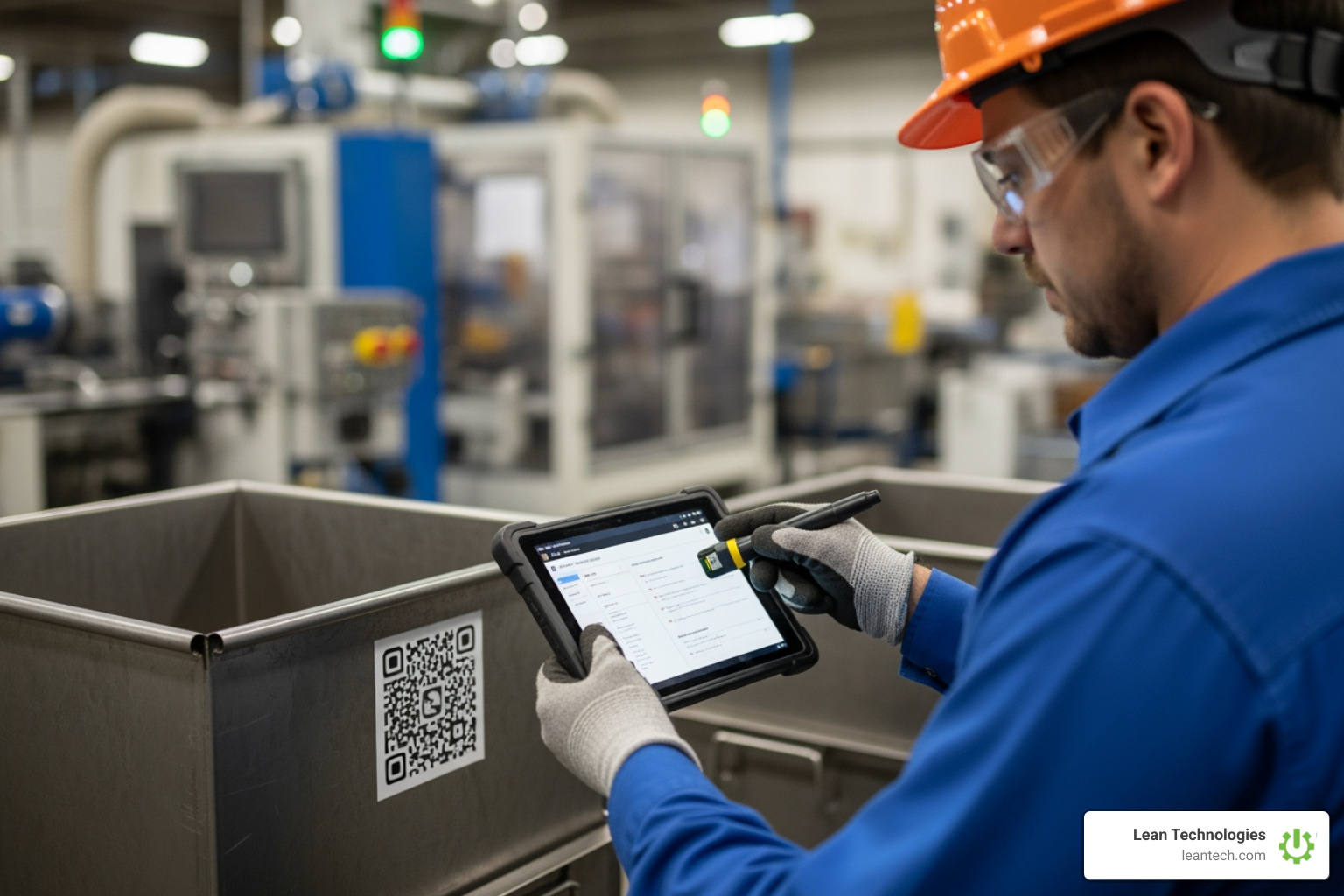
The days of tethered workstations are over. In May 2026, the most powerful tool on the shop floor is the mobile device in the operator's pocket or the ruggedized tablet mounted to the forklift.
Mobile-first inventory tracking shop floor systems allow for:
Camera-Based Scanning: No need for $2,000 proprietary hardware. Standard smartphones can now scan 1D and 2D barcodes with enterprise-grade speed.
Instant Cloud Sync: Multiple operators can work on the same inventory session simultaneously. If Operator A picks the last three bolts, Operator B’s screen updates instantly to show a stockout.
Error Reduction: Mobile apps can provide "forced validation," meaning an operator can't close a work order until they've scanned the correct components in the correct quantities.
This level of mobility leads to 99% inventory accuracy. When operators can update the system at the source of the work, the data remains pure.
Measuring Success with Production KPIs
You can't improve what you don't measure. Transitioning from "gut feel" to hard data is the hallmark of a mature manufacturing operation. By using Kanban board tools, managers can visualize these metrics in real-time:
OEE (Overall Equipment Effectiveness): Tracking how inventory availability impacts machine uptime.
Inventory Turnover: How fast are you moving raw materials into finished, billable goods?
Scrap Rate: Is a specific vendor's material consistently failing quality checks?
MTTR (Mean Time to Repair): Are maintenance delays caused by a lack of spare parts in the tool crib?
Integrating Shop Floor Control with Enterprise Systems
A shop floor inventory system shouldn't be an island. It needs to talk to the rest of the business. However, there is often confusion between Shop Floor Control (SFC) and Manufacturing Execution Systems (MES).
Feature | Shop Floor Control (SFC) | Manufacturing Execution System (MES) |
|---|---|---|
Focus | Daily workflows, task tracking, labor | Broad production oversight, quality, ERP link |
Inventory | WIP movement, material usage | Full traceability, BOM integration, costing |
Users | Operators, Supervisors | Plant Managers, Quality Engineers |
Complexity | Lightweight, fast to deploy | Heavyweight, multi-month implementation |
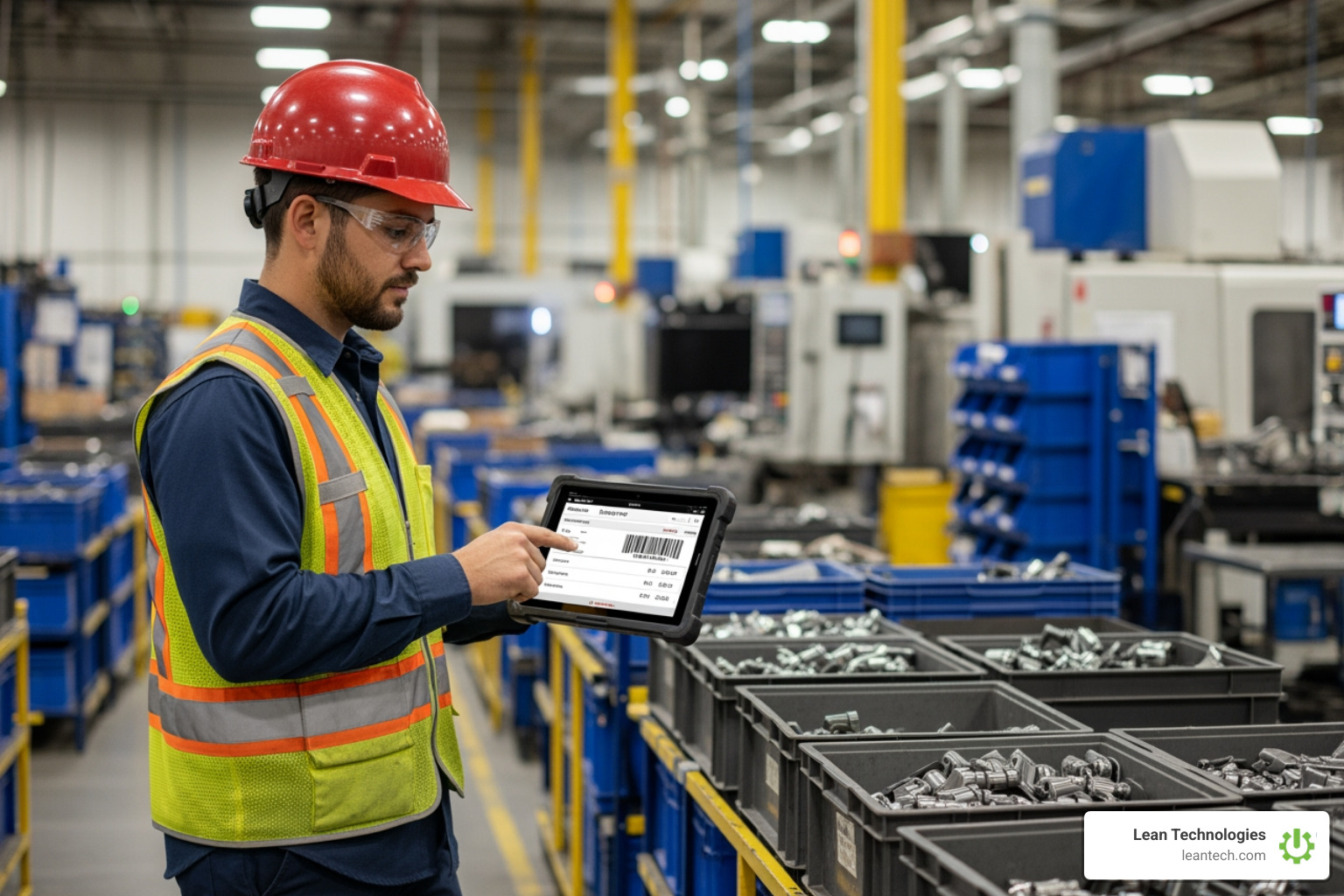
While an ERP handles the "business" of manufacturing (accounting, sales orders, high-level purchasing), the shop floor system handles the "execution." Integrating these via API ensures that when a worker scans a part on the floor, the finance team sees the cost update in the ERP immediately. This creates a "single source of truth" without the massive overhead of a traditional "big tech" software suite. This integration is especially vital for equipment asset tracking, ensuring that maintenance and production are always aligned on part availability.
Overcoming Challenges in Inventory Tracking Shop Floor Implementation
The biggest hurdle isn't the software; it's the people. Resistance to change is real, especially in facilities that have used paper for thirty years.
To ensure successful adoption in May 2026, follow these steps:
Start Small: Don't try to track every nut and bolt on day one. Start with your "A-items"—the 20% of inventory that represents 80% of your value.
Hardware Matters: If the tablets are slow or the scanners don't work in low light, the team will go back to paper. Invest in ruggedized gear that can survive a drop on concrete.
Training is Continuous: Don't just do a "one-and-done" session. Make the software part of the daily stand-up meeting.
Clean Your Data: If you migrate "garbage" data from a spreadsheet into a new system, you'll just have faster garbage. Validate your counts before you go live.
Frequently Asked Questions about Shop Floor Inventory
What is the difference between SFC and MES for inventory?
SFC (Shop Floor Control) is the execution layer—it’s about the "now." It tracks what an operator is doing, what materials they are using, and how long it takes. MES (Manufacturing Execution System) is broader; it includes quality management, detailed data analysis, and deep integration with the ERP to handle complex compliance and process improvements.
How does barcode scanning improve shop floor accuracy?
Manual data entry has a high failure rate due to typos, misread handwriting, and "memory-based" logging. Barcode scanning validates the item and quantity against the work order in real-time, reducing picking and recording errors from 5% down to less than 0.3%.
Can shop floor tracking work without a full ERP system?
Absolutely. Many small to midsize manufacturers use standalone shop floor tools to manage their production and inventory. These systems can often export data to accounting software like QuickBooks or Xero, providing the benefits of digital tracking without the six-figure cost of a full ERP.
Stop Managing Your Shop Floor Through Spreadsheets
If your "system" involves shouting across the floor to check stock levels or spending Saturday mornings reconciling spreadsheets, you are losing money.
Lean Technologies offers Thrive, an all-in-one, customizable shopfloor software built by manufacturing experts who have actually stood on the line. Thrive doesn't just "track" things; it streamlines your entire operation by digitizing lean work processes in real-time.
In the competitive landscape of May 2026, you cannot afford to be "real-late" with your data. Whether you need to tighten up your parts management or get a guide to digital lean manufacturing to start your journey, the goal is the same: precision.
Real-time beats real-late. Stop the guesswork and start tracking at the source.
Explore how Thrive can transform your inventory tracking shop floor today.