
How to Manage Assets Without Breaking a Sweat
The Hidden Cost of Not Managing Your Manufacturing Assets
Manufacturing asset management starts mattering the second a critical machine goes down and everyone starts asking the same question: why did nobody catch this sooner?
Here is the short version. If a plant cannot see asset condition, track work, and assign clear ownership, it ends up managing downtime with spreadsheets, hallway conversations, and luck. That is expensive.
Manufacturing asset management is the practice of tracking, maintaining, and optimizing physical assets - machines, tools, and facilities - across their full lifecycle so uptime stays high, costs stay controlled, and production targets stay realistic.
The core pillars, at a glance:
What It Covers | Why It Matters |
|---|---|
Equipment health monitoring | Catch failures before they stop production |
Preventive and predictive maintenance | Reduce unplanned downtime by up to 32% |
Asset lifecycle decisions | Know when to repair vs. replace |
Work order tracking and documentation | Build accountability on the shop floor |
KPI visibility (OEE, MTBF, MTTR) | Make decisions based on data, not gut feel |
Now the longer version, because this is where most plants feel the pain.
The average manufacturing facility loses around $25,000 for every hour of unplanned downtime. In automotive, that number can climb to $2.3 million per hour. Yet a lot of maintenance teams are still relying on paper forms, spreadsheets, or tribal knowledge sitting in one veteran technician's head.
Aging equipment is the leading cause of unplanned downtime, responsible for 29% of failures. At the same time, manufacturers are dealing with a labor shortage of nearly 2 million unfilled jobs. Fewer experienced people means fewer chances to catch small issues before they turn into major stops.
That pressure compounds fast. Margins get tighter. Schedules get less forgiving. Safety and compliance expectations keep rising. And the people who knew every machine's quirks are retiring.
This guide is for operations leaders who are tired of reacting. It lays out a practical way to build structure around assets, maintenance, and follow-through. If the current system runs on sticky notes and good intentions, this is the path out.
For broader background on how factories use asset management, it helps to think beyond maintenance alone. The real goal is better decisions, faster action, and fewer avoidable surprises.
What Manufacturing Asset Management Actually Means
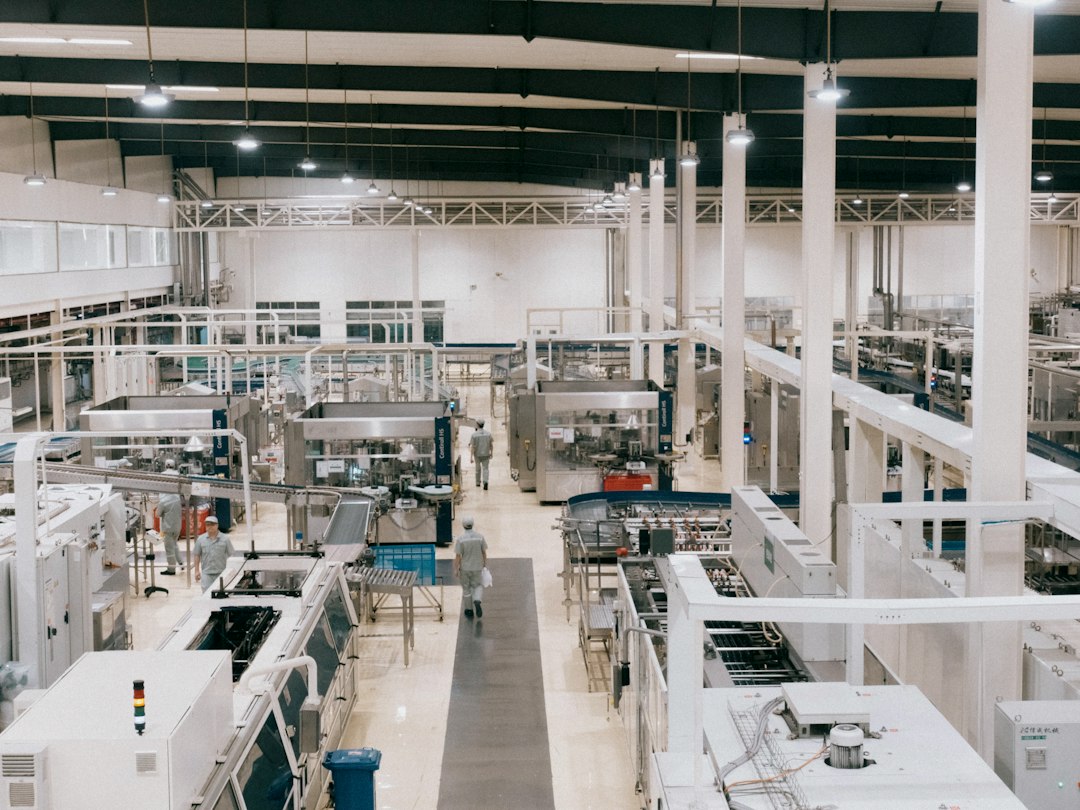
At its simplest, manufacturing asset management is how a plant keeps its physical assets ready to produce. That includes the obvious big-ticket equipment like presses, CNCs, packaging lines, conveyors, forklifts, and utilities, but also tools, gauges, spare parts, and supporting infrastructure.
Good asset management is not just fixing machines after they fail. It is a system for making better decisions across the full asset lifecycle: buy, install, operate, inspect, maintain, repair, improve, and replace.
What Is Manufacturing Asset Management?
Manufacturing asset management is the structured process of tracking and optimizing physical assets so they deliver the most value for the longest practical time.
That usually includes:
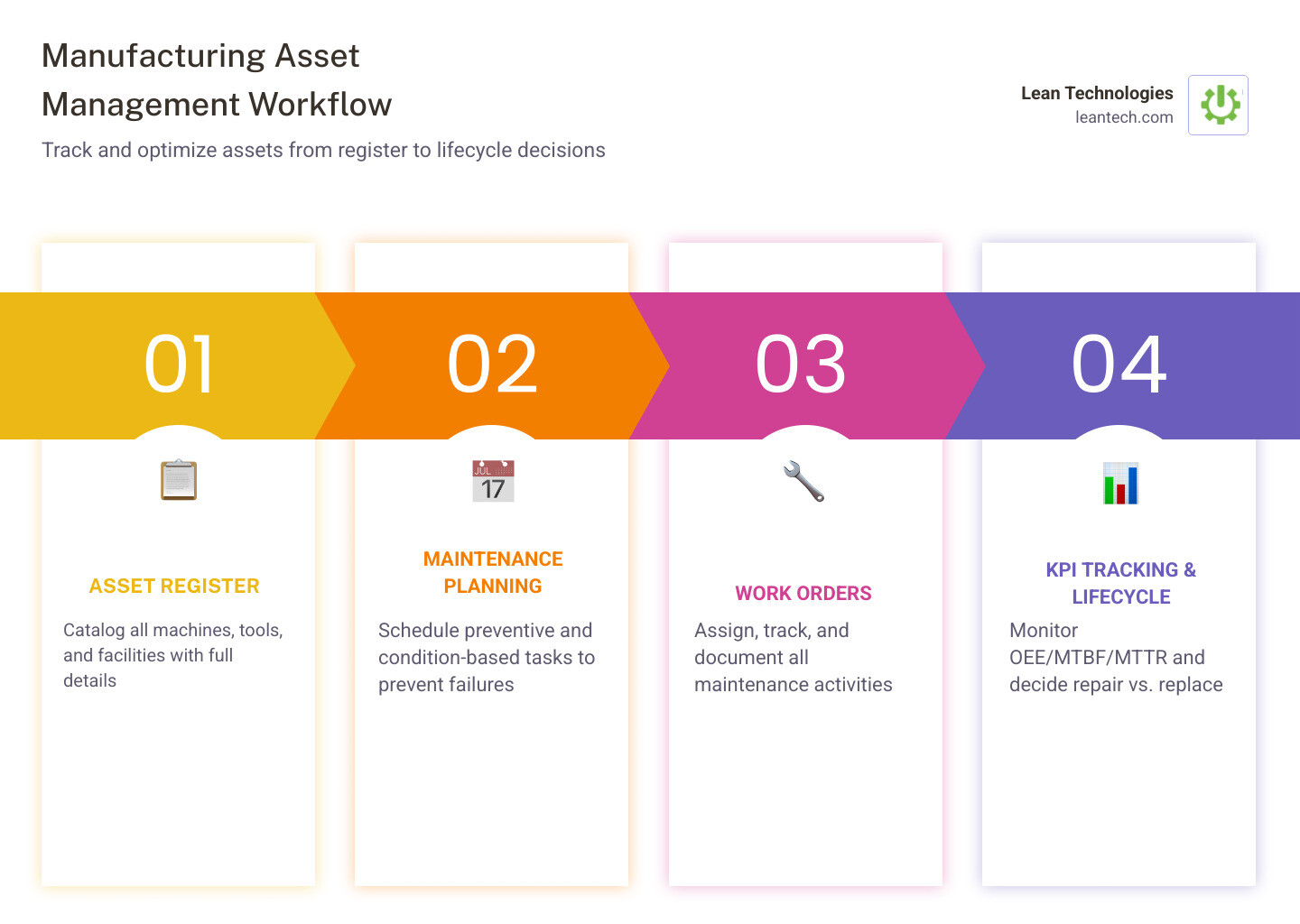
A complete asset register
Standard naming and location data
Maintenance plans
Inspection routines
Work order processes
Parts and inventory control
Asset history
Calibration records
Performance tracking
Repair-vs-replace decisions
On the shop floor, the definition is even simpler: know what assets exist, know what condition they are in, and know what action needs to happen next.
Why Manufacturing Asset Management Matters More in 2026
In 2026, plants are dealing with a rough mix of problems:
Downtime is expensive
Equipment is aging
Skilled maintenance labor is harder to find
Production schedules are less forgiving
Safety and compliance pressure is higher
Too much maintenance knowledge still lives in people's heads
Only 55% of companies have formal systems to capture and share maintenance knowledge. That means nearly half are still one retirement, vacation, or resignation away from, "Does anybody know how this line actually works?"
Modern asset management protects uptime, margins, and sanity. It also helps teams do more with fewer people. That matters when the labor gap is measured in millions of unfilled roles, not dozens.
The Core Goals of Manufacturing Asset Management
A strong program aims to improve five things:
Availability: assets are ready when production needs them
Reliability: assets perform consistently without surprise failures
Utilization: assets are used effectively, not sitting idle or underperforming
Compliance: records, inspections, and calibrations are controlled
Total cost: maintenance, parts, labor, and replacement costs are managed over time
This is also where digital structure matters. Real-time visibility only exists when the process is structured and the data gets entered at the source. If issues are written down on paper and typed in days later, the plant is not managing assets in real time. It is just documenting problems after the damage is done.
That is why strong manufacturing asset management is less about flashy technology and more about creating a system people on the floor will actually use.
The Business Case: Benefits, ROI, and KPIs That Matter
Plants do not invest in asset management because it sounds tidy. They invest because downtime hurts, rushed repairs cost more, and poor visibility creates bad decisions.
Key Benefits of Effective Manufacturing Asset Management
When done well, manufacturing asset management creates measurable operational gains:
Less unplanned downtime
Moving from reactive to preventive maintenance can cut overall downtime by up to 32% on average.
Better asset utilization
Organizations using asset performance management have reported utilization gains around 20%.
Longer asset life
Planned care reduces wear, misalignment, contamination, and repeat failure.
Improved labor efficiency
Technicians spend less time firefighting and more time doing planned work.
Better planning
Maintenance windows, labor, and parts can be coordinated with production.
Stronger accountability
Digital records make it clear what was found, what was done, and what still needs action.
Safer operations
Equipment issues affecting guards, leaks, heat, pressure, or instability are easier to catch and escalate.
Plants that want a more structured maintenance foundation can also explore Maintenance.
The Typical ROI Timeline for Asset Management Investments
The ROI timeline depends on how broken the current system is. Ironically, the messier the process, the faster the wins usually show up.
A common pattern looks like this:
First 30 to 90 days
Cleaner asset lists
Better work order visibility
Fewer missed PMs
Faster response to known recurring issues
3 to 6 months
Higher PM compliance
Lower emergency work
Better spare parts availability
Improved scheduling and backlog visibility
6 to 12 months
Noticeable downtime reduction
Better MTTR and MTBF trends
More informed repair-vs-replace decisions
Lower total maintenance cost as a share of output
The biggest early wins usually come from avoided downtime, better scheduling, and fewer duplicate or undocumented repairs.
KPIs Every Plant Should Track
If a team cannot see performance, it cannot manage it. At a minimum, most plants should track:
MTBF (Mean Time Between Failures): how long equipment runs between breakdowns
MTTR (Mean Time To Repair): how long it takes to restore operation
OEE (Overall Equipment Effectiveness): availability, performance, and quality rolled together
PM compliance: percent of planned maintenance completed on time
Planned vs. unplanned work: a strong indicator of maintenance maturity
Maintenance backlog: work waiting to be done
Schedule compliance: percent of scheduled work completed as planned
Spare parts turns and stockouts: whether inventory supports uptime or sabotages it
Downtime by cause: where the real losses are happening
Maintenance Approach | What It Means | Best Use | Main Risk |
|---|---|---|---|
Reactive | Fix it after it fails | Low-criticality assets | High downtime and disruption |
Preventive | Service on a schedule | Known wear patterns | Over-maintenance if poorly timed |
Condition-based | Act based on inspections or data | Critical assets with measurable health signals | Requires discipline and data |
Build the System: Strategy, Processes, and Ownership
A good asset management strategy is not software alone. It is a set of rules, routines, and responsibilities that make reliability repeatable.
The Main Components of a Successful Asset Management Strategy
Most successful programs include these building blocks:
Asset register
A complete list of equipment, locations, IDs, specs, manuals, and critical details
Criticality ranking
Not every asset deserves the same level of attention
Failure mode understanding
Teams should know how critical assets fail and what signals appear first
Maintenance plans
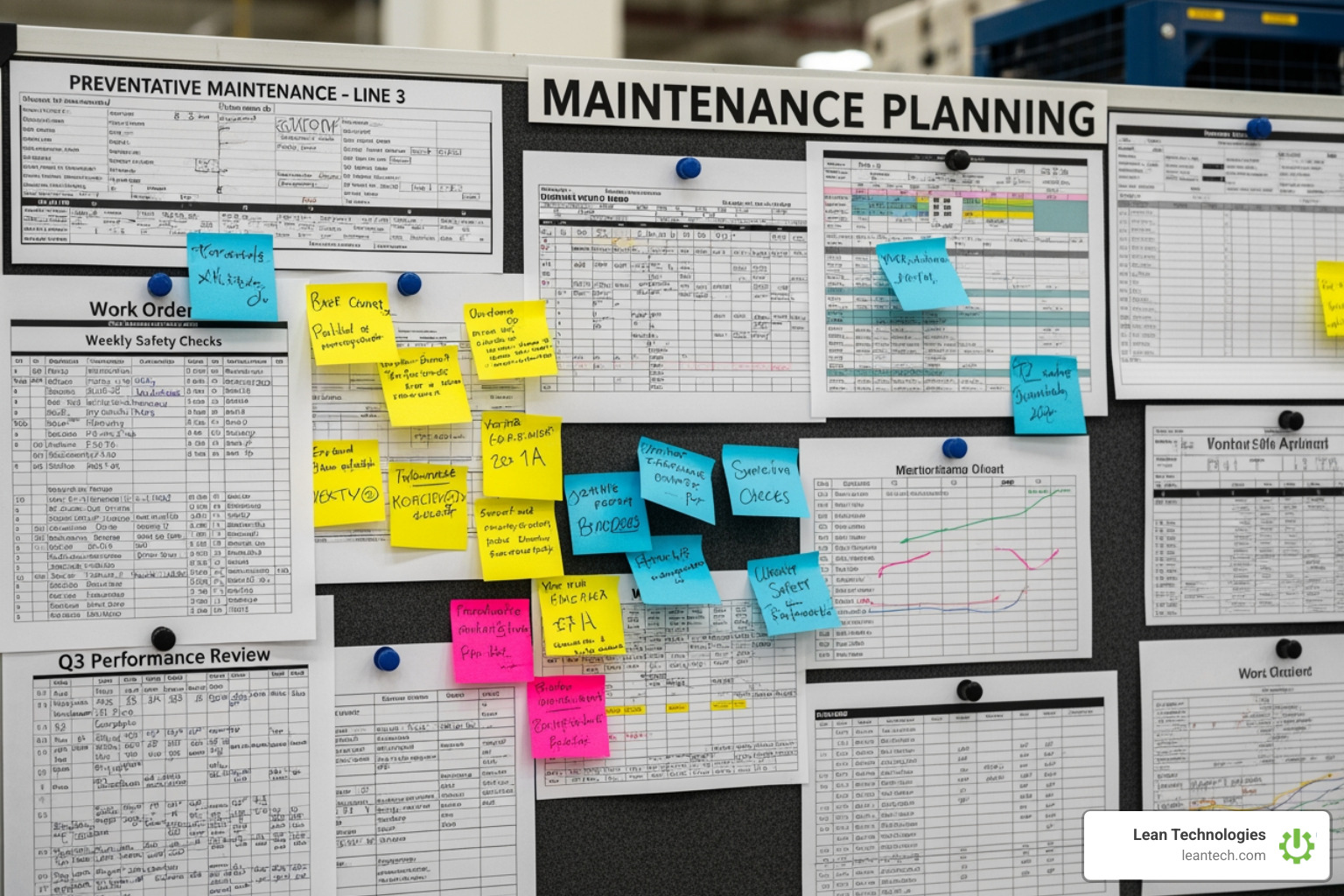
PM tasks, inspections, lubrication routes, and checklists
Work order management
Requests, assignments, completion notes, and closeout discipline
Spare parts control
Correct stock levels, locations, reorder points, and usage tracking through Parts Management
Calibration management
Especially for inspection and measurement assets, supported by Gage Calibration
Documentation and history
SOPs, manuals, repair notes, photos, and repeat-failure patterns
Ownership
Clear roles for operators, technicians, planners, supervisors, and engineering
Best Practices for Implementing Asset Management Without Chaos
Trying to digitize everything at once is the fastest path to frustration. The better approach is phased, practical, and boring in the best way.
A rollout that works often follows these steps:
Start with a pilot area
Pick one line, one cell, or one department with clear pain.
Build the asset list
Name assets consistently and assign IDs.
Rank asset criticality
Focus first on equipment that hurts throughput, safety, or quality when it fails.
Standardize work orders
Define required fields, failure codes, priorities, and closeout notes.
Create or clean PM plans
Base them on manufacturer guidance, failure history, and shop-floor reality.
Train by role
Operators should know how to report issues; technicians should know how to document fixes.
Track a small KPI set
Do not launch with 37 dashboards and a prayer.
Review weekly
Look at overdue PMs, repeat failures, backlog, and downtime causes.
Expand after proving the process
Scale what works instead of spreading a mess faster.
How to Overcome Common Asset Management Challenges
Common obstacles tend to be painfully familiar:
Siloed data
Maintenance info lives in one place, parts in another, downtime notes somewhere else
Paper forms and Excel sprawl
Information arrives late, incomplete, or not at all
Weak accountability
Issues are reported, but no one owns follow-up
Change resistance
Teams hate new systems that add admin without helping the floor
Skills gaps
Newer workers may not have deep equipment knowledge yet
Knowledge loss
Veteran know-how disappears without documentation
The fix is not more meetings. It is better structure:
Capture issues at the source
Standardize naming and failure codes
Make work visible
Build role-based ownership
Use history to find repeat failures
Audit PM coverage with tools like PM Gap Report
Preserve repair records with Work Order History
Maintenance Approaches and the Technology Stack Behind Them
Maintenance strategy is really a timing decision: act before failure, after failure, or when evidence shows failure is developing.
Preventive vs Reactive vs Condition-Based Maintenance
Here is the straight version:
Reactive maintenance
The asset breaks, then the team fixes it.
Useful for low-risk, low-cost assets.
Dangerous when used as the default strategy for critical production equipment.
Preventive maintenance
Work is done on a time- or usage-based schedule.
Good for assets with known service intervals.
Helps reduce surprise failures, but can waste time if schedules are too aggressive.
Condition-based maintenance
Action is triggered by inspections, readings, or observed asset condition.
A practical bridge between preventive and predictive methods.
Useful when teams can detect degradation before failure.
What about predictive maintenance? That is a more advanced form of condition-based maintenance that uses trend data, analytics, and patterns to estimate when a failure is likely to happen. Research shows 84% of companies are at least piloting predictive maintenance on critical assets, which shows where the market is heading. But predictive only works when the basics are already in place. Fancy alerts cannot rescue messy work processes.
What Role Digital Workflows Play in Asset Management
This is where plants either gain control or stay stuck.
Digital workflows help teams:
Create standardized asset records
Schedule PMs consistently
Submit and route work orders quickly
Capture downtime reasons in real time
Build a permanent audit trail
Review repair history before the next failure
Spot repeat issues and delayed actions
That matters because real-time beats real-late. If downtime gets scribbled on paper and entered next Friday, the team is not managing anything. It is just archiving disappointment.
For plants trying to standardize execution, Planned Maintenance and Work Order History are useful places to start.
Technologies That Enable Better Manufacturing Asset Management
Modern asset management can be enabled by a mix of practical technologies:
Barcode and QR code labels
Fast asset identification
RFID
Useful for tracking movable tools, containers, or inventory
Mobile apps and tablets
Let operators and techs enter issues at the source
Digital dashboards
Show backlog, PM compliance, downtime, and status
Imported machine data
Useful when paired with structured workflows and ownership
CMMS and EAM systems
Centralize records, scheduling, work orders, and history
One important distinction: Thrive is not an ERP, not an MES, and not a sensor platform. It does not generate predictive alerts from machine sensors on its own. It helps teams organize work, capture issues, assign actions, and close the loop using data entered by the team or imported from other systems.
That is the real point of the tech stack. Not collecting more data for fun. Not building a dashboard nobody trusts. The goal is to make sure the team can see issues, assign actions, and follow through before problems spread.
How Asset Management Connects to ERP, MES, and Daily Operations
Asset management should not sit in a corner by itself like the lonely vending machine in the back of the plant. It works best when it connects to production, inventory, quality, safety, and purchasing.
How Asset Lifecycle Management Improves Better Decisions
Lifecycle management gives leaders context for decisions such as:
Should this asset be repaired again or replaced?
Are failures increasing with age?
Is downtime cost now larger than replacement cost?
Are spare parts becoming obsolete?
Does this asset create quality or safety risk?
Should capex be prioritized elsewhere?
When teams can see total maintenance history, recurring failure modes, and actual production impact, repair-vs-replace decisions become less emotional and more economic.
How Asset Management Integrates With ERP and MES
Good integration usually supports:
ERP
Asset master data
Purchasing and procurement
Parts inventory
Supplier information
Cost tracking
MES
Production context
Downtime reasons
Machine status
Schedule impact
Quality correlations
Thrive fits in as a practical layer between systems and people. It helps teams structure work, log issues, track actions, and improve visibility in real time without replacing ERP or MES systems. That matters because many manufacturers do not need another giant rollout. They need a system operators and supervisors will actually use.
Plants exploring this type of structure often start with CMMS or Equipment Asset Tracking.
Real-World Examples of Successful Asset Management
Successful asset management usually does not begin with a glamorous enterprise launch. It starts with one painful bottleneck.
Common success patterns include:
Critical line focus
A plant starts with the one line causing most downtime and builds PM discipline there first.
PM compliance improvement
Teams move from inconsistent schedules to visible weekly execution and quickly reduce missed maintenance.
Spare parts control
Frequently needed parts are stocked correctly, reducing waiting time during breakdowns.
Digital work capture
Operators log issues immediately instead of mentioning them three shifts later.
Utilization gains
Better monitoring and planning improve asset use rather than just adding maintenance labor.
Plant accountability
Supervisors can see open work, overdue tasks, recurring failures, and owner names instead of chasing updates by hallway conversation.
These are not magic tricks. They are the result of visibility plus follow-through.
What to Do Next if Asset Management Still Feels Messy
If the current state is paper binders, half-updated spreadsheets, and "ask Mike, he knows that machine," the right next move is not panic. It is simplification.
Start here:
Build a basic asset inventory
Rank critical equipment
Set baseline KPIs
Standardize how issues are reported
Create or clean PM routines
Track work orders digitally
Review progress weekly
Expand one area at a time
For many small to midsize manufacturers, the real bottleneck is not lack of software. It is lack of structure. Lean Technologies' Thrive helps teams create that structure on the shop floor with accountable workflows, real-time visibility, and integrated processes built by manufacturing people.
Helpful next steps include exploring Equipment Asset Tracking and Maintenance.
Stop managing the floor through spreadsheets and wishful thinking. Manufacturing asset management works when the process is clear, the ownership is defined, and the data is captured where the work happens.
Frequently Asked Questions about Manufacturing Asset Management
What is the first step in manufacturing asset management?
The first step is creating a reliable asset inventory. A plant needs to know what equipment exists, where it is, what it does, and how critical it is. After that, criticality analysis and baseline KPIs should be established.
How long does it take to see results from manufacturing asset management?
Many plants see early wins within 30 to 90 days, especially around PM compliance, work visibility, and issue response. More meaningful downtime and cost improvements often become clearer over 6 to 12 months.
Do small and midsize manufacturers need digital asset management tools?
Yes. Smaller plants usually have less slack, fewer specialized resources, and more reliance on tribal knowledge. Digital tools help standardize work, improve visibility, and prevent important maintenance information from disappearing into notebooks or memory.
What role does CMMS or EAM software play?
CMMS and EAM platforms centralize asset records, maintenance schedules, work orders, parts, and history. They make it easier to plan work, document repairs, track KPIs, and support better lifecycle decisions.
How is predictive maintenance different from preventive maintenance?
Preventive maintenance happens on a fixed schedule. Predictive maintenance uses condition and trend data to estimate when failure is likely. Predictive can reduce unnecessary maintenance, but it requires solid data and disciplined processes to work well.
Which technologies matter most for modern asset management?
The most useful technologies depend on the plant, but common building blocks include mobile work capture, QR codes, barcode labels, dashboards, condition-monitoring sensors, and integrations with ERP or MES. The key is not collecting more data for fun. It is turning data into action.
What KPIs matter most?
The short list is:
MTBF
MTTR
OEE
PM compliance
Planned vs unplanned work
Backlog
Downtime by cause
Parts availability
If those are measured consistently, a plant already knows more than many teams running on gut feel alone.