
Why Your Factory Needs Predictive Maintenance to Stop the Bleeding
The $50 Billion Problem: Why Predictive Maintenance in the Manufacturing Industry Can't Wait
Predictive maintenance in the manufacturing industry is a data-driven strategy that uses real-time sensor data, AI, and machine learning to detect equipment problems before they cause a breakdown — so maintenance happens when it's actually needed, not on a fixed schedule or after something has already failed.
Here's a fast breakdown of what it means and why it matters:
What it is: Continuous monitoring of machine health using IoT sensors, with AI analysing the data to forecast failures days or weeks in advance
What it replaces: Reactive maintenance (fix it after it breaks) and preventive maintenance (fix it on a schedule, whether it needs it or not)
What it delivers: 30–50% less unplanned downtime, 25% lower maintenance costs, and a documented 10:1 ROI ratio
Who it's for: Any manufacturer running equipment where an unplanned stoppage costs more than the monitoring system itself — which is most of them
Unplanned downtime costs manufacturers an estimated $50 billion every year. That's not a rounding error — it's a structural problem baked into how most factories still manage their equipment.
The average large manufacturing plant loses $253 million annually to unplanned stoppages. In automotive, a single hour of downtime can cost $2.3 million. Even in lower-intensity sectors like fast-moving consumer goods, the bill runs to $36,000 per hour.
Most plants are still fighting fires. A machine breaks. Technicians scramble. Production halts. Parts get emergency-shipped. And then — once the chaos settles — someone asks why no one saw it coming.
The honest answer? They didn't have the right system in place to see it coming.
That's exactly the problem predictive maintenance solves. It shifts the model from reactive firefighting to proactive, data-informed decision-making. And in 2026, with AI accuracy on failure predictions running between 80–97% and sensor costs having dropped by over 70% in less than a decade, the barriers to getting started are lower than ever.
This guide breaks down how predictive maintenance works, what it costs, what it pays back, and how to build a practical programme — even if your plant runs on older equipment and a lean team.
Beyond Firefighting: Understanding Predictive Maintenance in the Manufacturing Industry
To understand predictive maintenance in manufacturing industry (PdM), we have to look at what it isn't. Most factories operate on a spectrum of maintenance strategies, often leaning too heavily on the "broken" ones.
Reactive Maintenance: This is the "run-to-failure" model. You fix the machine only after it stops. It’s the most expensive way to operate because it guarantees unplanned downtime, emergency labor rates, and stressed-out supervisors.
Preventive Maintenance: This is Planned Maintenance based on the calendar or run-hours. It’s better than reactive, but it’s still "loosely predictive." You might replace a perfectly good bearing just because the manual says to do it every six months. Research shows this leads to 20-30% waste in maintenance activities.
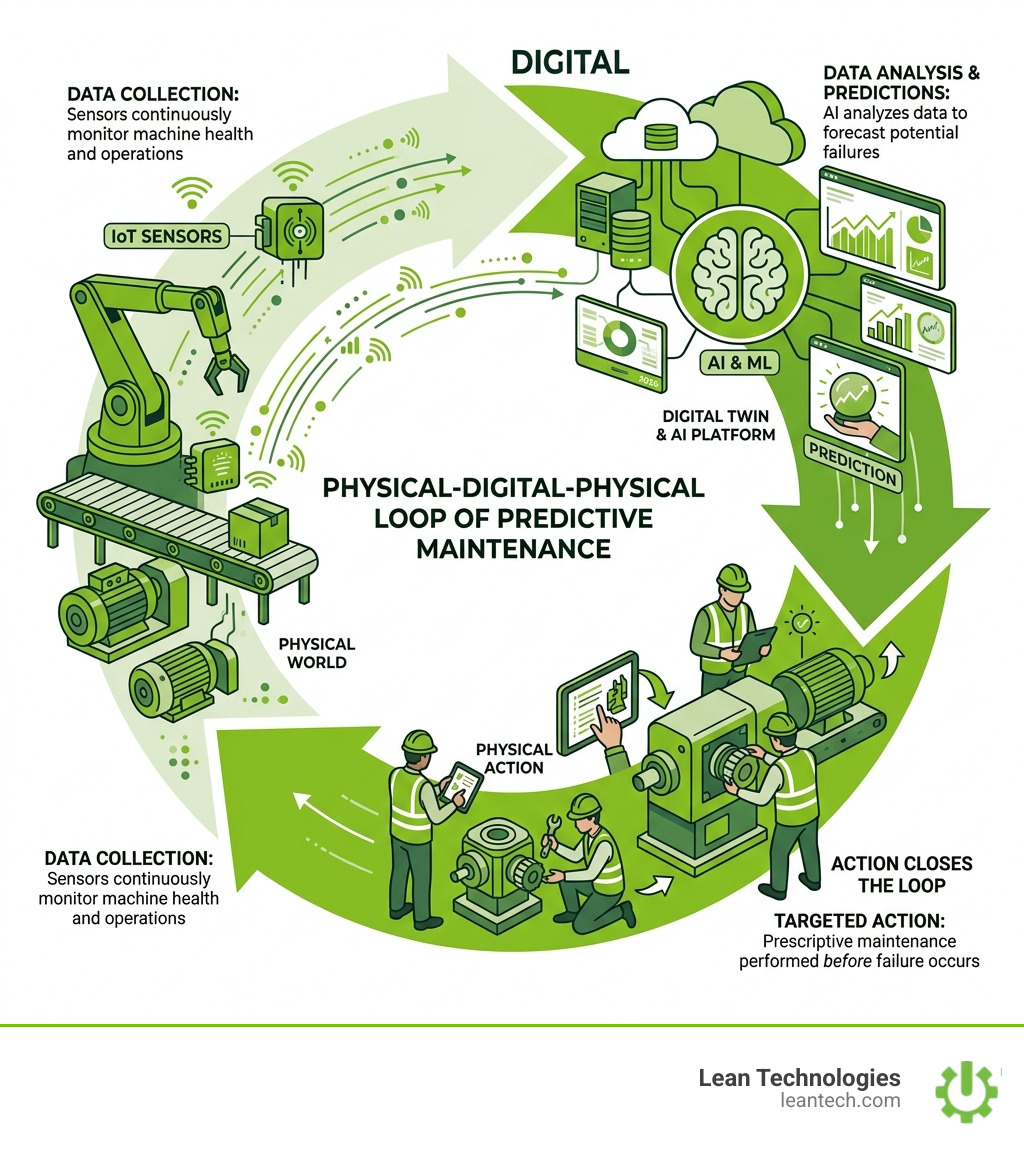
Predictive Maintenance: This is the "Goldilocks" zone. By using condition-based monitoring, you look at the actual health of the asset. If a motor is vibrating 5% more than its baseline, the system flags it. You don't guess; you know.
PdM completes what experts call the "physical-digital-physical" loop. You take physical data from the machine, turn it into digital insights via software, and then take a physical action (like a repair) before the machine fails.
The Tech Stack: How AI and IoT Predict the Future
In 2026, the technology behind PdM has moved from "science fiction" to "standard operating procedure." It relies on a stack of four key technologies working in tandem:
Internet of Things (IoT): These are the sensors that act as the nervous system of your factory. They collect the raw data.
Edge Computing: Instead of sending every bit of data to the cloud, "edge" devices process data right at the machine. This allows for sub-second response times if a critical threshold is breached.
Machine Learning (ML): This is the "brain." ML algorithms look at Work Order History and real-time streams to learn what "normal" looks like for a specific machine.
Digital Twins: These are virtual replicas of your machines. They allow you to simulate "what-if" scenarios without risking the actual equipment.
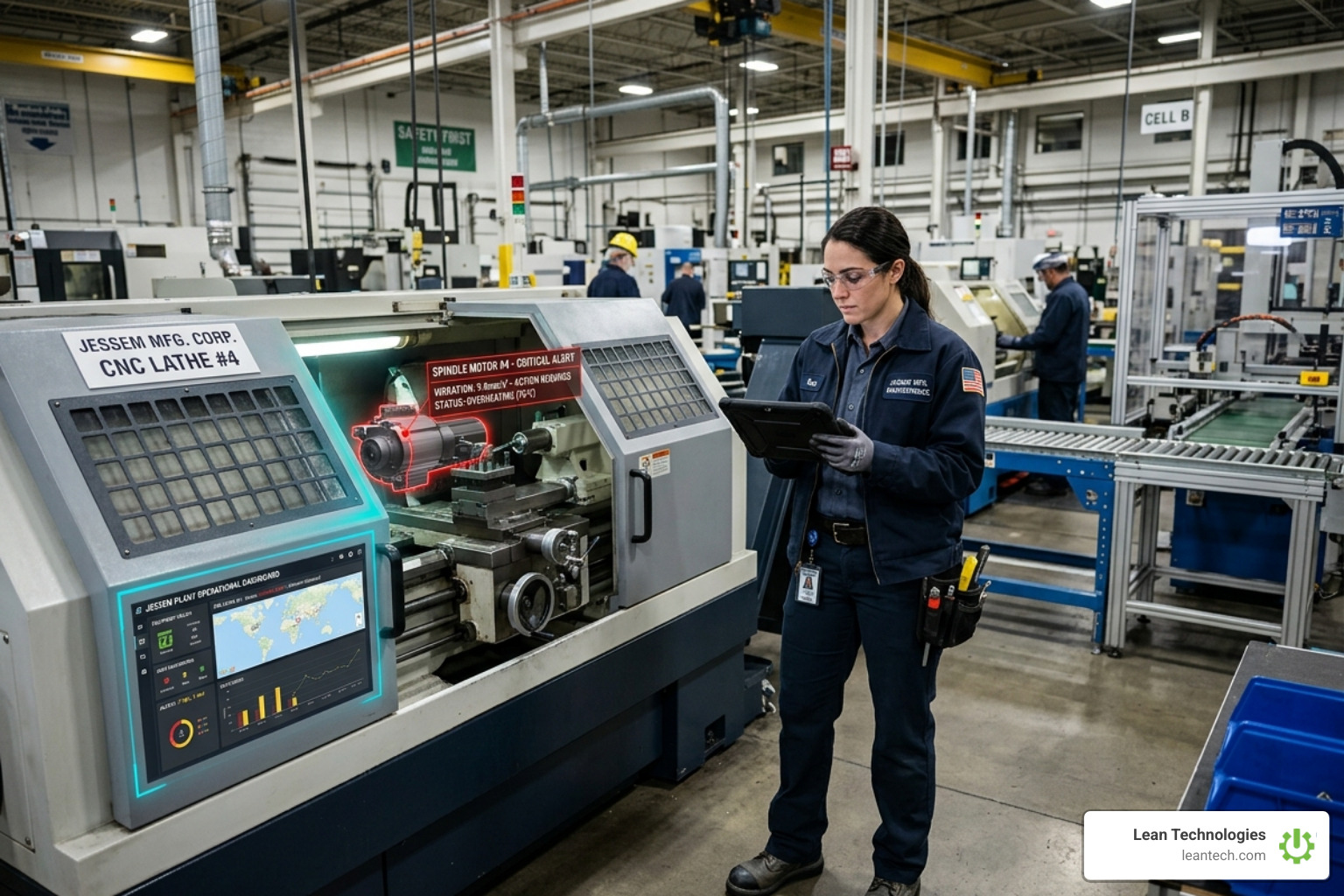
By integrating these with Equipment Asset Tracking, managers get a birds-eye view of every critical asset's health on a single dashboard.
Key Sensors for Predictive Maintenance in the Manufacturing Industry
You don't need to sensor-up every bolt. Most failures in the predictive maintenance in manufacturing industry context are caught by monitoring five key areas:
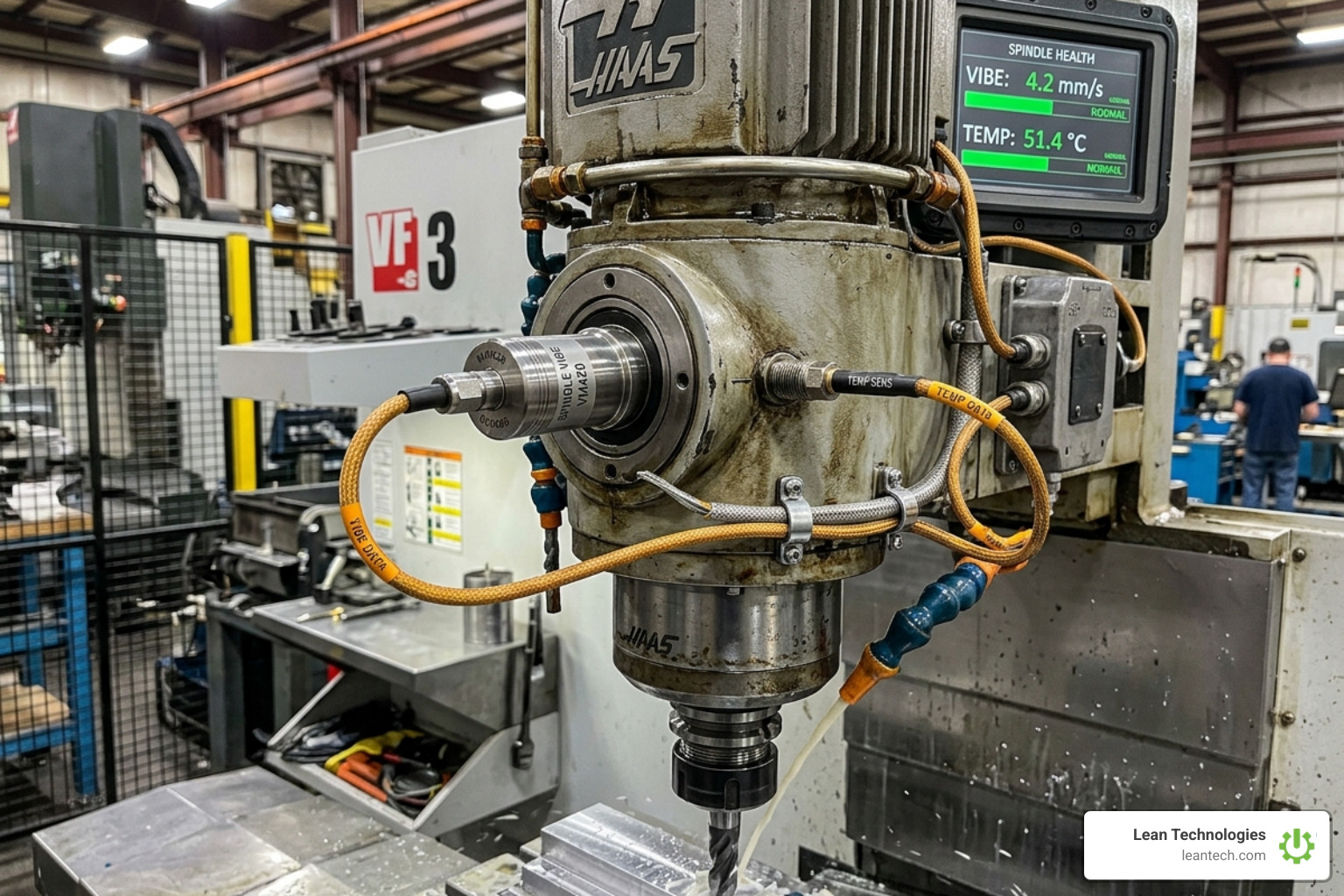
Vibration Analysis: The "gold standard." It detects 99% of mechanical issues like bearing wear, misalignment, or loose bolts. Following ISO 20816:2016 standards ensures your measurements are accurate.
Infrared Thermography: Uses heat signatures to find "hot spots" in electrical panels or friction in gearboxes before they smoke.
Ultrasonic Acoustics: "Listens" for high-frequency sounds that human ears miss, such as air leaks or early-stage bearing fatigue.
Motor Current Monitoring: Measures how hard a motor is working. If a motor draws more power to do the same job, something is dragging it down.
Oil Analysis: Checks for metal particles or contaminants in lubricants, which act like a "blood test" for hydraulic systems.
The Role of AI in Anomaly Detection
AI is what separates modern PdM from old-school alarms. Traditional systems use "fixed thresholds" (e.g., "Alert me if temp > 90°C"). AI uses pattern recognition.
It can see that even if the temperature is only 70°C, the relationship between temperature and vibration has shifted in a way that historically leads to a failure in 12 days. This allows for Work Request Queue automation, where the system identifies the "Remaining Useful Life" (RUL) and automatically schedules a technician during the next planned changeover.
The Financial Impact: ROI and the Cost of Doing Nothing
If you’re a Maintenance Manager trying to get budget approval, the Pm Gap Report is your best friend. The numbers for predictive maintenance in manufacturing industry are staggering:
10:1 ROI: For every $1 spent on PdM, the U.S. Department of Energy documents $10 in savings.
25% Cost Reduction: Total maintenance spend typically drops by a quarter because you stop performing unnecessary "preventive" work.
70% Fewer Breakdowns: Catching a $500 bearing before it kills a $50,000 spindle is where the "bleeding" stops.
Asset Life Extension: Equipment lasts 20–40% longer when it isn't subjected to the "trauma" of catastrophic failures.
According to Deloitte, poor maintenance strategies can reduce a plant's productive capacity by up to 20%. If you're curious where your plant stands, taking a Pm Gap Report Quiz can help identify the low-hanging fruit for ROI.
A 5-Step Roadmap to Implementing PdM Without the Chaos
Don't try to boil the ocean. A cmms shouldn't be a burden; it should be a tool. Follow this proven roadmap to get results in under 90 days:
Asset Criticality Assessment: Rank your machines. Which ones stop the whole line if they fail? Start with your top 5 "bottleneck" assets.
Establish a Data Foundation: Before buying AI, get your Work Order History in order. You need to know what has failed in the past to train a system for the future.
Pilot Program: Install sensors on those top 5 assets. Establish "baselines" for 30 days to see what "healthy" looks like.
System Integration: Connect your sensors to your shopfloor software. When an anomaly is detected, it should automatically trigger a work order—not just send an email that gets ignored.
Scale: Once you've proven ROI on the pilot (usually within 6 months), roll it out to the rest of the facility.
Measuring Success: KPIs for Predictive Maintenance in the Manufacturing Industry
You can't manage what you don't measure. Use this table to track your transition from reactive to predictive:
Metric Reactive (Firefighting) Predictive (Proactive) MTBF (Mean Time Between Failures) Low (Frequent breaks) High (Long runs) MTTR (Mean Time To Repair) High (Unplanned chaos) Low (Planned parts/tools) OEE (Overall Equipment Effectiveness) 60-70% 85%+ PMP (Planned Maintenance Percentage) <30% >85%
Overcoming the Barriers to Adoption in 2026
Implementation isn't always smooth sailing. The biggest hurdles in 2026 aren't the tech—it's the "tribal knowledge" and legacy habits.
The Skills Gap: With 2.1 million manufacturing jobs expected to be unfilled by 2030, you need systems that empower junior techs. AI can provide "step-by-step" repair instructions based on the specific fault detected.
Legacy Equipment: You don't need new machines. Retrofitting IoT sensors is cheap ($0.10 to $0.80 per unit for basic components) and can be done in hours.
Data Silos: If your maintenance data is in Excel and your production data is on a whiteboard, you're flying blind. Real-time visibility requires a single source of truth.
Generative AI: In 2026, we use GenAI to create "synthetic data" for rare failure modes, allowing us to train models even if a machine hasn't failed in years.
Frequently Asked Questions about Predictive Maintenance
How much does it cost to implement predictive maintenance in a mid-size plant?
For a typical plant with 20–40 critical assets, a pilot phase (sensors and software) usually runs between $25k and $60k. Most facilities see a full payback in 8 to 14 months just by avoiding one or two major "line-down" events.
Can predictive maintenance work on older, legacy machinery?
Absolutely. In fact, legacy equipment often sees the highest ROI because it's more prone to unpredictable failures. Modern IoT sensors are non-invasive—they often just "stick" onto the motor housing or clip onto power lines.
Do we need a dedicated data science team to start?
No. In 2026, most PdM platforms use "Pre-trained Models." You don't need a PhD to interpret the data; the software gives you a simple "Green/Yellow/Red" health score and tells you exactly what to check (e.g., "Check alignment on Spindle 3").
Stop Managing Your Shop Floor Through Spreadsheets
At the end of the day, predictive maintenance in manufacturing industry is only as good as the action it triggers. You can have the best sensors in the world, but if that data sits in a silo while your operators are still using paper logs, you haven't stopped the bleeding.
This is where Lean Technologies comes in. Our platform, Thrive, is the "digital toolbox" for the modern shop floor. We don't just give you data; we give you real-time visibility.
Thrive helps your team:
Log issues at the source: No more end-of-shift data entry that’s "already too late."
Structure work processes: Ensure that when a predictive alert hits, the right person is held accountable to fix it.
Drive Continuous Improvement: Use real data to close the loop on recurring problems.
Thrive isn't an ERP or a complex MES that takes two years to install. It’s a flexible, mobile-first platform built by manufacturing experts who have actually stood on a shop floor. It’s designed to help your operators and supervisors own their data and run lean.
Stop managing your shop floor through spreadsheets and wishful thinking. If you want to see how structured, real-time data can transform your maintenance department, learn how Thrive streamlines your maintenance operations today. Let your team run lean—with real-time visibility and zero workarounds.