
Step-by-Step Guide to Digital Continuous Improvement Implementation
What Is Digital Continuous Improvement and Why Does It Matter?
Continuous improvement has always been the heartbeat of world-class operations. However, traditional operational excellence initiatives often stall because valuable information stays trapped on whiteboards, handwritten shift logs, and disconnected spreadsheets.
Digital continuous improvement transforms this dynamic. By transitioning from static physical tools to connected digital workflows, organizations gain real-time operational visibility, accelerate waste reduction, and develop the process agility required to navigate market volatility in August 2026.
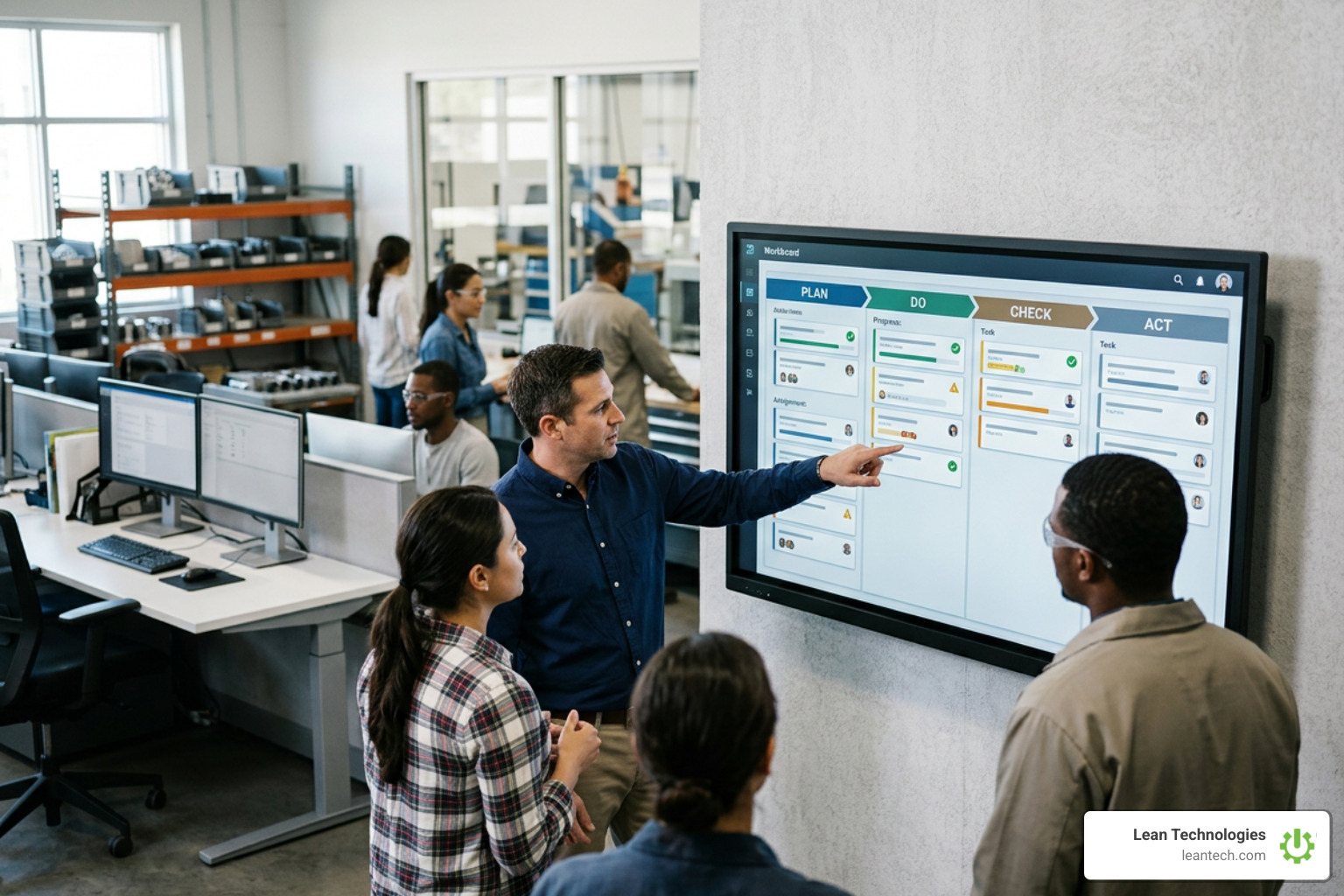
When frontline teams capture problems digitally at the point of execution, operational leaders no longer have to wait for end-of-month reporting to identify systemic friction. Instead, issues are documented immediately, root causes are investigated collaboratively, and corrective actions are tracked to completion.
Traditional vs. Digital Continuous Improvement
Traditional continuous improvement relies heavily on manual interventions: suggestion boxes that get reviewed once a quarter, physical Kaizen boards on the plant floor, and paper-based audit checklists. While these methods foster a foundational improvement mindset, they introduce significant latency and administrative drag.
Capability Traditional Continuous Improvement Digital Continuous Improvement Data Collection Paper forms, manual tally sheets, end-of-shift spreadsheets Direct point-of-work entry via mobile, tablet, or desktop interfaces Visibility Localized to physical boards; delayed until manual consolidation Immediate shopfloor visibility across lines, shifts, and departments Action Tracking Static whiteboard lists, unmonitored Excel action logs Centralized action tracking with automated escalation and accountability Root Cause Analysis Post-incident meetings based on memory and incomplete logs Evidence-backed investigations supported by structured historical records Knowledge Sharing Siloed within individual workcells, shifts, or facilities Standardized, accessible operating procedures shared across the enterprise
Moving from manual tracking to connected workflows bridges the gap between Continuous improvement and kaizen methodologies and modern execution speed. Instead of losing momentum between shift handoffs, plant teams establish closed-loop accountability where every logged anomaly receives a clear owner, target date, and verification protocol.
The Strategic Value of Digital Continuous Improvement in 2026
Modern manufacturing demands an operational model built for continuous adaptation. In 2026, operational excellence is not an isolated consulting exercise or a sporadic quarterly workshop; it is an everyday operating discipline.
Implementing Digital lean management principles enables operational leaders to move away from firefighting. When process abnormalities are logged digitally the moment they occur, supervisors and engineers can analyze recurring trends, pinpoint true root causes, and eliminate recurring bottlenecks before they compound into missed customer shipments or major scrap events.
Digital continuous improvement also democratizes problem-solving. By giving frontline workers intuitive digital tools to log safety near-misses, maintenance requests, and quality deviations, organizations tap into the collective intelligence of the entire workforce. For deeper strategic context on structuring these workflows, explore Continuous Improvement in a Digital Age to see how industry leaders evolve their continuous improvement architecture.
Core Methodologies and Enabling Technologies
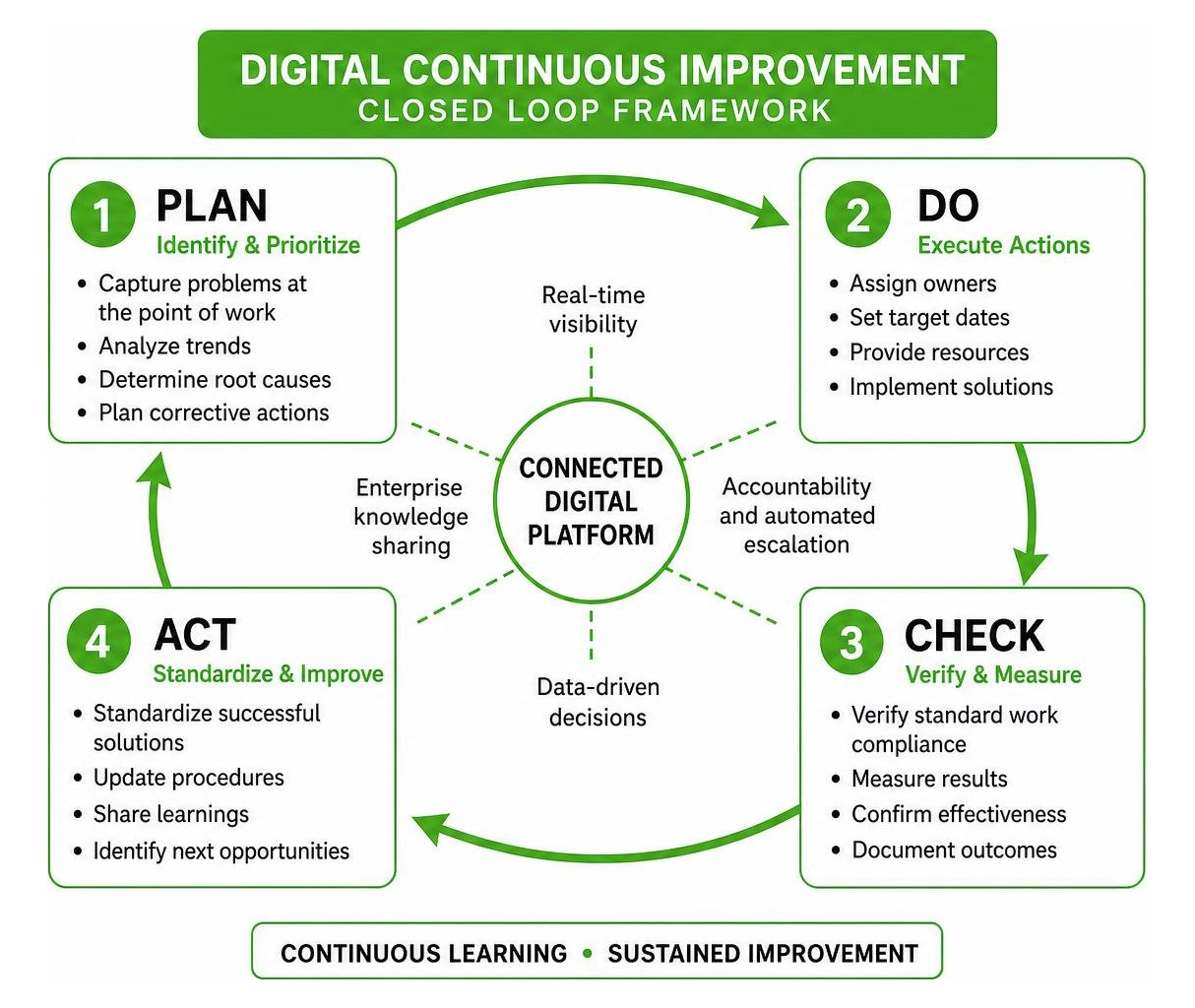
Digital continuous improvement does not replace proven operational frameworks like Lean, Six Sigma, and PDCA (Plan-Do-Check-Act). Instead, it supercharges these methodologies by eliminating administrative waste, accelerating feedback loops, and providing factual baselines for sustained problem-solving.
Lean, Six Sigma, and PDCA in Connected Environments
Traditional Lean and Six Sigma frameworks thrive on data integrity and standardized execution. In connected plant environments, the classic PDCA cycle shifts from a slow, paper-driven process into an active, iterative engine:
Plan: Operational leaders define standard work, set target thresholds, and prioritize improvement charters using historical shopfloor records rather than subjective opinions.
Do: Operators execute standardized routines and log anomalies directly through tablet or desktop interfaces at the workstation.
Check: Supervisors review live completion rates, evaluate process capability, and verify whether implemented countermeasures achieved target outcomes.
Act: Successful process adjustments are immediately codified into updated Standard Operating Procedures (SOPs) and rolled out across identical workcells.
Deploying structured Continuous improvement tools in manufacturing ensures that Lean techniques—such as 5S audits, Gemba walks, and Kaizen action sheets—remain living processes rather than neglected clipboards hung on plant walls.
To structure complex projects, teams often turn to DMAIC (Define, Measure, Analyze, Improve, Control). Modern platforms like DMAIC Suite™ | AI Master Black Belt Assistant for Lean Six Sigma demonstrate how structured software can streamline project milestones, validate statistical improvements, and guide cross-functional teams through Six Sigma tollgates.
AI, Automation, and Real-Time Decision Support
Artificial intelligence and automation act as powerful force multipliers for operational excellence programs. While frontline workers provide essential human context and critical thinking, digital systems streamline the administrative heavy lifting that often derails continuous improvement initiatives:
Automated Routing: Quality deviations and safety hazards are immediately assigned to the appropriate department or maintenance lead based on predefined plant logic.
Intelligent Action Prioritization: Systems highlight high-risk, overdue, or recurring issues, ensuring management resources focus on the most impactful operational friction.
Structured Root Cause Assistance: Guided digital 5-Why and Fishbone templates prompt operators to document contributing factors accurately, preventing vague descriptions like "machine jammed" or "operator error."
Integrating these capabilities with robust Continuous improvement tools in quality management creates an environment where defects are contained instantly, scrap trends are caught early, and corrective actions are tracked to verified completion.
6-Step Implementation Roadmap for Operational Leaders
Rolling out a digital continuous improvement program requires a structured, manageable approach. Trying to digitize every process across an entire facility overnight often leads to overwhelmed staff, low adoption, and fragmented data. Following a staged implementation roadmap ensures strong alignment, rapid user adoption, and measurable return on investment.
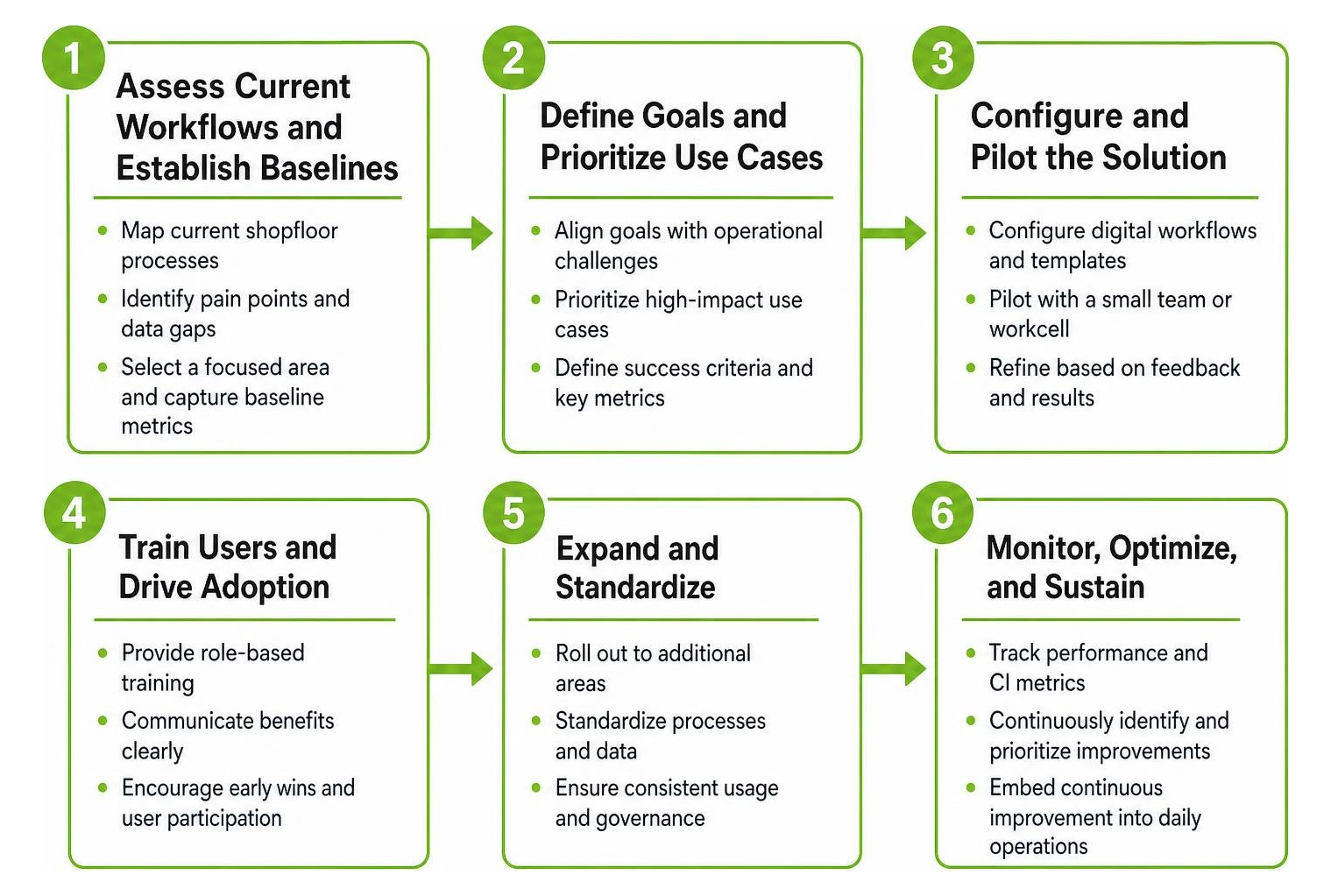
Step 1: Assess Current Workflows and Establish Baselines
Before introducing software, map the current state of your shopfloor processes. Identify where paper workarounds, late downtime logs, unclosed CI loops, and scattered compliance records cause daily headaches.
Select a specific operational area—such as a packaging line experiencing high changeover times or a machining cell with erratic scrap rates—and gather baseline metrics:
Average downtime hours per shift
First-pass yield and scrap percentage
Open action item aging (how long corrective actions sit uncompleted)
Mean time to respond (MTTR) for maintenance and quality escalations
Establishing clear quantitative baselines ensures that post-implementation gains are proven with empirical facts rather than subjective estimates. For a comprehensive overview of baseline structures, review Continuous Improvement Steps For Enhancing Digital Leadership.
Step 2: Standardize Data Logging at the Source
Visibility is impossible without structured data entered at the point of work. Equip frontline operators, maintenance technicians, and team leads with intuitive mobile, tablet, or desktop interfaces tailored to their daily tasks.
Standardize the exact data required when logging an issue:
Specific machine, line, or workstation ID
Clear categorization (e.g., mechanical, electrical, material defect, tooling wear)
Severity level and initial containment actions taken
Photo or visual evidence captured directly via mobile device
Understanding What is Lean continuous improvement software and why does your plant need it helps plant managers choose platforms that simplify entry for operators rather than burdening them with complex, multi-click enterprise forms.
Step 3: Implement Layered Action Tracking and Escalation
Logging an issue is only half the battle; closing the loop is where real improvement occurs. Replace disconnected whiteboards with a centralized digital action tracking system.

Ensure your action-tracking architecture enforces accountability:
Single Point of Ownership: Every logged action must have exactly one designated owner.
Explicit Target Dates: Avoid open-ended tasks; set concrete completion windows.
Layered Escalation: If an action is overdue or a safety/quality threshold is breached, the system should automatically alert supervisors and plant leadership.
Verification of Effectiveness: Require a designated reviewer to verify that the countermeasure resolved the underlying issue before closing the ticket.
Step 4: Deploy Pilot Programs in High-Impact Workcells
Rather than a facility-wide rollout, launch your digital continuous improvement workflows in one or two pilot workcells. Choose areas led by engaged supervisors and enthusiastic operators who are eager to test new approaches.
During the pilot phase:
Run daily stand-up meetings directly from the digital action board.
Solicit immediate feedback from frontline users regarding screen navigation, field clarity, and ease of logging.
Adjust dropdown categories, forms, and workflows rapidly to remove operational friction.
Celebrate quick wins—such as a persistent minor stop that was identified, escalated, and permanently fixed within the first week.
Applying structured Continuous improvement lean management principles during the pilot phase builds trust and creates enthusiastic internal advocates who will help train adjacent departments during broader rollout.
Step 5: Leverage Benchmarking and Peer Analytics
Once baseline operations are digitized, use the captured operational records to benchmark performance across shifts, lines, and identical machine cells.
Analyze variances across key dimensions:
Do certain shifts resolve line stoppages significantly faster than others?
Which tooling types or suppliers generate the highest volume of quality rejections?
How does action-closure velocity correlate with line Overall Equipment Effectiveness (OEE)?
Utilizing a proven Digital lean manufacturing framework allows leadership to identify top-performing practices, standard work gaps, and high-ROI opportunities for engineering investments.
Step 6: Institutionalize Standard Work and Review Cadences
To sustain improvements permanently, embed digital workflows into the plant's daily operating rhythm:
Tier 1 (Frontline Shifts): Operators review daily tasks, log shift handoff notes, and flag immediate safety or equipment issues.
Tier 2 (Department Leads): Maintenance, quality, and production supervisors conduct a 15-minute daily standup to clear blockers, assign cross-functional actions, and review open work requests.
Tier 3 (Plant Leadership): Plant managers and continuous improvement leaders review weekly trend analytics, scrap Pareto charts, and systemic action aging to align engineering priorities.
Consult our comprehensive Continuous improvement guide 2026 for actionable templates on structuring layered tiered management routines that keep teams aligned.
Overcoming Common Implementation Pitfalls
Even well-designed continuous improvement initiatives can run into friction. Anticipating cultural and technical roadblocks allows operational leaders to safeguard adoption and sustain long-term engagement.
Addressing Operator Resistance Through Usability
The most sophisticated operational software fails if operators find it cumbersome. When digital tools feel like top-down surveillance or double data entry, teams revert to paper notes and verbal workarounds.
To secure frontline buy-in:
Prioritize Clean User Experience: Choose interfaces designed specifically for plant environments—large touch targets, minimal required text fields, and simple visual dropdowns.
Involve Operators in Workflow Design: Include frontline team members when creating digital checklists and issue categories.
Foster Psychological Safety: Emphasize that digital logging is designed to fix broken processes and broken equipment, not to police individual operator speed.
Demonstrate Immediate Value: Show operators that logging an issue directly results in faster maintenance support and permanent resolution of daily annoyances.
Avoiding System Overhaul by Complementing Legacy Infrastructure
A frequent misconception in digital transformation is that plants must replace their legacy Enterprise Resource Planning (ERP) or Manufacturing Execution Systems (MES) to achieve modern continuous improvement workflows. In reality, attempting an all-in-one rip-and-replace strategy often leads to multi-year delays, exorbitant consulting costs, and severe IT-manufacturing misalignment.
Instead, plants achieve faster, higher-ROI outcomes by introducing lightweight, flexible digital toolboxes that sit alongside existing infrastructure. Discover How to optimize production with lean manufacturing software to learn how modular applications bridge shopfloor execution gaps without disrupting core transactional databases.
Measuring Impact: Key Metrics and ROI
A successful digital continuous improvement program must deliver verifiable operational and financial results. Tracking balanced leading and lagging indicators ensures leadership can evaluate program health and quantify business returns.
Operational Velocity and Defect Reduction
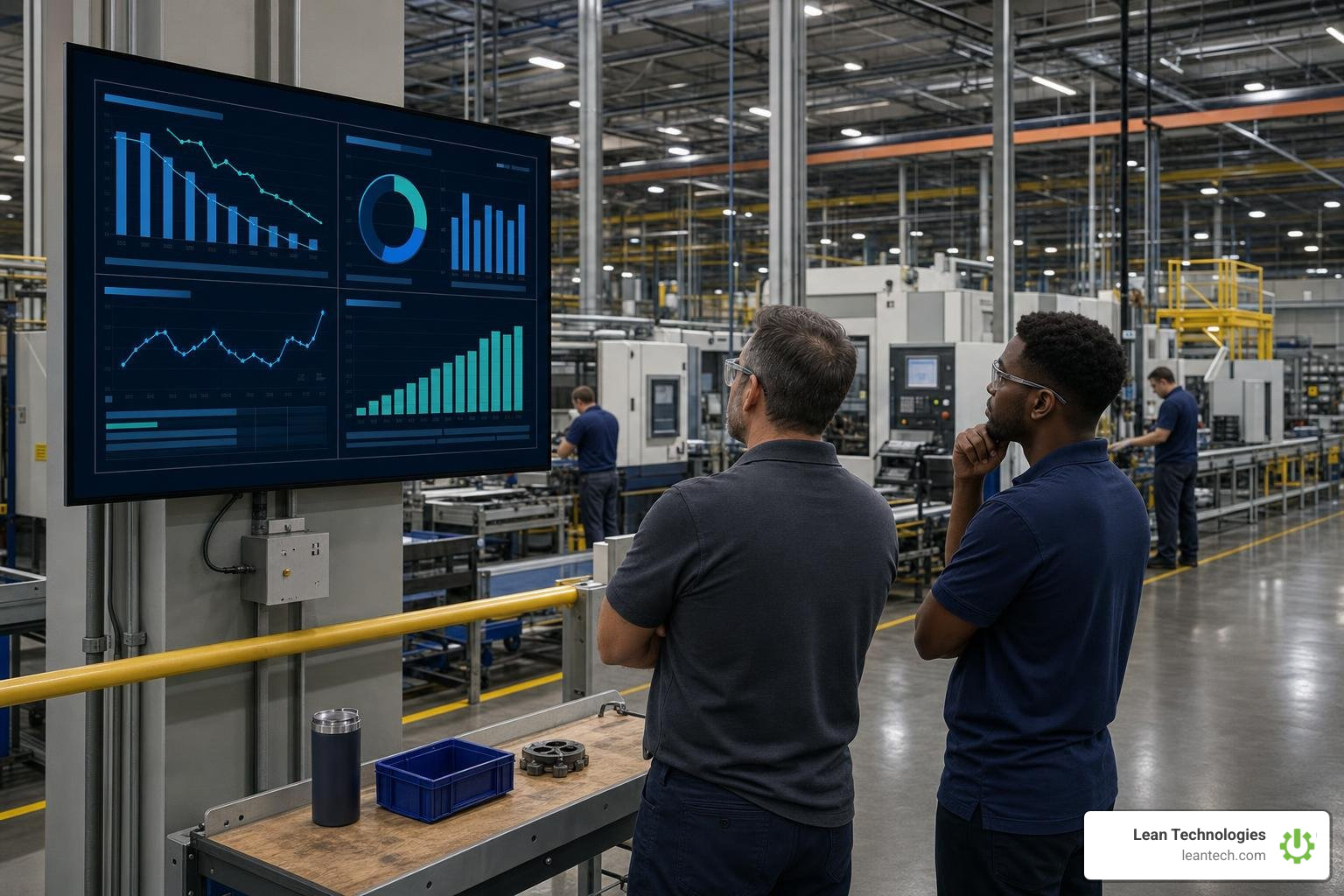
Operational metrics reflect how smoothly, safely, and predictably the plant runs on a day-to-day basis. Key operational indicators include:
Open-Action Closure Rate: The percentage of corrective actions completed within their designated target window.
Mean Time to Respond (MTTR): How quickly support functions (maintenance, quality, tooling) acknowledge and address frontline issues.
First-Pass Yield (FPY): The proportion of products manufactured correctly the first time without rework or scrap.
Unplanned Downtime Reduction: The decrease in lost production hours resulting from recurring mechanical failures or unaddressed line stoppages.
Deploying a connected Continuous improvement management system provides continuous visibility into these metrics, allowing operational teams to monitor trends in real time rather than waiting for static month-end reports.
Financial Returns and Cost Avoidance
To justify ongoing investment and expand continuous improvement across multiple facilities, operational gains must translate directly to the bottom line:
Scrap Cost Reductions: Quantifying the raw material and labor savings achieved by eliminating recurring quality defects.
Overtime Labor Containment: Reducing weekend and shift-extension overtime by clearing operational bottlenecks and accelerating changeovers.
Direct Cost Avoidance: Preventing catastrophic equipment failures by identifying minor equipment abnormalities during early operator inspections.
Payback Period: Well-targeted digital continuous improvement rollouts typically demonstrate clear positive returns within 60 to 90 days of active shopfloor adoption.
Frequently Asked Questions About Operational Excellence
How do digital workflows enhance traditional Kaizen events?
Traditional Kaizen events often suffer from post-event drop-off, where action items captured on physical flipcharts lose momentum once the team returns to daily responsibilities. Digital workflows digitize the Kaizen action list, assign owners with automated notifications, and provide leadership with visibility into post-event execution, ensuring that operational gains are sustained permanently.
Do plants need complex sensor networks to start digital CI?
No. Plants do not need extensive IoT sensor grids, automated telemetry, or expensive machine integrations to launch a highly successful continuous improvement program. Giving operators, quality techs, and supervisors structured digital tools to log downtime reasons, defect codes, and maintenance needs at the point of work delivers immediate, high-value operational visibility.
How quickly can a plant realize ROI from digital process tools?
Because modular digital toolboxes do not require complex infrastructure overhauls or extensive software coding, pilot workcells can be active within days. Plants frequently capture measurable ROI—such as a 10–20% reduction in minor stoppages and rapid closure of aging action items—within the first two to three months of active use.
What to Do Next: Building a Resilient Digital CI Ecosystem
Achieving operational excellence is an ongoing journey of structured problem-solving, active frontline engagement, and continuous learning. When manufacturing teams replace scattered notes, late spreadsheets, and unmonitored whiteboards with intuitive digital workflows, they eliminate daily friction and create an agile, accountable operating culture.
Thrive from Lean Technologies offers the fastest path to structured, accountable work processes. Built by manufacturing experts specifically for small to midsize manufacturers, Thrive provides a flexible digital toolbox for logging issues, tracking actions, and driving continuous improvement across maintenance, quality, safety, and production operations.
Thrive delivers real-time visibility when processes are structured and plant teams enter data at the source via mobile, tablet, or desktop interfaces. By organizing action around machine data entered by your team or imported from existing systems, Thrive empowers frontline operators and plant leadership to close the loop on shopfloor problems without replacing legacy ERP or MES investments.
Ready to eliminate paper workarounds, accelerate action closure, and engage your shopfloor in digital continuous improvement? Explore the Thrive Continuous Improvement Platform to discover how structured digital workflows can transform your plant operations today.