

The Definitive Guide to Job Shop Scheduling Tool Options
Choose a Job Shop Scheduling Tool That Fits Your Shop Floor
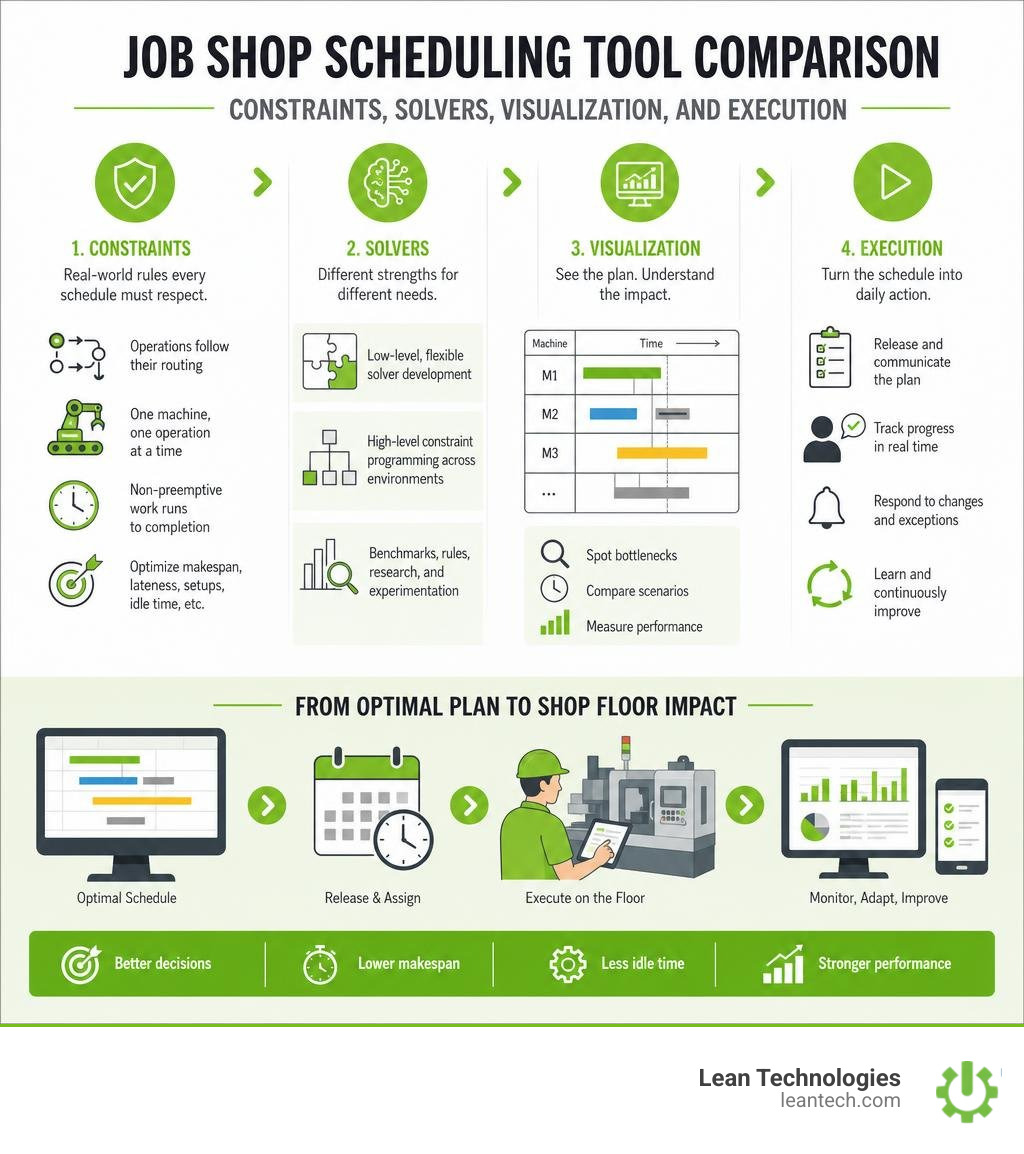
When jobs compete for the same machines, a job shop scheduling tool helps you decide what runs next, where it runs, and when it should start. For most teams, the right choice depends on the job: use OR-Tools for direct, flexible solver development; PyJobShop for higher-level constraint programming across several production environments; and JobShopLib for benchmarks, visualizations, dispatching rules, and scheduling research.
A good schedule must respect the real limits of the shop:
Operations must follow their required routing.
One machine cannot run two operations at once.
Non-preemptive work must finish once it starts.
The plan should reduce makespan, late jobs, setup time, idle time, or another business priority.
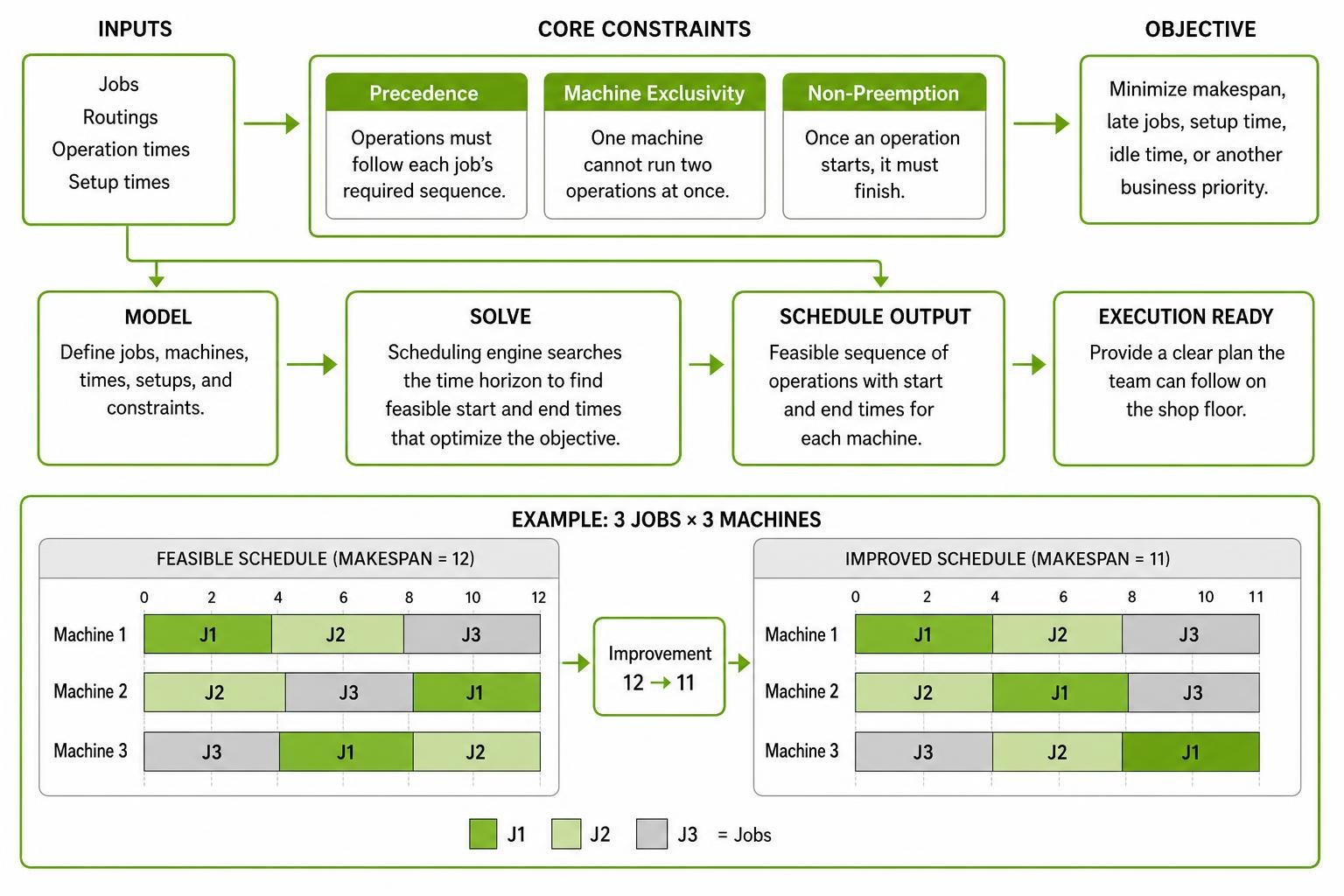
This matters because a schedule that looks workable in a spreadsheet can fail fast when a bottleneck machine, material delay, setup requirement, or urgent order changes the sequence. The classic 3-job, 3-machine example shows the gap: a schedule with a makespan of 12 can be improved to an optimal makespan of 11.
Scheduling software solves the planning problem. Execution is a separate challenge. Thrive is a digital platform built for small to midsize manufacturers to digitize lean work processes in real time without replacing ERPs or MES systems. It is a flexible digital toolbox for logging issues, tracking actions, and driving continuous improvement - not an ERP or MES. Thrive provides real-time visibility when processes are structured and people enter data at the source through mobile, tablet, or desktop. It does not collect sensor data or run predictive alerts; it organizes action around machine data entered by teams or imported from other systems.
This guide compares the leading open-source options, then shows how to connect a smarter schedule to clear daily action on the floor.
The Mechanics of the Job Shop Scheduling Problem
The job shop scheduling problem is a classic combinatorial optimization challenge. In a job shop, multiple jobs move through distinct production routes across a set of shared machines. Each job consists of an ordered sequence of tasks, and no two jobs share the exact same machine sequence. Finding an optimal schedule requires assigning every task a start and end time on its assigned machine without violating physical operational constraints.

The problem relies on three fundamental principles:
Precedence Constraints: Tasks within a single job must follow a strict sequential order. For instance, in an automotive components workflow, a metal stamping operation cannot begin until raw sheet cutting is complete, just as painting a component requires drying before assembly.
Machine Exclusivity: A single machine or work center can process only one operation at any given point in time.
Non-Preemption: Once a machine starts an operation, it must run to completion without interruption.
When tracking shop floor progress, relying on clear workflow tracking helps verify that physical operations match these mathematical dependencies.
To solve this problem computationally, mathematical models establish a search horizon. The horizon represents the total duration calculated by summing the run times of every task across all jobs. This total serves as a safe upper bound. The scheduling engine then searches within this finite time window to find start and end times that minimize overall completion duration.
Core Constraints and Resource Environments
Real-world manufacturing introduces additional complexity beyond basic machine exclusivity and task ordering:
Sequence-Dependent Setup Times: Transitioning a machine between different material types, colors, or tooling requires variable changeover periods that depend directly on the preceding job.
Release Dates and Due Dates: Raw materials arrive at predetermined times (release dates), while customers expect finished goods by strict contract deadlines (due dates).
No-Wait and Blocking Conditions: In processes like heat treatment or food processing, an operation must start immediately after the previous task finishes (no-wait). If downstream buffers are full, completed parts may physically block a machine from processing the next job.
Resource Breaks and Capacity Limits: Planned maintenance intervals, worker shift patterns, and power restrictions limit continuous machine availability.
Scheduling Objectives and Performance Metrics
Scheduling tools evaluate candidate schedules against defined operational targets. Common optimization objectives include:
Makespan Minimization: Shortening the total elapsed time from the start of the first operation to the completion of the final operation across all jobs.
Total Flow Time: Reducing the total duration jobs spend in the shop, which directly cuts down work-in-progress (WIP) inventory.
Tardiness and Lateness Reduction: Minimizing the maximum delay beyond promised customer due dates or reducing the total number of late jobs.
Earliness Penalties: Preventing premature production in just-in-time (JIT) environments where excess finished goods storage incurs holding costs.
Setup Time Reduction: Grouping similar operations to minimize total machine downtime spent on tooling changeovers.
Evaluating the Best Open-Source Job Shop Scheduling Tool Options
For teams building internal optimization tools or seeking mathematical control over their schedules, open-source Python libraries offer powerful solving capabilities. The following table highlights the core differences among the top options available as of August 2026.
Feature / Metric | Google OR-Tools (CP-SAT) | PyJobShop | JobShopLib |
|---|---|---|---|
Primary Approach | Constraint Programming Solver | Declarative CP-SAT / CP Optimizer wrapper | Graph Neural Networks, Dispatching Heuristics, CP-SAT |
Problem Types | Classical Job Shop, Flexible Job Shop, Custom | Flexible Job Shop, Flow Shop, Hybrid, RCPSP (10+ types) | Classical Job Shop, Flexible Job Shop |
Objective Functions | Custom algebraic formulations | 7 standard objectives (Makespan, Tardiness, Flow Time, etc.) | Makespan, Heuristic priority rules |
Visualizations | Manual (Matplotlib / Plotly scripts) | Built-in Gantt chart plotting | Matplotlib Gantt charts, GIFs, Disjunctive Graphs |
Standard Benchmarks | Manual data ingestion | Custom problem loader | Built-in (FT06, LA01-40, TA01-80, etc.) |
GitHub Stats | Industry standard engine | 140 stars, 24 forks | 93 stars, 16 forks, 1000+ commits |
Best For | Low-level algorithm design & maximum solver control | Complex industrial scheduling across varied environments | Academic research, AI/RL models, and quick benchmarking |
Google OR-Tools CP-SAT as a Job Shop Scheduling Tool
Google OR-Tools is an open-source software suite for combinatorial optimization. Its Constraint Programming SAT (CP-SAT) solver translates scheduling logic into boolean satisfiability problems, delivering speed for discrete scheduling challenges.
To model a job shop in OR-Tools, you define operations using integer variables for start times, processing durations, and end times. These variables combine into interval variables. The model uses:
AddNoOverlap: Enforces machine exclusivity by ensuring interval variables on the same machine never share timestamps.
Precedence Expressions: Constrains start times so that a later task cannot begin before the previous task ends, enforcing sequential task routing.
For a benchmark problem with 3 jobs, 3 machines, and 8 discrete tasks, OR-Tools CP-SAT finds the optimal makespan of 11 in under a second. Developers can consult the official The Job Shop Problem | OR-Tools - Google for Developers guide for complete multi-language API references.
PyJobShop: High-Level Constraint Programming Modeling
PyJobShop/PyJobShop provides a Python modeling interface for complex production scheduling. Instead of requiring users to construct raw mathematical constraint equations, PyJobShop offers a declarative API tailored directly to industrial terminology.
The library supports over 10 distinct scheduling problem types, including:
Flexible job shops (where operations can choose from multiple capable machines)
Hybrid flow shops and permutation flow shops
Resource-Constrained Project Scheduling Problems (RCPSP) with renewable and consumable resources
PyJobShop supports 7 built-in objective functions, such as minimizing makespan, total flow time, number of tardy jobs, total tardiness, maximum tardiness, total earliness, and sequence setup times. It uses Google OR-Tools CP-SAT as its default solver and also supports IBM ILOG CP Optimizer. Explore the GitHub - PyJobShop/PyJobShop: Solve production scheduling problems with constraint programming in Python. · GitHub repository for installation steps and documentation.
JobShopLib: A Graph-Based Job Shop Scheduling Tool
Pabloo22/jobshoplib is a modular Python library built for creating, solving, and visualizing job shop problems using both classical optimization and artificial intelligence.
JobShopLib provides solvers across four distinct paradigms:
Constraint Programming: Integration with Google OR-Tools CP-SAT.
Priority Dispatching Rules: Fast heuristic sequencing rules like Shortest Processing Time and Most Work Remaining.
Metaheuristics: Simulated annealing algorithms for exploring large solution spaces.
Graph Neural Networks (GNNs): Custom Gymnasium reinforcement learning environments that model scheduling via Resource-Task Graphs and Disjunctive Graphs.
The library includes benchmark datasets from 8 historical sources, including Fisher and Thompson (FT06, FT10), Lawrence (LA01–LA40), and Taillard (TA01–TA80). For example, it provides the standard FT06 instance, which has a known optimal makespan of 55.
Optimization Algorithms: Heuristics, Constraint Programming, and AI
Solving job shop schedules involves balancing computational speed against solution quality. Different operational situations call for different algorithmic strategies.

Priority Dispatching Rules
Priority dispatching rules (PDRs) assign work sequentially whenever a machine becomes idle. They process immediate task queues using simple ranking logic:
Shortest Processing Time (SPT): Prioritizes the operation with the shortest duration. This reduces localized queue build-up and lowers average WIP.
Most Work Remaining (MWKR): Selects the job that has the largest sum of remaining processing times across all subsequent tasks. This keeps long-running jobs moving.
First-Come, First-Served (FCFS): Sequences jobs based strictly on their arrival time at the machine buffer.
Largest Processing Time (LPT): Allocates the longest jobs first, which can help clear heavy operations early during a production shift.
While dispatching rules execute in milliseconds, they make myopic decisions. Because they do not evaluate downstream bottleneck interactions, their final makespan is often 10% to 30% longer than an optimal constraint programming schedule. When prioritizing work on the shop floor, maintaining a structured work request queue helps teams organize incoming demands before applying sequencing rules.
Constraint Programming and Exact Solvers
Constraint programming (CP) solvers, such as CP-SAT, systematically evaluate the global search space. They use constraint propagation—reducing the allowable time windows of unassigned tasks whenever an operation is placed—combined with branch-and-bound search trees.
Unlike heuristic rules, CP solvers provide mathematical guarantees: they either find the proven optimal schedule or return the mathematically best feasible schedule along with a known optimality gap within a specified time limit.
Graph Neural Networks and Reinforcement Learning
Modern scheduling research uses Graph Neural Networks (GNNs) and Deep Reinforcement Learning (DRL) to address dynamic shop environments. By representing a factory as a graph—where operations are nodes and machine sharing creates disjunctive edges—neural networks can learn sequencing policies from thousands of simulated production runs.
Once trained, an RL agent evaluates the shop state and selects the next dispatching action in milliseconds. This provides near-optimal decision quality while adapting dynamically to sudden disruptions on the line.
Connecting Job Shop Schedules to Real-Time Shopfloor Execution
An optimized schedule on a computer screen does not manufacture parts on its own. In many plants, an optimization model produces a production plan, but the schedule breaks down within hours due to paper workarounds, late downtime logs, and unclosed continuous improvement loops.
Solving the execution gap requires a connected manufacturing operations management platform approach where planned schedules align with daily execution.
Translating Optimized Schedules into Daily Shopfloor Actions
When an optimization tool determines the ideal task sequence, operators need a clear way to view and execute that plan. Displaying queues through a visual kanban board tool gives operators clear visibility into what to run next, reducing reliance on manual paper travel tickets.
Thrive acts as the fastest path to structured, accountable work processes by digitizing shop floor workflows in real time. Rather than replacing existing ERP or MES systems, Thrive operates as a flexible digital toolbox. Operators access job instructions, log process progress, and record quality verifications directly via mobile phones, tablets, or desktop stations right at their work centers.
Handling Unplanned Downtime and Dynamic Rescheduling
No matter how advanced your solver is, unexpected disruptions happen:
A cutting tool snaps on a primary CNC mill.
A raw material shipment arrives two hours late.
An operator calls in sick, temporarily reducing capacity in deburring.
When machine stoppages occur, logging maintenance delays and viewing past asset performance through a structured work order history prevents operational blind spots.
Thrive provides real-time visibility only when processes are structured and data is entered at the source via mobile, tablet, or desktop. It does not collect sensor data or run predictive alerts; instead, it organizes action from machine data entered by teams or imported from other systems. When an operator logs an unexpected breakdown, the continuous improvement loop activates immediately: maintenance receives an assigned task, supervisors assess the queue delay, and the scheduling tool updates with realistic machine availability parameters.
Frequently Asked Questions About Job Shop Scheduling
What is makespan in job shop scheduling?
Makespan is the total duration of time that elapses from the start of the very first operation of the first job until the final operation of the last job is completely finished. Minimizing makespan maximizes machine utilization and increases total factory throughput.
How do priority dispatching rules compare to exact CP-SAT solvers?
Priority dispatching rules (like SPT or MWKR) execute instantly and are easy to implement, but they make local decisions that can cause downstream bottlenecks and longer schedules. Exact CP-SAT solvers evaluate all factory constraints globally, producing mathematically optimal schedules at the cost of higher computation time for large job volumes.
How do graph neural networks improve job shop scheduling?
Graph Neural Networks represent manufacturing operations and machines as nodes and edges in a graph structure. By training on thousands of scheduling variations using reinforcement learning, GNNs learn dynamic scheduling policies that execute in milliseconds while achieving schedule quality close to exact solvers.
What to do next: Choosing the Right Scheduling Approach for Lean Operations
Building an efficient shop floor requires combining algorithmic planning with accountable execution:
Assess your mathematical complexity: If your shop has simple linear flows, heuristic dispatching rules may suffice. For complex, multi-machine routing with sequence-dependent setups, adopt a constraint programming framework like PyJobShop or Google OR-Tools.
Standardize data collection at the source: Optimization models are only as accurate as their input assumptions. Eliminate paper logs and undocumented floor delays so that task runtimes and setup durations reflect actual floor performance.
Equip your team with a flexible lean toolbox: Pair your scheduling models with structured floor execution. Explore our Guide to Digital Lean Manufacturing to learn how connecting structured digital workflows, mobile issue logging, and action tracking creates a resilient, high-performing shop floor.
By selecting the right open-source job shop scheduling tool and supporting it with disciplined shopfloor execution, your plant can minimize makespan, eliminate bottlenecks, and deliver on time.