

An Essential Guide to Preventive & Periodic Maintenance Scheduling
Why Preventive and Periodic Maintenance Matter on the Shop Floor
When a critical machine stops without warning, production schedules slip, teams scramble for parts, and managers are left chasing updates. Preventive and periodic maintenance help avoid that cycle by finding and addressing wear before it becomes a breakdown.
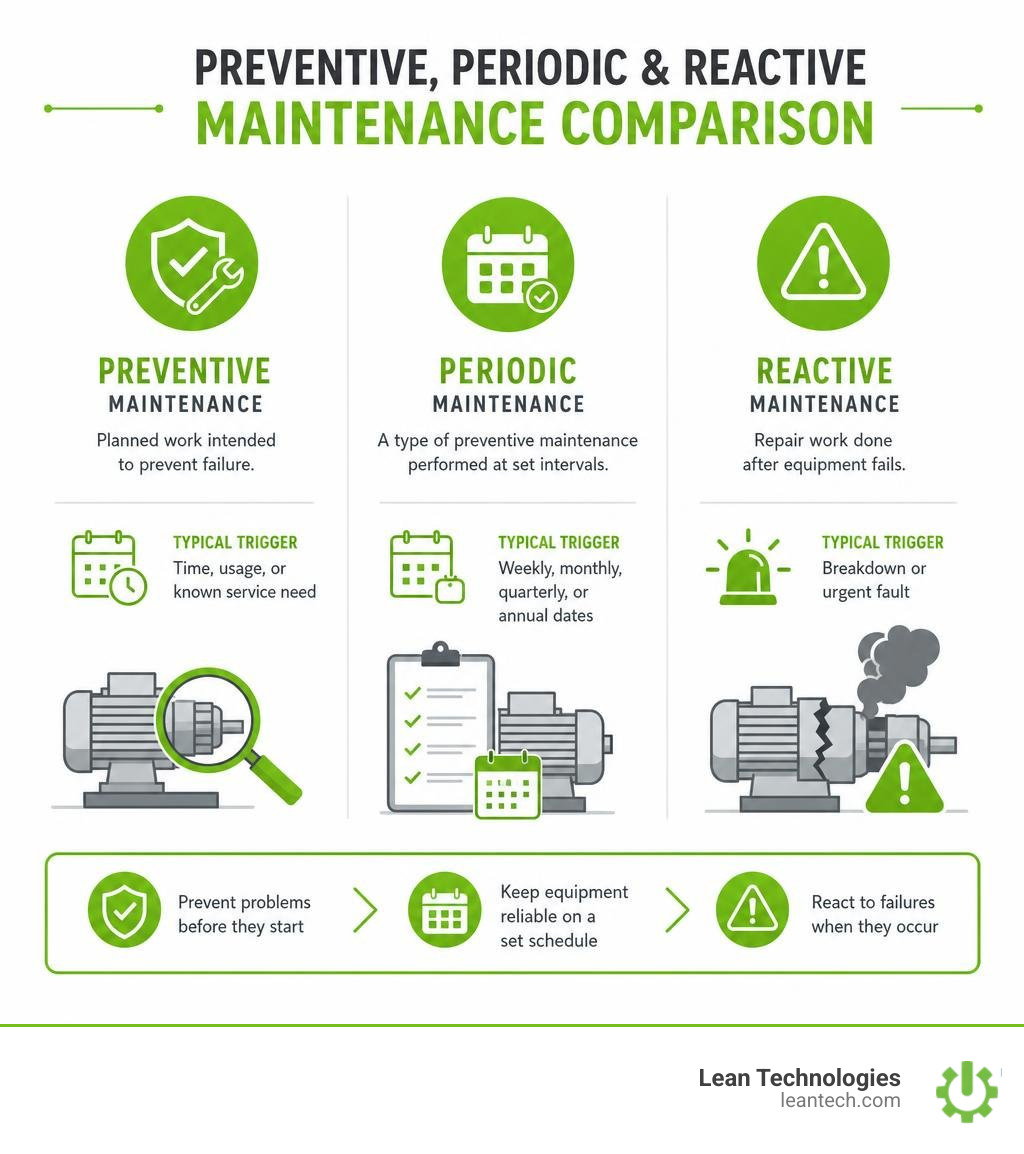
Maintenance type What it means Typical trigger Preventive maintenance Planned work intended to prevent failure Time, usage, or known service need Periodic maintenance A type of preventive maintenance performed at set intervals Weekly, monthly, quarterly, or annual dates Reactive maintenance Repair work done after equipment fails Breakdown or urgent fault
Put simply, periodic maintenance is preventive maintenance on a calendar-based schedule. It may include inspections, cleaning, lubrication, calibration, and planned replacement of wear parts. Preventive maintenance can also be triggered by run hours, production cycles, mileage, or equipment condition.
The difference matters because fixed schedules are not always the right answer for every asset. A low-risk fan may only need periodic checks, while a bottleneck machine may need service based on runtime, inspection findings, and failure history. Inadequate maintenance can reduce a company's production capacity by as much as 20%, so choosing the right trigger is an operations decision, not just a maintenance task.
For small and midsize manufacturers, the bigger challenge is often execution. Work requests sit in messages, paper checklists disappear, and machine issues stay disconnected from the people who need to act. Thrive is a digital platform built for small to midsize manufacturers to digitize lean work processes in real time without replacing ERP or MES systems. It is a flexible digital toolbox for logging issues, tracking actions, and driving continuous improvement - not an ERP or MES system.
Thrive organizes action from machine data entered by teams or imported from other systems; it does not collect sensor data or run predictive alerts. It provides real-time visibility only when processes are structured and data is entered at the source through mobile, tablet, or desktop.
Understanding Preventive and Periodic Maintenance
Core Fundamentals of Preventive and Periodic Maintenance
At its core, preventive and periodic maintenance represents a strategic shift from waiting for assets to break to systematically keeping them in operating order. Every machine begins to wear out from the moment it is installed. Proactive servicing manages that aging process, protecting asset availability and operational output.
Preventive maintenance (PM) encompasses all planned servicing designed to anticipate failures and extend asset lifespans. Periodic maintenance fits squarely inside this umbrella as a specialized, time-based subset. When teams execute periodic servicing—such as changing compressor filters every 30 days or performing annual electrical distribution checks—they rely on fixed calendar cadence to uphold asset reliability.

Understanding the distinction between these terms helps teams choose the right strategy for each asset:
Preventive Maintenance (PM): The overall umbrella of proactive work intended to minimize unplanned downtime. Triggers include calendar time, operating hours, production cycles, or condition readings.
Periodic Maintenance: Fixed-interval preventive maintenance anchored purely to calendar units (e.g., weekly, monthly, quarterly, or annually).
Failure Prevention Goal: Ensuring assets perform safely and within quality limits without unexpected catastrophic stops.
Comparing Time-Based and Usage-Based Triggers
Choosing how to trigger maintenance tasks impacts both operational performance and maintenance spend. Setting arbitrary calendar dates on high-use equipment can lead to under-maintenance during peak production shifts or over-maintenance when machines sit idle.
Time-based triggers work best for assets with steady, predictable usage patterns or strict regulatory mandates. However, meter-based or usage-based triggers anchor maintenance to actual machine work—such as operating hours, stroke counts, or miles driven.
To fine-tune schedule execution, maintenance managers must also choose between fixed and floating schedules:
Fixed Scheduling: Tasks trigger on predefined calendar dates regardless of when the previous service was actually completed. If a monthly task due on the 1st is completed on the 5th, the next work order is still due on the 1st of the following month.
Floating Scheduling: The next task due date is calculated relative to the completion date of the last work order. If a 30-day task is completed on May 5th, the next event shifts to June 4th. This prevents unnecessary, closely stacked work orders when maintenance falls behind schedule.
Tracking Mean Time Between Failures (MTBF) helps teams optimize these service intervals. If historical MTBF data shows an impeller bearing consistently degrades after 4,000 run hours, setting a meter-based service trigger at 3,500 hours prevents unexpected breakdowns without incurring early maintenance costs.
The Spectrum of Proactive Maintenance Strategies
Modern industrial plants deploy a spectrum of proactive maintenance methodologies. Understanding where periodic maintenance sits relative to advanced techniques enables teams to build a balanced, cost-effective maintenance strategy.
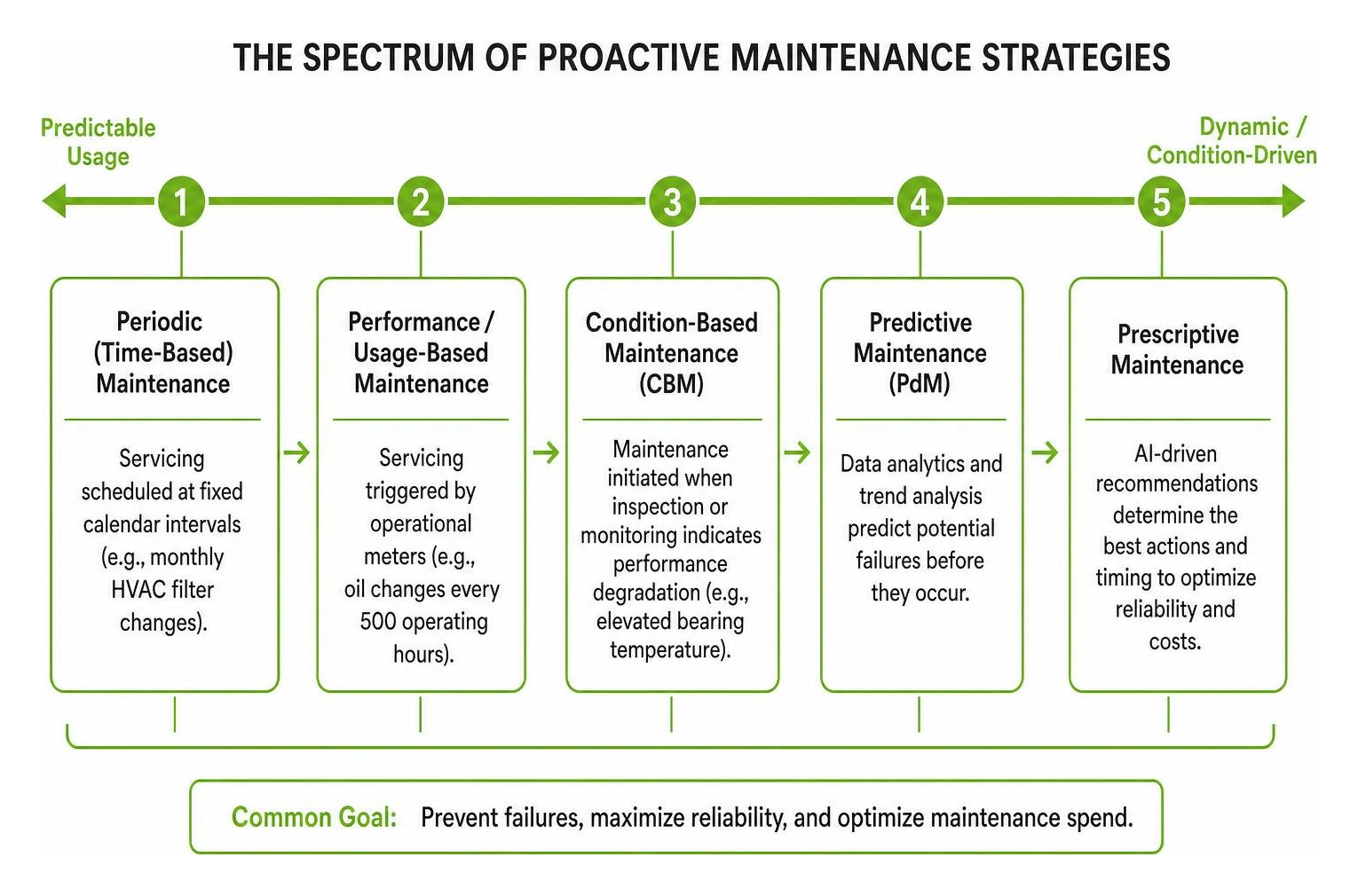
The spectrum includes five distinct approaches:
Periodic (Time-Based) Maintenance: Servicing scheduled at fixed calendar intervals (e.g., monthly HVAC filter changes).
Performance/Usage-Based Maintenance: Servicing triggered by operational meters (e.g., oil changes every 500 operating hours).
Condition-Based Maintenance (CBM): Maintenance initiated when real-time or manual inspection indicates performance degradation (e.g., elevated bearing temperature).
Predictive Maintenance (PdM): Using statistical modeling and trend analysis to predict exact failure windows before breakdown occurs.
Prescriptive Maintenance: Advanced software analysis that recommends specific corrective actions based on operational machine data.
Maintenance Strategy Trigger Source Relative Implementation Cost Primary Ideal Use Case Periodic Maintenance Fixed calendar time Low General facility systems, safety checks, electrical panels Usage-Based Maintenance Run hours, cycles, mileage Moderate Heavy production assets with variable production runs Condition-Based Maintenance Measured degradation thresholds Moderate to High Bottleneck equipment subject to environmental wear Predictive Maintenance Advanced trend & failure modeling High High-capital, continuous-process machinery Prescriptive Maintenance AI-driven action recommendations Very High Specialized enterprise-level multi-plant operations
To prioritize which strategy fits each asset, maintenance teams often use the Risk Priority Number (RPN) calculation:
$$\text{RPN} = \text{Severity (1–10)} \times \text{Occurrence (1–10)} \times \text{Detection (1–10)}$$
Assets with high RPN scores warrant multi-layered PM strategies, while non-critical assets with low RPN scores can be managed with simple periodic checklists or run-to-failure strategies.
Key Business Benefits and Industry Benchmarks
Key Advantages of Preventive and Periodic Maintenance
Transitioning away from emergency reactive repairs yields significant, measurable financial returns. When operations run reactively, emergency repairs cost up to three to four times more than scheduled interventions due to expedited shipping fees, overtime labor rates, and lost production capacity.
Standard industry benchmarks show that a comprehensive maintenance strategy delivers significant operational savings:
Production Capacity: Avoiding unmanaged equipment degradation protects production throughput, preventing the estimated 20% capacity loss typical of under-maintained plants.
Planning ROI: Every dollar invested in upfront task planning saves between three and five dollars during work execution.
Labor Efficiency: A well-planned maintenance job takes approximately half the time to execute compared to an unplanned emergency breakdown response.
Energy and Fuel Economy: Proper upkeep directly influences energy efficiency. For example, commercial tires running just 10 pounds underinflated can reduce fuel economy by up to one percent, while ungreased S-cams cause power drag and excess fuel burn.
Critical Standards for Maintenance Schedule Compliance
Achieving operational stability requires tracking specific maintenance key performance indicators (KPIs). According to loss prevention guidelines detailed in Maintenance Program Elements, high-performing manufacturing facilities maintain strict targets:
85% Proactive Benchmark: At least 85% of all maintenance work performed across the plant should be proactive (preventive, periodic, or predictive), keeping reactive work below 15%.
95% PM Schedule Compliance: High-reliability facilities achieve at least 95% schedule compliance on preventive and predictive work orders.
85% Overall Schedule Compliance: Total work order execution compliance across all task categories should consistently meet or exceed 85%.
Wrench Time Target: Direct active maintenance execution time (wrench time) should aim for a benchmark of 55% of technician paid hours.
Backlog Control: Healthy maintenance work order backlogs should remain tightly controlled between two and four weeks of total capacity.
Unscheduled Downtime: Unscheduled equipment downtime should remain at or below 2% of total operational run hours.
Maintaining proper organizational span-of-control staffing ratios is equally crucial. World-class facilities maintain approximately 1 supervisor for every 10 technicians (ranging from 1:8 to 1:15) and 1 maintenance planner/scheduler for every 20 technicians (ranging from 1:12 to 1:30).
How to Build an Effective Maintenance Schedule
Step 1: Asset Inventory and Risk Prioritization
Building an effective maintenance program starts with creating a thorough, structured asset inventory. Missing assets lead directly to unallocated maintenance budgets, unassigned labor hours, and unexpected equipment failures.
To establish proper Equipment Asset Tracking, teams should systematically categorize every piece of equipment on the shop floor:
Assemble Asset Hierarchy: Log parent-child relationships for machinery (e.g., Stamping Press Line 1 to Hydraulic Power Unit to Pump Motor).
Gather OEM Baseline Specifications: Collect original equipment manufacturer manuals, baseline operating parameters, recommended service intervals, and safety mandates.
Evaluate Asset Criticality: Calculate RPN scores for every asset to categorize equipment into critical, major, and balance-of-plant tiers.
Determine Maintenance Strategy: Match asset criticality to the right strategy—applying usage-based or condition monitoring to bottleneck equipment and simple periodic schedules to balance-of-plant systems.
Step 2: Task Definition and Work Order Planning
Once assets are categorized, maintenance planners must define exact procedures for every recurring work order. Scheduling a task without proper planning often results in delayed work and poor execution quality due to missing parts, missing tools, or unclear steps.

A comprehensive Planned Maintenance program depends on clear distinctions between planning and scheduling:
Maintenance Planning: Determines what work will be done and how it will be executed. Planners compile Standard Operating Procedures (SOPs), safety protocols, required tools, bill of materials (BOM), torque specifications, and clearance steps.
Maintenance Scheduling: Determines who will do the work and when it will occur based on operational availability, shift patterns, and technician skill sets.
For specialized equipment, planners should align checklists with governing standards. For example, electrical infrastructure maintenance should follow the guidelines in Standard for an Electrical Prevention Maintenance (EPM) Program or the Maintenance (EPM) Program guidelines published by engineering insurers.
These standards emphasize that more than two-thirds of electrical failures are preventable with planned upkeep. Key practices include:
Vacuuming switchgear interiors rather than using compressed air, which can embed conductive particles into fragile insulation.
Applying antioxidant compounds to copper-to-aluminum electrical connections.
Performing annual dielectric screen testing and dissolved gas analysis (DGA) on liquid-filled transformers.
Enforcing strict Lockout/Tagout (LOTO) protocols, Electrical Work Program (EWP) rules, and Energy Control Procedures (ECP) prior to servicing live machinery.
For broad asset coverage, teams can leverage structured checklists to standardize task execution across HVAC, mechanical, plumbing, and life-safety systems. Technical guidance for low-voltage switchgear can also be referenced via TECHNICAL standards like IEC TR 63482.
Step 3: Labor Allocation and Inventory Management
A major source of maintenance inefficiency is technician travel time and waiting for spare parts. Effective labor management requires coordinating technician schedules while ensuring required spare parts are stocked and staged ahead of time.

To optimize labor allocation and materials:
Implement Integrated Parts Management: Link work orders directly to Parts Management systems. Automatically generate purchase requisitions when stock hits reorder points so critical parts are available before planned downtime begins.
Optimize Maintenance Technician Routes: Group periodic tasks geographically across the plant floor. As noted in technical directives like Maintenance Management Order, grouping inspections of adjacent components—such as steam traps, valves, and air handlers—reduces technician transit time between jobs.
Match Technician Skill Levels: Align work order complexity with certified skill levels (e.g., assigning high-voltage transformer testing exclusively to master electricians) to ensure safety and quality compliance.
Executing Maintenance Workflows on the Shop Floor
Streamlining Work Requests and Backlog
Even well-designed maintenance schedules can break down if shopfloor communication relies on verbal handoffs, paper forms, or messy spreadsheets. When operators spot minor machine anomalies, those findings must be captured immediately before they escalate into major equipment failure.

A modern digital workflow structures the handoff between operations and maintenance:
Issue Logging: Operators log equipment issues, leaks, or unusual noises directly through an intuitive digital interface on the shop floor.
Queue Prioritization: Maintenance leads triage incoming items in the central Work Request Queue, converting valid requests into planned work orders.
Backlog Management: Work orders are categorized by urgency and added to the backlog, ensuring critical safety and production work takes priority over cosmetic tasks.
Historical Asset Tracking: Reviewing complete Work Order History inside a digital system or cmms allows teams to identify recurring equipment issues and refine periodic maintenance intervals.
Analyzing Maintenance Performance and Gaps
To keep maintenance programs effective over time, leaders must regularly evaluate execution performance against target KPIs. Tracking operational data reveals whether tasks are being completed on time or sitting in unassigned backlogs.
Key metrics to track include:
Scheduled Maintenance Critical Percent (SMCP): Prioritizes delayed work orders based on how late they are relative to their routine cycle interval.
Mean Time To Repair (MTTR): Measures technician efficiency and job preparation quality during repair events.
PM-to-Reactive Work Ratio: Verifies that at least 85% of total plant workhours remain proactive.
Teams can systematically audit performance by running a Pm Gap Report to surface overdue tasks, missing parts, or unassigned maintenance routes. Testing team knowledge using tools like the Pm Gap Report Quiz helps ensure supervisors and planners understand how to analyze backlog trends and maintain audit readiness across all shifts.
Frequently Asked Questions About Preventive and Periodic Maintenance
What is the difference between preventive maintenance and periodic maintenance?
Preventive maintenance is an overall proactive strategy aimed at preventing equipment failure before it occurs. It includes any planned task triggered by time, usage hours, production cycles, or condition monitoring.
Periodic maintenance is a specific sub-category of preventive maintenance that relies strictly on fixed calendar intervals—such as weekly, monthly, quarterly, or annual schedules—regardless of how much or how little the equipment was used during that timeframe.
How often should periodic maintenance be performed?
Periodic maintenance frequencies should be established using baseline Original Equipment Manufacturer (OEM) guidelines, historical Mean Time Between Failures (MTBF) data, regulatory requirements, and environmental operating conditions.
Assets running in harsh environments (such as high dust, moisture, or extreme temperatures) or assets operating on 24/7 continuous schedules require more frequent periodic checks than equipment running intermittently in climate-controlled environments.
What compliance targets define a well-maintained facility?
A well-maintained manufacturing facility typically operates against the following quantitative industry standards:
85% Proactive Work Ratio: At least 85% of total maintenance workhours are spent on planned proactive maintenance, with reactive work kept below 15%.
95% PM Schedule Compliance: At least 95% of scheduled preventive and predictive maintenance tasks are completed on time within their defined compliance window.
85% Overall Schedule Compliance: Total work order calendar adherence across all maintenance activities reaches 85% or higher.
55% Wrench Time: Maintenance technicians achieve 55% or higher active execution time during paid shifts.
2 to 4 Weeks Backlog: Total maintenance work backlog is kept controlled between two and four weeks of operational capacity.
What to do next
Establishing an effective schedule for preventive and periodic maintenance is one of the most reliable ways to protect plant capacity, improve workplace safety, and reduce operating costs. Moving away from reactive repairs requires clear asset tracking, planned work orders, structured labor allocation, and continuous KPI monitoring.
For small to midsize manufacturers, digitizing maintenance routines does not require expensive, multi-year enterprise software installations. Thrive is a digital platform built for small to midsize manufacturers to digitize lean work processes in real time without replacing ERP or MES systems. Positioned as a flexible digital toolbox for logging issues, tracking actions, and driving continuous improvement, Thrive provides real-time visibility only when processes are structured and data is entered at the source via mobile, tablet, or desktop.
By organizing action from machine data entered by teams or imported from other systems, Thrive helps operations and maintenance teams collaborate seamlessly on the shop floor to establish robust preventive and periodic maintenance. Explore Lean Tech's Planned Maintenance Solutions today to streamline your work order workflows and eliminate unplanned downtime.