

In Depth Guide to SAP PM Process
Before executing work in SAP PM, you must establish an accurate master data foundation. Master data mirrors your physical plant structure inside the ERP system. If master data is incomplete or incorrectly built, maintenance plans fail to schedule properly, spare parts won't map to assets, and cost center accounting gets distorted.
A structured master data model follows a 6-phase setup sequence. It begins with establishing locations and physical assets, followed by classification, measurement points, work centers, task lists, and finally maintenance plans. For a detailed roadmap on structural data setup, consult this SAP PM Master Data Overview. To learn more about modern computerized maintenance architecture, review standard cmms software concepts.
Functional Locations vs. Equipment Master
SAP PM distinguishes clearly between standard spatial locations and individual physical assets:
Functional Locations (IFLOT table): Represent static functional or spatial zones in a plant hierarchy (e.g.,
Plant 1010 to Packaging Line 2 to Sealing Area). They allow companies to aggregate maintenance costs and track operational history by location over decades, regardless of which physical machine is installed there.Equipment Master (EQUI table): Represents individual, physical machines or components (e.g., an industrial pump or motor with a specific serial number) that can be installed, dismantled, repaired, or moved between different functional locations.
Maintaining a clean separation preserves equipment installation history. When an electric motor fails and is swapped out for repair, its historical downtime, repair costs, and run hours remain tied to that specific equipment serial number. Meanwhile, the functional location maintains a complete log of all work performed at that operational position.
Maintenance Task Lists and BOMs
Task lists and Bills of Materials (BOMs) standardize work execution and material requirements across plant assets:
Maintenance Task Lists (PLKO table): Reusable sequences of maintenance operations detailing step-by-step instructions, required labor crafts, work center capacity requirements, and estimated duration. Standard usage code 4 indicates a Plant Maintenance task list.
Maintenance Bills of Materials (BOMs): Structured lists of spare parts and components assigned to equipment or functional locations. Standard usage code 3 is used for maintenance BOMs.
When a technician attaches a task list to a work order, the system automatically pulls linked BOM components into the order as reserved materials (RESB table). Standardized catalog structures—including damage codes, object parts, and cause codes—ensure technicians record accurate failure data instead of typing generic notes.
End-to-End Execution of the SAP PM Process
The standard sap pm process follows a clear multi-step lifecycle connecting physical maintenance events to financial control.
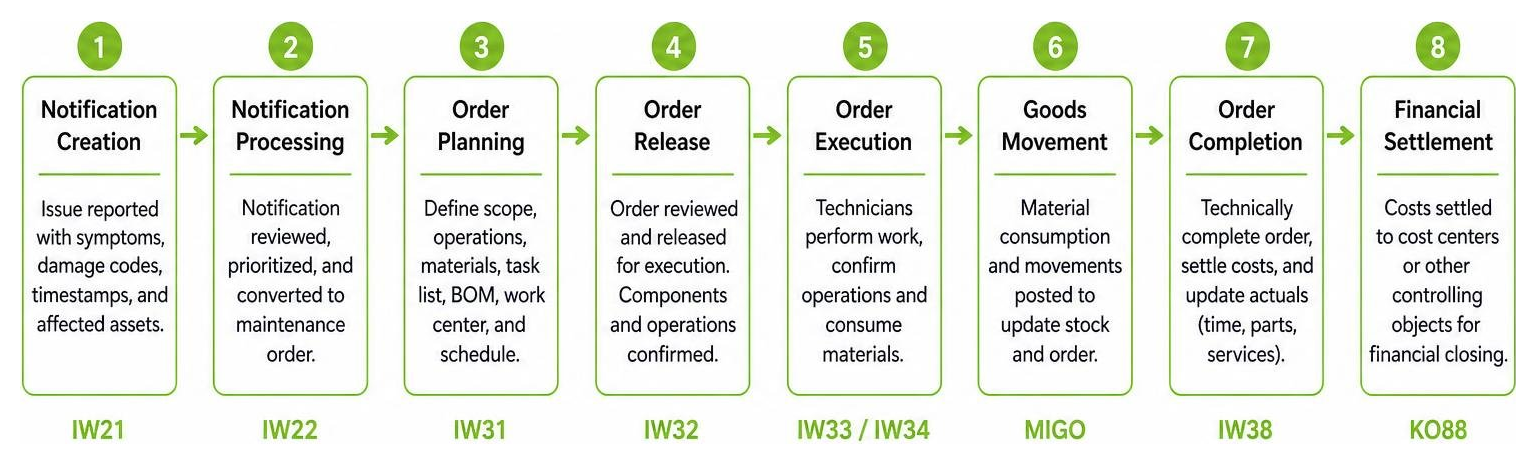
Understanding each stage ensures maintenance actions on the shop floor reflect accurately in executive dashboards. For complete transactional process flows, explore this detailed SAP PM Process Overview and see how tracking complete asset records benefits overall work order history tracking.
Mastering the Core SAP PM Process Steps
Notification Creation (IW21): A malfunction or service request is reported, capturing failure symptoms, damage codes, breakdown timestamps, and affected assets (QMEL table).
Order Conversion & Planning (IW31/IW32): The planner screens the notification and converts it into a formal maintenance work order (AUFK table). Operations, labor hours, internal work centers, external services, and spare parts are assigned.
Scheduling & Work Center Capacity Planning: The order is scheduled against available work center capacity and released for shop floor execution.
Goods Issue (MIGO): Spare parts reserved for the maintenance order are picked from inventory and issued using Movement Type 261, transferring inventory value directly to the order cost collector.
Work Confirmation (IW41/IW42): Maintenance technicians log actual hours worked, operational notes, final breakdown status, and variance details.
Technical Completion (TECO): Once physical work and testing are complete, the order is set to TECO, locking further operational changes while leaving it open for financial transactions.
Order Settlement (KO88): Financial accounting runs order settlement, transferring accumulated labor, material, and external service costs from the work order to the target cost center or asset account (COEP table).
Maintenance Notifications vs. Maintenance Orders
Understanding the difference between notifications and orders is essential for operational discipline:
Maintenance Notification: A demand entry document. It acts as the initial call for action, capturing what happened, where it occurred, when it started, and why the equipment stopped. It does not carry financial costs or reserve materials directly.
Maintenance Order: An execution and financial document. It plans and executes the work, detailing who will fix the issue, how it will be repaired, what parts are required, and how much the intervention will cost.
Key Transaction Codes in the SAP PM Process
Phase Transaction Code Function / Description Notifications IW21 / IW22 / IW23 Create, Change, and Display Maintenance Notifications IW28 / IW29 List Display of Notifications (Multi-selection editing) Maintenance Orders IW31 / IW32 / IW33 Create, Change, Plan, Release, and TECO Maintenance Orders IW38 / IW39 Mass selection and status management for Work Orders Time Confirmations IW41 / IW42 Single-operation or mass time confirmation for maintenance labor Preventive Maintenance IP01 / IP02 / IP03 Create, Change, and Display Maintenance Plans IP10 / IP30 Schedule Maintenance Plan / Execute Deadline Monitoring Batch Goods Movements MIGO / MB26 Goods Issue (Movement Type 261) and Picking List processing Cost Settlement KO88 / CO88 Individual or mass financial settlement of orders to Cost Centers
Maintenance Types and Preventive Strategy Setup
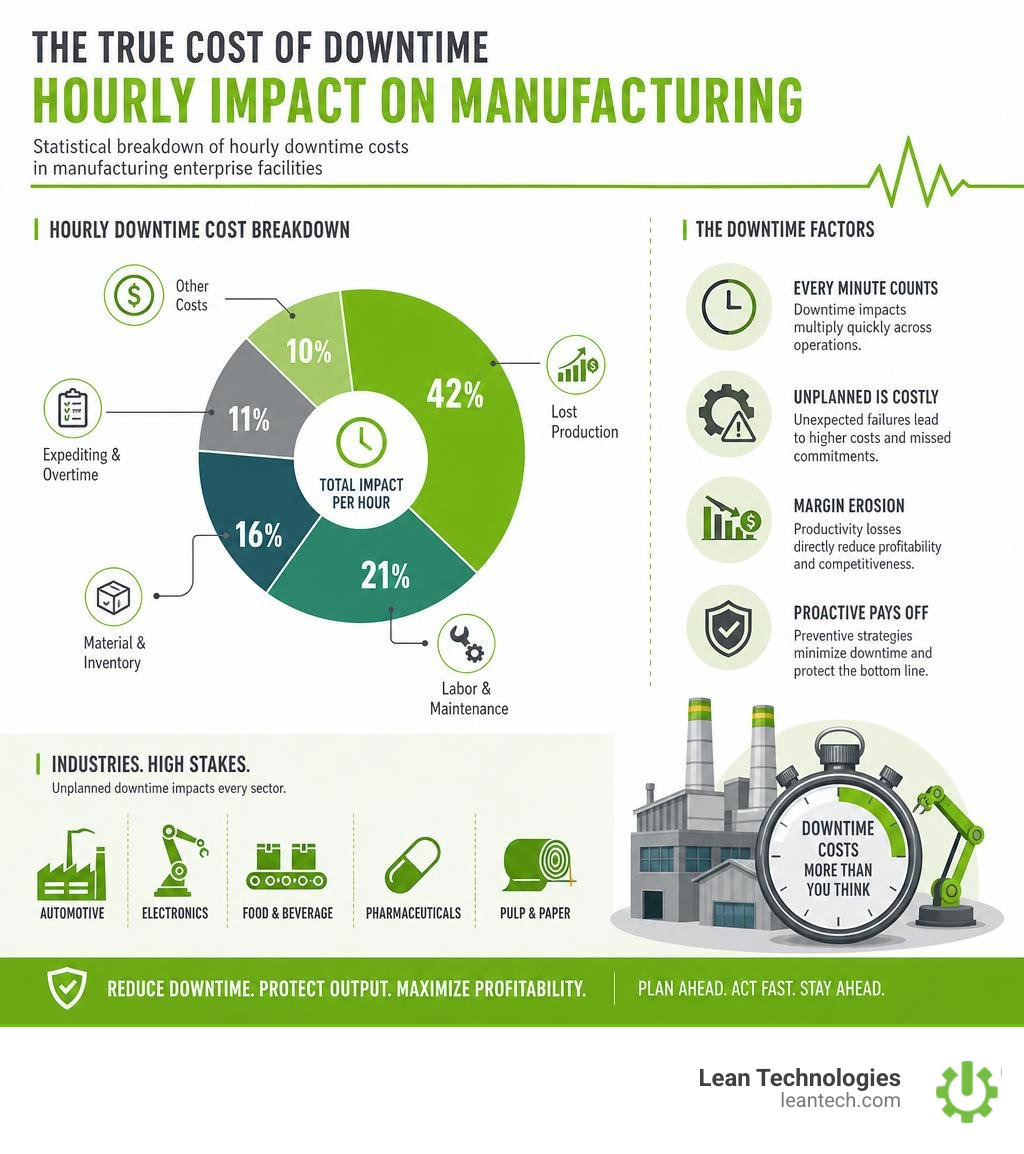
Unplanned downtime presents severe financial risks to manufacturing plants. Statistics show 98% of surveyed organizations lose over $100,000 per hour during unplanned downtime, with 81% exceeding $300,000 per hour. Managing maintenance proactively directly protects factory profitability.
SAP PM supports four primary maintenance execution models:
Corrective (Breakdown) Maintenance: Unplanned work triggered by sudden asset failure or immediate safety hazards.
Preventive Maintenance: Scheduled inspections, routine lubrications, and planned component overhauls designed to stop failures before they start. Read more about implementing structured time-based preventive maintenance.
Predictive Maintenance (Condition-Based): Maintenance triggered when condition monitoring parameters (e.g., thermal levels or vibration limits recorded via transaction IK11) cross defined thresholds.
Refurbishment / Overhaul Maintenance: Capital repairs that rebuild high-value spare components and return them to inventory stock.
Single-Cycle, Strategy-Based, and Counter Plans
Preventive maintenance in SAP PM relies on linked master records: Maintenance Strategies (IP11), Task Lists (IA01), and Maintenance Plans (IP42).
Single-Cycle Plans: Simplest form of preventive scheduling based on a single recurring time interval (e.g., every 30 days) or counter interval (e.g., every 1,000 machine cycles).
Strategy-Based Plans: Multi-tiered maintenance structures using defined packages (e.g., 1-month inspection, 3-month minor service, 12-month major overhaul).
Multiple Counter Plans: Advanced scheduling used when maintenance depends on multiple operating metrics (e.g., servicing a transport vehicle every 10,000 km or 500 operating hours, whichever occurs first).
Crucial parameters inside SAP PM control scheduling timing and buffer lead times:
Call Horizon: A percentage parameter determining when a maintenance order generates relative to the scheduled plan date. For example, on a 30-day cycle, an 80% call horizon triggers order creation on day 24, giving planners a 6-day lead time to stage parts and assign technicians.
Shift Factor: Automatically recalculates future maintenance dates based on actual completion dates. If work is completed late, a 100% late shift factor pushes the next due date forward by the exact number of overdue days, preventing premature servicing.
Tolerance Keys: Define acceptable variance windows before shift factor adjustments trigger.
Cycle Modification Factor: Multiplies base cycle lengths (e.g., a 1.5 factor converts a 30-day base cycle to 45 days) to adjust maintenance frequency across seasonal shifts.
Preventive Maintenance Deadline Monitoring
Automating preventive work requires regular execution of transaction IP30 (Deadline Monitoring). Running IP30 evaluates all active maintenance plans against current calendar dates or counter readings. When a plan reaches its call date, IP30 automatically generates maintenance notifications or work orders.
Enabling the Completion Requirement checkbox on a plan protects operational schedule integrity. It ensures the system will not issue a new preventive work order until the previously generated order reaches TECO status, preventing backlogs of open, unexecuted work orders. Explore proven frameworks for structuring your planned maintenance strategies.
Cross-Module Integration and Financial Settlement
SAP PM does not operate in isolation. Its strength comes from deep, automatic integration across core SAP ERP modules.
Connecting shop floor execution to materials management, production scheduling, and financial accounting ensures operational decisions update corporate records instantly.
Material Management and Extended Warehouse Integration
Materials Management (MM): Adding spare parts to a maintenance work order checks real-time inventory levels and posts reservations to database table RESB. When parts are issued using transaction MIGO (Movement Type 261), inventory balances decrease immediately, and component costs attach to the order.
Extended Warehouse Management (EWM): In S/4HANA environments, releasing a PM work order creates component staging requests and outbound delivery orders (document type OPM via BC set
/SCWM/DLV_OUTBOUND_PM). Pickers stage components in dedicated warehouse bins for maintenance retrieval.Refurbishment (PM-MM): High-value repairable parts are managed via refurbishment orders. Worn components are issued from inventory at lower valuation, repaired via specialized maintenance orders, and returned to warehouse stock at refurbished value. Learn more about the sap pm refurbishment process.
Financial Settlement and Cost Allocation
Maintenance execution generates direct financial postings. Labor hours confirmed in transaction IW41 calculate costs based on internal activity rates defined in Work Center cost centers. Spare parts consumption and external vendor services post actual expenses to financial table COEP.
During monthly financial closing, accountants run transaction KO88 (Individual Settlement) or CO88 (Mass Settlement). Order settlement rules execute, transferring all accumulated actual maintenance costs off the temporary work order balance sheet and posting them directly to the asset's assigned Cost Center or Asset Under Construction (AuC) account. For facilities coordinating complex production systems, robust software integration is essential. Learn how modern asset tools link with enterprise systems in this overview of computer integrated manufacturing software.
Optimization Best Practices and Mobile Execution
While the backend architecture of SAP PM is robust, field implementation frequently runs into administrative friction:
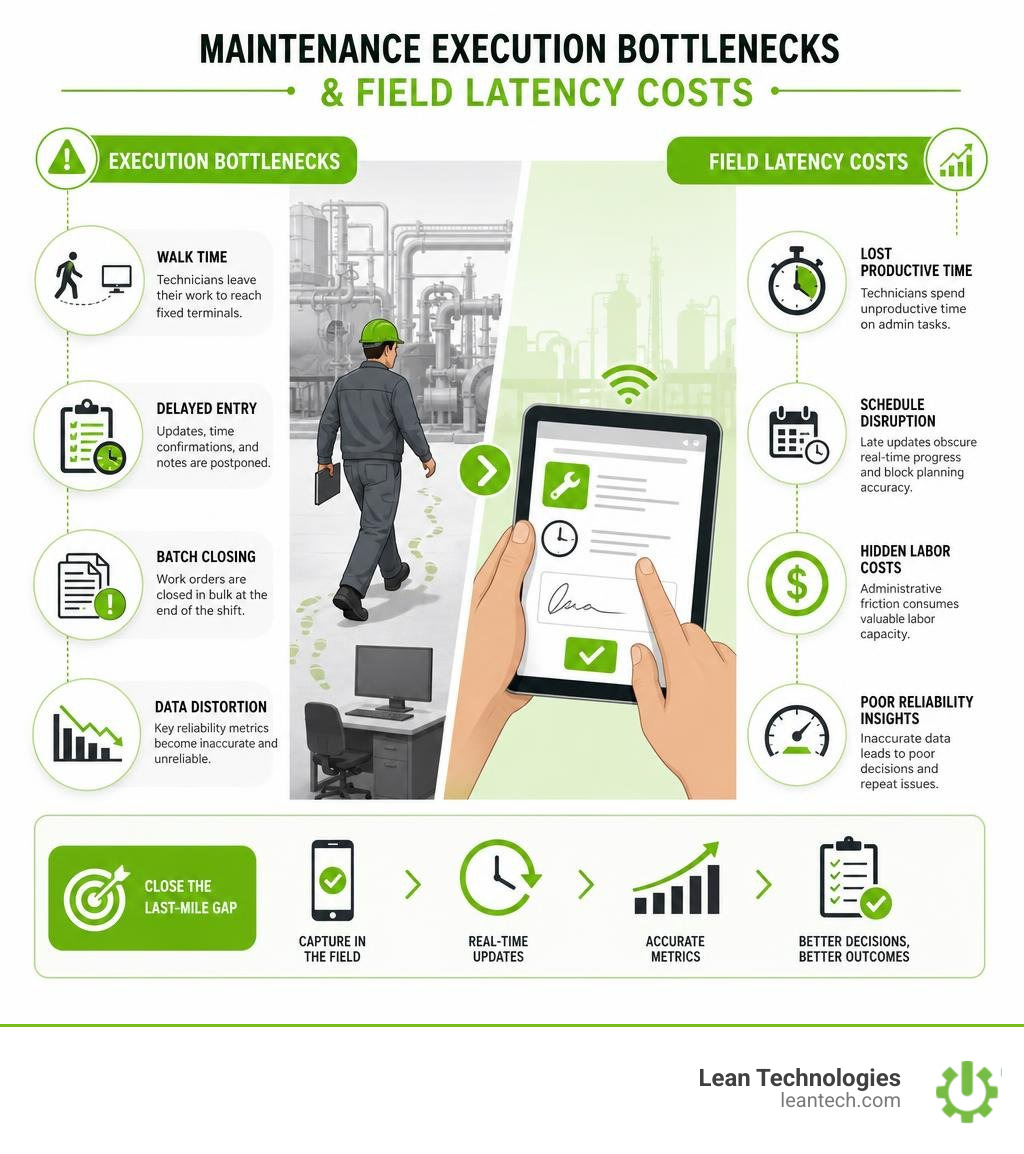
Closing the Last-Mile Field Reporting Gap
In many facilities, maintenance maintainers lose 30 minutes per shift walking to computer terminals to log notes, confirm hours, and close orders. In a plant employing 40 technicians, this administrative friction wastes 20 labor hours every day—equivalent to losing 2 to 3 complete maintenance work orders daily.
Worse, technicians often defer system updates until the end of their shift, batch-closing work orders all at once. Batch entry distorts critical reliability metrics like Mean Time Between Failures (MTBF) and Mean Time To Repair (MTTR), making breakdown timestamps and repair durations inaccurate.
To eliminate this gap, forward-thinking manufacturers pair SAP PM backend systems with real-time digital tools on the shop floor. For step-by-step guidance on modernizing plant workflows, consult this comprehensive guide to digital lean manufacturing.
Frequently Asked Questions About SAP PM
What is the basic process flow of SAP Plant Maintenance?
The standard sap pm process follows six main phases:
Notification Creation (IW21): Reporting a problem, damage, or service request.
Order Planning (IW31): Defining work operations, labor crafts, material components, and costs.
Order Release & Scheduling (IW32): Allocating work center capacity and releasing the order for execution.
Goods Issue (MIGO): Pulling reserved spare parts from inventory using movement type 261.
Work Confirmation (IW41): Logging actual labor hours, repair notes, and technical status.
Technical Completion & Settlement (TECO / KO88): Closing the work order technically and settling accumulated repair costs to financial cost centers.
What is the main difference between a notification and a work order in SAP PM?
A notification is a request document that records a detected malfunction, service demand, or inspection finding (capturing what happened and when). A work order is an execution and financial document used to plan labor, reserve spare parts, schedule work centers, capture actual costs, and settle expenses to financial accounts.
How does SAP PM integrate with MM and CO for cost and inventory tracking?
SAP PM integrates natively with Materials Management (MM) by creating automatic material reservations (RESB table) when parts are added to orders, updating inventory balances and triggering purchasing PRs for non-stock items. It integrates with Controlling (CO) by linking work centers to cost centers, calculating labor costs from confirmed hours, and transferring all accumulated project costs to corporate cost center accounts during monthly order settlement (KO88).
What to do next
Optimizing your plant maintenance strategy requires connecting enterprise structured systems to real-time shop floor execution. A disciplined sap pm process gives your business complete financial traceability, organized asset hierarchies, and accurate equipment lifecycle histories.
However, high data accuracy depends on making shop floor entry simple and immediate. When technicians face cumbersome screens or fixed-terminal reporting, data entry delays skew downtime metrics and lower visibility across operations.
Thrive offers a practical path forward. Thrive is a digital platform built for small to midsize manufacturers to digitize lean work processes in real time without replacing ERP or MES systems. Thrive is not an ERP or MES system. It is a flexible digital toolbox for logging issues, tracking actions, and driving continuous improvement. It provides real-time visibility only when processes are structured and data is entered at the source via mobile, tablet, or desktop. Thrive does not collect sensor data or run predictive alerts; instead, it organizes action from machine data entered by teams or imported from other systems.
By streamlining front-line issue tracking and continuous improvement loops, Thrive provides the fastest path to structured, accountable work processes. Explore how you can empower your workforce and optimize shop floor execution with Modern Plant Maintenance Solutions.