

Planned vs Unplanned Maintenance: A Practical Guide
Planned vs. Unplanned Maintenance: The Difference That Shapes Uptime
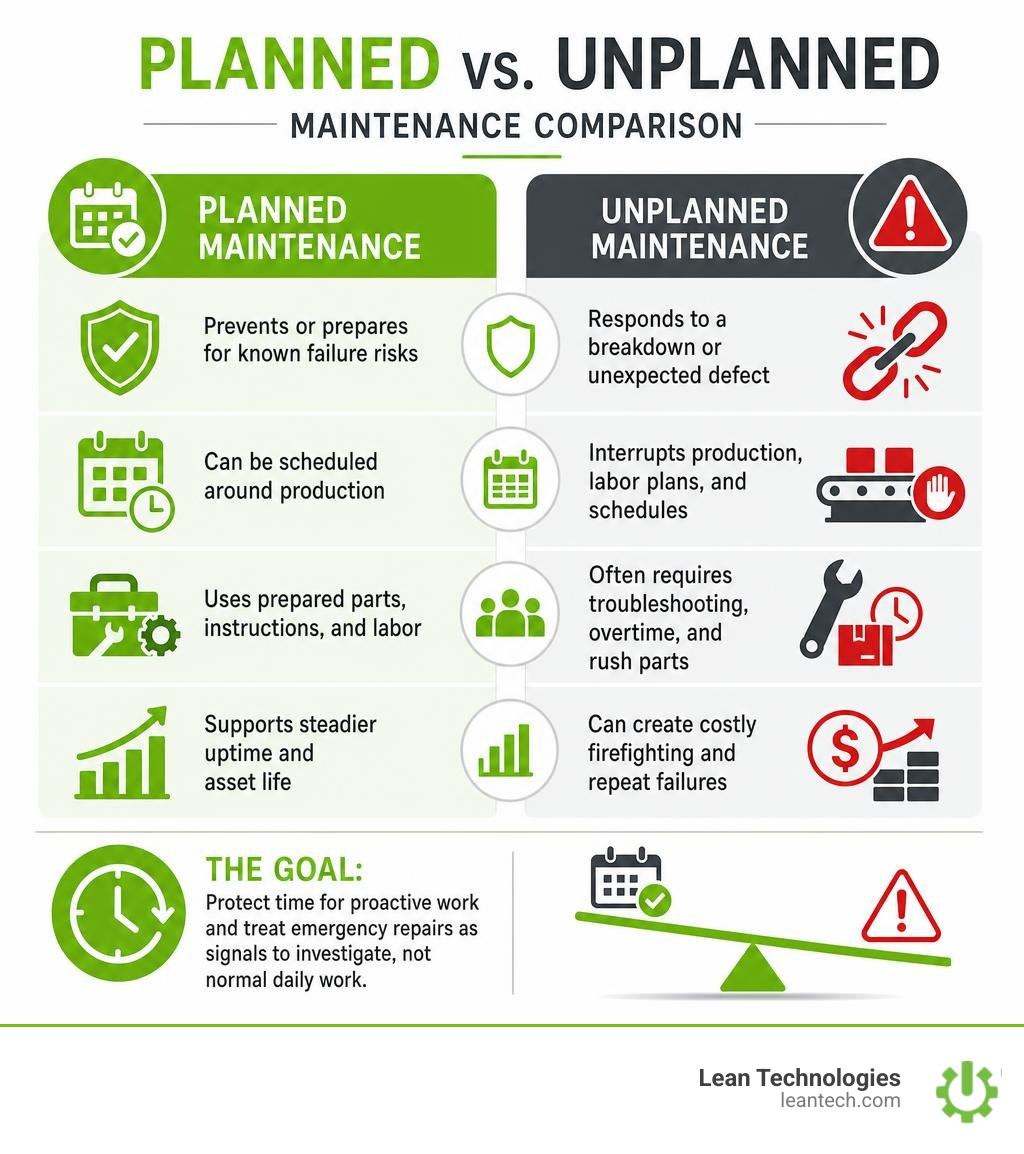
A snapped belt, failed motor, or leaking line can wipe out a carefully planned production day. Planned maintenance prepares work before it is needed: the task, people, parts, tools, and timing are defined in advance. Unplanned maintenance starts after an unexpected failure or urgent problem disrupts operations.
The practical goal is simple: protect time for proactive work and treat emergency repairs as signals to investigate, not normal daily work.
Planned maintenance | Unplanned maintenance |
|---|---|
Prevents or prepares for known failure risks | Responds to a breakdown or unexpected defect |
Can be scheduled around production | Interrupts production, labor plans, and schedules |
Uses prepared parts, instructions, and labor | Often requires troubleshooting, overtime, and rush parts |
Supports steadier uptime and asset life | Can create costly firefighting and repeat failures |
Unplanned repairs can cost three to five times more than planned work, especially when downtime, expedited parts, and overtime are involved. That is why maintenance teams commonly aim to move most labor hours toward planned work while keeping room for true emergencies.
For plant operations managers, the challenge is not just doing more PMs. It is making every issue, action, and work order visible enough to spot repeat failures before they become the next production-stopping event. Thrive is a flexible digital toolbox built for small to midsize manufacturers to log issues, track actions, and drive continuous improvement without replacing ERP or MES systems. It provides real-time visibility when processes are structured and data is entered at the source through mobile, tablet, or desktop. Thrive does not collect sensor data or generate predictive alerts; it helps teams organize action from machine data they enter or import from other systems.
Understanding Planned Maintenance and Unplanned Maintenance
Balancing planned maintenance and unplanned maintenance defines whether a plant operates in steady control or constant firefighting. Understanding this balance begins with looking at operational intent.
As explored in the concept of operational choice versus asset condition, planned downtime represents an operational choice where management pauses production intentionally. Unplanned downtime, by contrast, acts as a system signal indicating degraded asset health or process failure.
When teams ignore this distinction, they risk measuring performance inaccurately. Planned stops reduce scheduled operating time to preserve machinery, while unplanned stops erode true operational availability and inflate the cost of downtime.
Defining Planned Maintenance and Unplanned Maintenance Workflows
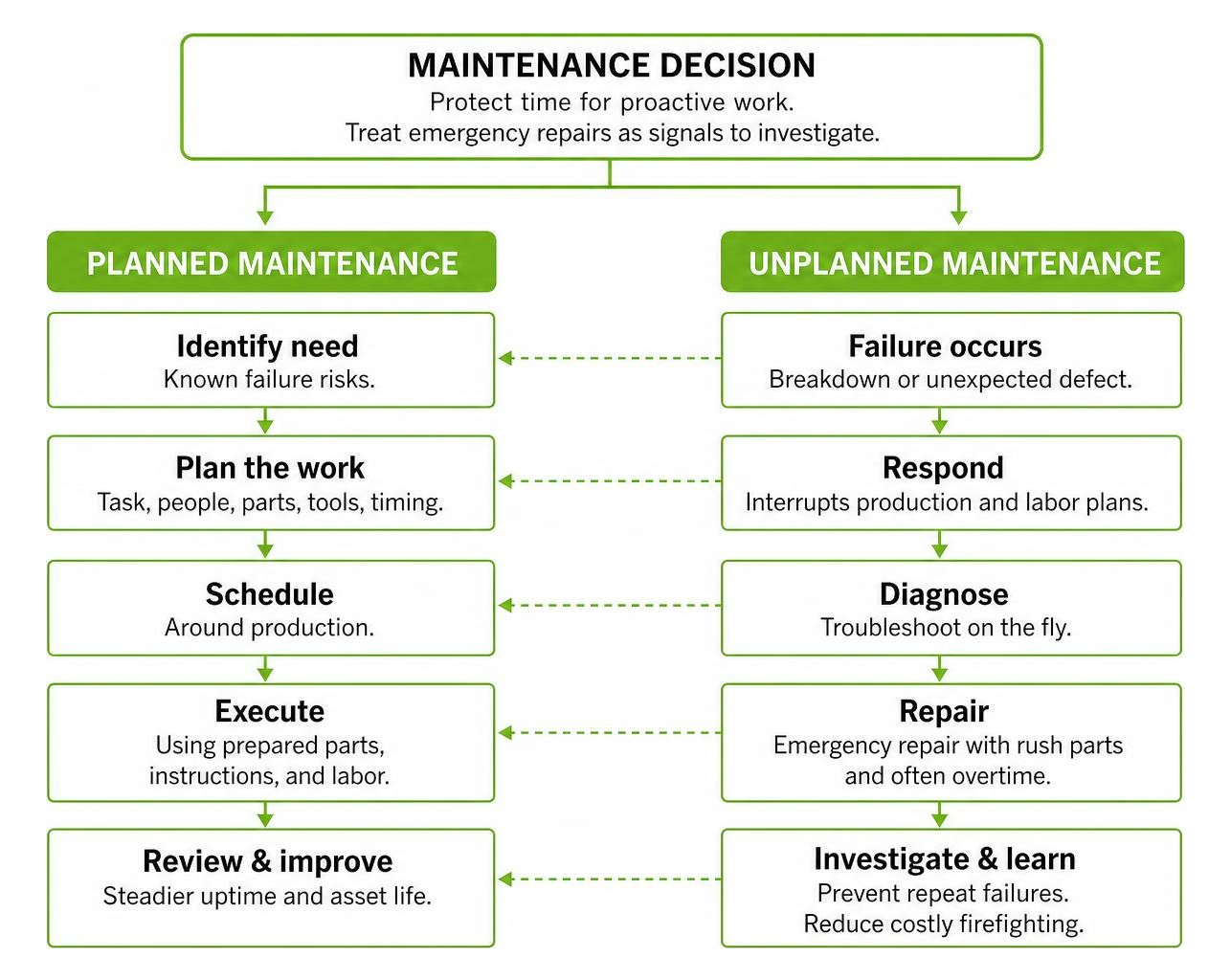
A planned workflow starts long before a technician turns a wrench. When work is planned, the team identifies the failure mode, writes standard operating procedures, verifies spare parts availability, and sets labor requirements. A structured maintenance work order system logs the task, allowing schedulers to coordinate windows with operations without disrupting production targets.
An unplanned workflow begins abruptly. A machine trips, an operator halts a line, or a bearing seizes. Technicians must drop their current work, diagnose the problem on the fly, search for spare parts, and execute an emergency repair. This reactive scramble pulls focus from routine care and increases the likelihood of human error.
Planned vs. Unscheduled Maintenance: Understanding the Distinctions
Many plant teams confuse "unplanned" with "unscheduled." They are not identical:
Planned work specifies how a job is done: the scope, technical documentation, tools, safety protocols, and bill of materials.
Scheduled work specifies when the job occurs and who will execute it.
Maintenance can be planned but unscheduled. For example, a facility might stage parts, safety steps, and work instructions for a pump overhaul triggered after 5,000 runtime hours. The task is fully planned, but its spot on the weekly calendar remains unscheduled until runtime hours trigger the threshold.
Conversely, unscheduled work that lacks planning forces technicians to search for parts and guess procedures, compounding delays.
Key Types of Planned and Unplanned Maintenance Strategies
A balanced maintenance program uses different strategies matched to asset criticality, failure modes, and operational risk.

Proactive Approaches: Preventive, Predictive, and Condition-Based
Proactive maintenance prevents asset failure or detects degradation early. Core proactive strategies include:
Planned Preventative Maintenance: Recurring, calendar- or cycle-based maintenance tasks such as lubrication routines, belt tensioning, and filter replacements.
Predictive Maintenance: Techniques such as vibration analysis, thermography, and oil analysis that assess component wear patterns to pinpoint failure timing.
Condition-Based Maintenance (CBM): Actions triggered when parameters like operating temperature, motor current, or pressure cross predefined operating thresholds.
Using these approaches across critical machinery provides clear insights into plant maintenance performance, extending equipment lifespans by 15% to 25%.
Reactive Responses: Emergency, Corrective, and Strategic Run-to-Failure
Not all reactive tasks stem from poor management; some are deliberate choices:
Emergency Break-Fix: Immediate intervention required after a sudden, catastrophic breakdown that presents safety hazards or stops critical production lines.
Planned Corrective Maintenance: Restoring equipment that exhibits minor defects or abnormal wear back to standard operating conditions before total breakdown occurs.
Opportunistic Maintenance: Utilizing unexpected production pauses to inspect and service adjacent components.
Strategic Run-to-Failure: Intentionally letting non-critical, inexpensive, and easily replaceable assets run until they fail, supported by pre-staged spare parts.
Understanding the balance between breakdown and preventive maintenance helps teams deploy labor where it protects plant throughput most effectively.
Operational and Financial Impact: Comparing Costs, Downtime, and Asset Health
The differences between planned and unplanned maintenance directly affect operating budgets, workforce productivity, and shop floor safety.
Impact Dimension | Planned Maintenance | Unplanned Maintenance |
|---|---|---|
Direct Labor Costs | Standard hourly rates during planned windows | Overtime rates, call-in pay, and idle production crews |
Material Costs | Bulk parts purchasing and standard shipping | Rush shipping surcharges and emergency part runs |
Asset Lifespan | 15–25% increase in equipment operating life | Accelerated wear, secondary collateral damage |
Production Impact | Controlled, scheduled production pauses | Unplanned downtime costing 35% more per minute |
Workplace Safety | Controlled environments, documented JSAs | Elevated risk during urgent emergency troubleshooting |
Balancing Planned Maintenance and Unplanned Maintenance for Optimal ROI
According to an analysis of planned vs unplanned maintenance mix, reactive tasks cost 3 to 5 times more than planned tasks. When a critical drive motor fails mid-shift, the expense includes not just the replacement component, but also idle line operators, expedited courier fees, off-spec product scrap, and technician overtime.
Unplanned downtime concentrated on constraint assets represents a major risk to plant capacity. In a study of 100 factories, shifting focus toward planned maintenance cut overall downtime by 30% to 50%. Planning tasks in advance optimizes technician wrench time, keeps inventory holding costs lean, and stabilizes operating budgets.
Benchmarking and Calculating Your Maintenance Mix Ratio
To improve maintenance operations, teams must establish where their hours are currently spent.

The 80/20 Rule and Industry Targets
The industry standard for high-performing maintenance operations is the 80/20 ratio: 80% planned maintenance hours to 20% unplanned maintenance hours. Leading industry guidelines, such as those from Reliable Plant, recommend targeting up to 90% planned activities in highly automated or continuous-process facilities.
Reactive Organizations: Average 64% unplanned work and 36% planned work, operating in constant firefighting mode.
Preventive-Focused Organizations: Average 64% planned work and 36% unplanned work.
World-Class Operations: Consistently maintain 75% to 85% planned work, keeping emergency tasks below 10%.
A 100% planned maintenance ratio is rarely practical or cost-effective. Achieving 100% usually signals over-maintenance or under-reporting of minor fixes by shopfloor crews.
Step-by-Step Formula for Calculating Maintenance Ratios
Calculate the Planned Maintenance Percentage (PMP) using labor hours, not simple work order counts. A two-minute sensor wipe and a twelve-hour gearbox rebuild should not carry equal weight.
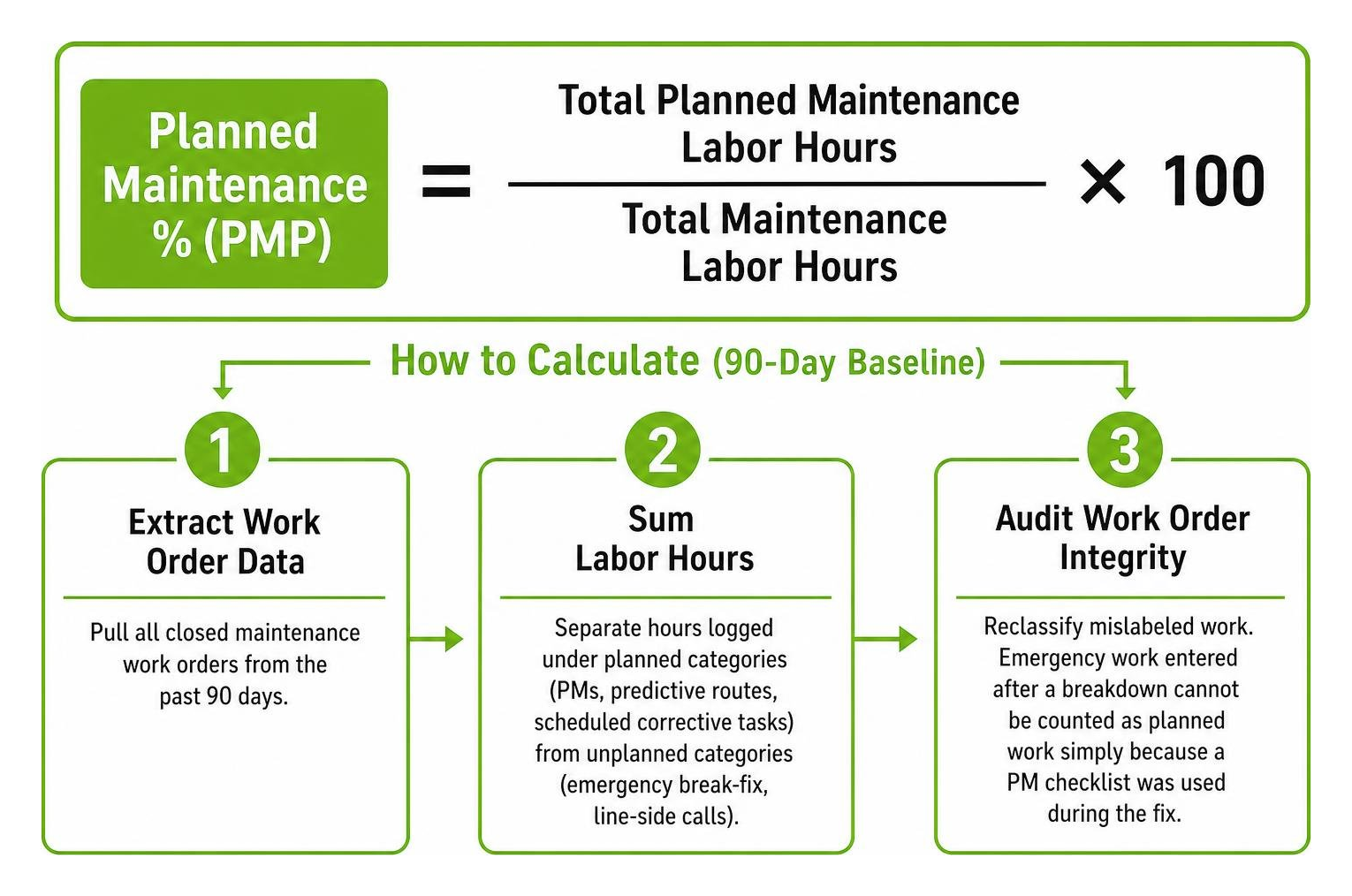
Follow these steps over a rolling 90-day baseline:
Extract Work Order Data: Pull all closed maintenance work orders from the past 90 days.
Sum Labor Hours: Separate hours logged under planned categories (PMs, predictive routes, scheduled corrective tasks) from unplanned categories (emergency break-fix, line-side calls).
Audit Work Order Integrity: Reclassify mislabeled work. Emergency work entered after a breakdown cannot be counted as planned work simply because a PM checklist was used during the fix.
Calculate Ratio: Divide planned hours by total maintenance hours (planned + unplanned).
Maintaining accurate work order tracking ensures your ratio reflects true operational reality rather than incomplete logs.
6 Steps to Shift from Reactive Firefighting to Planned Reliability
Transitioning away from a reactive shopfloor culture requires structured processes and disciplined execution.
Step 1: Establish an Asset Criticality Matrix
Categorize every machine into A, B, or C tiers based on safety risks, throughput impact, and replacement cost. Focus initial preventive routines on constraint assets (Tier A) where unplanned downtime directly threatens customer delivery schedules.
Step 2: Standardize Work Intake with Digital Capture
Informal maintenance requests—such as hallway conversations, sticky notes, or radio chatter—hide actual labor demands. Low-discipline teams capture only 45% of actual maintenance work, while high-discipline teams capture 82%.
Implement a centralized digital work order system where operators scan QR codes on machines using tablets or mobile devices to log anomalies immediately.
Step 3: Implement a Weekly Schedule Freeze
Lock 70% to 80% of available technician capacity one week in advance. Coordinate scheduled maintenance windows directly with operations leaders. Treat break-in work as an exception requiring supervisor sign-off to protect scheduled PM routines.
Step 4: Enforce Spare Parts Kitting
Never release a non-emergency work order to the floor until all required replacement parts, consumables, and specialized tools have been verified and kitted. Technicians should spend their shifts maintaining equipment, not searching storeroom shelves for unrecorded inventory.
Step 5: Perform Root Cause Analysis on Repeat Breakdowns
Track recurring failures and conduct systematic 5-Why or fishbone analyses on top "bad actor" assets. Identify whether breakdowns stem from lubrication gaps, operator training needs, or worn subassemblies, and convert those findings into updated PM routines.
Step 6: Embed Workflows into a Digital Lean Framework
Connect maintenance activities with daily shopfloor management, autonomous operator inspections, and continuous improvement tracking. Deploying a structured digital lean manufacturing framework ensures maintenance, quality, and production teams work toward shared availability goals.
Frequently Asked Questions About Planned and Unplanned Maintenance
What is a healthy planned vs unplanned maintenance ratio?
An 80/20 ratio (80% planned maintenance to 20% unplanned maintenance) is the standard benchmark for industrial manufacturing. Discrete and continuous manufacturing plants often target an 85/15 mix, while facilities management environments typically target 70/30.
When is unplanned maintenance an acceptable strategy?
Unplanned maintenance is appropriate when managing non-critical, redundant, low-cost assets where failure presents zero safety, environmental, or operational risk. Examples include non-essential indicator lights, small auxiliary coolant pumps with automatic backups, or standard shop hand tools.
How does shop floor software help reduce unplanned downtime?
Shop floor software provides a structured way to capture maintenance requests at the source via mobile or tablet devices. By digitizing work order queues and standardizing routine inspection checklists, teams capture hidden work, track PM compliance, and address minor equipment degradation before it triggers catastrophic stoppages.
What to Do Next
Achieving operational stability requires transitioning maintenance from a reactive firefighting team into a disciplined, proactive operation. With 31% of manufacturing organizations reporting rising unplanned downtime costs over the past year, stabilizing asset health is essential for protecting plant capacity and profitability.
Thrive is a digital platform built for small to midsize manufacturers to digitize lean work processes in real time without replacing ERPs or MES systems. It acts as a flexible digital toolbox for logging issues, tracking actions, and driving continuous improvement.
Thrive provides real-time visibility only when processes are structured and data is entered at the source via mobile, tablet, or desktop. Rather than collecting raw sensor data or running predictive alerts, Thrive organizes action from machine data entered by your teams or imported from other systems.
To eliminate paper workarounds, improve maintenance accountability, and optimize your mix of planned maintenance and unplanned maintenance, evaluate planned maintenance solutions that help your team build structured, repeatable reliability across every shift.