
Why Planned Maintenance Beats Unplanned Chaos Every Time
The Hidden Cost of Letting Breakdowns Run the Show
Planned corrective maintenance is the practice of scheduling known repairs before an asset reaches complete failure — so your team fixes equipment on your terms, not at 3 AM under panic.
Here's the quick answer if that's all you need:
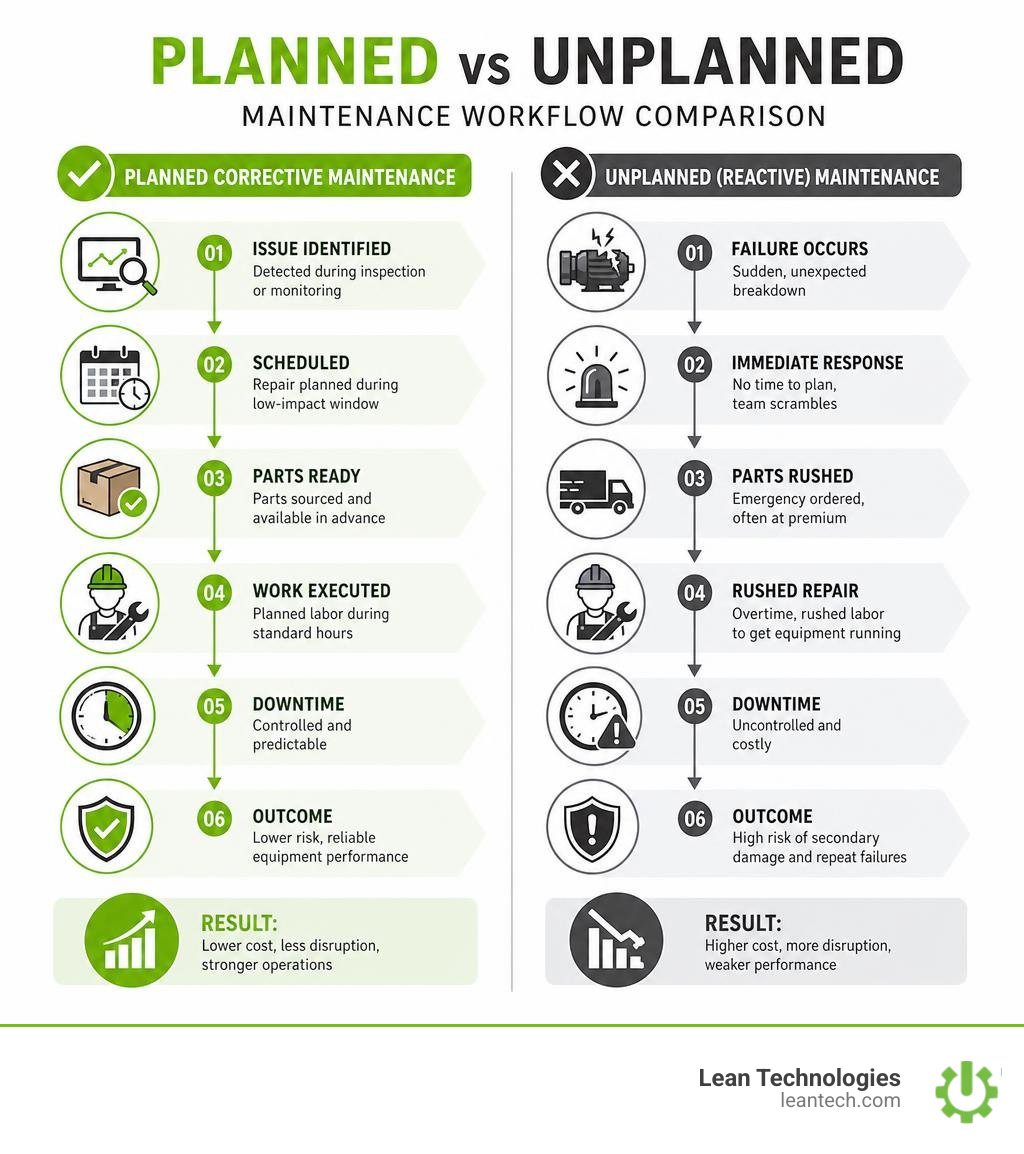
Planned Corrective Maintenance Unplanned (Reactive) Maintenance Trigger Defect identified during inspection or monitoring Sudden, unexpected failure Timing Scheduled during low-impact windows Immediate — no preparation Parts Sourced in advance Emergency ordered, often at premium Labor Planned, standard hours Overtime, rushed Downtime Controlled and predictable Uncontrolled and costly Risk Low High — secondary damage likely Cost Lower overall Significantly higher
The difference sounds simple. But in practice, most manufacturing plants are still stuck in reactive mode — and paying for it every single shift.
Downtime costs some industrial facilities as much as $500,000 per hour. And 39% of industrial teams report that downtime is costing them more than it did before. That's not just a maintenance problem. That's a visibility problem, a culture problem, and an operations problem all at once.
When a critical machine goes down without warning, everything breaks — not just the equipment. Schedules collapse. Supervisors scramble. Technicians drop everything. And the root cause? Often still unfixed a week later because the team was too busy putting out fires to actually solve anything.
Planned corrective maintenance flips that dynamic. It turns a known defect into a scheduled work order, with the right parts, the right people, and the right window to get it done properly.
The rest of this guide walks through exactly how to make that shift — from firefighting culture to controlled, accountable repairs.
What is Planned Corrective Maintenance?
To understand planned corrective maintenance, we need to strip away the jargon. At its core, this strategy is about identifying a specific defect in a machine and deliberately choosing to schedule the repair for a later, more convenient time.
It is often called deferred maintenance. This does not mean ignoring the problem or neglecting the asset. Instead, it means making a strategic decision based on asset criticality, parts availability, and production schedules. You find the issue during a routine check, realize the machine can run safely for a bit longer, and schedule the repair before a complete breakdown occurs.
To see where this fits in the broader picture, let's look at how the industry defines common CMMS Terms - Preventive, Corrective, Reactive, Predictive | Maintainly:
Preventive Maintenance (PM): Time- or usage-based actions (like changing oil every six months) designed to keep healthy machines running smoothly.
Predictive Maintenance (PdM): Using condition monitoring tools to detect early warning signs of wear before a defect even becomes visible.
Corrective Maintenance: Repairing or restoring equipment after a defect is found. This can be planned (deferred) or unplanned (emergency).
Reactive Maintenance: Running a machine until it breaks, then rushing to fix it.
By integrating a structured approach to planned maintenance, you move away from the chaos of reactive mode. Instead of waiting for a machine to force your hand, your team manages maintenance proactively.
Planned Corrective Maintenance vs. Unplanned Firefighting
Unplanned corrective maintenance is a high-stress firefight. It happens when an asset fails unexpectedly, forcing immediate emergency repairs. There is no time to plan, no time to source cheap parts, and no time to optimize technician schedules.
While run-to-failure can be a legitimate strategy for non-critical, inexpensive, and easily replaceable parts (like office lightbulbs), applying it to core production assets is incredibly expensive. In fact, research shows that corrective maintenance costs 79% of facilities either more or the same as other proactive maintenance strategies.
When you compare the two side-by-side, the business case for planning becomes clear:
Operational Metric Planned Corrective Unplanned (Reactive) Secondary Damage Minimal. The issue is caught before it ruins adjacent parts. High. A broken bearing can seize the shaft and destroy the motor. Parts Sourcing Standard shipping. Sourced at negotiated rates. Expedited shipping. Premium prices for emergency orders. Labor Utilization Technicians work standard shifts with clear SOPs. Technicians work high-stress overtime, often rushed. Production Impact Scheduled during planned downtime or off-shifts. Stops the line immediately, delaying customer shipments.
The Strategic Role of Planned Corrective Maintenance on the Shop Floor
In a world-class plant, planned corrective maintenance acts as the crucial bridge between detection and failure. This is best illustrated by the P-F Curve, a foundational concept in reliability-centered maintenance.
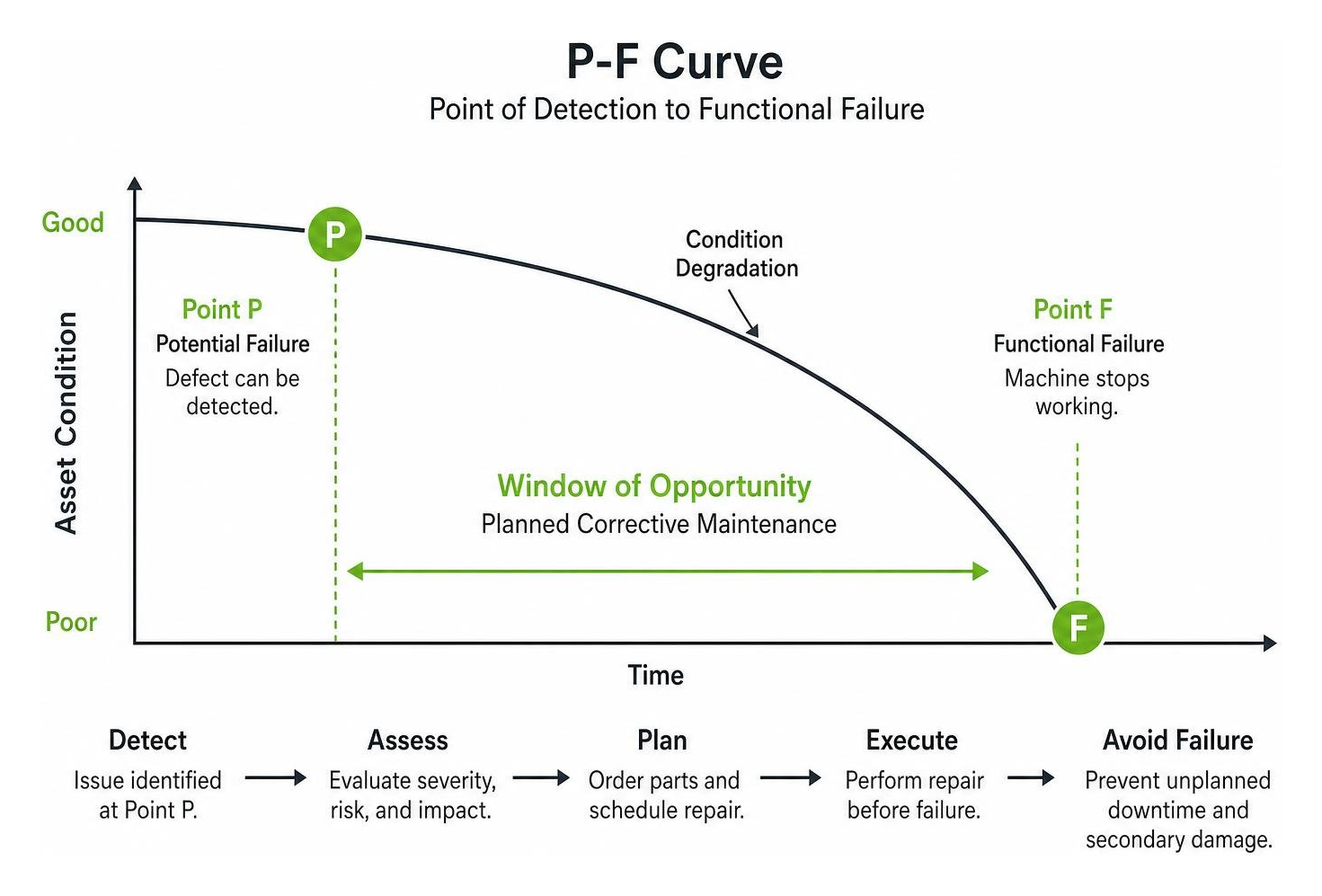
The P-F Curve shows the lifecycle of a failure:
Point P (Potential Failure): This is the earliest point where a defect can be detected (often via condition monitoring or a sharp-eyed operator during an inspection).
Point F (Functional Failure): This is the point where the machine stops working entirely.
The space between Point P and Point F is your window of opportunity. Planned corrective maintenance is designed to live entirely within this window. Once you detect the potential failure at Point P, you do not panic. You use your Equipment Asset Tracking system to log the defect, order the necessary parts, and schedule the repair work before the machine reaches Point F.
This strategy is not just for small factories. Even massive energy infrastructure operators rely on this approach to keep systems running. For instance, the Consolidated Maintenance Works plan for the Baltic-Finnish region, covering the period from 01.01.2026 to 31.12.2026 details how regional gas giants coordinate pipeline defect elimination months in advance. Because repairs can restrict regional capacity, these works are planned meticulously to align with periods of low demand, ensuring regional energy stability without sudden outages.
If utility giants can plan repairs on thousands of miles of high-pressure pipelines, your shop floor can certainly plan a motor replacement on Line 2.
When to Choose Planned Corrective Actions Over Preventive Routines
You cannot prevent every single failure. If you try to perform preventive maintenance on everything, you will end up "over-maintaining" your equipment, wasting valuable labor, and driving up costs.
So, how do you find the right balance?
First, look at the asset's lifecycle and its criticality to your production process. If an asset is highly critical to safety or production, you want a strong preventive or predictive program. But if the asset is non-critical, or if the cost of preventive maintenance exceeds the cost of occasional failure and repair, a planned corrective approach is far more cost-effective.
To help find this balance, reliability experts point to two industry benchmarks:
The 80/20 Ratio: This rule of thumb suggests that 80% of your maintenance activities should be preventive, while 20% should be corrective.
The 6-to-1 Maintenance Philosophy: Created by maintenance pioneer John Day, this philosophy states that for every six preventive maintenance tasks your team completes, you should find and execute approximately one planned corrective task.
If you complete dozens of PMs and never find a corrective action, your PMs are likely too frequent or not thorough enough. If you are constantly flooded with corrective tasks, you have a gap in your preventive program.
To find where your plant stands, you can run a Pm Gap Report to identify which machines are draining your resources. You can also take the Pm Gap Report Quiz to quickly evaluate the health of your current maintenance scheduling.
To prioritize which assets deserve preventive care versus planned corrective action, use a simple asset prioritization matrix:

Step-by-Step: Executing a Controlled Corrective Workflow
Moving from a reactive firefighting culture to a planned corrective workflow requires a structured, repeatable process. You cannot rely on verbal agreements or notes scribbled on paper towels.
Here is how a high-performing shop floor executes a controlled corrective workflow in five steps:
Step 1: Fault Identification & Reporting
An operator notices a minor issue — like a slight oil leak, an unusual vibration, or a worn belt — during their daily walk-through. Instead of waiting for the shift to end, they log the issue immediately at the source using a digital tablet.
Step 2: Work Order Creation & Triage
The reported issue enters the digital Work Request Queue. The maintenance planner reviews the request, assesses the risk, and checks the Work Order History of that specific asset to see if this is a recurring problem. The planner then approves the request, turning it into a formal planned corrective work order.
Step 3: Planning & Scheduling
The planner determines exactly what is needed to complete the repair:
What tools are required?
Which technicians have the right skills?
Are the replacement parts in stock? (Managed via your Parts Management system).
When is the next scheduled production downtime window?
If parts are missing, they are ordered. The work order is held in the queue until the parts arrive on-site. Once everything is ready, the job is scheduled for an upcoming low-impact production window.
Step 4: Execution & Verification
The assigned technician executes the repair according to standard operating procedures. Once finished, they test the machine under normal operating conditions to verify that it is fully restored to its design function, rather than just patched up.
Step 5: Root Cause Analysis (RCA) & Documentation
The technician documents the exact cause of the defect, the parts used, and the labor hours in the system. If the failure was significant, the team performs a quick RCA (using the 5 Whys) to understand why the defect occurred and updates future preventive routines to catch it earlier next time.

Managing Risk and Safety During Repairs
Speed should never come at the expense of safety. Unplanned repairs are notoriously dangerous because technicians are working under pressure to bring a down line back online. They are more likely to skip safety steps, miss lock-out/tag-out (LOTO) protocols, or use the wrong tools.
Planned corrective maintenance dramatically improves shop floor safety. Because the repair is scheduled in advance, the maintenance team has ample time to conduct a proper Risk Assessment. Technicians can review standard operating procedures, print the necessary safety checklists, and ensure all energy isolation devices are ready before they ever touch the machine.
Frequently Asked Questions about Planned Corrective Maintenance
What is the ideal ratio of preventive to corrective maintenance?
Most reliability experts recommend aiming for an 80/20 ratio, where 80% of your maintenance activities are preventive and 20% are corrective. Another excellent benchmark is the 6-to-1 rule, which dictates that for every six preventive tasks your team performs, you should generate one planned corrective task. This balance ensures your PM program is active enough to catch wear early, without wasting resources on over-maintaining healthy machines.
How does planned corrective maintenance reduce overall operational costs?
Planned corrective maintenance reduces costs in three major ways:
Eliminates Secondary Damage: Fixing a worn bearing before it fails prevents it from destroying the shaft, motor, or housing.
Reduces Shipping and Parts Premiums: You can order spare parts via standard ground shipping rather than paying for overnight air freight.
Optimizes Labor: Technicians complete repairs during standard working hours, reducing high-cost emergency overtime.
What role does a CMMS play in scheduling deferred repairs?
A cmms acts as the central brain for your maintenance operations. It tracks your digital parts inventory, manages your work order queue, and records your asset history. While a CMMS is excellent for housing this historical data, shop floor teams often need more flexible, real-time tools to coordinate these tasks on the floor and ensure operators can easily log defects the moment they see them.
In Summary: Take Control of Your Shop Floor
Stop managing your shop floor through spreadsheets and wishful thinking. If your team is constantly firefighting unexpected breakdowns, you are losing valuable production hours, driving up parts costs, and burning out your technicians.
By shifting your focus toward planned corrective maintenance, you take control of your equipment and your schedule. You turn chaotic, high-stress breakdowns into calm, scheduled, and highly efficient repairs.
But you cannot make this shift if your shop floor processes are locked on paper or trapped in a hard-to-use legacy system. Real-time visibility is the key to catching defects early. If an operator notices a minor issue but has to wait until the end of the week to write it down, that defect will likely turn into an expensive breakdown long before anyone schedules the repair. Real-time beats real-late every single time.
This is where Thrive by Lean Technologies comes in. Thrive is an all-in-one, customizable shop floor software built by manufacturing experts to streamline your operations. It provides your team with the real-time visibility they need to log, track, and resolve issues directly from the plant floor.
With Thrive, you can easily manage:
nonconformance tracking to catch quality and equipment issues early.
Defect Scrap Tracking to see where machine wear is impacting your yield.
Change Management and Project Management tools to keep your engineering and maintenance projects on schedule.
Workflow Tracking and Follow Up Tools On Action Items to ensure no defect gets lost in the shuffle.
Escalations Chats Notifications And Audit Tracking to keep your entire team aligned and accountable in real time.
Let your team run lean — with real-time visibility and fewer workarounds. Transition your plant away from reactive chaos and build a highly effective planned maintenance strategy.