The Ultimate Guide to Better Resource Allocation and Faster Decisions
Why So Many Plants Struggle to Achieve Operational Excellence (And What Actually Works)
To achieve operational excellence, manufacturers need to:
Standardize work processes across every shift and every team
Capture data in real time — not at the end of the shift, not in a spreadsheet
Eliminate waste using proven frameworks like Lean, Six Sigma, and TPM
Give leaders visibility into what's actually happening on the floor, right now
Build a culture where every operator owns the process — not just the output
Every plant manager knows the feeling. You're walking the floor at 2 PM, and you're already finding out about a problem that started at 6 AM. The downtime log is half-filled in. The action item from last week's stand-up meeting? Still open. And somewhere in a shared drive, there's a spreadsheet that someone is supposed to be updating.
This isn't a people problem. It's a systems problem.
Operational excellence isn't about working harder. It's about building the kind of operation where problems surface fast, decisions happen quickly, and improvement compounds over time. The concept traces back to Dr. Joseph Juran's work in the 1970s — and the core idea hasn't changed: do things better, eliminate waste, and never stop improving.
What has changed is how fast the gap is growing between manufacturers who have real-time visibility into their operations and those still running on paper and gut instinct.
The data backs this up. A mining company that committed to operational excellence principles boosted output by 25% in year one — then added another 15 percentage points in year two, and 8 more in year three — all with flat capital and labor costs. A financial services organization cut rework by 60% and reduced poor-quality outcome costs by 30%, while also reversing a slide in both employee and customer satisfaction. These aren't outliers. They're what structured, sustained operational excellence actually produces.
The difference between those organizations and the ones still firefighting every day? It usually comes down to when they see their data — and whether their teams are working from the same playbook.
This guide breaks down exactly how to achieve operational excellence on the shop floor: the frameworks that work, the metrics that matter, the tools that make it stick, and the cultural shifts that make it last.
What It Really Means to Achieve Operational Excellence

In April 2026, the definition of excellence has evolved. It’s no longer just about having a clean floor or a "Safety First" sign. True operational excellence is a holistic philosophy where every part of the organization aligns to deliver leading value to the customer by optimizing processes and dissolving silos.
While the concept was pioneered by Dr. Joseph Juran, modern frameworks like the Shingo Model have refined it into ten core principles. These aren't just "feel-good" ideas; they are the bedrock of Next-generation operational excellence.
To truly achieve operational excellence, you have to look at three specific areas:
Cultural Enablers: Respecting every individual and leading with humility. If the person running the machine doesn't feel safe pointing out a flaw, your "excellence" is a facade.
Enterprise Alignment: Ensuring that the guy on the CNC machine knows exactly how his scrap rate affects the company's quarterly goals.
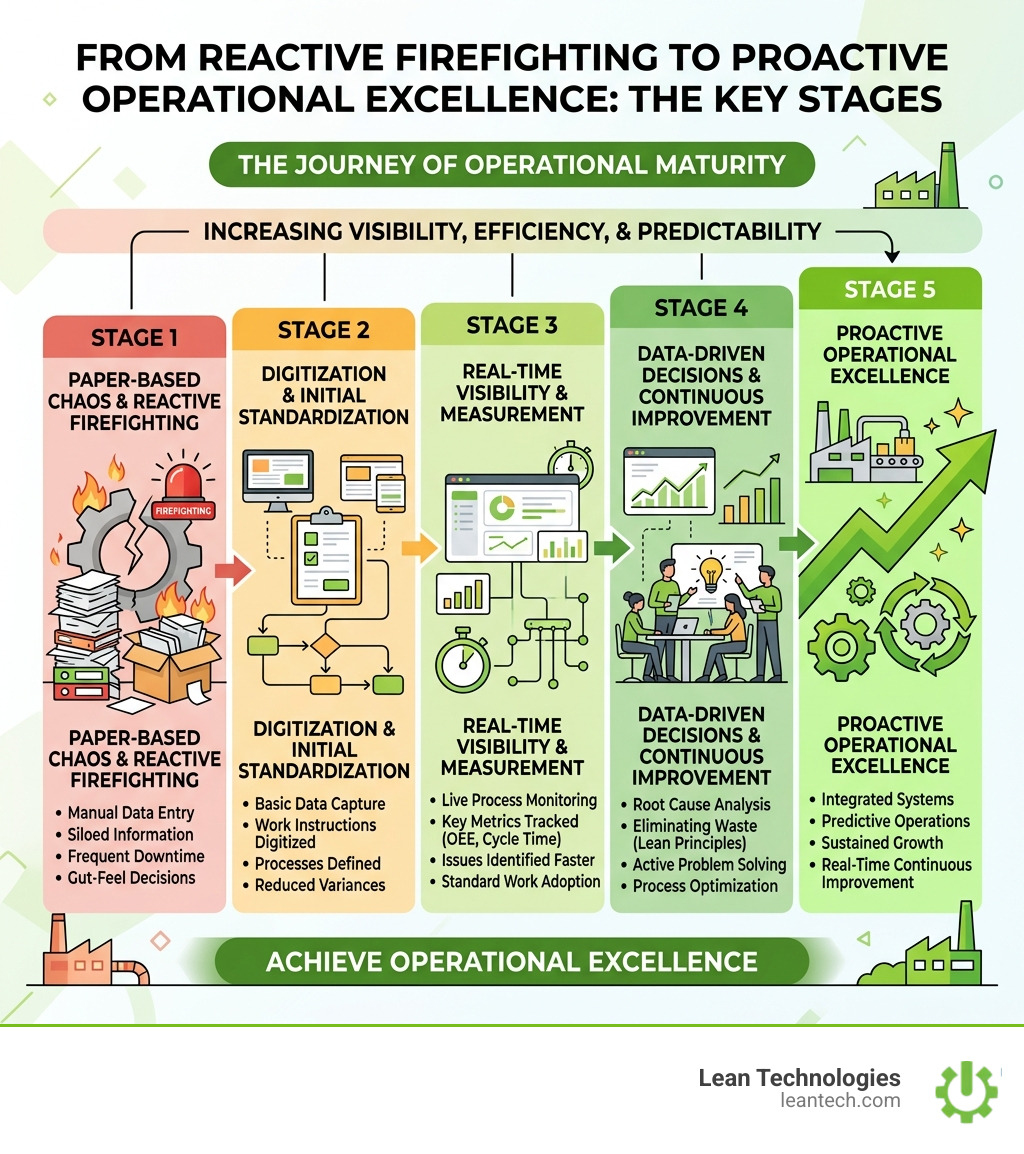
Continuous Improvement: Moving from "fixing things when they break" to a scientific mindset of constant experimentation.
Process Excellence vs. Business Excellence Don't confuse the two. Process excellence is tactical—it's making one specific workflow better. Business excellence is the "big picture." Operational excellence is the bridge between them. It’s the execution of your strategy through the disciplined application of your processes. When you hit this sweet spot, you don't just grow; you achieve sustainable growth that doesn't collapse the moment the market gets volatile.
The Core Frameworks: Lean, Six Sigma, and TPM
You’ve heard the buzzwords, but on the shop floor, these are the tools that actually move the needle. You don't need to pick just one; the best plants blend them.
Lean Manufacturing
Lean is the relentless pursuit of value by eliminating waste (Muda). Whether it's excess inventory or unnecessary motion, Lean asks: "Would the customer pay for this step?" If the answer is no, it's waste. For those moving into the digital age, our Guide to Digital Lean Manufacturing explains how to take these paper-based concepts and make them live in real-time.
Six Sigma and DMAIC
Where Lean focuses on speed and flow, Six Sigma focuses on quality and consistency. By using the DMAIC (Define, Measure, Analyze, Improve, Control) method, teams reduce variation. If every part you make is slightly different, your process isn't excellent—it's out of control.
Total Productive Maintenance (TPM)
You can’t achieve operational excellence if your machines are down. TPM involves everyone—not just the maintenance tech—in equipment upkeep. It starts with the 5S methodology (Sort, Set in Order, Shine, Standardize, Sustain). A messy workstation isn't just an eyesore; it's a hidden tax on your productivity.
Before diving into a massive overhaul, it helps to know where you stand. A Lean Culture Assessment can highlight whether your team is ready for these frameworks or if you’re just "checking boxes."
5 Proven Strategies to Achieve Operational Excellence
If you want to stop firefighting and start leading, these five strategies are non-negotiable.
Standardize the Work: If three different operators run the same machine three different ways, you don't have a process; you have three different hobbies. Use Leader Standard Work to ensure that management is checking the right things at the right time.
Dissolve Silos: Production, Maintenance, and Quality need to talk to each other in the same language. When data is trapped in department-specific spreadsheets, you get "real-late" information.
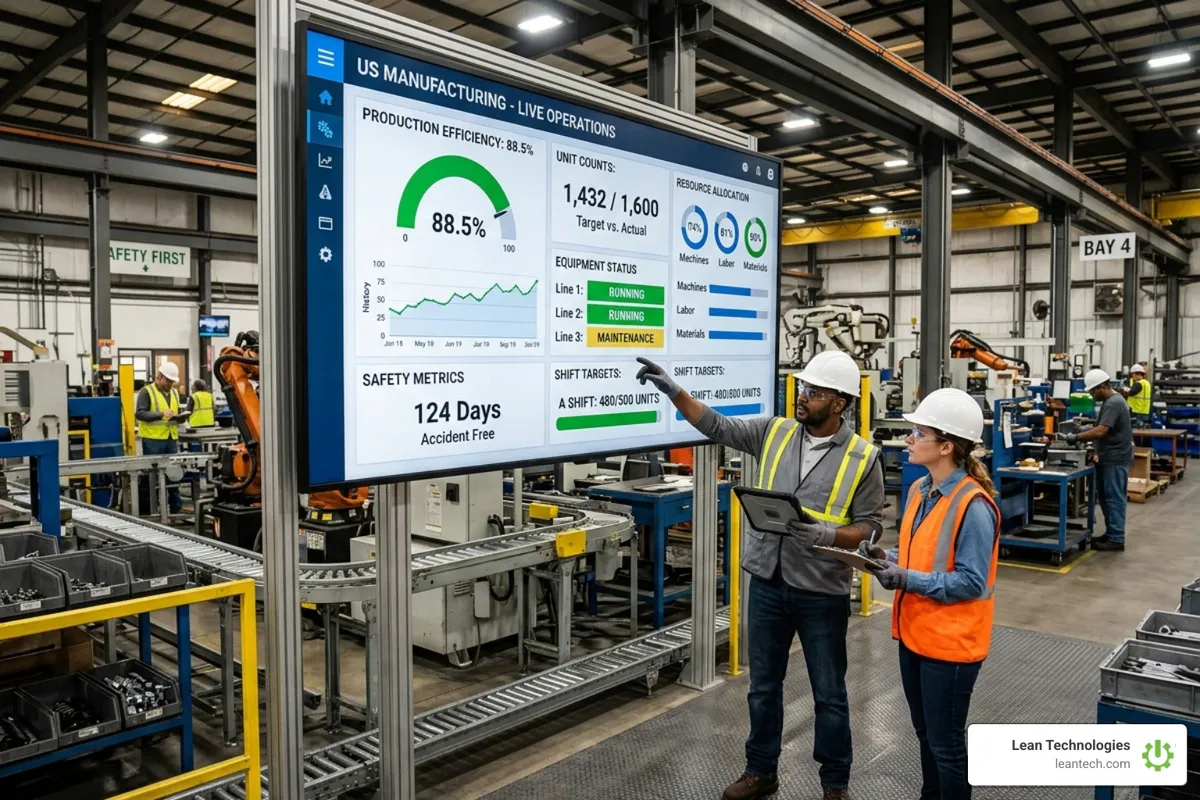
Visual Management: People should be able to walk onto the floor and know within 30 seconds if you're winning or losing the day. Performance Goal Boards are the scoreboard for your team.
Focus on "Flow and Pull": Only make what the customer has asked for. This reduces the "hidden factory" of rework and overproduction.
Go See (Gemba): Leaders must be on the floor. You can't achieve operational excellence from a conference room.
Leveraging Digital Tools to Achieve Operational Excellence
In 2026, "digital" doesn't mean "expensive." No-code software and AI automation are now accessible to mid-sized manufacturers. By implementing Workflow Tracking, you replace the "I think" with "I know." Digital tools allow for:
Mobile Accessibility: Operators logging issues at the source.
Real-time Analytics: Seeing a trend before it becomes a scrap event.
Structured Project Management: Ensuring that improvement ideas don't die in an inbox.
Building a Culture to Achieve Operational Excellence
Culture eats strategy for breakfast. To make excellence stick, you need leadership commitment that goes beyond a memo. It requires humility—admitting that the operators often have better solutions than the engineers. Tools like Thrive CI help capture this bottom-up innovation, while Project Tracking ensures the team sees their ideas actually being implemented. This builds the accountability needed to sustain the journey.
Measuring Success: KPIs That Move the Needle
What you measure is what your team will focus on. If you only measure volume, don't be surprised when quality tanked.
KPI Type Metric Why It Matters Lagging Total Revenue Tells you what happened last month. Leading Audits Completed Predicts future quality and safety performance. Efficiency OEE (Overall Equipment Effectiveness) Measures how well you use your assets. Quality First Time Right (FTR) Measures how much you get right the first time without rework. Maintenance MTBF (Mean Time Between Failures) Tracks the reliability of your equipment.
To get a handle on your maintenance costs and uptime, a modern CMMS is essential. It moves you away from "emergency repairs" and toward a proactive stance. Similarly, Thrive Quality ensures that compliance and standards aren't just "extra work" but are baked into the daily flow.
Tracking Metrics to Achieve Operational Excellence
Data-driven decisions require data that is accurate and timely. If your Work Request Queue is a stack of paper on a desk, your response time will always be too slow. Use a Kanban Board Tool to visualize work in progress and identify bottlenecks before they shut down a line. Real-time reporting creates a feedback loop that allows for rapid performance benchmarking.
Overcoming Roadblocks on the Shop Floor
The path to achieve operational excellence is rarely a straight line. You will hit walls.
Resistance to Change: "We've always done it this way" is the most expensive sentence in manufacturing. Overcome this by involving the team in the solution design.
Legacy Systems: Your ERP might be great for accounting but terrible for the shop floor. Don't try to force it to do everything. Use flexible tools that bridge the gap.
IT-Manufacturing Misalignment: IT wants security; Manufacturing wants speed. The solution is finding a "middle ground" platform that satisfies both.
The "Data Graveyard": Collecting data is useless if no one looks at it. Ensure every metric has an owner and a required action.
When things go wrong, don't just fix the symptom. Use Work Order History to perform a deep-dive root cause analysis. This prevents the same breakdown from happening next Tuesday. And never compromise on Safety; an unsafe plant can never be an excellent one.
Frequently Asked Questions about Operational Excellence
What is the difference between operational efficiency and operational excellence?
Efficiency is tactical—it's about doing a specific task with the least amount of resources (doing things right). Operational excellence is strategic—it's about aligning the entire culture to consistently improve and deliver value (doing the right things). Efficiency is a component of excellence, but you can be "efficiently" making the wrong product.
How long does it take to see results from an operational excellence program?
You can see "quick wins" in process visibility and communication within 3 to 6 months. However, a full cultural transformation where continuous improvement is "just how we work" typically takes 2 to 3 years. As noted in the research, sustaining a high operational index for at least 18 months is often the "inflection point" where gains become permanent.
Can small manufacturers achieve operational excellence without a massive IT budget?
Absolutely. In fact, smaller plants are often more agile and can implement changes faster than global giants. The key isn't spending millions on a new ERP; it's using "right-sized" digital tools that structure your existing work processes and give you real-time visibility without the bloat.
Why Real-Time Visibility is the Final Piece
If you are still managing your shop floor through spreadsheets and "wishful thinking," you are leaving money on the table. The statistics are clear: companies that integrate automated controls see up to a 60% reduction in compliance costs. Those that digitize workflows see efficiency jumps of 80%.
At Lean Technologies, we built the Thrive platform because we’ve been in your shoes. We know that "real-late" data is just a history lesson—it doesn't help you win the shift you’re in right now. Thrive provides the structured work processes and real-time visibility your team needs to stop reacting and start optimizing.
Stop settling for "good enough." Your competitors aren't. It's time to digitize your lean journey, empower your operators, and finally achieve operational excellence that lasts.
Start your journey with Thrive CI and turn your shop floor data into a competitive advantage.