
Preventive Maintenance System Checklist: Routine Activities That Protect Equipment
Essential Activities Carried Out in a Preventive Maintenance System
Building an effective preventive maintenance program requires structured, daily execution on the plant floor. Unplanned downtime can cost industrial facilities tens of thousands of dollars per hour in lost throughput, scrap, and emergency labor. By standardizing routine tasks, operations and maintenance teams keep critical assets operating within standard tolerances.
A comprehensive preventive strategy organizes tasks into several distinct operational areas:
Equipment Inspections: Visual and sensory checks to detect fluid leaks, structural cracks, loose fasteners, unusual vibration, and audible abnormalities before catastrophic failures occur.
Cleaning Protocols: Removing dust, metal shavings, sludge, and debris from motors, cooling fans, and hydraulic units to prevent thermal build-up and mechanical fouling.
Lubrication Routes: Regularly applying greases, synthetic lubricants, and gear oils according to original equipment manufacturer (OEM) viscosity and volume requirements.
Component Replacement: Swapping out high-wear components like seals, gaskets, belts, and filters prior to their statistical mean time between failures (MTBF).
Calibration Tasks: Verifying instrumentation, load cells, pressure transmitters, and thermal sensors against traceable standards to ensure product quality and operational precision.
Safety System Checks: Testing emergency stops, safety light curtains, interlocks, and pressure relief valves to maintain regulatory compliance and protect floor personnel.
Routine Servicing: Core Activities Carried Out in a Preventive Maintenance System
Routine servicing forms the baseline of equipment care. When operators and technicians know how to conduct preventive maintenance systematically, machine lifecycles expand significantly.
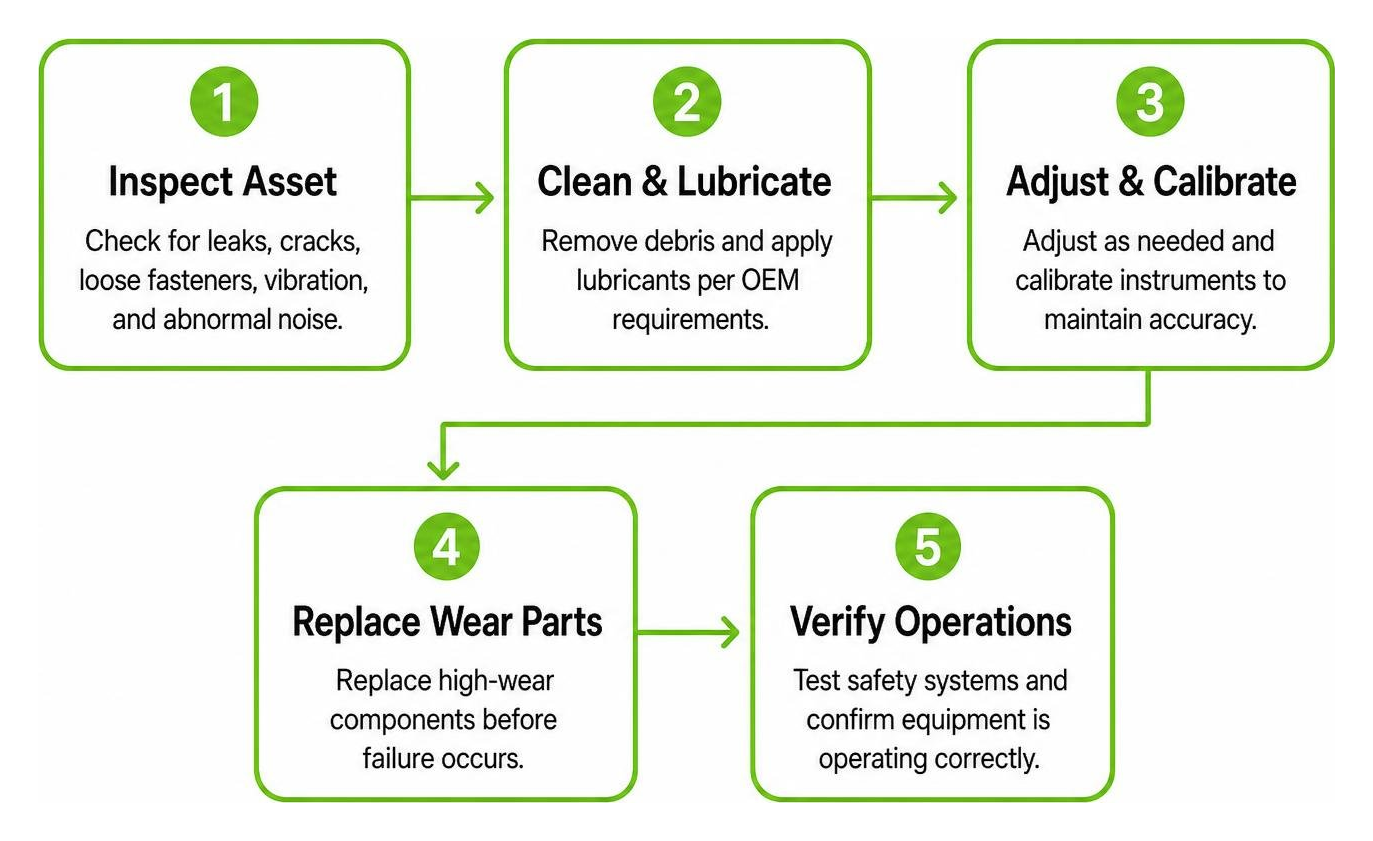
Core servicing activities center around five primary mechanical and electrical disciplines:
Fluid Management and Top-Offs: Technicians check hydraulic reservoirs, gearbox sumps, and coolant tanks, sampling fluid condition and topping off levels to prevent cavitation or friction wear.
Filtration Replacements: Swapping pneumatic, hydraulic, and intake air filters on predetermined cycles keeps contaminants from scouring precision valves and internal cylinder walls.
Belt and Chain Tensioning: Checking drive belt tension, chain stretch, and alignment eliminates slippage, premature bearing wear, and energy waste across drive trains.
Electrical Testing and Terminal Torquing: Performing thermal scans, checking motor winding resistance, and re-torquing terminal connections inside control cabinets minimizes hot spots and nuisance tripping.
Mechanical Adjustments: Re-aligning shafts, adjusting gibs on machine tools, and tightening loose brackets keeps production tolerances crisp.
Work Order Execution: Operational Activities Carried Out in a Preventive Maintenance System
Having a schedule is only half the battle; shopfloor execution determines reliability results. Deploying a structured maintenance work order system ensures that work is authorized, performed safely, and documented accurately.
A disciplined work order process follows these operational stages:
Safety Isolation and Permitting: Before touching equipment, technicians obtain hot-work or confined-space permits, verify zero energy state, and execute strict Lockout/Tagout (LOTO) protocols.
Material Staging: Staging necessary replacement parts, gaskets, sealants, and specialty tools prior to machine shutdown minimizes wrench time and prevents line-restart delays.
Technician Assignment and Execution: Maintenance supervisors assign tasks based on trade qualifications (mechanical, electrical, automation), tracking execution against standardized checklists.
Runtime and Parameter Logging: Technicians record operating hours, cycle counts, as-found condition codes, and as-left parameters directly into the system.
Order Closeout and Handover: The production supervisor and technician sign off on the work, clearing LOTO locks and verifying normal operating condition during test runs.
Separate PM Actions vs Route PM Actions
In enterprise asset management, preventive maintenance tasks are categorized into either Separate PM Actions or Route PM Actions. Understanding the difference prevents maintenance departments from drowning in administrative overhead.
Separate PM Actions: These are dedicated, detailed work packages configured for a single, complex technical asset (such as an overhaul of a central hydraulic power unit). They involve multi-craft labor, specific spare parts kits, independent safety permits, and detailed step-by-step procedures.
Route PM Actions: These combine multiple simple, repetitive, low-risk tasks across many assets into a single consolidated work order. Examples include a weekly plant-wide lubrication route, an emergency light inspection route, or a motor thermal inspection walk.
Attribute | Separate PM Action | Route PM Action |
|---|---|---|
Asset Scope | Single asset or functional location | Multiple assets across a line or plant |
Task Complexity | High (overhauls, internal rebuilds, calibrations) | Low to Medium (lubrication, visual checks, filter changes) |
Material Needs | Dedicated bills of materials (BOM), custom parts | Standard consumable supplies (grease tubes, rags, basic filters) |
Administrative Work | Individual work order per asset with detailed sign-offs | Single master work order with a batched checklist |
Primary Advantage | High traceability and custom resource planning | High efficiency and reduced administrative clutter |
Industry references such as the UJVNL PM User Manual and standard PM Action documentation detail how structuring tasks into batched routes saves hundreds of planning hours annually while maintaining strict asset compliance.
Structuring Preventive Maintenance: Task Lists, Plans, and Schedules
Reliable asset care requires deep structure. Maintenance planners define technical task lists, master data hierarchies, and maintenance plans within their operational systems to turn tribal knowledge into standardized procedures. Proper equipment maintenance planning aligns production schedules with craft labor availability to eliminate scheduling bottlenecks.

Setting up the system includes defining key data entities:
Functional Locations & Assets: Mapping where equipment sits in the facility hierarchy (e.g., Facility > Packaging Line 2 > Case Packer > Drive Assembly).
Task Lists (Job Plans): Standardized, reusable operation sequences that specify required tools, safety warnings, estimated labor hours, and technical acceptance criteria.
Planner Groups & Work Centers: Grouping maintenance resources by specialty (e.g., Millwrights, Electricians, Controls Specialists) to balance resource loading.
Single Cycle vs Strategy Maintenance Plans
Maintenance schedules fall into two core plan designs depending on task complexity:
Single Cycle Plans: The simplest plan structure, defining exactly one time-based or usage-based maintenance interval for an asset. For example, an air compressor receives a single cycle plan triggering a basic visual check and oil top-off every 30 days.
Strategy Maintenance Plans: Used for complex assets requiring multiple maintenance cycles of varying depth. A strategy plan groups multiple "packages" under one master plan.
For instance, a heavy industrial extruder might use a strategy plan with three distinct packages:
Package A (500 operating hours): Lubricate bearings, clean air intakes, check drive belt tension.
Package B (2,000 operating hours): Complete Package A tasks, replace primary oil filters, perform oil sampling.
Package C (4,000 operating hours): Complete Packages A & B, flush gearbox lubricant, inspect coupling alignment, calibrate thermal sensors.
Using strategy plans prevents conflicting work orders from generating simultaneously, automatically rolling minor servicing into major overhaul packages when cycles align.
Fixed vs Floating Interval Scheduling
When defining schedule frequencies, planners choose between fixed or floating interval logic, which fundamentally alters when subsequent work orders trigger.
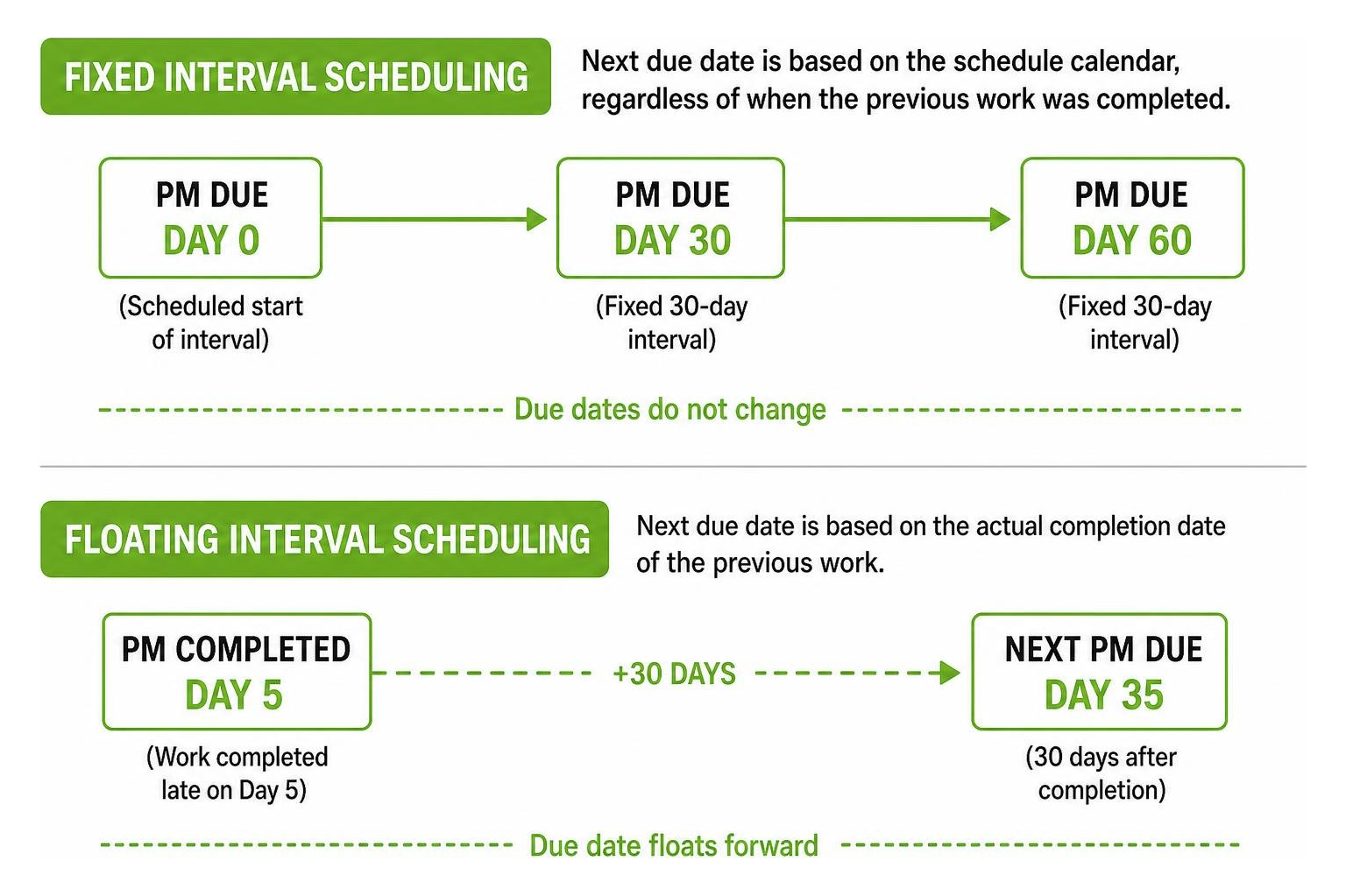
Fixed Intervals: The next maintenance due date is calculated strictly from the schedule calendar, regardless of when the previous work order was completed. If a monthly PM is completed late on Day 38, the next order still generates on Day 60. This is essential for statutory safety inspections, emissions audits, and regulatory compliance tasks.
Floating Intervals: The next due date calculates from the actual completion timestamp of the previous work order. If a 30-day filter change is finished 10 days late (Day 40), the next task floats forward to Day 70. This prevents over-maintaining equipment when production slowdowns or backlog delays push work out, preserving labor resources. Balancing these schedules helps teams manage both planned and unplanned maintenance without overwhelming technicians.
Monitoring Equipment Conditions and Managing PM Revisions
Preventive maintenance is not static. Moving from rigid time intervals to condition-responsive interventions improves equipment uptime while lowering unnecessary parts consumption. Standard procedures like the Eni S.p.A. Preventive Maintenance Guidelines illustrate how integrating condition monitoring into standard maintenance plans protects capital-intensive equipment.

Connecting operational data to plant workflows allows facilities to practice proactive asset management preventive maintenance across mechanical systems.
Triggering Maintenance via Parameter Thresholds and Runtime Counters
Rather than servicing machines strictly by calendar dates, modern plants leverage runtime counters and threshold-based triggers:
Runtime Hour Meters: Generating service orders after a machine reaches 1,000 running hours ensures equipment running 24/7 receives frequent care, while backup units are not over-serviced.
Cycle Counters: Stamping presses, injection molding tools, and high-speed packaging heads trigger tool rebuilds based on stroke counts or shot tallies.
Vibration and Thermal Boundaries: Technicians log bearing temperature or overall vibration velocity (in/s or mm/s) during routine rounds. If a value breaches a predefined warning threshold, the system triggers an investigation work order before bearing seizure occurs.
Pressure Differential Readings: Logging differential pressure across baghouses or hydraulic filter banks triggers element replacements exactly when flow restricts, maximizing filter life.
Standard process architectures, like those found in Oracle's Preventive Maintenance Process Flow documentation, outline how trigger parameters connect directly to automated maintenance work orders.
Managing PM Action Revision Lifecycles
To maintain compliance and operational consistency, maintenance procedures must be governed by strict revision controls. Standardizing updates ensures that technicians do not execute outdated tasks or follow obsolete safety procedures.
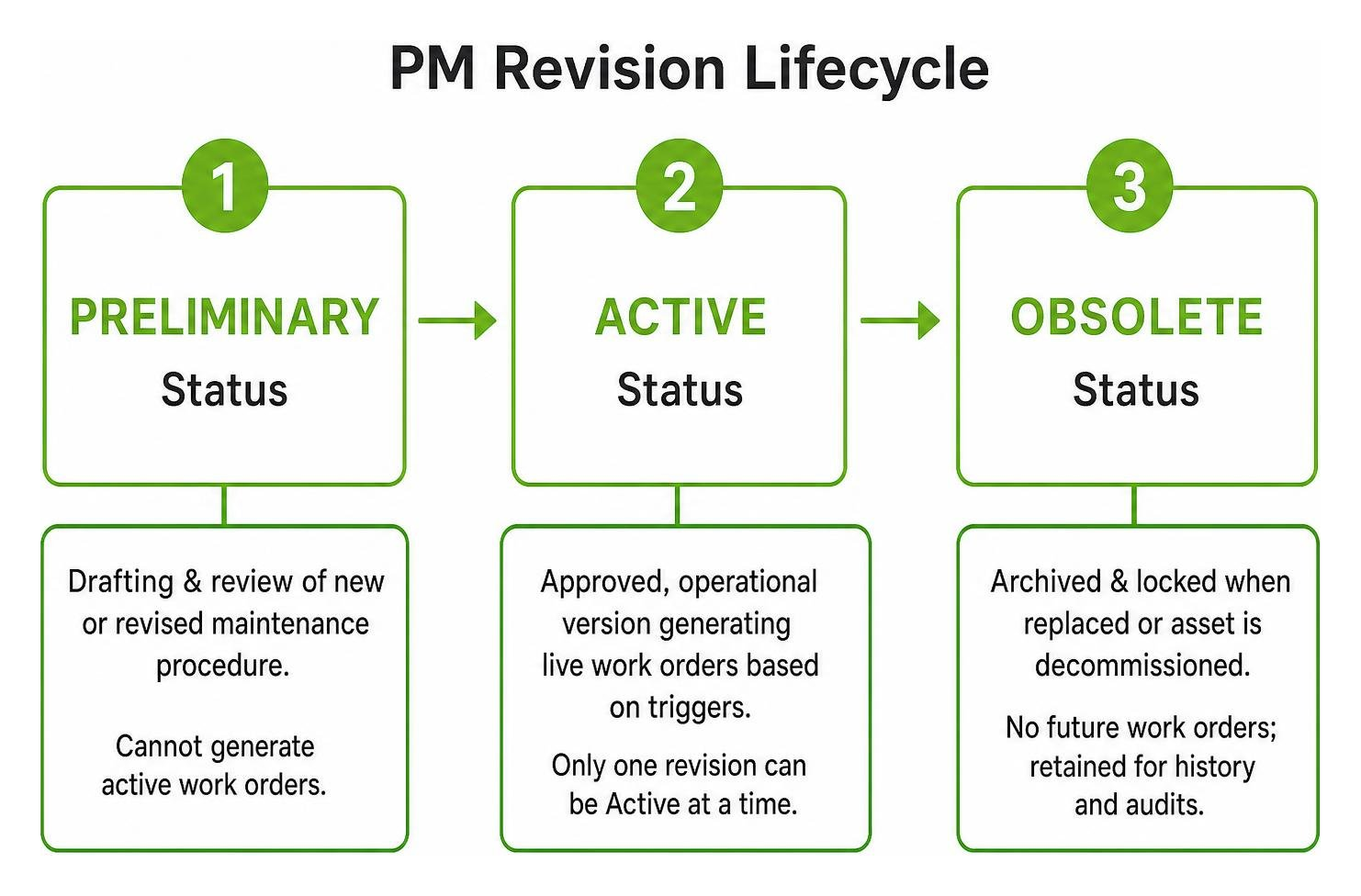
The lifecycle of a preventive maintenance specification follows three distinct states:
Preliminary Status: A new or revised maintenance procedure currently in draft. Engineers define updated steps, adjust spare parts lists, or refine safety instructions. Preliminary plans cannot generate active shopfloor work orders.
Active Status: The approved, operational version of a PM task. Active plans automatically generate work orders based on defined calendar intervals, run hours, or parameter breaches. Only one revision of a specific PM action can remain Active at a time.
Obsolete Status: When an asset is decommissioned or a maintenance strategy is replaced, the active revision moves to Obsolete. Obsolete records are locked against future work generation but preserved for historical audit trails and warranty reviews.
When standard procedures change, best practices dictate creating a new Preliminary revision, securing supervisory approvals, and promoting it to Active—simultaneously retiring the previous version to keep documentation clear.
Frequently Asked Questions About Preventive Maintenance Activities
What are the core activities carried out in a preventive maintenance system?
The primary activities include routine visual inspections, equipment cleaning, fluid and lubrication servicing, wear part replacement, instrument calibration, safety system verifications, work order management, and post-maintenance performance reviews.
How do time-based and condition-based preventive maintenance workflows differ?
Time-based maintenance relies on fixed calendar intervals (e.g., weekly, monthly, annually) regardless of machine utilization. Condition-based maintenance relies on operational data—such as operating hours, cycle counters, vibration measurements, or operating temperatures—to trigger service tasks when specific operational thresholds are crossed.
How do route PM actions reduce administrative overhead compared to separate PMs?
Route PM actions group multiple routine, low-risk tasks across several machines into a single master work order (such as a plant-wide lubrication run). This eliminates the need to create, track, print, and individually close dozens of standalone work orders, saving maintenance supervisors and technicians hours of paperwork.
What to Do Next
A successful preventive maintenance program is built on consistency, clear standards, and continuous follow-through on the shop floor. When teams systematically execute the core activities carried out in a preventive maintenance system, unexpected breakdowns drop, safety incidents decrease, and asset lifecycles extend.
To elevate maintenance performance across your facility:
Audit Your Asset Criticality: Identify your top 20% of bottleneck equipment and ensure they have complete, up-to-date task lists.
Standardize PM Checklists: Replace vague work orders (e.g., "service machine") with step-by-step tasks featuring explicit tolerances, lubricant types, and safety requirements.
Eliminate Paper and Spreadsheet Bottlenecks: Moving maintenance tracking away from paper clipboards into accessible digital platforms increases task visibility and prevents missed PM intervals.
Lean Technologies' Thrive is a flexible digital toolbox designed for small to midsize manufacturers to digitize lean work processes, log issues, track daily actions, and drive continuous improvement. Thrive is not an ERP or MES, and it does not replace those core systems. Instead, Thrive organizes machine and maintenance data entered directly by operators and technicians on mobile devices, tablets, or workstations—providing plant managers and supervisors with clear visibility into floor activities.
Explore how to streamline preventive and planned maintenance across your plant floor to boost asset reliability and eliminate unplanned downtime.