

A Practical Shop Floor Guide to PM in Maintenance
What PM in Maintenance Means on the Shop Floor
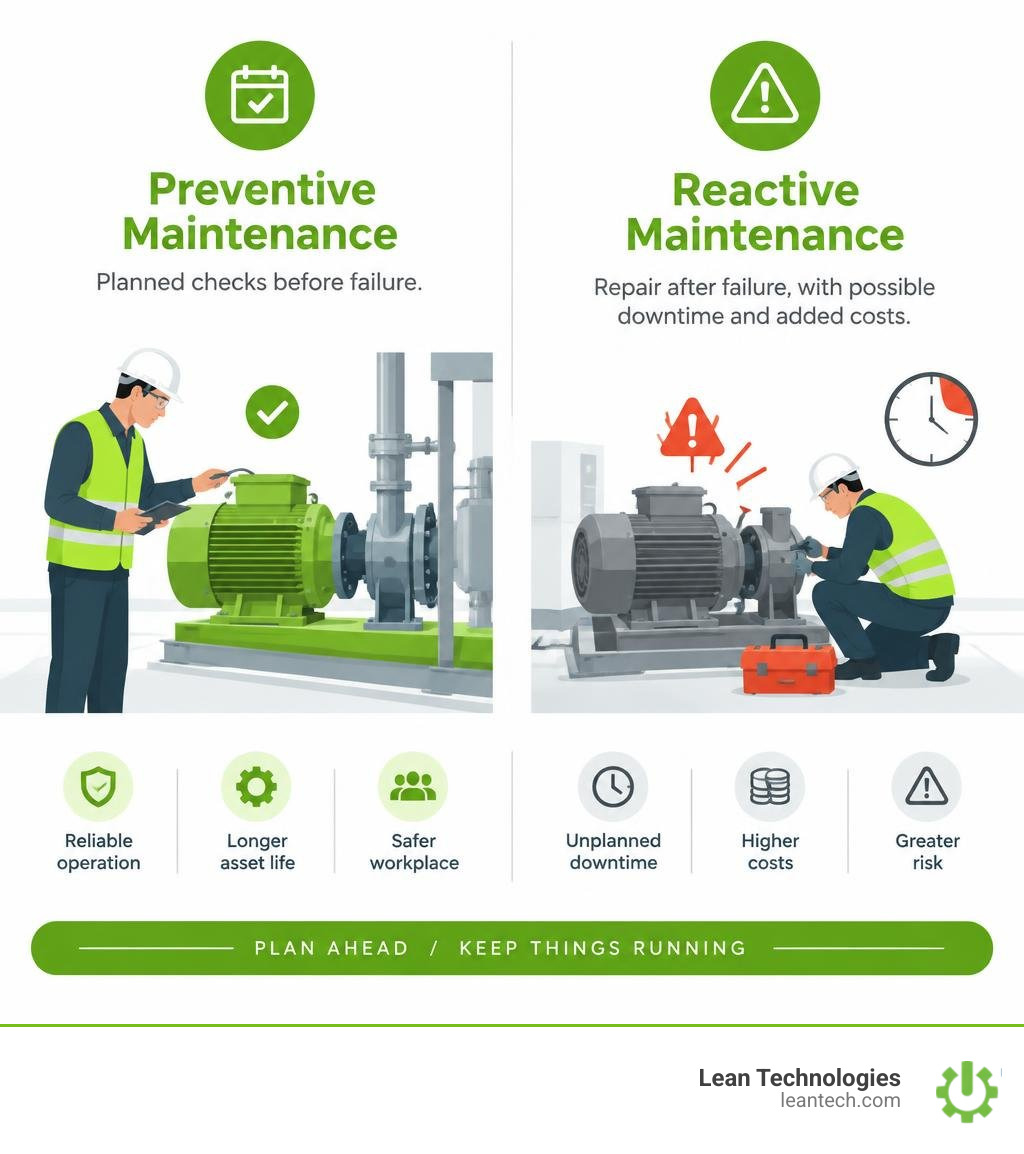
PM in maintenance means preventive maintenance: planned checks and service done before equipment fails. Instead of waiting for a conveyor bearing to seize during a shift, your team inspects and lubricates it on a set schedule. The goal is to catch wear early, protect workers, and avoid unplanned stops.
A good PM program gives each task an owner, a due date, and a record of what was found. That matters when you need to know whether a machine is ready to run, not just whether someone checked a box. This guide covers the main ways to schedule PM and how to make the work visible on the shop floor.
Understanding PM in Maintenance: Definitions and Operational Impact
On any active production line, equipment will deteriorate through friction, thermal expansion, vibration, and general mechanical stress. In an unmanaged environment, machines run until a catastrophic breakdown halts the line. At that point, operations stall, emergency work orders flood in, and the team scrambles for replacement parts.
Executing pm in maintenance systematically replaces reactive firefighting with proactive servicing. Poor maintenance practices can reduce a company's production capacity by 20%. When machines suffer from neglected lubrication, undetected alignment issues, or clogged filtration systems, their operational capacity plummets. In asset-heavy industries, research into the definition of maintenance and maintenance types shows that structured maintenance integrates technical, administrative, and managerial actions to retain an asset in a state where it can perform its required function.
Neglecting baseline upkeep creates direct financial damage. Industry data indicates that running a piece of equipment to failure can cost up to ten times as much as performing periodic maintenance. Beyond the immediate repair bill, emergency fixes trigger secondary damage to surrounding components, expensive rush shipping for parts, overtime labor, and lost customer shipments. Understanding the core dynamic of breakdown and preventive maintenance helps plant teams shift their focus toward steady operational availability.
What Is the Core Purpose of PM in Maintenance?
The primary objective of preventive maintenance is simple: preserve equipment health to ensure safe, predictable, and cost-effective production. A comprehensive preventive maintenance program complete guide focuses on addressing small abnormalities before they cascade into system failures.
Implementing routine PM delivers measurable improvements across key manufacturing metrics:
Maximizing Equipment Lifespan: Regular oil changes, seal replacements, and belt tensioning prevent premature wear on expensive capital assets.
Improving Workplace Safety: Worn electrical harnesses, unlubricated high-speed bearings, and failing safety interlocks create severe hazards for operators. Regular PM identifies and mitigates these conditions before an OSHA recordable incident occurs.
Lowering Energy Consumption: Equipment running under mechanical strain consumes significantly more power. For instance, poorly aligned motors and unserviced compressors draw excessive amperage to compensate for internal friction.
Optimizing Asset Reliability: A disciplined PM strategy increases Mean Time Between Failures (MTBF) while driving down Mean Time to Repair (MTTR) by keeping minor fixes from turning into major overhauls.
Preventive vs. Corrective and Reactive Workflows
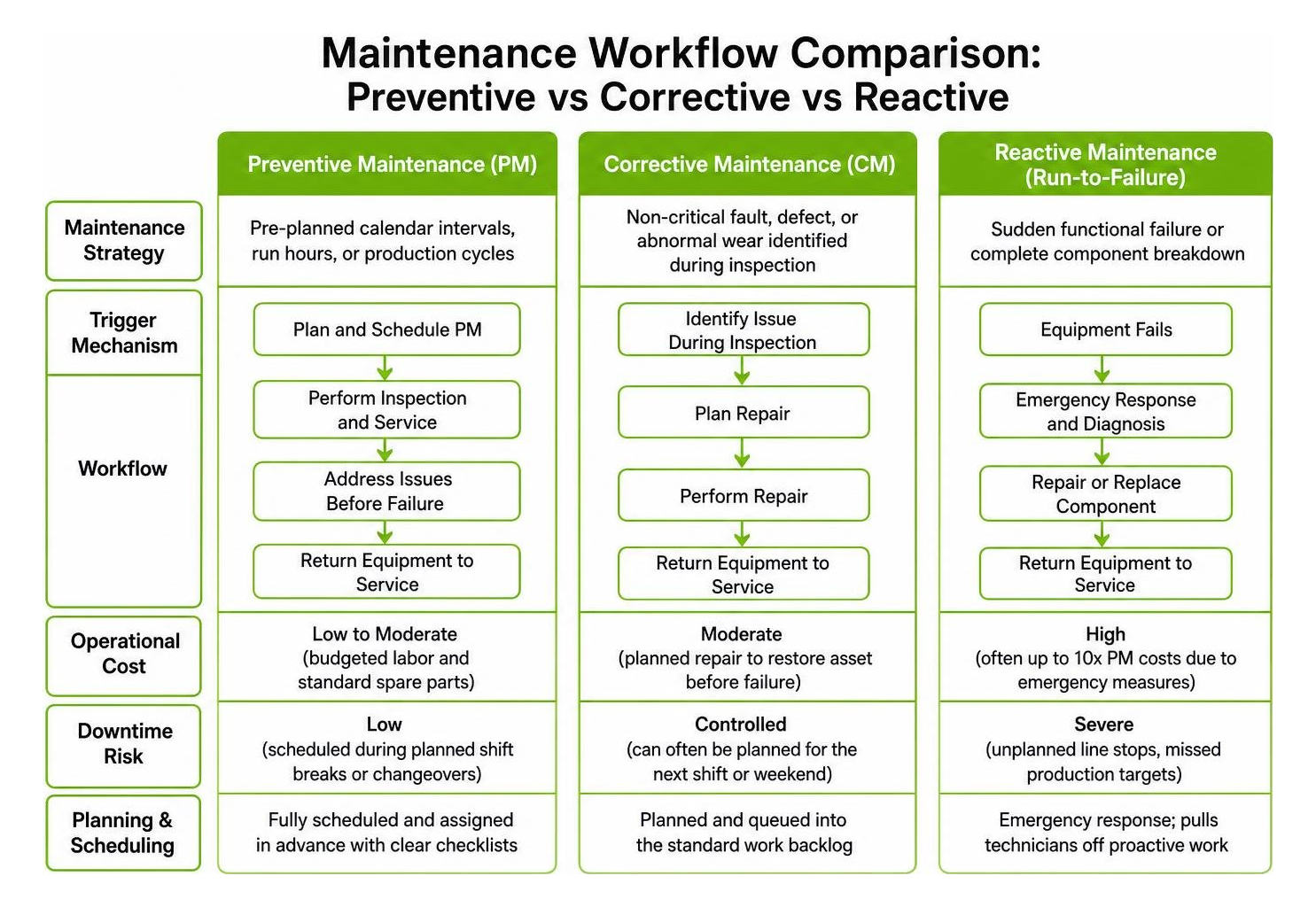
Maintenance tasks fall into distinct operational workflows depending on whether the action is proactive, responsive, or an emergency response. Authoritative sources like TWI Ltd emphasize that distinguishing these classifications is essential for proper resource allocation and planning.
Maintenance Strategy | Trigger Mechanism | Operational Cost | Downtime Risk | Planning & Scheduling |
|---|---|---|---|---|
Preventive Maintenance (PM) | Pre-planned calendar intervals, run hours, or production cycles | Low to Moderate (budgeted labor and standard spare parts) | Low (scheduled during planned shift breaks or changeovers) | Fully scheduled and assigned in advance with clear checklists |
Corrective Maintenance (CM) | Non-critical fault, defect, or abnormal wear identified during inspection | Moderate (planned repair to restore asset before failure) | Controlled (can often be planned for the next shift or weekend) | Planned and queued into the standard work backlog |
Reactive Maintenance (Run-to-Failure) | Sudden functional failure or complete component breakdown | High (often up to 10x PM costs due to emergency measures) | Severe (unplanned line stops, missed production targets) | Emergency response; pulls technicians off proactive work |
Key Approaches: Time-Based, Usage-Based, and Condition-Driven Strategies
Preventive maintenance is not a one-size-fits-all checklist. Plants must structure their activities around how specific assets degrade. Understanding the various activities carried out in a preventive maintenance system allows maintenance managers to deploy the right strategy for each machine class.

Time-Based vs. Meter-Based Schedules for PM in Maintenance
The two most common foundational PM approaches are calendar-driven (time-based) and cycle-driven (usage- or meter-based) strategies. Deciding how to balance preventive and periodic maintenance depends heavily on whether asset wear correlates with time or operational throughput.
Time-Based Maintenance: Work orders trigger at set calendar intervals—such as weekly, monthly, or quarterly. This strategy works well for assets that degrade over time regardless of runtime, such as roof-mounted HVAC filters, emergency eye-wash stations, or seasonal building systems. However, static calendar schedules carry the risk of over-maintenance if a machine sat idle for two weeks, or under-maintenance if the line ran triple shifts to meet surging demand.
Usage-Based (Meter-Based) Maintenance: Work orders trigger when a machine hits a specific threshold of operating hours, strokes, miles, or production cycles. This approach ties maintenance directly to physical wear and tear. Managing meter-based PMs requires accurate tracking of continuous counters to calculate dynamic due dates.
Fixed vs. Floating Intervals: In a fixed schedule, PMs generate on preset dates regardless of when the last task was completed. In a floating schedule, the next due date recalculates based on the actual completion date or the latest meter reading. Floating schedules prevent backlogs of duplicate work orders when production schedules shift.
Distinguishing Preventive from Predictive and Prescriptive Maintenance
While preventive maintenance relies on predetermined intervals, advanced strategies leverage equipment health indicators. Exploring what is the difference between predictive and preventive maintenance helps maintenance and operations teams build a mature reliability roadmap.
Preventive Maintenance: Tasks are executed on a fixed time or usage interval regardless of the machine's actual internal health.
Condition-Based & Predictive Maintenance (PdM): Technicians monitor physical parameters—such as vibration analysis, thermal imaging, acoustic ultrasound, or oil particle contamination—to detect early signs of failure. Research by the US Department of Energy indicates that implementing predictive maintenance can reduce maintenance costs by 25% to 30%, eliminate 70% to 75% of breakdowns, and cut downtime by 35% to 45%. Considering that over 75% of rotating equipment failures stem from misalignment and unbalance, vibration and acoustic checks are highly effective for high-criticality assets.
Prescriptive Maintenance (RxM): Advanced analytics evaluate operational data and recommend specific operating adjustments or maintenance interventions to prevent projected failures.
While sophisticated engineering teams may leverage external predictive tools or dedicated condition-monitoring packages for specialized machinery, everyday shopfloor tools like Thrive do not collect raw sensor data or run automated predictive machine alerts. Instead, Thrive acts as a lean execution layer: it organizes and drives action from machine data when entered directly by technicians or imported from other systems. This ensures shop floor teams have complete visibility when tasks are executed at the source rather than transcribed later onto static spreadsheets.
How to Build and Execute an Effective Shop Floor PM Program
Launching a successful PM program requires systematic structure, clear accountability, and realistic shop floor execution. Following a step-by-step how to conduct preventive maintenance guide ensures tasks are practical and actionable for technicians on the line.
Asset Criticality and Task List Creation
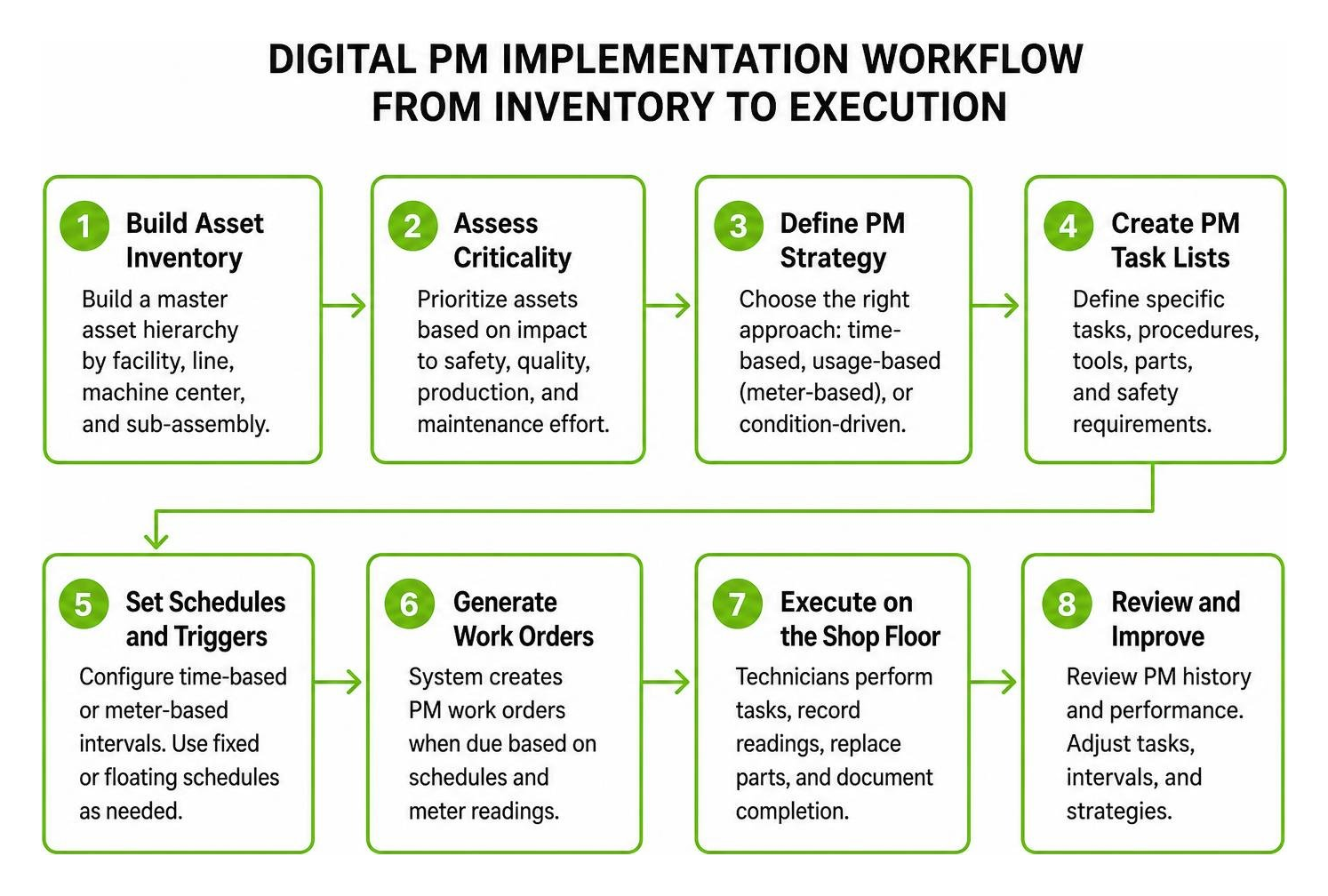
Every plant has limited maintenance bandwidth. You cannot service every auxiliary exhaust fan with the same intensity as a primary stamping press. A structured program begins with an asset inventory and a formal criticality assessment.
Build a Master Asset Hierarchy: Group your equipment by facility, production line, machine center, and sub-assembly.
Conduct Criticality Scoring: Evaluate each machine based on safety risk, environmental impact, single-point-of-failure risk, throughput dependency, and repair cost. High-criticality assets receive rigorous usage-based and condition-driven PMs, while low-criticality, non-hazardous assets can follow basic inspection routines.
Draft Actionable Task Lists: Avoid vague instructions like "Inspect pump." Standard work task lists must provide clear, binary steps with explicit tolerance bands:
Check hydraulic reservoir level (acceptable range: green indicator band, 45–55 gallons).
Measure motor casing temperature with an infrared thermometer (maximum threshold: 165°F / 74°C).
Inspect drive belt tension and record deflection (target: 0.25 inches under 10 lbs of force).
Apply 3 pumps of synthetic grease to drive-end and non-drive-end bearings.
Structuring Work Orders and Digital Maintenance Schedules
To keep preventive maintenance operational across shifts, plant leaders should consult comprehensive operational playbooks like the plant maintenance complete guide 2026. In large enterprise environments, maintenance systems can use maintenance items, functional locations, and standard task lists to automate work order generation.
Regardless of the enterprise software handling macro asset planning, shop floor teams need intuitive work order structures:
Work Order Job Templates: Pre-populate standard spare parts, estimated labor hours, required personal protective equipment (PPE), and safety lock-out/tag-out (LOTO) procedures.
Lead Time and Threshold Percentages: Configure work orders to generate with adequate lead time, ensuring maintenance technicians can stage filters, lubricants, and replacement seals before taking a machine offline.
Digital Shopfloor Logging: Paper binders and clipboards create delays and obscure maintenance status. When technicians log PM checks on mobile devices or shop floor tablets right at the machine, supervisors get immediate visibility into work completion and overdue items.
Addressing Common Challenges and Maximizing ROI
Transitioning to a proactive maintenance model requires active change management. Without clear systems, maintenance programs run into common failure modes that drain budgets and frustrate production teams.

Applying practical cost control in preventive maintenance helps operations balance resource constraints against equipment protection. Common obstacles include:
Budget Constraints: PM is often viewed as a cost center until an avoidable breakdown halts customer shipments. Framing PM through downtime reduction and asset preservation metrics secures leadership buy-in.
Pencil Whipping: When paper forms require technicians to manually sign off on dozens of checks, fatigue leads to rushed checkmarks without actual physical inspection.
Over-Maintenance: Servicing assets too frequently drives up consumable costs and introduces human error into functioning systems. Unnecessary disassembly can introduce contaminants into clean hydraulic circuits or cause mechanical misalignment.
Eliminating Paper Workarounds and Missed PM Intervals
When maintenance activities live on paper work orders stacked on a maintenance supervisor's desk, visibility disappears. Operations managers do not know if a task was delayed, and technicians have no quick way to flag an emerging issue that needs follow-up.
Using a clear PM gap report workflow allows supervisors to identify missed cycles, track task compliance, and reallocate labor before an overdue check leads to an unexpected machine stop. Moving checklists to digital interfaces ensures accountability: timestamps, mandatory numerical entries, and photo attachments confirm that checks were actually completed at the machine.
Real-World Industry Examples: Manufacturing, Fleet, and Healthcare
Preventive maintenance looks different across operating environments, but the core discipline remains consistent:
Discrete & Process Manufacturing: A packaging facility establishes weekly lubrication and belt tensioning rounds for its main conveyor lines. On CNC milling centers, technicians perform spindle alignment checks and coolant concentration testing every 250 operating hours, keeping equipment within tight precision tolerances and preventing expensive spindle rebuilds.
Fleet & Heavy Mobile Equipment: Fleet supervisors track engine run hours and odometer readings. Oil samples are pulled every 500 operating hours to evaluate soot buildup and wear metals, triggering fluid changes and brake pad replacements before vehicles experience roadside failures.
Healthcare & Regulated Facilities: Hospital facility teams perform strict, calendar-based calibrations on autoclaves and diagnostic imaging systems. Routine environmental testing and filter replacements across cleanroom HVAC systems ensure strict compliance with air exchange standards and sterility mandates.
Frequently Asked Questions about PM in Maintenance
What is the 10x rule regarding reactive vs. PM in maintenance?
The 10x rule is an established maintenance principle stating that repairing a machine after a catastrophic failure costs roughly ten times more than performing planned preventive service on that same component. The added cost comes from secondary equipment damage, unplanned production downtime, operator idle time, rush shipping fees for replacement components, and technician overtime.
What is the difference between mandatory and non-mandatory PM tasks?
Mandatory PM tasks are non-negotiable activities tied directly to personnel safety, statutory environmental compliance, or legal requirements—such as annual pressure vessel relief valve testing or emergency stop circuit verifications. Non-mandatory tasks involve routine operational upkeep, such as replacing cosmetic wear covers or non-critical secondary filtration. While non-mandatory tasks can be briefly deferred during peak production runs, mandatory tasks must be executed on schedule without exception.
How often should shop floor PM schedules be reviewed and optimized?
PM schedules should undergo a formal continuous improvement review at least once or twice per year. Additionally, maintenance and operations teams should review specific PM task lists whenever an asset suffers an unexpected breakdown between service intervals (indicating under-maintenance or an ineffective task list), or when an asset consistently shows zero component wear over multiple cycles (indicating possible over-maintenance).
What to do next
Transitioning from reactive maintenance chaos to a structured, proactive culture requires simple, standardized shopfloor workflows that frontline operators and technicians will actually follow.
Lean Technologies offers Thrive, an all-in-one, customizable shopfloor software for manufacturing developed by manufacturing experts to streamline operations, boost productivity, and improve profit through a cohesive, integrated platform. Thrive serves as a flexible digital toolbox for small to midsize manufacturers that digitizes lean work processes to help operators and supervisors log issues, track actions, and drive continuous improvement.
It is important to note that Thrive is not an ERP or MES system and does not replace your existing enterprise infrastructure. Instead, Thrive organizes and drives action from machine data when entered directly by your team or imported from other systems. By capturing data at the source on tablets, mobile devices, or workstations, Thrive gives maintenance and operations teams real-time visibility into shopfloor tasks, eliminating paper workarounds and ensuring your scheduled planned maintenance routines run smoothly every shift.
Standardizing how your shop floor executes pm in maintenance protects your machine assets, stabilizes production schedules, and empowers your frontline team to build a safer, more productive plant floor.