
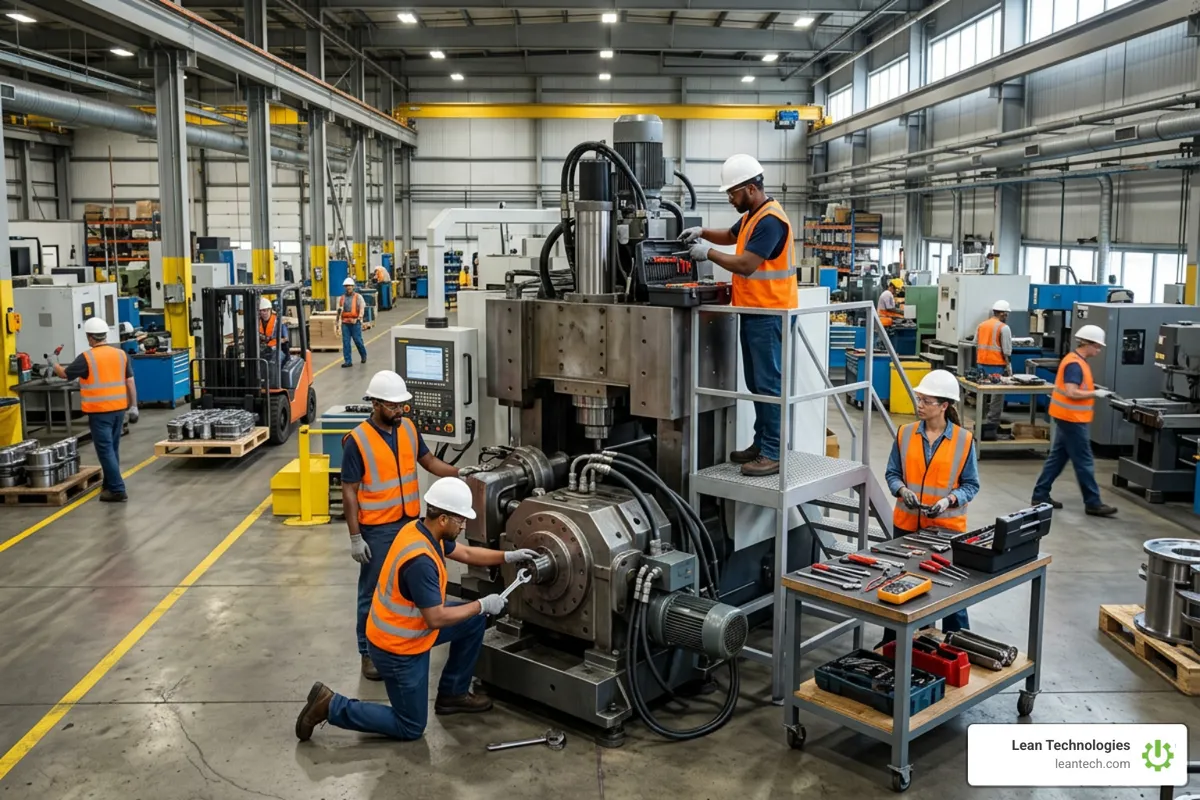
The Ins and Outs of Plant Maintenance for Beginners
The Hidden Cost Your Shop Floor Can't Afford to Ignore
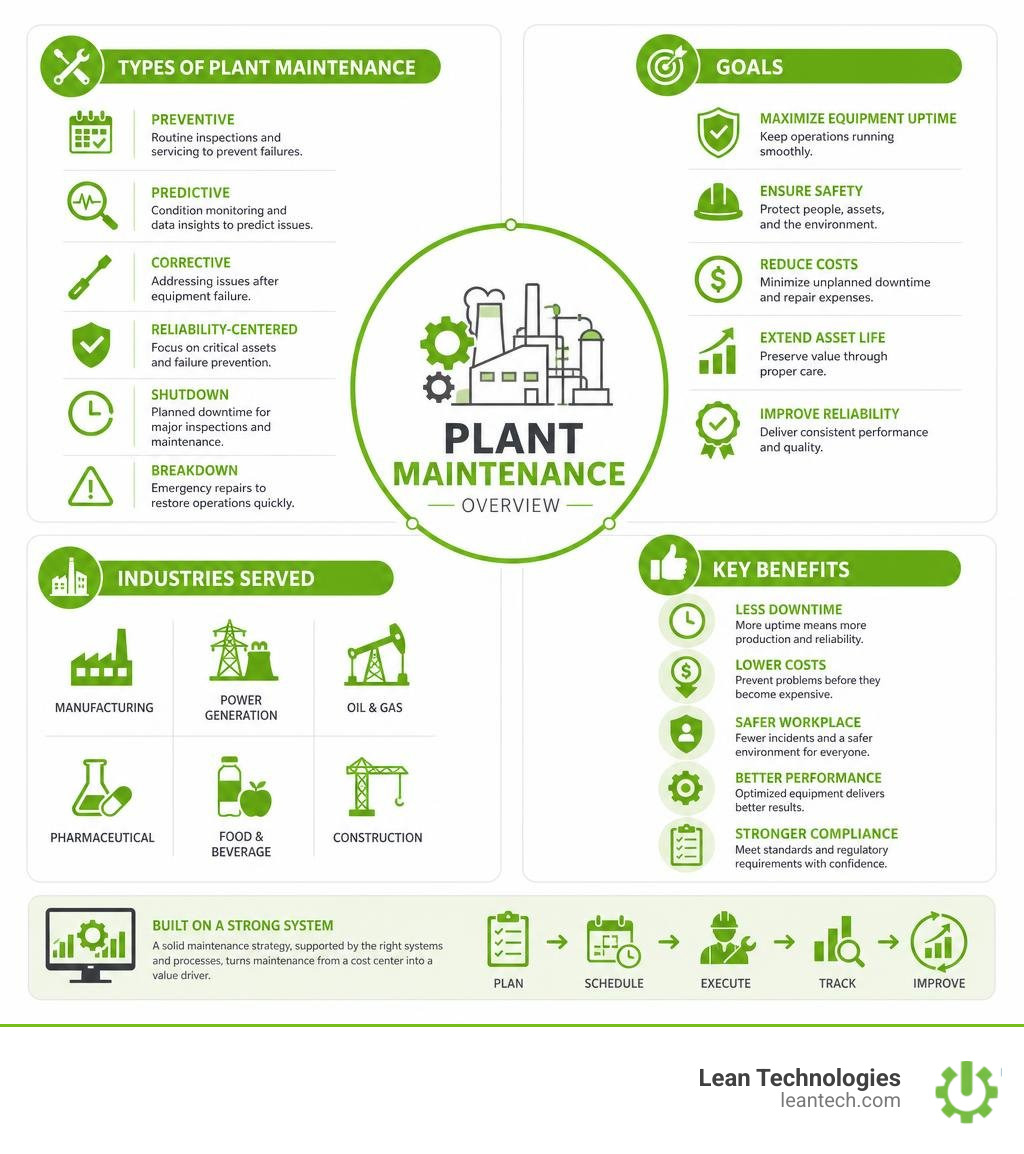
Plant maintenance is the practice of keeping industrial equipment and assets in safe, reliable working condition — through planned inspections, routine servicing, scheduled shutdowns, and emergency repairs.
If you want the quick version, here's what plant maintenance covers:
What it is: Inspecting, servicing, and repairing industrial equipment to prevent failures and extend asset life
Why it matters: Unplanned downtime, safety incidents, and rising repair costs all trace back to poor maintenance practices
Who needs it: Manufacturing, power generation, oil and gas, pharmaceutical, food and beverage, and construction industries
Key types: Preventive, predictive, corrective, reliability-centered, shutdown, and breakdown maintenance
Best tool: A Computerized Maintenance Management System (CMMS) to schedule tasks, track work orders, and manage parts inventory
Here's the reality: operational costs for manufacturers have been climbing steadily — driven by inflation, supply chain disruptions, and post-pandemic pressures. When equipment fails without warning, production stops. And every unplanned stoppage hits twice — once in lost output, and again in emergency repair costs.
Most plants don't fail because their equipment is old. They fail because nobody had a system to catch the warning signs early enough.
A solid plant maintenance strategy changes that. It moves teams from fighting fires to preventing them — protecting assets, protecting people, and protecting the bottom line.
What is Plant Maintenance and Why Does It Matter?
At its core, plant maintenance is the strategic management of all physical assets within an industrial facility. It is not just about fixing machines when they break. Rather, it is a comprehensive, lifecycle-focused discipline designed to maximize equipment uptime, safeguard workforce safety, and preserve the long-term value of capital investments.
In heavy industrial operations, the cost of neglect is staggering. When critical machinery fails, the entire production flow grinds to a halt, triggering a cascade of logistical headaches and lost revenue. Proactive Maintenance strategies ensure that assets are monitored, serviced, and optimized before minor wear turns into a catastrophic failure. This lifecycle preservation is the foundation of modern plant engineering, as detailed in Maintenance Management —A Conceptual Framework .
Different industries face distinct operational pressures, making a tailored approach to plant maintenance essential:
General Manufacturing: Focuses on maintaining high-speed conveyor belts, packaging systems, and assembly lines to protect overall equipment effectiveness (OEE).
Power Generation: Requires rigorous, non-negotiable inspections of boilers, steam turbines, and generators to guarantee continuous grid reliability.
Oil and Gas: Operates in highly volatile environments where maintaining pumps, compressors, and pressure vessels is critical to preventing environmental hazards and massive financial losses.
Pharmaceutical: Demands absolute precision, requiring strict temperature, pressure, and humidity controls to preserve drug integrity and maintain regulatory compliance.
Food and Beverage: Must keep refrigeration, mixing, and packaging systems in pristine, sanitary condition to comply with stringent food safety laws.
Understanding the fundamentals of asset preservation is the first step toward building a resilient, high-performing shop floor.

Core Goals of an Effective Plant Maintenance Strategy
An optimized maintenance program is built around four primary operational objectives:
Minimizing Wear and Tear: Routine lubrication, cleaning, and adjustments prevent friction and mechanical fatigue from degrading moving parts prematurely.
Breakdown Prevention: By identifying and resolving hidden defects during planned windows, teams can eliminate the chaos of sudden, mid-shift equipment failures.
Significant Cost Reduction: Emergency repairs are expensive. They require expedited shipping for spare parts, last-minute contractor labor, and lost production time. Proactive care reduces these emergency expenses.
Maximizing Equipment Availability: Ensuring assets are ready and capable of running whenever production demands them. In unoptimized plants, equipment utilization can drop as low as 30%. With a structured maintenance strategy, facilities can push utilization past 80% to 90%, boosting capacity without buying new machinery.
The 6 Key Types of Plant Maintenance
Industrial facilities cannot rely on a single maintenance method. Different machines require different levels of care based on their criticality, cost, and failure patterns. An effective plant strategy balances six distinct types of maintenance.
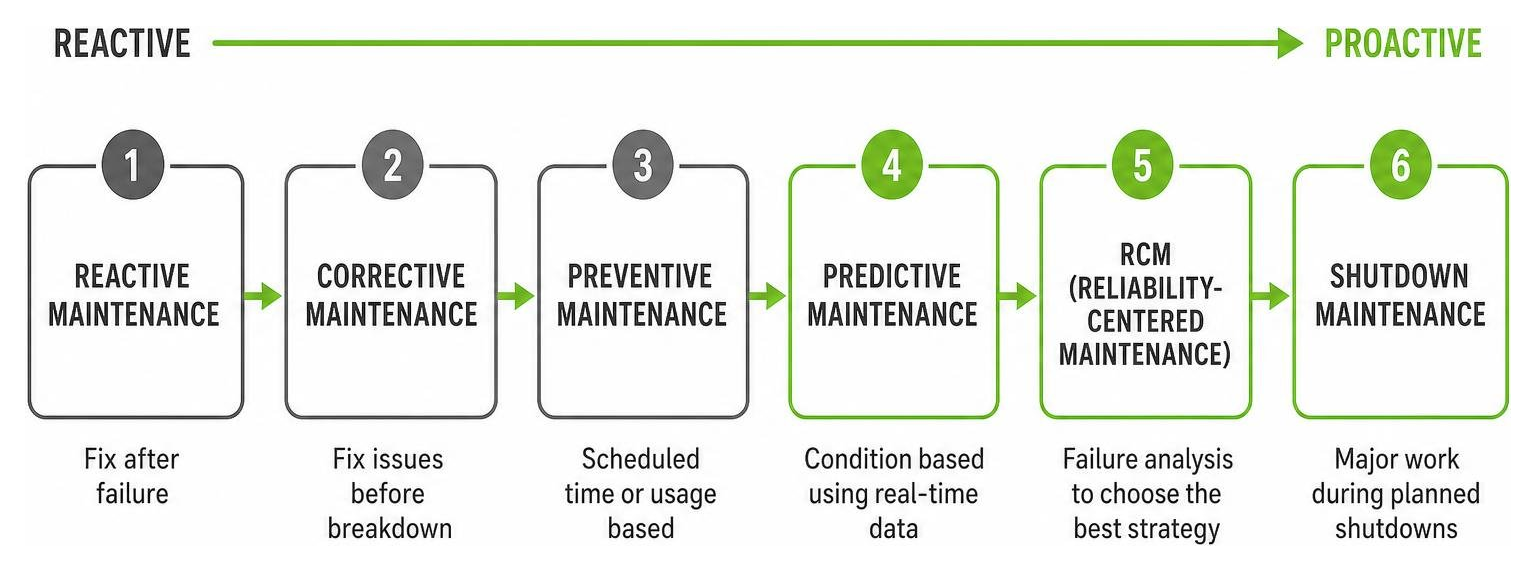
Preventive Maintenance: Time- or usage-based servicing designed to keep equipment running smoothly. This includes scheduled tasks like changing oil every three months or replacing a belt every 1,000 running hours. Learn more about setting up these schedules with Planned Maintenance.
Predictive Maintenance: A condition-based approach that uses real-time diagnostic data to determine exactly when a machine needs service. Instead of guessing based on the calendar, teams monitor the actual health of the asset.
Corrective Maintenance: Servicing performed to restore a machine to its proper working state after a fault or degradation is detected. This is planned work initiated by a technician or operator noticing a minor issue before it causes a total shutdown.
Reliability-Centered Maintenance (RCM): A highly analytical framework used to identify the specific failure modes of each asset and apply the most cost-effective maintenance strategy to address them.
Shutdown Maintenance: Intensive maintenance activities that can only be executed when the entire plant or a major production line is completely offline.
Breakdown Maintenance: Reactive, unplanned maintenance performed immediately after an asset has completely failed. This is reserved for non-critical assets where the cost of preventive care outweighs the cost of run-to-failure.
For a clearer picture of how these strategies compare, review the breakdown below:
Maintenance Type Trigger Cost Risk Level Best Used For Preventive Calendar or Run-Time Moderate Low High-wear parts, motors, standard vehicles Predictive Condition Thresholds High (Initial Setup) Very Low Critical gearboxes, turbines, high-value pumps Corrective Detected Degradation Low to Moderate Low to Moderate Non-critical machinery with early warning signs
Technical Execution of Plant Maintenance
To move away from reactive "run-to-failure" habits, modern plants deploy advanced diagnostic technologies. These technical execution methods allow technicians to peer inside running machinery without interrupting production:
Vibration Analysis: Measuring the oscillation of rotating equipment (like bearings, shafts, and motors) to identify misalignment, unbalance, or bearing wear long before failure occurs.
Thermal Imaging: Using infrared cameras to detect abnormal heat signatures in electrical panels, motor bearings, and gearboxes, pinpointing friction or electrical resistance.
Ultrasonic Tests: Capturing high-frequency sound waves to locate microscopic structural cracks, gas leaks, or vacuum losses in pressurized piping systems.
Non-Destructive Testing (NDT): Utilizing dye penetrants, magnetic particles, or radiography to inspect the structural integrity of welds, pressure vessels, and structural steel without damaging the asset.
How to Build and Perform a Plant Maintenance Program
Setting up a plant maintenance program from scratch can feel overwhelming, but breaking it down into structured phases ensures long-term success. The process begins with a complete physical audit.
First, the maintenance team must build a comprehensive equipment inventory. This means walking the floor and documenting every single asset, noting serial numbers, manufacturer guidelines, installation dates, and current operating conditions. To make this data actionable, assets should be organized into a logical "machine tree" hierarchy (Section > Installation > Equipment).
Second, transition from calendar-based schedules to tracking run-time hours. Scheduling service based strictly on dates (e.g., "every six months") often leads to over-maintaining idle machines or under-maintaining heavily used ones. Converting actual machine run-time hours into days on the calendar provides a much more accurate reflection of physical wear.
Third, establish a strict protocol for shutdown planning. Major overhauls must be coordinated around planned production gaps (the "dead state" of the machine, such as holidays, nights, or scheduled off-shifts) to eliminate lost production time. Best practices suggest planning predictive maintenance checks exactly nine weeks prior to a scheduled shutdown. This nine-week buffer gives the team ample time to secure budget approvals, order long-lead spare parts, and schedule specialized contractors.
Finally, establish a clear framework for task scheduling. Utilize priority fields to rank work orders so technicians always know which critical assets require immediate attention. For a deeper dive into designing customized, reliability-focused maintenance schedules, consult the research on the Assisted-Driven Design of Customized Maintenance Plans for Industrial Plants .

To manage this entire process seamlessly from the palm of your hand, teams utilize specialized Equipment Asset Tracking systems to keep records accurate and up to date.
Managing Parts and Work Orders
A maintenance plan is only as good as the execution of its daily work orders and the availability of spare parts. If a technician is ready to service a machine but the required gasket is out of stock, the entire plan falls apart.
To prevent these costly bottlenecks, facilities must maintain a clean, centralized Work Order History. This history allows teams to review past repairs, identify recurring failures, and understand which parts are consumed most frequently. New maintenance requests should flow into a structured Work Request Queue, where they can be vetted, prioritized, and assigned to the right technician based on skill level and availability.
On the inventory side, robust Parts Management is critical. This involves setting strict minimum and maximum (min/max) stocking levels for every critical spare part. When stock falls below the minimum threshold, the system should trigger reorder alerts to avoid stockouts. Keeping physical and digital parts inventory in perfect sync through regular cycle counts prevents delayed repairs and eliminates the need for expensive, last-minute expedited shipping.
Safety, Compliance, and Audits in the Plant
Maintenance and safety are deeply intertwined. A poorly maintained plant is a dangerous plant, and unsafe maintenance practices are a leading cause of industrial accidents.
Prioritizing Safety means integrating strict risk controls into every single work order. Before a technician opens an electrical cabinet or steps inside a mixing vessel, they must execute rigorous safety protocols. Foremost among these is lockout/tagout (LOTO), which ensures that all energy sources — electrical, pneumatic, hydraulic, chemical, and thermal (covering up to 11 distinct energy types) — are completely isolated, locked, and tagged.
Furthermore, plants must maintain continuous compliance with OSHA, EPA, and other local safety and environmental regulations. This requires conducting regular Safety Audits to verify that safety guards are in place, warning decals are legible, and emergency systems are functional. Before starting any high-risk task, a comprehensive Risk Assessment must be completed to identify potential hazards and establish appropriate mitigation steps.
Handling Nonconformance and Calibrations
Compliance isn't just about safety; it's also about product quality. In precision manufacturing, even a microscopic deviation in machine calibration can ruin an entire batch of product.
To prevent quality issues, facilities must implement systematic Gage Calibration programs. Tracking the calibration drift of instruments ensures that all measurement tools, scales, and sensors remain within strict operating tolerances.
When a machine or process drifts out of spec, it results in a Nonconformance event. The maintenance team must work closely with quality managers to log these events, trace them back to the root mechanical cause, and implement corrective actions. By linking maintenance activities with quality data, plants can significantly reduce waste and improve margins through accurate Defect Scrap Tracking.
Skills and Training for Modern Maintenance Mechanics
The rise of smart factories and complex industrial machinery has transformed the role of the traditional mechanic. Today's MAINTENANCE MECHANIC must possess a sophisticated blend of mechanical expertise, basic electrical knowledge, and digital literacy.
In demanding environments like chemical processing plants, mechanics handle highly specialized equipment including distillation columns, heat exchangers, multi-stage compressors, and positive displacement pumps. To work safely and effectively in these settings, technicians must master:
Standard Dimensional Tolerances: Achieving high-precision fits, such as maintaining a ±0.25mm tolerance for basic fitting operations and ±0.04mm for precision step fits.
Electrical Parameter Measurement: Using multimeters and diagnostic tools to safely measure voltage, current, and resistance on machine control panels.
Precision Mechanical Alignment: Executing precise shaft, pulley, and coupling alignments using dial indicators or laser alignment systems to prevent premature bearing failure.
Rigorous Safety Protocols: Strict adherence to Occupational Safety, Health, and Environment (OSHE) guidelines, including proper chemical handling and the correct selection of personal protective equipment (PPE).
Industry veterans like Mohandas Hegde and bhartandra gaur emphasize that maintaining safety and reliability in large-scale plants requires a proactive mindset, continuous skill development, and a deep understanding of OEM specifications.
Continuous Learning and Career Progression
As industrial technology evolves, maintenance departments must invest in continuous education to keep their workforce sharp. Utilizing structured Training Program Tracking allows managers to monitor which technicians have completed certifications in specialized areas like vibration analysis, laser alignment, or advanced safety procedures.
Keeping detailed Employee Documentation ensures that safety credentials, vocational degrees, and compliance training records are easily accessible during audits. This structured approach to training not only protects the plant from compliance violations but also provides a clear career progression path for technicians, helping them transition from entry-level hands-on mechanics to senior supervisors and maintenance managers.
How a CMMS Optimizes Shopfloor Efficiency
Relying on paper logs, whiteboards, or scattered Excel spreadsheets to manage a modern plant is a recipe for high downtime and lost profits. To run a lean, competitive operation, successful plants centralize their maintenance workflows within a CMMS (Computerized Maintenance Management System).
A CMMS acts as the single source of truth for the entire maintenance department. It digitizes paper-based processes, automates administrative tasks, and provides real-time visibility into asset health and technician workloads.
Implementing a modern CMMS delivers significant, measurable operational benefits:
32% Reduction in Unplanned Downtime: By automating preventive maintenance schedules and catching equipment wear early.
53% Improvement in Work Order Completion Rates: Streamlining assignments so technicians know exactly what to do, where to go, and which tools to bring.
38% Decrease in MTTR (Mean Time to Repair): Providing instant mobile access to equipment history, manual schematics, and standard operating procedures (SOPs) right at the machine.
Data-Driven Insights: Generating clear reports on asset reliability, maintenance costs, and labor efficiency to help managers make smart replacement decisions.
Frequently Asked Questions about Plant Maintenance
What is the difference between preventive and predictive plant maintenance?
Preventive maintenance is scheduled based on time or usage intervals (e.g., changing a belt every six months), regardless of the actual condition of the machine. Predictive maintenance uses real-time diagnostic tools (like vibration sensors or thermal cameras) to monitor the actual health of the machine and triggers service only when wear is detected.
How does a CMMS reduce unplanned downtime?
A CMMS reduces downtime by automatically scheduling preventive maintenance tasks, tracking equipment wear patterns, managing spare parts inventory to prevent repair delays, and ensuring that critical maintenance issues are logged, prioritized, and resolved before they cause a breakdown.
Why is run-time tracking better than calendar-based scheduling?
Calendar-based scheduling assumes all machines run at the same rate. This can lead to over-maintaining idle machines or under-maintaining heavily used ones. Run-time tracking schedules maintenance based on actual machine usage hours, ensuring service is performed precisely when the physical wear of the asset demands it.
What to Do Next
Stop managing your shop floor through spreadsheets and wishful thinking.
If your team is still tracking maintenance on clipboards, logging downtime on paper slips, or chasing down work orders via text message, you are losing money every single shift. Real-time visibility beats real-late paperwork every single time.
Lean Technologies offers Thrive, an all-in-one, customizable shopfloor software platform built by manufacturing experts to streamline your operations, boost productivity, and improve profit. Thrive is not an ERP or a heavy MES. It is a flexible, mobile-first digital toolbox designed specifically for the people who keep things running.
With Thrive, your operators and technicians can log downtime, track work orders, manage parts, and drive continuous improvement in real time from any tablet or mobile device.
Ready to eliminate paper workarounds and take control of your asset reliability? Explore our comprehensive Guide to Digital Lean Manufacturing or get in touch with Lean Technologies today to see how Thrive can transform your shop floor.